Skip to the main content.
 💡 Generational patient communication means matching your outreach style to each age group in your practice. Gen Z and Millennials want text-based, mobile-first contact. Gen X likes a mix of texts, emails, and phone calls. Baby Boomers value personal ties with their providers but are getting more open to texting. The Silent Generation still prefers phone calls and in-person visits.

The best approach is to ask each patient how they want to hear from you, then use tools that support more than one channel. Avoid the trap of using one method for everyone. Practices that adapt their style by age group see better response rates, fewer no-shows, and stronger patient trust across the board.

A 22-year-old college student and a 78-year-old retiree walk into the same clinic. They both need care, but they want to hear from you in very different ways. One might ghost your phone call. The other might not check a patient portal.

This is the core challenge of generational patient communication. Your practice likely serves five age groups at once, each with its own habits and needs. What feels easy and natural to one group can feel cold or confusing to the next.

Think about it this way. If you send a text reminder to a Gen Z patient, they'll likely confirm in seconds. Send that same text to a Silent Generation patient, and it might sit unread for days.

Now flip it. A warm phone call lands well with an older patient, but a Millennial may let it ring to voicemail and never call back.

The one-size-fits-all method doesn't work in today's clinics. You need age-based communication strategies that meet each patient where they are. That means knowing what each group expects, which channels they trust, and how they like to be spoken to.

In this guide, you'll learn the generational healthcare preferences that shape how each group responds to your practice. We'll cover Gen Z through the Silent Generation, with real-world tips for each. You'll also find a framework to build a flexible plan that works for your entire patient base, no matter how wide the age range.

Why Generational Communication Strategies Matter

Every day, your front desk fields calls, sends texts, and manages portal messages. But if those messages don't match the patient's preferred style, they often go ignored. That's why age-based outreach is no longer a nice-to-have. It's a must-have for any practice that wants better results.

The Cost of a One-Size-Fits-All Approach

When you blast the same message through the same channel to every patient, you lose people. A voicemail reminder to a 25-year-old is almost sure to be skipped. A portal-only message to an 80-year-old may never get seen.

Based on our internal data, practices using tailored outreach (like targeted SMS recalls) have seen a 35% appointment reconversion rate. That proves the gap between generic outreach and targeted contact is real and costly.

Trust Depends on Tone and Channel

How you reach a patient shapes how they feel about your practice. Older patients may feel rushed by a short text. Younger patients may feel annoyed by a long phone call. Matching the right tone to the right channel builds trust. It shows you see the patient as a person, not just a chart number.

Health Literacy Varies by Age

Not every patient processes health info the same way. Some want to research on their own. Others want you to walk them through every detail. Knowing which group tends toward which style helps you share info they'll actually use. This cuts down on confusion and missed follow-ups.

Better Engagement Means Better Outcomes

At the end of the day, clear contact leads to more kept visits, better follow-through, and fewer gaps in care. Practices that take generational healthcare preferences into account don't just improve satisfaction scores. They build stronger clinical results by reaching patients in a way that actually lands.

Nurse on the phone with a senior patient in a friendly clinic office setting

Gen Z Patients (Born 1997–2012, Age 14–29)

Gen Z healthcare communication is all about speed, ease, and mobile access. This group grew up with phones in their hands. They don't just prefer digital contact — they expect it.

How Gen Z Wants to Hear from You

Gen Z patients are true digital natives. Over 95% of this age group owns a smartphone, and most manage nearly all of their daily tasks on it.

They want to book, confirm, and even handle forms by text or app. If your practice still relies on phone calls for scheduling, you'll struggle to connect with this group.

They also have short windows of focus when it comes to admin tasks. Long hold times and phone trees frustrate them fast.

A quick text with a link to self-schedule is far more likely to get a result. For example, instead of calling to confirm a visit, send a two-tap text: "Reply YES to confirm your 3pm visit on Thursday."

What Gen Z Values Most

This generation cares a lot about openness and access. They want to know wait times, costs, and what to expect — before they arrive. They don't like to feel caught off guard. A short pre-visit text with a few details goes a long way in earning their trust.

Mental health is also a big topic for Gen Z. They're more open about it than any prior age group. Your messaging should reflect that. Avoid stiff, clinical language.

Keep it friendly, direct, and judgment-free. Even the way you word a check-in — like "How are you feeling about your visit?" — can make a real difference.

Quick Tips for Gen Z Outreach:

  • Use text as your primary channel for reminders and updates

  • Offer online self-scheduling and digital intake forms

  • Keep messages short, clear, and action-focused

  • Be upfront about costs and what to expect

  • Use a warm but casual tone in all written contact

Millennial Patients (Born 1981–1996, Age 30–45)

Millennial patient engagement requires a blend of ease and quality. This group is tech-savvy and busy. Many are raising young children, which means they want their healthcare fast, flexible, and respectful of their time.

How Millennials Prefer to Connect

Millennials are at ease with many channels. They use text, email, patient portals, and even chat tools. Unlike Gen Z, they don't lean on just one channel.

They pick the one that fits the moment. A text for a quick reminder works great. But for lab results or care plans, they may prefer an email or portal message they can read at their own pace.

Online scheduling is a must. Millennials don't want to call during business hours to book a visit. They want to do it at 10pm from the couch after the kids are in bed. If your practice doesn't offer web-based or app-based scheduling, you're adding friction where this group wants none.

What Millennials Expect from Providers

Millennials do their homework. They read reviews, compare providers, and research conditions before their visit. They want to feel like a partner in their care, not just a passive patient.

Give them access to notes, results, and resources. Let them ask follow-up questions by text or message after a visit.

They also respond well to proactive outreach. Based on our internal research, automated post-visit surveys paired with Google review requests have helped practices earn 90% five-star review rates. Millennials are happy to leave reviews — if you make it easy.

Quick Tips for Millennial Outreach:

  • Offer two or more contact channels (text, email, portal)

  • Provide online scheduling that works on mobile

  • Share educational content and post-visit summaries

  • Make it easy to leave feedback or reviews

  • Use a friendly, professional tone that feels personal


Gen X Patients (Born 1965–1980, Age 46–61)

Gen X is often called the "forgotten middle" in marketing. But in healthcare, this group is one of your most active segments. They juggle their own health, their aging parents, and their kids. Time is their most limited resource.

How Gen X Prefers to Communicate

Gen X has adapted to new tech over the years but didn't grow up with it. They're fine with text and email for simple things like reminders and confirmations. But when the topic is complex — say, a new diagnosis or a care plan change — they still want a phone call or in-person talk.

This means your practice needs to offer the right channel for the right message. A text to confirm a visit? Perfect. A text to discuss test results? That may feel too cold for this group. Read the room and match the weight of the message to the channel.

The Caregiver Factor

A key thing about Gen X is their role as caregivers. Many are helping manage their parents' care while also handling their children's health needs. This makes them frequent users of your practice in many ways. They may be booking visits for three different family members in the same week.

Make it easy for them to manage more than one patient if possible. Shared access tools, family accounts, or even just clear notes about who is calling on whose behalf can help. The less time they spend on the phone with your front desk, the more they'll value your practice.

Quick Tips for Gen X Outreach:

  • Use text and email for routine updates and reminders

  • Reserve phone calls for complex or sensitive topics

  • Respect their time — keep all messages brief and clear

  • Offer tools that help them manage family members' care

  • Be flexible with scheduling, as their days are often packed


Baby Boomer Patients (Born 1946–1964, Age 62–80)

Baby Boomers are a large and diverse group when it comes to tech comfort. Some use texting and patient portals with ease. Others still prefer to call the office for everything. The key is to not assume one way or the other.

How Boomers Want to Be Reached

Many Boomers have come around to texting in recent years. In fact, a growing share are now open to text reminders for things like visits and prescription refills. However, this group still places high value on personal contact. They want to feel known, not processed.

Phone calls remain the top pick for many Boomers, especially for health discussions. They appreciate when someone takes the time to call, explain, and listen. For routine updates, though, a text or email can work — as long as your practice has first asked what they prefer.

Based on our internal data, practices using automated reminders still achieve over 75% confirmation rates, and many of those confirmed patients are Boomers who respond well to clear, well-timed messages.

Chronic Care and Follow-Up

Boomers are often managing one or more ongoing health conditions. This means regular follow-up is a big part of their care. Your practice needs reliable, repeat touchpoints with this group. Missed follow-ups don't just hurt outcomes — they hurt revenue too.

To communicate with elderly patients and older Boomers well, keep your messages clear and direct. Avoid jargon. Use plain terms like "blood sugar check" instead of "glycemic panel review." And if a patient misses a follow-up, a personal phone call is still the most effective tool to bring them back.

Quick Tips for Boomer Outreach:

  • Ask about their channel preference at intake

  • Use phone calls for sensitive or complex health topics

  • Send text reminders for routine visits and refills

  • Speak in plain, jargon-free language

  • Follow up personally when patients miss visits

Silent Generation (Born 1928–1945, Age 81+)

The Silent Generation has the lowest rate of tech use among your patients. That doesn't mean they can't be reached, though. It just means you need a more hands-on, personal approach.

How This Generation Prefers Contact

Phone calls and in-person visits are the strongest channels for this age group. Many do not use smartphones, and even among those who do, app-based or text-based messaging can feel unclear or overwhelming. This group values hearing a real voice and having time to ask questions.

When you call a Silent Generation patient, expect a longer conversation. They may want to review the details of an upcoming visit, go over their medications, or simply chat. That interaction is the relationship. Rushing it breaks trust. For this group, the call isn't just a reminder — it's part of the care.

Family and Caregiver Involvement

A major factor in serving this age group is the role of family. Adult children or caregivers often manage visits, medications, and follow-ups. Your practice should be set up to loop them in — with the patient's consent, of course.

This means keeping contact info on file for both the patient and their caregiver. It may also mean sending reminders to the caregiver's phone while still calling the patient directly. Flexible tools that allow more than one point of contact per patient make this much easier to manage.

Accessibility Needs

Hearing loss, vision changes, and cognitive decline are real concerns in this population. Use large print on any mailed material. Speak slowly and clearly on the phone. And always confirm that the patient understood the key points before ending a call.

Quick Tips for Silent Generation Outreach:

  • Make phone calls your primary channel

  • Include caregivers in the communication loop

  • Speak slowly, clearly, and with patience

  • Use large print for any written material

  • Confirm understanding before ending each conversation

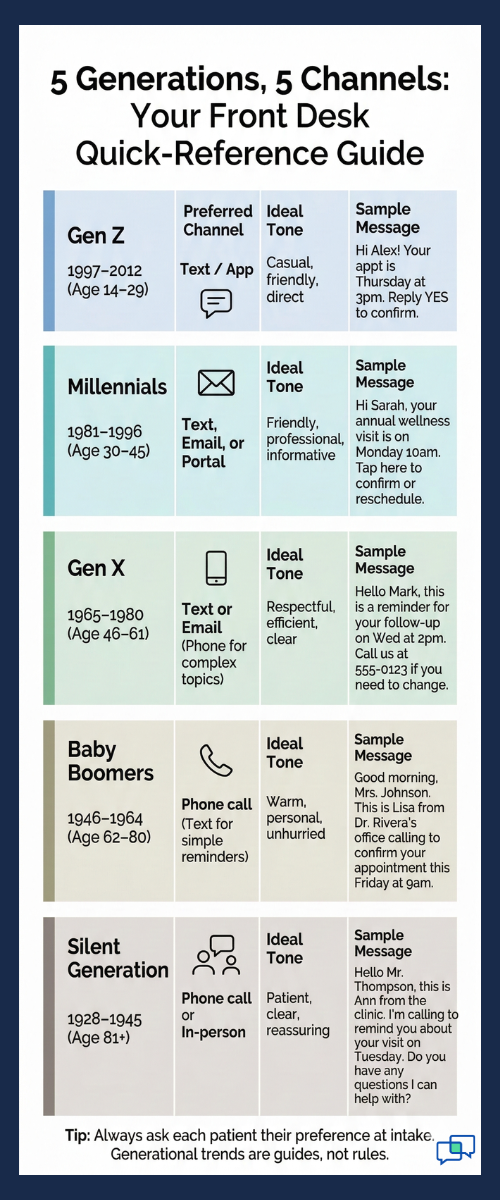
Infographic showing preferred communication channels for five patient generations from Gen Z to Silent Generation

Multi-Generational Practice Strategy

Knowing each group's habits is one thing. Putting it all into action is another. Your practice needs a clear plan that serves patients of every age without making your staff's job harder.

Start with a Preference Check

The simplest first step? Ask. During intake or check-in, ask every patient: "How would you like us to reach you — call, text, or email?" Then log that choice in your system. This one small step cuts down on wasted effort and missed messages across the board.

Don't assume you know the answer based on age alone. Some 75-year-olds love texting. Some 30-year-olds still prefer calls.

Stereotypes lead to bad outreach. Real data leads to results. Update this preference at least once a year, because people's habits shift over time.

Build Flexible Channel Options

Your practice should support at least two or three contact channels. That means text and phone at a minimum, with email or portal access as a bonus. The goal is to match the patient, not to force everyone into the same box.

This is where age-based communication strategies truly come alive. When you pair the right channel with the right message for each patient, you see less friction.

Based on our internal research, one clinic reduced no-shows from 14.20% to just 4.91% in three months — results like these come from matching patients with the channels they actually respond to.

Train Your Team

Your front desk and clinical staff need to know why generational differences matter and how to adjust. A quick 30-minute training session can cover the basics: when to call vs. text, how to adjust tone, and why patience matters with older patients. Make it part of your onboarding process for new hires.

Avoid Age-Based Assumptions

Finally, remember: generational trends are guides, not rules. Use them to inform your default approach, but always let the individual patient's preference lead. The best practices treat every person as unique while using generational insights as a helpful starting point.


Technology Selection for All Generations

The right platform can make generational patient communication feel seamless instead of stressful. But not all tools are built to serve every age group. Here's what to look for when choosing the right system for your practice.

Simple, Intuitive Design

Any tool you choose needs to be easy for staff and patients. If a patient portal is hard to navigate, your Boomers won't use it. If an app feels clunky, Gen Z will abandon it. Look for clean layouts, simple buttons, and a minimal learning curve.

The best platforms work like texting — because nearly everyone understands how to send and read a text. Tools that mimic that natural, everyday feel tend to get the highest adoption rates across all age groups.

Support for Multiple Channels

A platform that only supports one channel won't cut it. You need the option to reach patients by text, email, and phone.

Bonus points if the tool lets you set a default channel per patient based on their stated preference. This saves your team from having to look up the preference each time.

Accessibility and Family Features

For older patients and those with caregivers, your platform should support large text, clear design, and the option to add a second contact.

If a caregiver needs to get a copy of the appointment reminder, your tool should make that easy to set up without extra steps.

Integration with Your Current System

A communication tool that doesn't connect with your existing software creates double work. Look for a platform that syncs with your practice management system or electronic health record. This ensures that confirmed appointments, form completions, and messages all flow into one place.

Curogram was built with this kind of multi-generational approach in mind. It integrates with any EMR, supports two-way texting, automated reminders, and offers the flexibility practices need to serve every age group from one platform.


Conclusion

Reaching every patient in your practice starts with one simple truth: not everyone wants to hear from you the same way. A Gen Z patient and a Baby Boomer may sit in the same waiting room, but their expectations for how you communicate couldn't be more different. The practices that thrive are the ones that recognize this and act on it.

Generational patient communication isn't about being perfect with every message. It's about being thoughtful. It's about asking patients how they prefer to be reached, then honoring that choice.

When your outreach matches a patient's comfort level, they're more likely to confirm visits, follow through on care plans, and stay loyal to your practice.

The steps aren't complex. Start by asking for channel preference at intake. Train your team on the basics of each generation's habits.

Use a platform that supports more than one contact method. And above all, don't let assumptions guide your outreach — let the patient lead.

Whether you serve mostly young adults or care for a mix of ages from Gen Z to the Silent Generation, the framework is the same. Meet each patient where they are.

Use the right channel, the right tone, and the right timing. These small adjustments add up to big gains in trust, engagement, and clinical outcomes.

Your patient panel is diverse, and your communication approach should be too. Start with one change this week — even if it's just adding a "How would you like us to contact you?" field to your intake form. That one question can shift the way every patient in your practice feels about their care.

Cut no-show rates and confirm more appointments with less manual work. Book a demo with us to see how generational communication can work on autopilot for your team.


Frequently Asked Questions

How do I find out which communication channel each patient prefers?
Add a simple question to your intake or check-in form asking if they prefer calls, texts, or email. Log the answer in your system and update it each year.
Why do younger patients ignore phone calls from my practice?
Gen Z and Millennials often screen unknown numbers and prefer text-based contact. A quick text with clear info gets a faster, more reliable response from these groups.
How should I adjust my tone when reaching out to older patients?

Speak in plain, clear language and avoid rushing. Older patients value a warm, personal tone and want time to ask questions. Patience builds trust with this group.

Why does a one-size-fits-all outreach method lead to more no-shows?

Patients who receive messages through a channel they don't use are far less likely to respond. Matching the channel to the patient's preference leads to more confirmed visits and fewer missed slots.

How can my staff learn to handle generational differences without spending hours on training?

A 30-minute team session covering the basics of each generation's habits and preferred channels is enough to start. Pair it with a simple reference chart staff can keep at the front desk.


How to Generate Google Reviews for Your Business Success

How to Generate Google Reviews for Your Business Success

In today's digital-first world, have you ever wondered how some businesses consistently capture attention and dominate Google searches while others...

Read More
Patient Communication Evolution: Phone to Multi-Channel Guide (2026)

Patient Communication Evolution: Phone to Multi-Channel Guide (2026)

💡 Patient communication evolution refers to the shift from phone-only contact to multi-channel outreach in healthcare. For years, medical...

Read More
Text vs Phone Calls in Healthcare: Data-Driven Comparison

Text vs Phone Calls in Healthcare: Data-Driven Comparison

💡 When comparing text vs phone calls in healthcare, data shows that text messaging wins on speed, cost, and patient preference, while phone calls...

Read More