Skip to the main content.

15 min read

Future of Healthcare Technology: 2026 Trends and Predictions

Future of Healthcare Technology: 2026 Trends and Predictions
💡 Healthcare technology trends 2026 are defined by rapid AI adoption, hybrid telemedicine models, true data interoperability, and growing cybersecurity demands. Practices of every size face pressure to modernize workflows, protect patient data, and meet new government mandates.

Key trends include AI-powered clinical decision support, cloud-based health systems, voice-enabled documentation, patient-generated health data from wearables, and deeper integration of social determinants of health into EHRs.

Medical practices that plan ahead, invest in the right tools, and train their staff will be best positioned to deliver better care, lower costs, and stay competitive in a fast-changing healthcare landscape.

Healthcare is moving faster than most practices can keep up with. Every year brings new tools, new rules, and new patient expectations that push the industry forward. For 2026, the pace of change is only picking up speed.

Think about where your practice was just five years ago. You may have scrambled to set up telehealth during the pandemic, adopted a new EHR, or started texting patients for the first time. Those once-radical changes are now the basics.

The question today is not whether to use technology, but which healthcare technology trends 2026 will bring that deserve your attention and investment.

The gap between early adopters and everyone else is widening. Large health systems pour millions into AI, automation, and data platforms.

Meanwhile, small and mid-size practices often feel stuck, unsure where to start or how to justify the cost. The good news is that many of these trends are becoming more accessible and affordable, even for independent providers.

At the same time, patient expectations continue to evolve. People now expect seamless digital experiences, faster communication, and personalized care. Practices that fail to adapt risk falling behind, not just in efficiency, but in patient satisfaction and retention. Understanding the latest trends isn’t just about staying current—it’s about staying relevant.

Some innovations may feel intimidating at first, like artificial intelligence or predictive analytics. Others, like patient portals, remote monitoring, or secure messaging, are simpler to implement but still offer big benefits. The key is knowing which tools will deliver the most impact for your practice size and patient population.

In this article, you will get a clear look at the most important shifts shaping future medical technology this year and beyond. We will cover eight major trends, from artificial intelligence and telemedicine to cybersecurity and social determinants of health.

For each trend, you will learn what is happening, why it matters, and what it means for your day-to-day operations. Whether you run a solo practice or manage a multi-location group, this guide will help you make smarter decisions about where to spend your time and budget. The goal is simple: help you stay ahead without getting overwhelmed.

Where Healthcare Technology Stands in 2026

The healthcare technology landscape in 2026 looks very different from just a few years ago. The COVID-19 pandemic forced practices to adopt tools they had been putting off for years, and that momentum has not slowed down. From telehealth platforms to digital patient intake, the baseline for what counts as modern care has shifted dramatically.

Adoption rates vary widely depending on practice size. Large health systems and hospital networks tend to lead the way, with dedicated IT teams and bigger budgets. Small and mid-size practices often lag behind, not because they lack interest but because they lack the resources and guidance to move forward.

Healthcare Tech in 2026: By the Numbers

$6T 78.6% 45%
Projected U.S. healthcare spending by 2026 Of U.S. hospitals with a telemedicine solution installed Of health system executives citing care model change as the top 2026 priority

Investment and Innovation Are Accelerating

Investment in healthcare innovation 2026 is at record levels. Venture capital funding in digital health remains strong, and major EHR vendors are rolling out AI-powered features at a rapid clip. Government programs are also pushing adoption, with new mandates around data sharing and interoperability taking effect.

The biggest challenge right now is the gap between what is possible and what most practices can realistically do. Cutting-edge tools exist, but integrating them into busy clinical workflows takes time, training, and money. The practices that succeed will be the ones that focus on practical, step-by-step improvements rather than trying to overhaul everything at once.

AI and Machine Learning Are Changing Clinical Practice

Artificial intelligence is no longer a future concept in healthcare. It is here, and it is already changing how clinicians make decisions, document visits, and manage patient care. In 2026, AI tools are moving out of pilot programs and into everyday clinical use.

Where AI Is Making the Biggest Impact

One of the biggest areas of growth is clinical decision support. AI systems can now analyze patient records, lab results, and imaging data to flag potential risks before a provider even reviews the chart. This does not replace clinical judgment. Instead, it gives your team a second set of eyes that works around the clock.

Automated documentation is another game-changer. Ambient listening technology sits quietly in the exam room, captures the conversation between provider and patient, and generates a structured clinical note. This can save providers up to two hours a day on charting, which means less burnout and more face time with patients.

Predictive analytics is also gaining ground as part of the broader digital health trends shaping 2026. Algorithms can identify patients at high risk for hospital readmission, chronic disease progression, or missed appointments. Your practice can then reach out proactively instead of waiting for a crisis.

Separating Hype From Reality

Not every AI promise is ready for prime time.

Here is a quick snapshot of where things stand:

  • AI for imaging analysis and radiology triage is already delivering measurable results in clinical settings.
  • Ambient documentation tools are proving their value, with many EHR vendors now bundling basic versions into standard plans.
  • AI-generated treatment recommendations are still in early stages and require careful human oversight.

The key for small and medium practices is to start with tools that solve an immediate pain point, such as documentation or scheduling, rather than chasing the most advanced features. The timeline for mainstream adoption is shorter than most people think. If you have been waiting to explore AI, 2026 is the year to start.

Telemedicine Is Evolving Into Hybrid Care

Telemedicine is not going away. In fact, it is growing into something bigger and more useful than the basic video visits that became common during the pandemic.

By the end of 2026, experts predict that 25% to 30% of all medical visits in the U.S. will happen remotely.

The real story in 2026 is the shift toward hybrid care models. Instead of choosing between in-person and virtual visits, practices are blending both into a single, seamless workflow. A patient might complete intake forms online, have a quick video check-in, and then come into the office only when a hands-on exam is needed.

Remote Monitoring Is Expanding

Remote patient monitoring is growing quickly alongside telemedicine. Connected devices like blood pressure cuffs, glucose monitors, and pulse oximeters send data directly to your EHR. This gives your care team a continuous view of a patient's health, not just a snapshot from the last office visit.

Telehealth Adoption: Key Numbers

Metric Value
Projected share of U.S. medical visits via telehealth by end of 2026 25–30%
Physicians using telehealth weekly in 2024 71.4%
Psychiatrists using video visits weekly 85.9%
U.S. hospitals with telemedicine solutions installed 78.6%
Adults who have used telemedicine at least once 80%
Global telehealth market forecast for 2026 $175.5 billion

The Reimbursement Picture Is Improving

The financial side of telehealth is getting friendlier for practices. Nearly half of U.S. states have implemented payment parity policies, and the DEA and HHS extended telemedicine waivers through 2026.

Congress continues to debate making these flexibilities permanent, which would give practices the confidence to invest more heavily in virtual care infrastructure.

The technology requirements for telehealth are evolving too. Patients expect a smooth, app-like experience, not a clunky portal with multiple logins. Practices that invest in user-friendly platforms and integrate them tightly with their existing systems will see higher adoption and satisfaction from both patients and staff.

Interoperability Is Finally Becoming a Reality

For years, healthcare interoperability felt like a promise that never quite arrived. Systems could not talk to each other, patient data lived in silos, and sharing records between providers was slow and frustrating. That is finally starting to change in 2026.

Government mandates are driving much of this progress. The 21st Century Cures Act requires healthcare organizations to make patient data more accessible and prohibits information blocking. New rules are pushing EHR vendors to open up their systems and support standardized data exchange.

FHIR Adoption Is Picking Up Speed

FHIR, which stands for Fast Healthcare Interoperability Resources, is the technical standard making this possible. FHIR adoption is accelerating across the industry, allowing different systems to share data in a common format.

If your practice uses a PACS radiology system or any other specialty tool, FHIR-based connections make it far easier to pull that data into your main workflow.

Health Information Exchanges, or HIEs, are also maturing. These regional networks let providers access a shared pool of patient records, which reduces duplicate testing and improves care coordination. For practices that refer patients to specialists or hospitals, this is a major time saver.

What This Means for Your Day-to-Day Operations

The rise of API-first healthcare systems is another important development. Modern platforms are built from the ground up to connect with other tools through open interfaces. This means you can add new features, like patient texting or appointment reminders, without ripping out your entire tech stack.

For your practice, true interoperability means less manual data entry, fewer faxes, and better information at the point of care. It also means patients can access their own records more easily, which is both a regulatory requirement and a growing expectation.

Patient-Generated Health Data Is on the Rise

Patients are collecting more health data on their own than ever before. Wearable devices, smartphone apps, and home monitoring tools generate a steady stream of information about everything from heart rate and sleep quality to blood sugar and activity levels. This flood of patient-generated health data is creating both opportunities and challenges for medical practices.

Turning Raw Data Into Clinical Value

Integrating this data into your EMR is one of the biggest opportunities. When a patient with diabetes shares daily glucose readings through a connected device, your care team can spot trends and adjust treatment plans without waiting for the next appointment. Patient-reported outcomes can also give you a more complete picture of how someone is doing between visits.

Remote monitoring devices are another part of this emerging health tech category. Blood pressure monitors, weight scales, and even ECG patches can transmit data directly to your practice. Medicare and many private insurers now reimburse for remote patient monitoring, which makes this a potential revenue stream as well.

Data quality and reliability remain real concerns. Not all consumer-grade devices meet clinical standards, and the sheer volume of data can overwhelm a small practice that does not have a system to filter and prioritize what matters. Setting up clear workflows for which data gets reviewed, by whom, and how often is essential.

The key is to start small — pick one or two conditions where patient-generated data can make the biggest difference, such as hypertension or diabetes management, prove the value, and then expand from there.

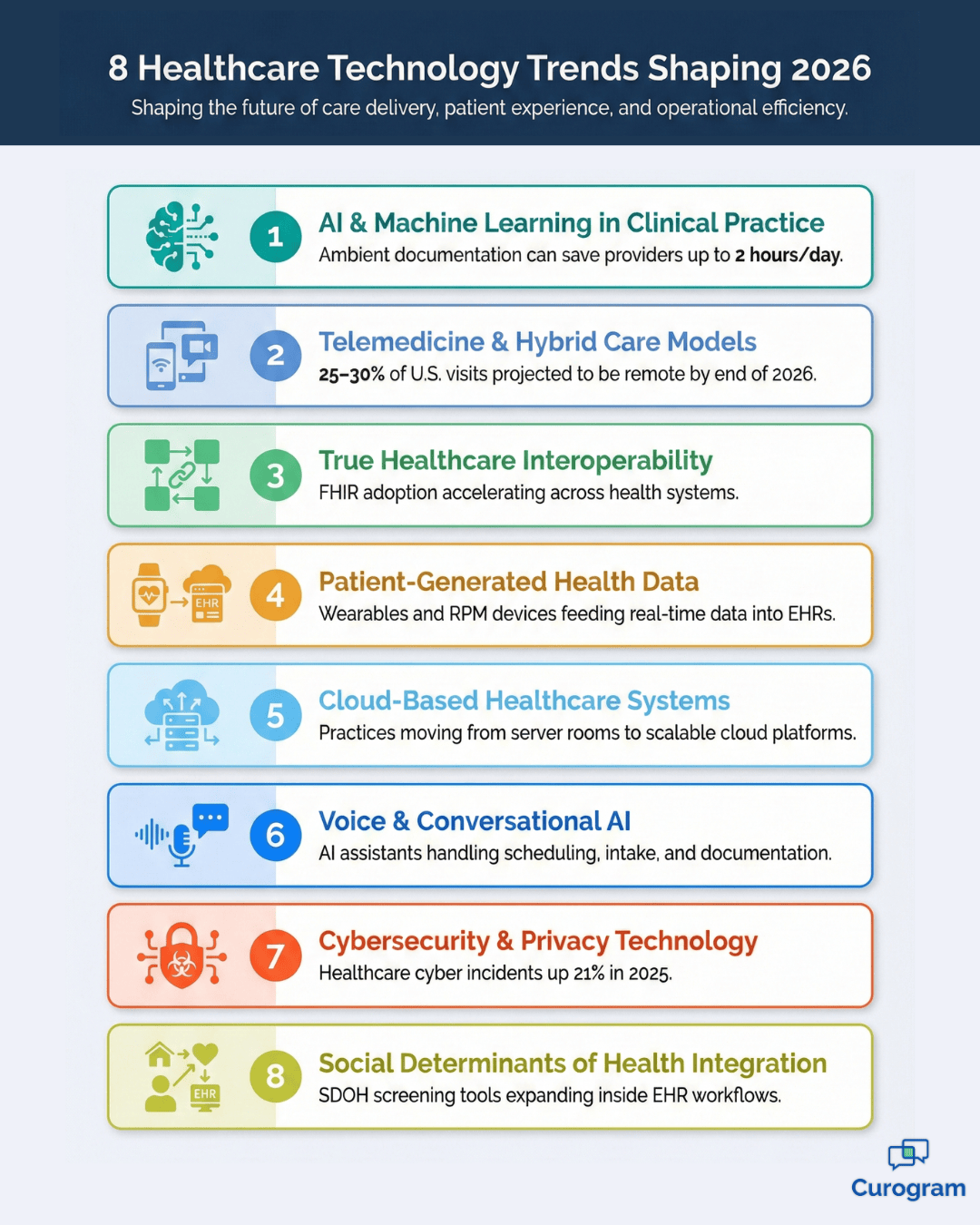
Healthcare technology trends 2026 infographic showing eight key predictions for medical practices

Cloud-Based Systems Are Reshaping Medical Practices

The shift from on-premise servers to cloud-based healthcare systems is one of the most significant changes happening in medical IT right now.

In 2026, a growing number of practices are ditching the server room and moving their core systems to the cloud.

Why Practices Are Making the Switch

The benefits of cloud-based systems touch nearly every part of your operations:

  • Access patient records, schedules, and billing from anywhere with an internet connection.
  • Scale up or down based on your needs without paying for hardware you do not use.
  • Receive automatic updates so you are always running the latest and most secure version.

Security is a common concern, but modern cloud providers invest far more in data protection than most individual practices can afford on their own. Leading platforms offer encryption at rest and in transit, multi-factor authentication, and round-the-clock monitoring.

Of course, you still need to do your part by choosing a HIPAA-compliant vendor and training your staff on best practices.

Vendor Consolidation and Simplification

Many practices use a patchwork of tools that do not work well together. Cloud-based platforms are increasingly offering all-in-one solutions that combine EHR, billing, patient communication, and telehealth in a single system. This simplifies operations and reduces the headaches that come from managing multiple vendors.

For small practices in particular, cloud systems lower the barrier to entry. You do not need a big IT budget or a dedicated server room. You just need a reliable internet connection and a willingness to make the switch.

Voice Technology and Conversational AI Are Gaining Ground

Voice technology is becoming a serious tool in healthcare, not just a novelty. In 2026, more practices are using voice-enabled documentation, virtual health assistants, and automated patient communication systems to lighten the load on their staff.


Voice-enabled documentation is leading the charge. Providers can now dictate notes naturally during a patient visit, and AI-powered tools convert that speech into structured clinical documentation.

This is a step beyond traditional dictation because the system understands medical terminology and formats the note according to your templates.

Beyond Dictation: Assistants and Ambient Intelligence

Virtual health assistants are also making inroads. These AI-driven tools can answer common patient questions, help with appointment scheduling, and even guide patients through pre-visit intake forms. They work around the clock, which means your front desk is not the bottleneck for routine tasks.

Ambient clinical intelligence takes voice technology even further. These systems listen to the entire patient encounter, extract relevant clinical details, and generate a draft note for the provider to review. Early adopters report significant time savings and say it helps them focus on the patient instead of the keyboard.

What Is Holding It Back

Accuracy is improving but still not perfect. Accents, background noise, and complex medical terms can trip up even the best systems. Most providers still need to review and edit AI-generated notes before signing off. The technology works best as a draft, not a finished product.

Mainstream use of voice and conversational AI in healthcare is expected to grow steadily over the next two to three years, and practices that experiment now will have a head start when these tools become standard.

Cybersecurity Threats Demand Stronger Defenses

Cyberattacks on healthcare organizations are getting worse, not better. The numbers paint a stark picture, and every practice needs to pay attention regardless of its size.

Healthcare Cyber Threats: By the Numbers

21% 30% $9.77M
Increase in healthcare cyber incidents in 2025 Jump in ransomware attacks on healthcare businesses Average cost of a single healthcare data breach


57M+ 40% 63%
Individuals affected by healthcare breaches in 2025 Of U.S. health systems predicted to face ransomware by end of 2026 Of breaches caused by phishing as the entry point

These attacks are not just targeting large hospitals. Small practices are increasingly in the crosshairs because they often have weaker defenses and fewer resources to recover.

A single ransomware attack can shut down your operations for weeks, compromise patient records, and damage your reputation beyond repair.

Zero-Trust and the New Security Mindset

Zero-trust security models are gaining traction as a response. Instead of assuming everything inside your network is safe, zero-trust requires verification for every user and device that tries to access your systems. It is a mindset shift that treats every login as potentially suspicious until proven otherwise.

You may have heard about blockchain for health data security. While the concept is interesting, the reality is that blockchain in healthcare is still in its early stages and has not yet delivered on its big promises. For most practices, the better investment is in proven measures that deliver immediate protection.

Steps Every Practice Should Take Now

  • Train your staff regularly to spot phishing emails and suspicious links.
  • Enable multi-factor authentication on every system that supports it.
  • Keep all software updated and apply patches as soon as they are available.
  • Encrypt patient data both at rest and in transit, and maintain regular off-site backups.

Every practice, no matter how small, needs a cybersecurity plan. Conduct regular risk assessments and make sure your business associates are meeting HIPAA security requirements. The cost of prevention is always less than the cost of a breach.

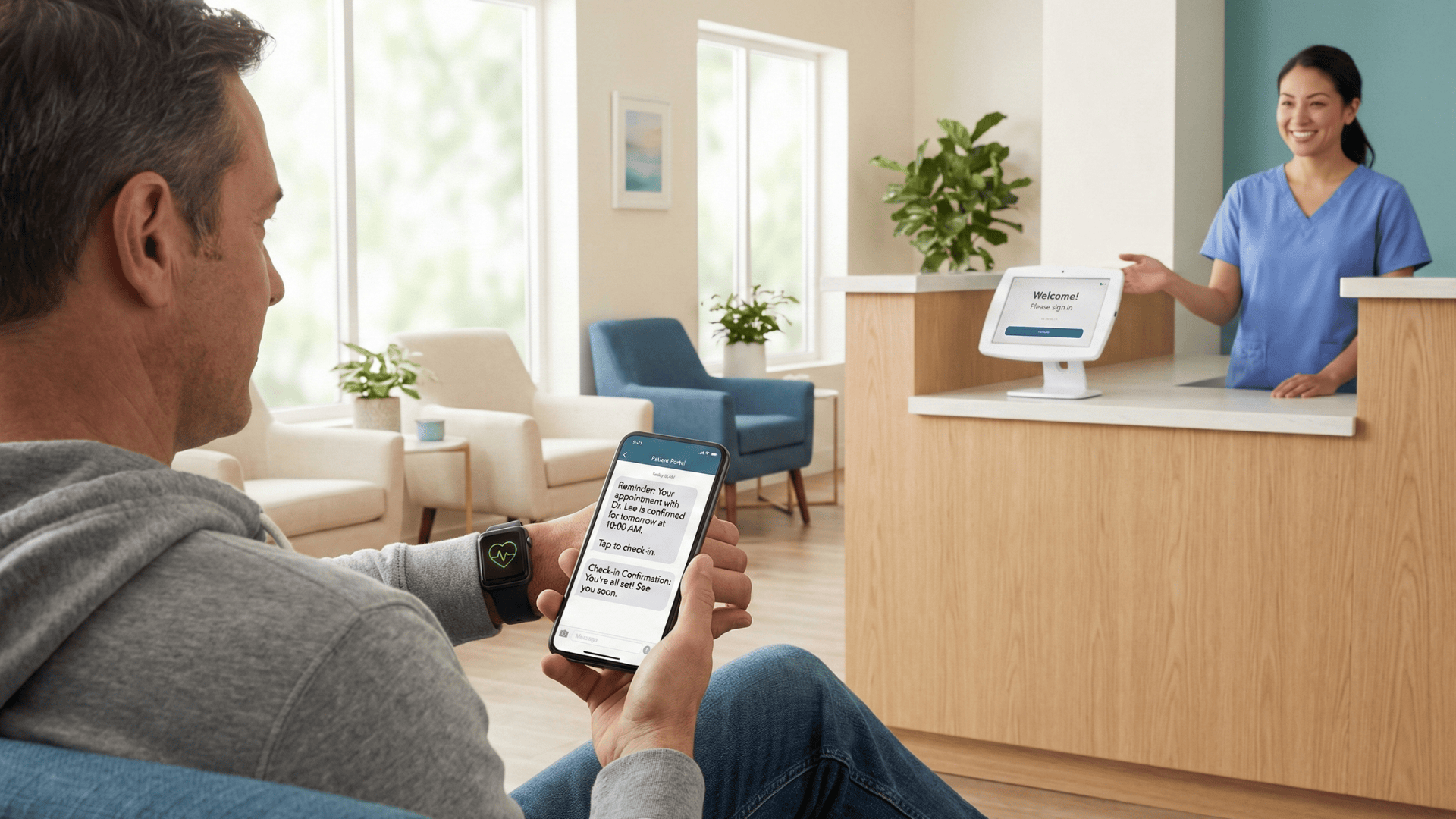
Patient using smartphone to check in at a tech-enabled medical practice waiting area

Social Determinants of Health Are Entering the EHR

Healthcare is starting to look beyond the exam room. Social determinants of health, or SDOH, refer to factors like housing, food access, transportation, and education that have a major impact on patient outcomes. In 2026, more practices are finding ways to capture and act on this information.

EHR systems are expanding to include SDOH screening tools. Standard questionnaires can be built into your intake process so that patients are asked about non-clinical needs during every visit. This data goes into the medical record, giving your care team a fuller picture of what each patient is dealing with. Community resource integration is the next step.

Some platforms now connect screening results to local support services, such as food banks, housing assistance, or transportation programs. When a need is identified, the practice can refer the patient directly instead of simply noting it in the chart.

Value-based care contracts are accelerating SDOH adoption. Payers increasingly want to see that practices are addressing the whole patient, not just the diagnosis. Practices that can document SDOH screenings and interventions may qualify for higher reimbursements or performance bonuses.

Technology is making SDOH integration more practical than ever.

Tools such as:

  • Automated screening during intake
  • Built-in referral pathways to community services
  • Analytics dashboards to track trends and outcomes

…help even small practices take meaningful action without adding excessive workload. The healthcare transformation around SDOH is still in its early stages, but the direction is clear: capturing and acting on social factors is becoming a standard part of quality care.

What These Trends Mean for Your Practice

Every practice will feel the impact of these healthcare technology trends 2026 differently. A two-physician family medicine clinic faces different challenges than a 50-provider multi-specialty group. The key is to focus on the trends that align with your biggest pain points and your patients' needs.

Priorities at a Glance

The table below outlines where different practice types should focus their technology efforts in 2026.

Practice Type Top Technology Priorities Biggest Challenge
Small practice (1–5 providers) Cloud EHR, patient texting, automated reminders, basic telehealth Limited budget and IT resources; staff wearing multiple hats
Mid-size practice (6–20 providers) Interoperability, remote patient monitoring, AI documentation, cybersecurity Coordinating change across locations; integrating new tools with legacy systems
Large practice / health system (20+ providers) Enterprise AI analytics, advanced interoperability, SDOH integration, zero-trust security Change management at scale; getting clinical staff buy-in across departments

Choosing Where to Invest

Technology investment priorities should be guided by return on investment, not hype. Ask yourself which tools will save time, reduce costs, improve patient outcomes, or generate revenue. If you cannot answer that question clearly, the tool probably is not worth the money right now.

Staff training and change management deserve as much attention as the technology itself. The best software in the world will fail if your team does not know how to use it or does not trust it. Plan for a learning curve, celebrate early wins, and build a culture where people feel comfortable trying new things.

How to Prepare Your Practice for What's Coming

Preparing for the future does not mean you need to adopt every new tool that comes along. It means being intentional about where you invest your time and resources. Start with a technology assessment that identifies where your current systems are falling short and where you are losing the most time or money.

Build a three-to-five year technology roadmap that maps out your priorities in phases. Maybe year one is migrating to a cloud-based EHR. Year two might focus on adding telehealth and remote patient monitoring. Year three could bring AI-powered documentation tools.

Breaking it into stages keeps the process manageable and gives your team time to adjust.

When choosing vendors, think about the future, not just today. Pick platforms that are open, interoperable, and built to grow with you. Ask vendors about their API capabilities, their FHIR compliance, and how they handle integrations with other tools you already use.

A closed system may be easier to set up now, but it will hold you back later.

Staff development is just as important as the technology. Invest in training programs that help your team build confidence with new tools. Identify champions within your practice who can lead the way and support their colleagues through the transition.

Finally, balance innovation with stability. You do not want to be so far behind that you cannot compete, but you also do not want to chase every shiny new thing. Focus on proven solutions that solve real problems, and leave room in your budget for the surprises that every year brings.


Conclusion

The future of healthcare technology is not some distant vision—it is unfolding right now, in exam rooms, front desks, and server rooms across the country. The trends covered in this article are already reshaping how practices deliver care, manage operations, and connect with patients.

What matters most is not adopting every new tool on the market. What matters is having a plan: understand where your practice stands today, identify gaps that are costing you time or money, and take deliberate steps to close them.

The practices that will thrive in 2026 and beyond are those that treat technology as a partner, not a threat. They invest in the right tools, train their teams, and stay flexible enough to adapt as the landscape shifts. They also lean on trusted partners who understand both technology and the unique demands of healthcare.

You don’t have to do everything at once. Start with one trend that addresses your biggest challenge, take action, and build from there. The practices that invest wisely in technology—from AI-powered documentation and hybrid telemedicine to stronger cybersecurity—will deliver better care while running more efficiently.

But knowing the trends is only half the battle. The real challenge is putting them into action without disrupting your daily workflow. That’s where Curogram comes in.

Curogram is built for medical practices like yours. Whether you are a solo provider or manage a multi-location group, our platform brings together the tools you need to stay ahead. Two-way patient texting, automated appointment reminders, digital intake forms, and telehealth capabilities all work together in one HIPAA-compliant system that integrates with almost any EMR.

Our platform reduces the administrative burden on your front desk and call center staff while improving the patient experience. Patients get the fast, text-friendly communication they expect, and your team gets time back in their day. That means fewer no-shows, faster payments through text-to-pay, and smoother workflows from check-in to checkout.

You don’t need to overhaul your entire tech stack to see results. Curogram works alongside your current systems and can be up and running quickly with minimal training. Thousands of practices across the country have modernized their communication and operations without the headaches that usually come with new technology.

The future of healthcare technology is here, and your practice deserves to be part of it.

Book a demo today to see how Curogram can help you work smarter, connect with patients, and stay competitive in a rapidly changing industry.

Frequently Asked Questions

What are the most important healthcare technology trends for 2026?

The most important trends include AI and machine learning in clinical practice, telemedicine evolution toward hybrid care, true healthcare interoperability, patient-generated health data, cloud-based systems, voice and conversational AI, cybersecurity improvements, and social determinants of health integration. Each of these areas is seeing rapid growth and real-world adoption across practices of all sizes.

How will AI affect small medical practices in 2026?

AI is becoming more accessible for small practices through built-in features in modern EHR systems. Tools like automated documentation, ambient clinical intelligence, and predictive scheduling can save small teams hours each week. The key is to start with AI features that address your biggest bottleneck, whether that is charting, patient outreach, or appointment management.

Is telemedicine still growing in 2026?

Yes. Experts predict that 25% to 30% of all U.S. medical visits will happen remotely by the end of 2026. The trend is shifting from standalone video visits toward hybrid care models that blend in-person and virtual care into a single patient journey. Reimbursement support and regulatory extensions are helping drive continued growth.

What should practices do to improve cybersecurity in 2026?

Start with the basics: train your staff to recognize phishing attempts, enable multi-factor authentication on all systems, keep software updated, and encrypt all patient data. Conduct regular risk assessments and make sure your business associates are also following HIPAA security guidelines. Consider adopting a zero-trust security model for stronger protection.

How can a practice prepare for healthcare interoperability requirements?

Choose EHR and technology vendors that support FHIR standards and open APIs. Connect to your regional Health Information Exchange if available. Review your current data-sharing workflows and identify where information is still being shared by fax or phone. Prioritize platforms that are built to integrate with other tools, not ones that lock you into a closed ecosystem.


EMR vs EHR vs Practice Management: Complete Guide for Practices

EMR vs EHR vs Practice Management: Complete Guide for Practices

💡 An EMR is a digital chart used inside one practice. An EHR goes further by sharing patient data across different providers and hospitals. A...

Read More
HL7 and FHIR Integration: What Medical Practices Need to Know

HL7 and FHIR Integration: What Medical Practices Need to Know

💡 HL7 and FHIR are the two most important healthcare data exchange standards used today. HL7 version 2 has been the backbone of healthcare...

Read More
DICOM Standards Explained Simply: Healthcare Staff Guide

DICOM Standards Explained Simply: Healthcare Staff Guide

💡 DICOM stands for Digital Imaging and Communications in Medicine. It is the global standard that lets medical imaging equipment store, share,...

Read More