11 min read
Best Patient Engagement Software for Small and Mid-Size Practices
Mira Gwehn Revilla
:
April 18, 2026
Practices using the right patient engagement software have seen no-show rates drop by more than 50% and new 5-star reviews grow by the hundreds in just a few months. The best fit for your practice depends on your size, specialty, and current tech stack.
Focus on tools that work with your existing EMR, offer real-time staff messaging, and automate tasks that eat up front desk time. A strong platform should pay for itself in saved hours and recovered revenue.
Your front desk is buried in phone calls. Patients are missing visits. Your Google reviews haven't moved in months. If this sounds like your practice, you're not alone.
Small and mid-size medical offices face these problems every day. The good news? The best patient engagement software can fix most of them — often within weeks, not months.
Patient engagement tools help your team talk to patients through text, send visit reminders on autopilot, collect intake forms online, and even ask for Google reviews after each visit. Think of it as a single hub that handles the tasks your staff spends hours doing by hand.
But with so many options on the market, how do you pick the right one? Not every tool is built for smaller practices. Some are clunky, pricey, or don't work with the EMR you already use.
This guide breaks it all down. We'll cover what patient engagement software does, which features matter most, and how to compare your options side by side. We'll also share real numbers from practices that have used these tools to cut no-shows, save staff time, and grow their online presence.
Whether you run a solo primary care clinic or a five-location specialty group, the right platform can level the playing field. You don't need a huge budget or a full IT team to get started. You just need a clear picture of what to look for — and what to avoid.
By the end of this post, you'll know exactly how to evaluate your choices. You'll also see how a digital patient engagement platform can drive real results for a practice your size. Let's dive in.
What Is Patient Engagement Software?
Patient engagement software is a set of tools that helps your practice connect with patients before, during, and after their visit. It replaces scattered phone calls, paper forms, and manual follow-ups with one simple system.
At its core, this kind of software covers five main areas:
- Messaging - Two-way texting that lets your staff and patients send messages back and forth in real time — just like a normal text thread.
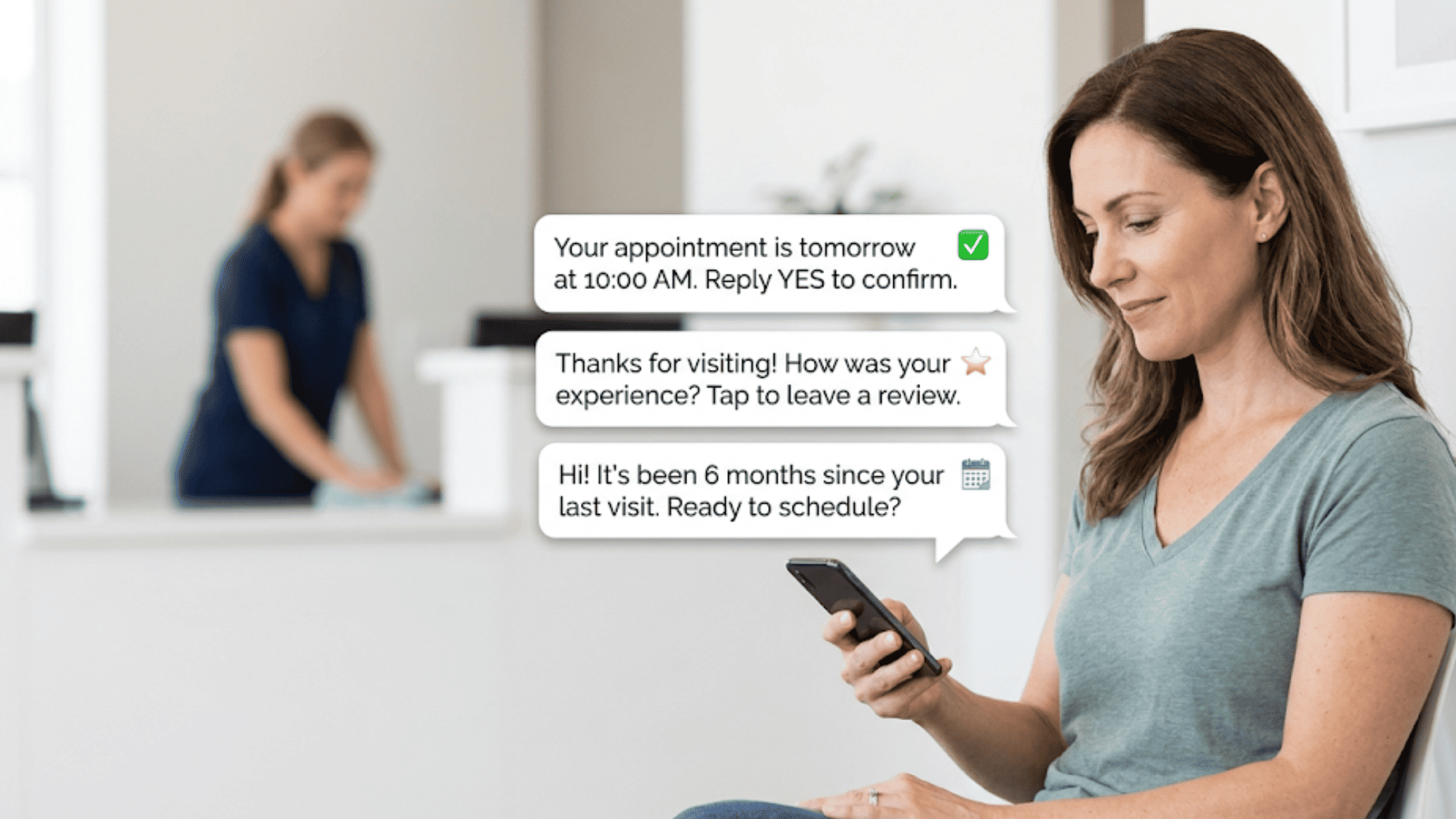
- Reminders - Automated visit alerts sent by text or email. These go out at set times before the visit, so patients don't forget.
- Intake forms - Digital forms that patients fill out on their phone or computer before they arrive. No clipboard. No pen. No wasted lobby time.
- Surveys and review requests - After the visit, the system can ask for feedback and route happy patients to leave a Google review.
- Internal team messaging - Secure chat between your staff — from front desk to billing to providers — that keeps everything HIPAA compliant.
Here's a simple way to think about it. Without patient engagement software, your front desk might spend 10 minutes per patient just on phone tag, form printing, and manual reminder calls. Multiply that by 30 patients a day, and you've lost over five hours of staff time.
With the right digital patient engagement tools, most of those tasks run on their own. Your team gets time back. Patients get a smoother experience. And you get a practice that runs more like a modern business.
The key thing to know is that patient engagement software is not one single feature — it's a full toolkit that touches every part of the patient journey.
Why Patient Engagement Matters for Practice Growth
Patient engagement isn't just about better bedside manner. It has a direct impact on your bottom line. When patients feel connected to your practice, they show up, come back, and tell others about you.
Fewer No-Shows Mean More Revenue
Based on our internal data, practices using automated reminders and two-way texting see no-show rates that are 53% lower than the industry average.
One practice — Atlas Medical Center — dropped its no-show rate from 14.20% to 4.91% in just three months. That's three times better than the typical clinic. Every filled slot is money your practice would have lost.
Better Reviews Bring in New Patients
About 90% of new patient leads check your Google Business Profile before they visit your website. If your rating is low or your reviews are stale, they move on.
Based on our internal research, one multi-location practice earned 1,064 new 5-star Google reviews in only three months after turning on automated post-visit surveys. That kind of online presence draws patients straight to your door.
Staff Time Goes Further
When you swap manual phone calls for text-based workflows, your front desk can breathe. Based on our internal data, practices using two-way texting cut phone call volume by up to 50% and see a 30%+ boost in staff output. That means fewer overtime hours and less burnout.
Patients Come Back for Follow-Ups
Lost patients are lost revenue. One of the biggest wins we've seen is from SMS-based recall campaigns. In one case, 35% of patients who received a recall text booked an appointment within a month — and 1,240 patients were seen from those messages alone.
When you add it all up, the math is clear. Even a 10–20% bump in revenue from recovered visits can pay for your entire patient engagement software investment many times over.

Key Features to Look for in Patient Engagement Software
Not all patient engagement tools are built the same. Some platforms offer dozens of features you'll never use. Others leave out the basics.
When you're choosing software for a small or mid-size practice, focus on the features that save time, protect patient data, and drive real results.
Here's a quick checklist of the core features that matter most:
|
Feature |
Why It Matters |
|
Two-way texting |
Lets patients text your office like they text a friend. Cuts phone calls, speeds up replies, and boosts patient satisfaction. |
|
Automated visit reminders |
Sends text or email alerts before each visit. Reduces no-shows without any manual work from your staff. |
|
Automated surveys and review requests |
Collects patient feedback after visits and routes happy patients to leave a Google review. Builds your online reputation on autopilot. |
|
Digital intake forms |
Patients fill out forms on their phone before they arrive. Saves lobby time, reduces paper costs, and cuts data entry errors. |
|
Internal staff messaging |
Secure, HIPAA-compliant chat between front desk, billing, and providers. Keeps your team aligned without shouting across the hall. |
|
HIPAA compliance |
Non-negotiable. Every message, form, and file must be encrypted and meet federal privacy standards. |
|
The software should sync with your current EMR so your team doesn't have to enter data twice. |
A few things to watch out for: Some tools claim they integrate with your EMR but only do it one way. Others charge extra for features like review requests or digital forms. Always ask what's included in the base price.
Switching to digital intake alone can cut wait times and reduce front desk workload in the first week. The best approach is to match the feature list to your practice's biggest pain points. If no-shows are your top problem, prioritize reminders and texting. If your Google rating needs help, start with survey tools.
Best Patient Engagement Software: How to Compare Your Options
Choosing the best patient engagement software can feel daunting when every vendor claims to be the top pick. The easiest way to cut through the noise is to compare platforms on the features that matter most to your practice.
Below is a side-by-side look at what a purpose-built platform like Curogram offers versus what you'll find with a typical general engagement tool:
|
Feature |
Curogram |
Generic Engagement Tool |
|
EMR Integration |
Works with any EMR — syncs patient data so your team avoids double entry |
Often limited to a few EMRs, or requires costly custom setup |
|
Two-Way Texting |
Full two-way SMS with patients in real time, just like normal texting |
May only offer one-way messages or require a patient portal login |
|
Review Automation |
Automated post-visit surveys that route 5-star ratings straight to Google |
Basic survey tools with no direct link to Google Reviews |
|
Patient Intake |
Digital forms patients fill out on their phone before arriving |
Paper-based or PDF forms that still need manual data entry |
|
HIPAA Compliance |
Built-in encryption and compliance across all features |
Varies — some tools only encrypt certain channels |
|
Pricing |
Affordable, flat-rate pricing for small and mid-size practices |
Tiered plans where key features cost extra |
|
Onboarding |
Staff training in as little as 10 minutes — minimal disruption |
Weeks-long setup with dedicated IT support required |
A few things stand out. First, EMR integration is a make-or-break feature. If the platform doesn't talk to your existing system, your staff ends up typing the same data in two places. That kills the whole point of automating.
Second, look at how texting works. Two-way texting is not the same as a patient portal message. Patients read texts within minutes. Portal messages often sit unread for days.
Third, check the real cost. A tool that looks cheap at first but charges add-ons for intake forms, reviews, or HIPAA compliance can end up costing more than a platform that bundles everything.
How a Digital Patient Engagement Platform Helps Small Practices Compete
Big health systems have full marketing teams, call centers, and custom-built tech stacks. Small and mid-size practices don't. But a digital patient engagement platform can close that gap faster than you might think.
Here's the reality. Patients today expect to text their doctor's office, fill out forms on their phone, and get visit reminders without a phone call. They don't care if your practice has three providers or three hundred. They just want a smooth experience.
When a small practice adopts the right tools, the results are striking. Based on our internal data, practices using automated reminders confirmed over 1,100 appointments per month without a single phone call from staff. That level of efficiency used to be reserved for large clinics with big teams. Now, a two-person front desk can match it.
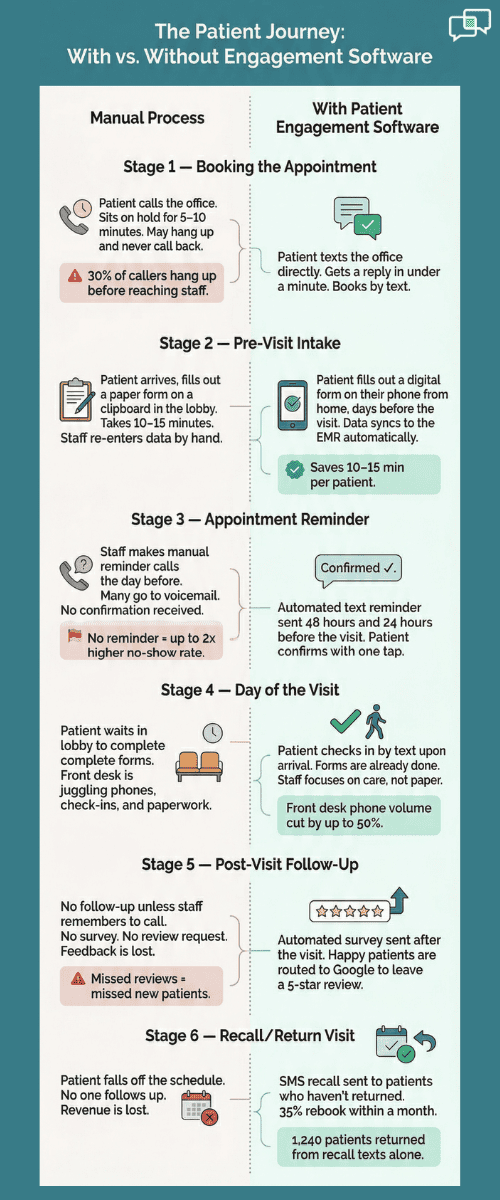
Think about the patient's journey at your office right now. They call to book, then wait on hold. They arrive and fill out a paper form. They miss a follow-up because no one reminded them. At each step, patients slip through the cracks.

Now, picture the same journey with a digital patient engagement platform in place. The patient books by text. They fill out intake forms from their couch. They get a reminder the day before and confirm with one tap. After the visit, they get a survey link and leave a 5-star review. Then, a month later, a recall text brings them back for a follow-up.
That's how smaller practices compete. Not by hiring more staff, but by letting the right software do the heavy lifting. Based on our internal research, practices that used SMS recall campaigns saw 35% of those patients book a return visit within a month. In total, 1,240 patients came back from those messages alone.
You don't need a big budget. You need a smart system. And for most small practices, investing in a platform that bundles texting, reminders, intake, and reviews is the fastest way to grow.
Questions to Ask When Evaluating a Healthcare Engagement Platform
Before you sign a contract, you need to ask the right questions. Not every healthcare engagement platform is a good fit for every practice. The answers to these questions will save you time, money, and a lot of headaches down the road.
Here are 10 questions to bring to every vendor demo:
- Does it integrate with my EMR? This is the single most important question. If the platform doesn't sync with your system, you'll create more work, not less.
- Is it HIPAA compliant across all features? Some tools are only compliant for certain channels. Make sure every message, form, and file is encrypted.
- Does it offer two-way texting? One-way blasts aren't enough. Patients need to reply, ask questions, and confirm visits by text.
- How long does onboarding take? A tool that takes weeks to set up may not be worth the disruption. Look for platforms that get your team up and running in days — or even minutes.
- What does the pricing include? Ask for a clear list of what's in the base plan and what costs extra. Watch for add-on fees for features like reviews, intake, or extra users.
- Can it automate review requests? If growing your Google reviews is a goal, you'll want a tool that sends survey links right after the visit — not one that requires your staff to do it by hand.
- Does it support digital intake forms? Paper forms are slow and error-prone. Confirm that the platform offers mobile-friendly forms patients can fill out before they arrive.
- Is there internal staff messaging? Your team needs a secure way to chat about patient needs without using personal phones or email.
- What kind of support is available? Ask about live chat, phone support, and training resources. You need help when things go wrong — not just during setup.
- Can I see data on results? Ask for case studies or outcome data. A good vendor should be able to show you real numbers on no-show reduction, review growth, and staff time saved.
What Results Can You Expect from Patient Engagement Tools?
Adopting new software always raises one question: what will I actually get out of this? With patient interaction software, the results are measurable and show up fast — often within the first few months.
Here are the most common outcomes practices see when they use patient communication platforms the right way:
-
No-Show Reduction - This is the most immediate win. Based on our internal data, Curogram users see no-show rates 53% lower than the industry average. One practice went from a 14.20% no-show rate to just 4.91% in three months. That's the kind of shift that shows up directly in your revenue.
-
Staff Time Saved - With texting and automation doing the heavy lifting, your front desk spends less time on the phone. Practices using two-way SMS have cut phone volume by up to 50%, giving staff hours back every single week. That time can go toward higher-value tasks like patient follow-ups or billing.
-
Google Review Growth - A strong online reputation brings in new patients — and it starts with a system that asks for reviews at the right moment. Based on our internal research, one practice collected over 1,000 new 5-star Google reviews in just three months after switching on automated surveys.
-
Patient Recall and Retention - Patients who fall off the schedule don't have to stay lost. SMS recall messages bring them back. In one case, 35% of patients who got a recall text returned within a month, resulting in 1,240 additional visits.
Here's a quick snapshot of what these outcomes look like in practice:
|
Outcome |
Typical Result |
|
No-show rate reduction |
Up to 53% lower than industry average |
|
Phone call volume |
Reduced by up to 50% |
|
Staff productivity |
30%+ improvement |
|
New 5-star Google reviews |
1,000+ in 3 months (one practice) |
|
Patient recall response rate |
35% booked within 1 month |
|
Revenue impact |
10–20% increase from recovered visits |
These aren't projections. They're based on real outcomes from practices that use Curogram. Keep in mind that results vary depending on your size, specialty, and how fully you use the platform. But even partial adoption tends to show strong returns within the first quarter.
Conclusion
Picking the right patient engagement software is one of the best moves a small or mid-size practice can make. It's not just about keeping up with bigger clinics. It's about giving your patients a better experience while freeing your team to focus on care.
The tools are there. Two-way texting, automated reminders, digital intake forms, review requests, and secure staff messaging can all run from one platform. You don't need five different systems or a full-time IT person to make it work.
What matters most is finding a platform that fits your practice. It should work with your EMR, be HIPAA compliant from top to bottom, and be easy enough for your staff to learn in minutes — not weeks. Price should be clear, with no surprise add-ons.
The data backs this up. Practices using the right tools have cut no-shows by more than half, earned hundreds of new 5-star reviews in months, and saved their front desk teams hours of phone time every week.
Those gains compound. Fewer missed visits means more revenue. Better reviews means more new patients. Less phone time means happier, more productive staff.
If you've been on the fence, now is the time. The sooner you adopt, the sooner your practice starts seeing results. And with platforms that offer fast onboarding and flat-rate pricing, the barrier to entry has never been lower.
Don't wait for the next missed appointment or unanswered phone call to push you over the edge. Take the first step today.
Your practice deserves a patient engagement platform that actually works with your EMR and fits your budget. Talk to us to see how two-way texting, automated reminders, and review requests work in real time.
Frequently Asked Questions
Without it, your staff enters the same data twice — once in the platform and once in your EMR. Integration saves time, prevents errors, and keeps patient records accurate.
The system sends a survey link right after the visit. Happy patients are routed to Google to leave a review. This creates a steady stream of fresh, positive ratings without any staff effort.
Track three things: no-show rate changes, new Google reviews per month, and front desk phone volume. Compare these numbers before and after launch to see the real impact on revenue and staff time.