
1 min read
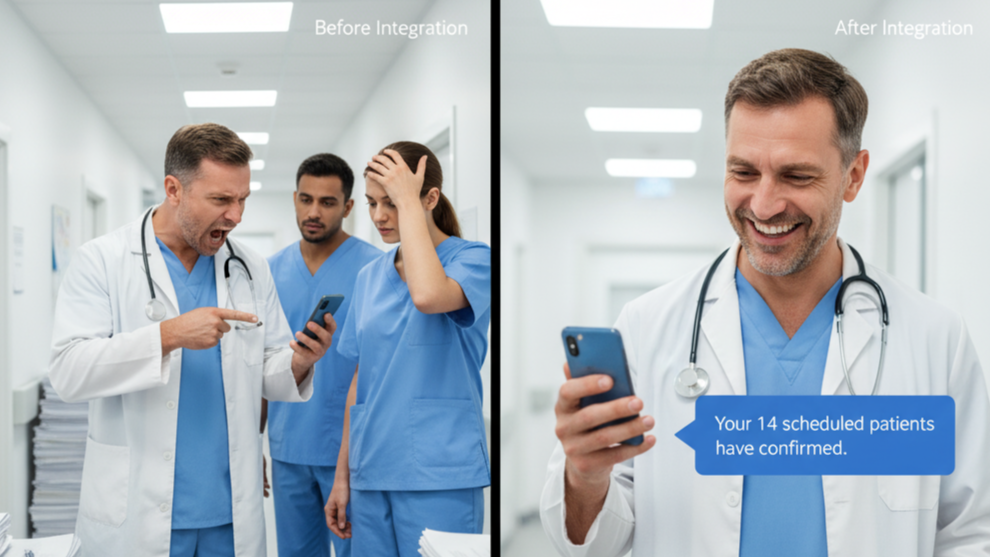
Before vs. After Integration: EMR Integration Daily Workflow Changes
💡Clinic workflow integration changes everything. Before integration, staff juggle phone calls, paperwork, and disconnected systems. After...
8 min read

Your patient already answered these questions. Last Tuesday, she typed her allergies, insurance details, and current medications into an online form before her first visit.
Today she's back at your front desk, filling out the same details on a clipboard.
She isn't happy about it. Neither is your receptionist, who now has to manually re-enter every answer into the electronic health record. And the phone has rung four times since the patient walked in.
This is what happens when EMRs aren't integrated. Your scheduling tool, intake forms, reminders, and patient messages each hold a piece of the same story. But none of them share it. So your team becomes the bridge, copying, pasting, and calling patients to fill every gap in the process.
Each gap looks small on its own: a missed prep note here, an unreturned callback there. Together, they add up to lost staff hours, empty appointment slots, and patients who start to wonder whether anyone is really keeping track.
Disconnected EMR systems don't just slow you down. They quietly shape how your entire practice operates, from patient check-in to final billing.
In this guide, you'll learn the seven most common signs that your systems aren't talking to each other. You'll see what EMR communication issues really cost in time, revenue, and compliance risk. You'll also learn why interoperability in healthcare matters more now than ever, and how a HIPAA-compliant communication layer can connect the pieces you already use.
Along the way, you'll see the results practices get once those gaps close. Think fewer no-shows, quieter phone lines, and patients who feel supported instead of forgotten.
If your staff spends more time chasing information than helping patients, this article is worth a few minutes of your day. Let's start by looking at where the friction actually comes from.
Disconnected EMR systems occur when your clinical record, scheduling, intake forms, reminders, payments, and patient messaging operate in silos. Because these tools don’t share data, staff are forced into copy‑paste routines, manual re‑entry, and endless phone tags—activities that slow check‑in, introduce errors, and frustrate patients.
A unified, HIPAA‑compliant communication layer that integrates with the EMR reduces this “swivel‑chair” work and keeps information consistent across the entire patient journey.
When information is fragmented, patients feel the gaps: unclear prep instructions, repeated questions, and delayed responses that erode trust and satisfaction.
These are the seven warning signs that EMR communication issues have become systemic. If two or more are familiar, you’re likely paying a compounding “integration tax” in time, cost, and patient experience.
Without reliable EMR or EHR integration, team members transcribe demographics, insurance, and clinical details between systems. This inflates administrative workload, elongates front‑desk cycles, and increases error risk.
Practices that add an EMR‑aware messaging and forms layer eliminate most duplicate entries and see smoother operations and fewer corrections downstream.
Patients call to confirm, reschedule, or clarify instructions because updates aren’t reaching them in their preferred channel. Call volume spikes, wait times grow, and staff burn out. Clinics that move routine workflows to secure two‑way texting commonly cut call volume by about 50%, freeing hours every week for higher‑value tasks.
When intake responses, confirmations, or post‑visit messages don’t flow back to the chart, providers arrive at visits missing context.
That drives repeat questioning, duplicated work, and delays in care coordination. Closing this loop with integrated forms and messaging ensures that what patients share is visible at the point of care.
One‑size‑fits‑all reminders sent at the wrong time or without prep details fail to change behavior. The result is softer confirmation rates and persistent no‑shows. EMR‑aware, automated reminders—timed to appointment type and patient needs—consistently reduce misses and keep schedules productive.
When communications live in scattered inboxes or personal devices, you lose audit trails and raise HIPAA risk. A centralized, HIPAA‑compliant platform that logs messages, reminders, and form submissions protects PHI, standardizes workflows, and gives you defensible records if questions arise.
Siloed systems make it hard to answer basic questions:
Which reminder cadence reduces no‑shows?
How many patients finished intake before arrival?
Which locations are drowning in calls?
Integrated communication produces clean, attributable data for operational dashboards and quality initiatives—fuel for continuous improvement.
In multi‑specialty or multi‑site groups, disconnected tools multiply handoff failures. Prep steps get missed, follow‑ups lag, and patients bounce between departments retelling the same story. Standardizing on an EMR‑connected communication hub shortens handoffs, clarifies ownership, and improves patient experience across the network.
The net effect of these challenges is predictable: more labor for the same outcomes, staff and patient dissatisfaction, and revenue leakage from preventable no‑shows and rework.
The good news is that each symptom is reversible once you connect reminders, two‑way messaging, intake forms, and payments to your EMR in a single, HIPAA‑compliant workflow.
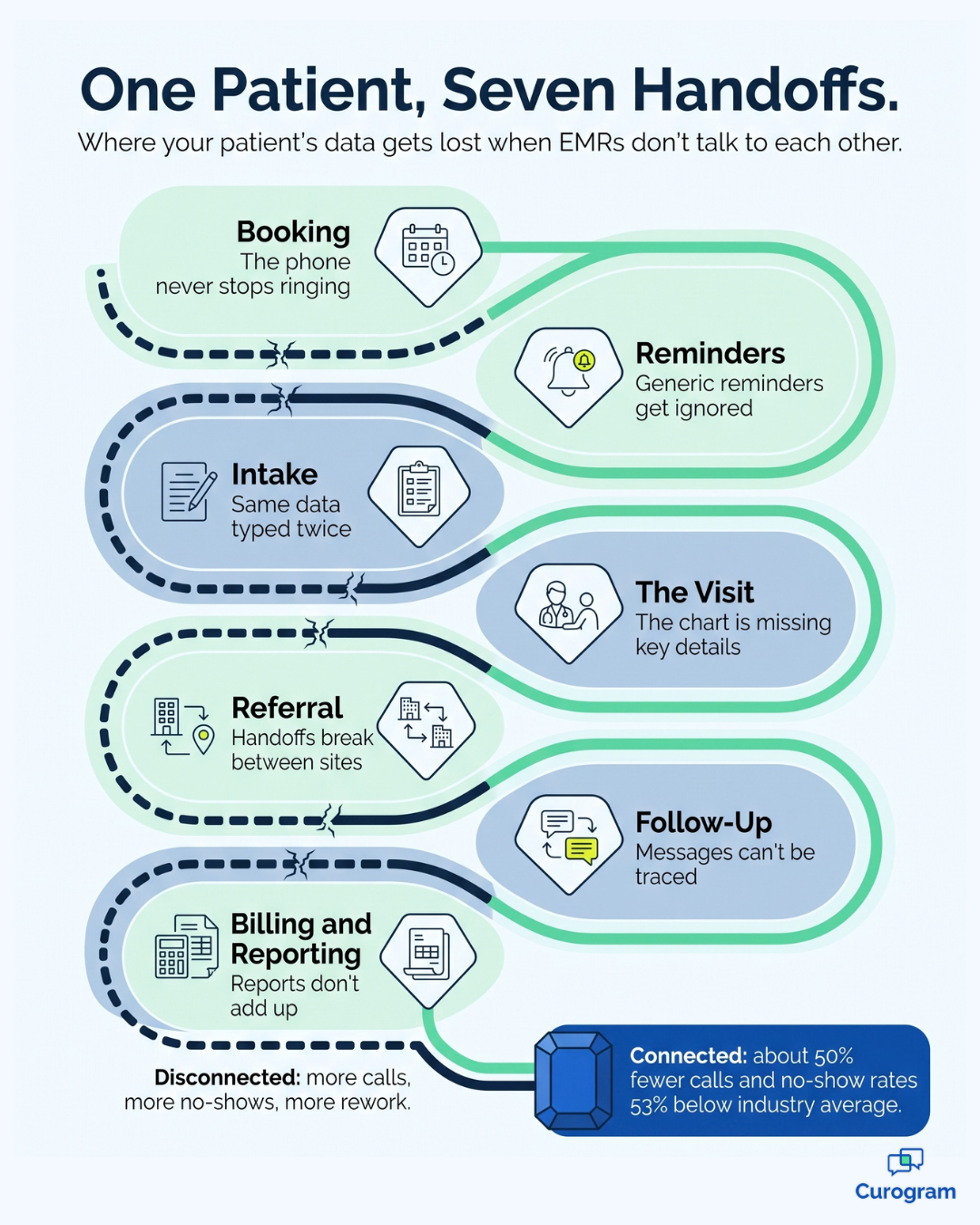
Healthcare data silos don't show up as a line item on your budget. But they drain it every day.
On the operations side, disconnected tools push phone volume up and productivity down. When reminders aren't timely or personal, attendance slips. Practices that switch to connected, automated reminders often see a big change. Atlas Medical Center, for example, cut its no-show rate from 14.20% to 4.91% in three months with Curogram.
Compliance risk also grows when messages and forms aren't stored in one place with a full audit trail. And patient experience takes a hit when people have to repeat themselves or wait for a callback.
To see what this looks like in real numbers, here's an illustrative example for a mid-sized practice.
These figures are sample assumptions, not client data.
| Cost Area | Illustrative Example (Before) | Illustrative Example (After) | Monthly Difference |
|---|---|---|---|
| Routine phone calls | 1,600 calls/month × 3 min = 80 staff hours | About 50% fewer calls = 40 staff hours | 40 hours saved |
| Missed appointments | 1,200 visits × 14% no-show = 168 missed | 1,200 visits × 5% no-show = 60 missed | 108 visits recovered |
| Lost visit revenue (at $150/visit) | 168 × $150 = $25,200 | 60 × $150 = $9,000 | $16,200 recovered |
This means a practice like this could win back about 40 staff hours and $16,200 in visit revenue each month. Over a year, that's roughly 480 hours and $194,400.
For your team, it's the difference between constantly catching up and actually getting ahead.
Each of those moments is a handoff your EMR isn't handling automatically. If you find more than five, a connected communication layer will likely pay for itself in staff time alone. Use that list to guide your demos, and ask every vendor to show you how their platform removes each step.

In short, fix the handoffs and everything moves faster: intake, prep, visit, follow‑up, and billing.
Curogram was built around front‑desk reality: make communication simple, secure, and integrated. It’s a HIPAA‑compliant, best‑in‑class two‑way texting platform that integrates with almost any EMR, automates front‑desk functions, and streamlines patient interactions—without steep training curves.
What’s different about Curogram?
It was shaped by watching real front desks work, so staff can learn it in about 10 minutes—no heavy lift, just immediate wins. By unifying messaging, reminders, forms, payments, and reputation into a single EMR‑aware layer, Curogram closes the gaps that disconnected EMR systems create and gives patients the consumer‑grade experience they expect.
Practices from solo to multi‑location report smoother days and happier teams when communication is integrated. Patients notice, too—fewer callbacks, clearer prep, and faster answers build trust and drive loyalty.
When your EMR can't communicate with the rest of your tools, the problem goes far beyond IT. It becomes a barrier to growth, efficiency, and patient trust. Every missing connection turns into extra typing, another phone call, or a patient who shows up unprepared.
You've seen how those gaps accumulate on each other. Staff members retype the same information, and reminders go out too late or not at all.
Charts miss details that patients already shared. Somewhere in between, appointments get missed and revenue slips away without anyone noticing.
The encouraging news is that none of this is permanent.
For practice administrators, managers, and providers, the path forward is clear. Integration isn't an optional upgrade anymore. It's what keeps your practice operating efficiently in a healthcare environment where speed and patient experience matter more every year.
Consider who you're serving. Your patients expect fast, clear updates on the mobile phone they already carry. Your staff deserves tools that reduce their workload instead of adding to it. And your providers need accurate, up-to-date information to deliver excellent care during every visit.
A connected communication platform like Curogram meets all three needs at once. It resolves today's operational headaches while setting your practice up for long-term success. You don't have to replace your EMR or retrain your entire team. You simply add a layer that makes your existing systems work together.
The cost of doing nothing keeps growing, one missed call and one empty slot at a time. The cost of fixing it is often smaller than you'd expect.
If disconnected systems are slowing your practice down, now is an ideal time to explore what a connected workflow looks like. Book a demo to see how Curogram connects with your EMR and find out how much time your team could get back.
Frequently Asked Questions
1 min read
💡Clinic workflow integration changes everything. Before integration, staff juggle phone calls, paperwork, and disconnected systems. After...
1 min read
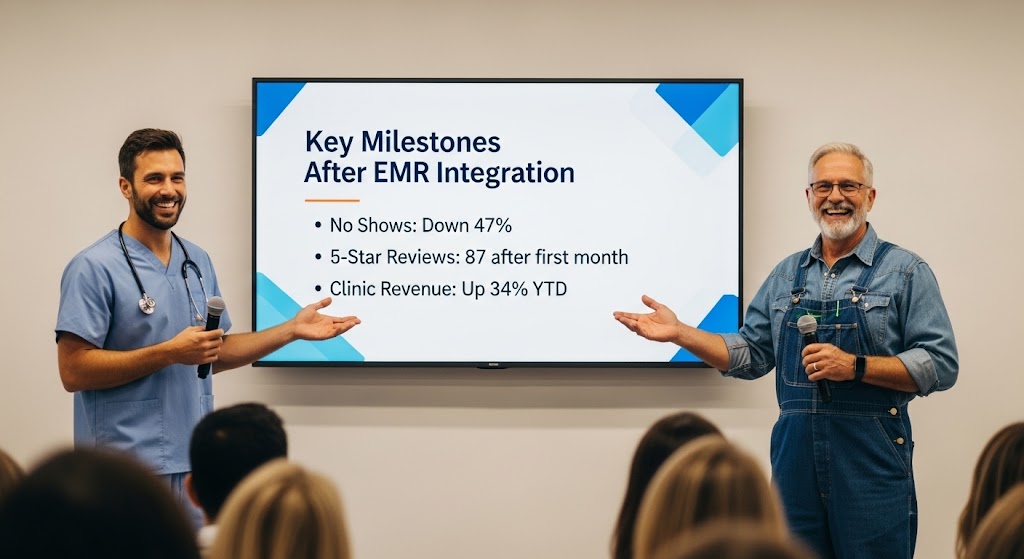
💡 A small clinic fixed its biggest workflow bottlenecks by integrating communication with its EMR. Before: Staff spent hours on phones, patients...

1 min read
Telemedicine solutions are in demand among United States medical offices as 43% of American survey respondents indicated they want to continue using...