Fill Schedule Gaps in Prime Clinical | Revenue on Demand
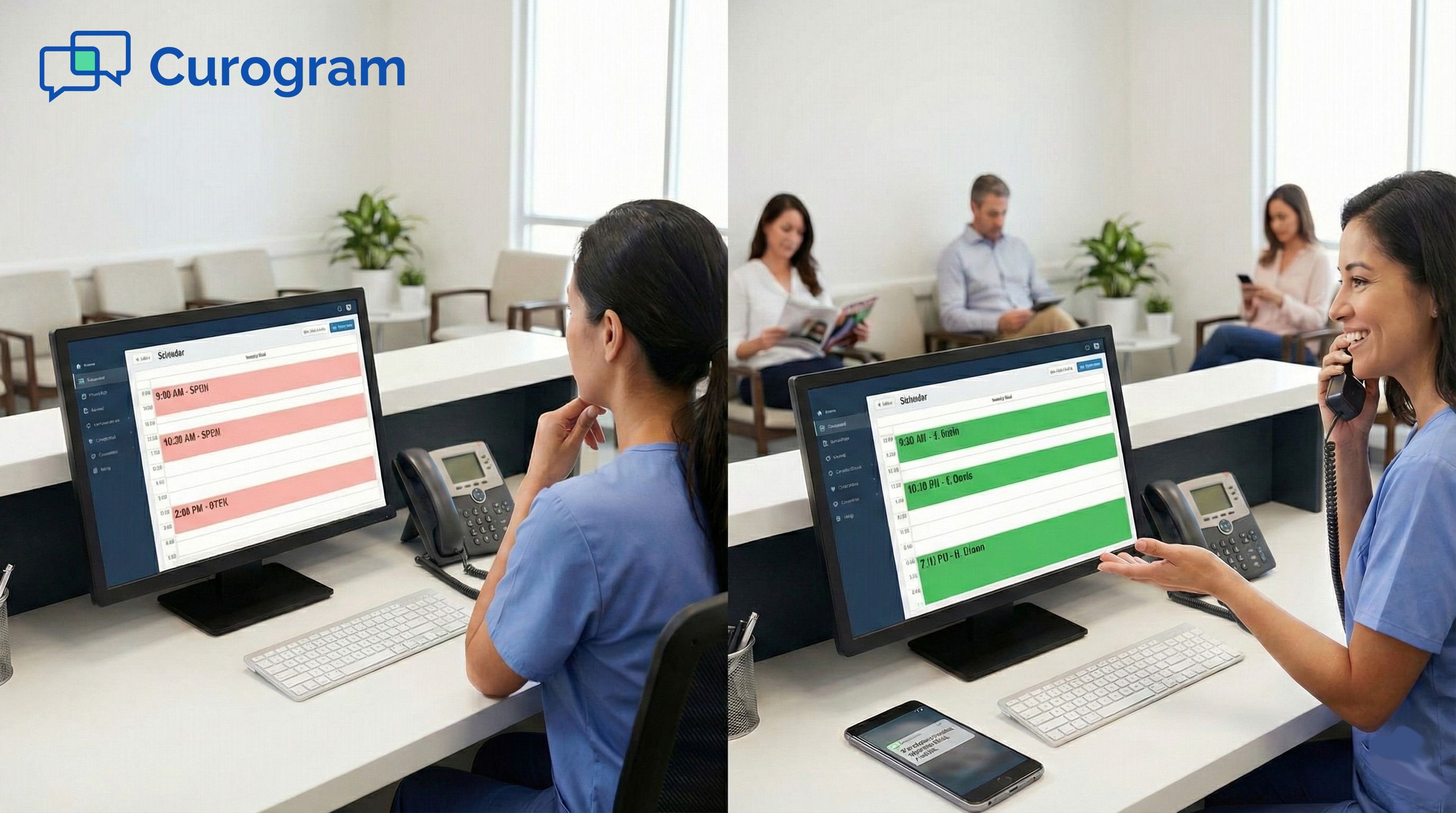
💡 To fill schedule gaps in Prime Clinical Systems, the most direct method is targeted broadcast messaging through Curogram. Practices filter...
7 min read
Aubreigh Lee Daculug
:
February 25, 2026
You put real work into planning your events. You book the speaker, prepare the materials, coordinate volunteers, and set up the room with care. You think through the details because you know the impact these gatherings can have.
But when only a handful of people show up, it feels like all that effort was for nothing. The empty chairs become louder than the message you worked so hard to prepare.
The truth is, most no-shows are not about disinterest. They are about distraction.
People genuinely intend to come. They mean to RSVP. They plan to rearrange their schedule. But life moves quickly. Emails pile up. Social media feeds refresh by the second. A post from Monday can get buried by Tuesday morning. Notifications compete for attention all day long.
When your invitation lives in the same crowded digital space as everything else, it becomes just another scroll.
If your only outreach was digital noise, the attendance problem is not your fault. It is a communication problem, and it has a fix.
The solution is not doing more. It is communicating smarter.
Broadcast messaging for eKyros events gives pregnancy centers a direct line to the people who matter most. Instead of hoping someone sees a post or opens an email, you send a message that arrives directly in their pocket.
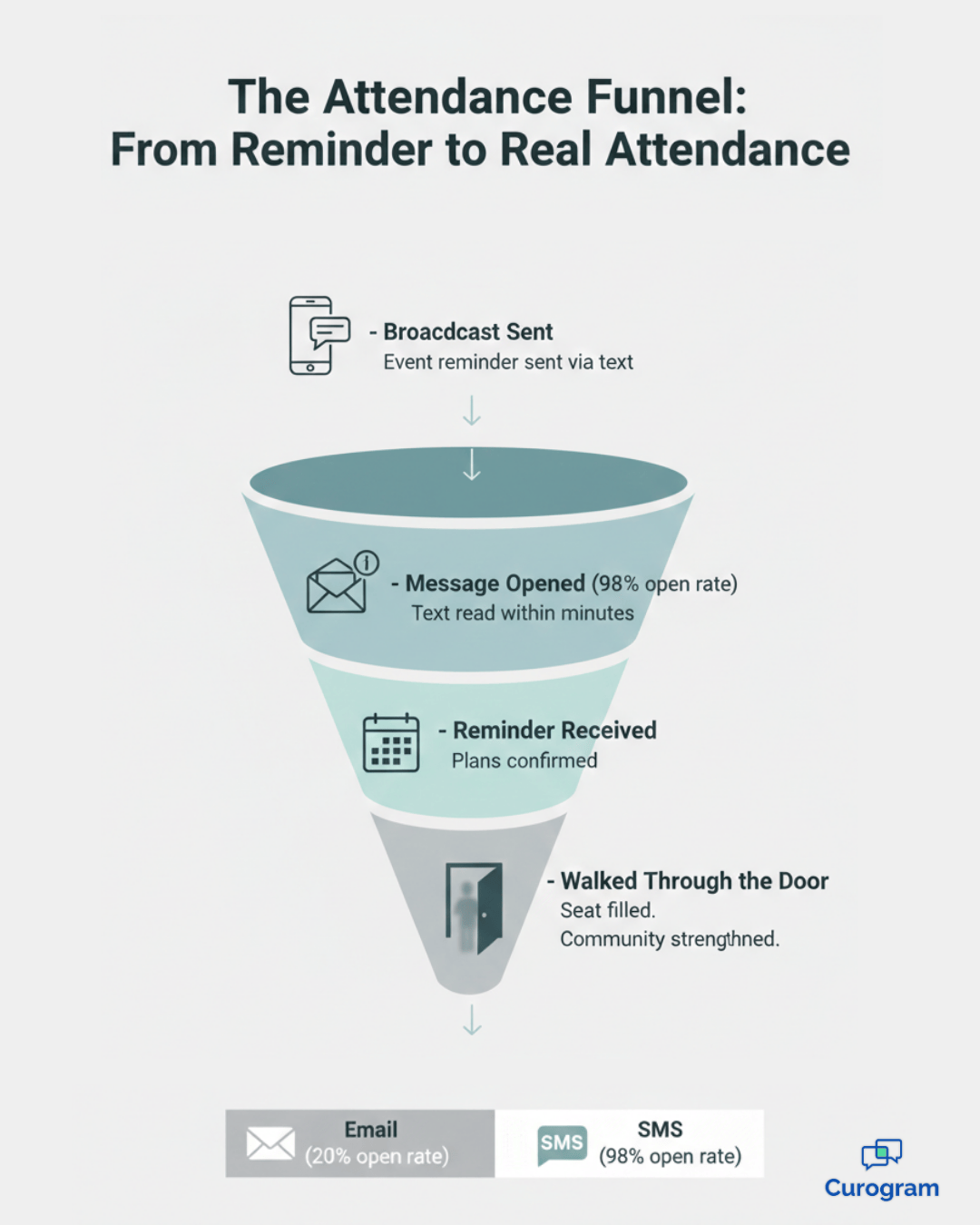
A simple text message cuts through the clutter in a way that email and social media rarely can. Studies show that texts have a 98% open rate, compared to around 20% for email. That means your reminder is not just sent. It is seen.
And being seen changes everything.
A well-timed reminder the day before an event can dramatically increase attendance. A follow-up message an hour before start time helps people remember to walk out the door.
A short, clear volunteer call-to-action can fill open slots faster than weeks of passive promotion. When your communication becomes direct and intentional, participation follows.
This article walks you through how to use Curogram's broadcast tool to boost class attendance, drive volunteer recruitment text campaigns, and keep your community connected long after the event ends.
You will also learn how smart segmentation makes your messages feel personal rather than spammy, even when you are reaching a large group at once. Because when people feel personally invited, they are far more likely to show up.
And when they show up, your mission moves forward.
You invited 15 women to your New Moms support group. You bought snacks, printed handouts, and your guest speaker drove 30 minutes to be there. And then three people walked in.
Low attendance is more than just disappointing. It signals to your staff and volunteers that the work is not landing. It makes it harder to justify future programming. Over time, it drains the energy out of the people who care most about the mission.
Why People Stop Showing Up
The problem is rarely the event itself. Most of the time, people "forgot it was Tuesday." Life got in the way, and no one sent a reminder. When they miss it, they often feel guilty, which makes them even less likely to engage the next time around.
This cycle is common in non-profit community engagement, especially at centers that rely on social media and email as their main outreach channels. Both channels are crowded, and neither gives you any guarantee your message was actually seen.
A Facebook post disappears into a feed within hours. An email sits in a Promotions tab.
But a text message shows up directly on someone's phone. If you need a practical guide to SMS outreach, it starts with meeting people where they already are — on their phones.
Most people read it within three minutes of receiving it. That difference in reach is everything when you are trying to get someone out of the house and into your classroom. Strong text messaging engagement turns passive interest into real attendance.
The Real Cost of an Empty Seat
Beyond the emotional toll, low attendance has a real operational cost. Staff time, printed materials, food, and facility prep all go to waste when people do not show up.
For centers operating on tight budgets, that is not a small thing.
There is also a ripple effect on momentum. When a class consistently draws low numbers, facilitators lose confidence in it.
Donors and board members may start questioning whether a program is worth funding. What started as a scheduling problem can quietly become a strategic one.
The good news is that most of these no-shows are preventable. A well-timed message, sent to the right person at the right moment, is often all it takes to turn an empty chair into a filled one.
Sending a broadcast 24 hours before your event is one of the simplest things you can do to improve attendance.
Something as short as;
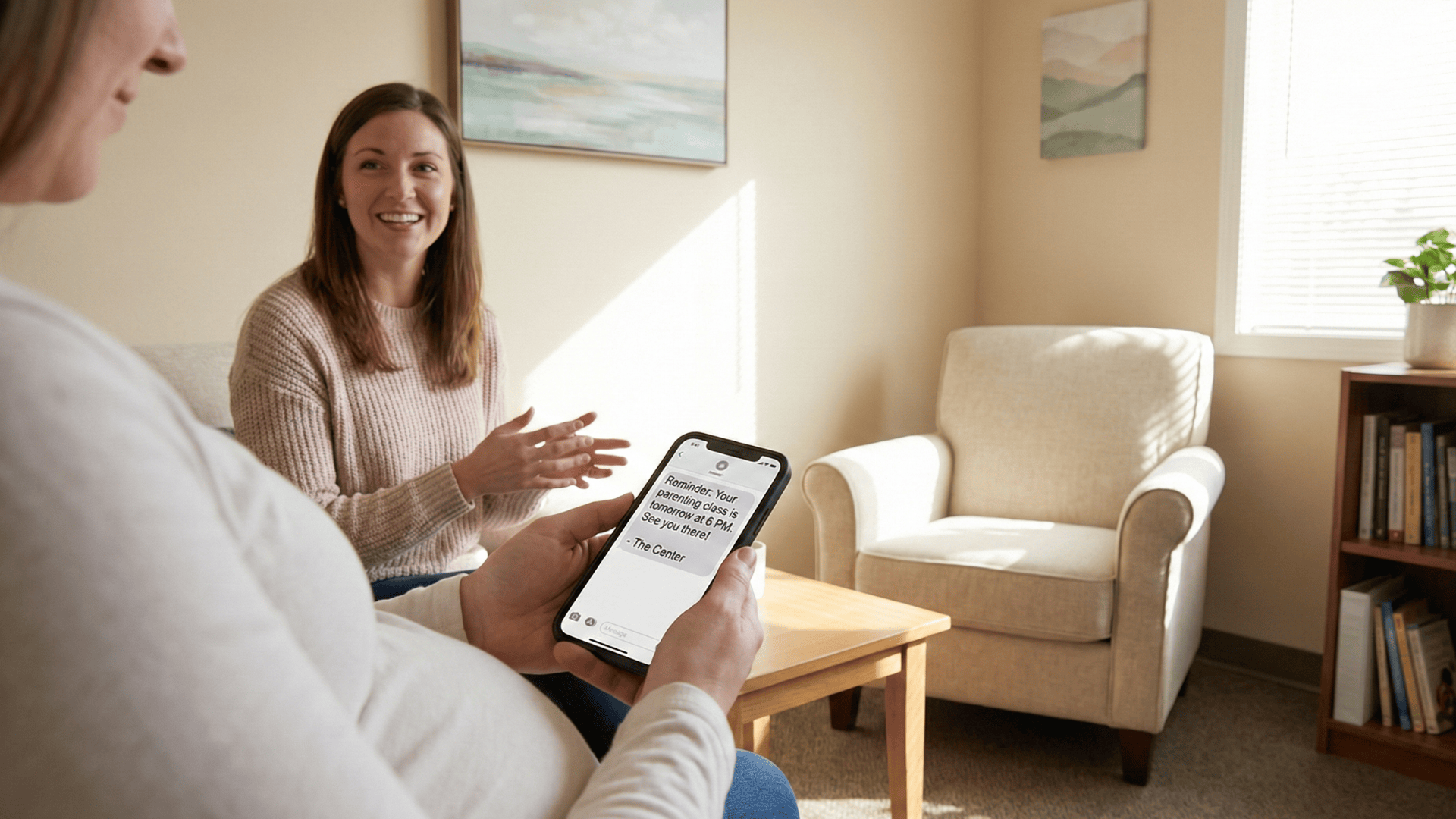
"Can't wait to see you at Parenting Class tomorrow at 6 PM! We have a great session planned" is enough to turn a forgotten event into a kept commitment.
The "I forgot!" reaction becomes an "I'll be there!" People appreciate the reminder. It does not feel pushy. It feels like you genuinely care whether they show up, because you do.
When to Send and What to Say
Timing matters more than most people realize.
Here is a simple broadcast schedule that works well for most events:
7 days out: A save-the-date message with key details — time, location, and what to bring.
24 hours out: A warm reminder that assumes they are still coming.
Same day (morning): A brief, enthusiastic nudge — "See you tonight!"
You do not need all three for every event. A single 24-hour reminder is often enough to significantly boost turnout. The goal is to meet people where they already are and make showing up feel easy.
Beyond reminders, Curogram also makes it easy to follow up after the event.
A message like;
"Thanks for coming tonight, see you next week!" keeps the connection warm.
It shows attendees that their presence was noticed, which makes them more likely to return.
What This Means for Your Staff
Increasing class attendance through text reminders is not a new idea, but it is still one of the most underused tools at pregnancy centers. Most centers rely on email blasts or a phone tree that eats up hours of staff time each week.
Curogram automates the process. You set up the message once, schedule it, and the platform handles the delivery. The use of smart automation ensures reminders go out consistently without adding manual work for your team.
That is a core principle in any utoma — simplify the system so consistency becomes easy.
Your team can focus on the people walking through the door instead of spending the morning making confirmation calls.
That shift in time is meaningful, especially for centers with small teams.
Staff morale improves too. When your team sees seats filling up, it reinforces that the work they do matters. Attendance is not just a metric. It is feedback that your community is alive and engaged.

Not every message is right for every person on your list. Sending a parenting class reminder to a donor who has never attended a class is confusing at best and off-putting at worst.
The key to real non-profit community engagement is relevance, and relevance starts with knowing who you are talking to. A strong guide to SMS messaging always emphasizes segmentation over mass blasts.
Curogram syncs with your eKyros data so you can build smart lists based on how people already interact with your center. This is where segmentation changes everything.
Instead of one big blast to everyone, you send targeted messages to the groups that actually care about what you are saying.
Building Smart Lists from Your eKyros Data
Your eKyros database already holds the information you need to segment effectively.
Think about the natural groups that exist within your community:
Active volunteers who need a volunteer recruitment text for an upcoming Saturday shift.
Current donors who should hear about walk registration or a year-end giving campaign through eKyros donor communication.
Parenting class participants who need a reminder about next week's session.
Post-abortion support group members who need to know about a room or time change. Medical practices can also use similar workflows to send policy updates or intake forms to patients quickly and securely.

Each of these groups gets one message written for them. None of them see what went to the others. That is what makes the difference between a broadcast that builds community and one that feels like spam.
When you match the message to the audience, your pregnancy center event reminders stop feeling like notifications and start feeling like personal outreach. People are more likely to respond, more likely to show up, and more likely to stay connected long term.
Privacy Comes First, Even in a Broadcast
One of the most common concerns about mass texting is that it feels impersonal or intrusive. Curogram is built to prevent that. Even when you send to a large list, each message arrives as a private, one-on-one text. Recipients do not see who else received the same message.
For eKyros donor communication, this matters a great deal. Donors want to feel like partners, not like entries on a spreadsheet. For support group members dealing with sensitive situations, privacy is non-negotiable.
A broadcast tool that preserves that intimacy is what separates a real community-building strategy from a bulk message blast.
The trust your center has built with these groups took time. The way you communicate should reflect that. Curogram gives you the reach of a broadcast with the feel of a one-on-one conversation, which is the best of both worlds.
Does broadcast messaging feel too impersonal for pregnancy center outreach?
Not when it is done correctly. With Curogram, each broadcast message is delivered as a private, one-on-one text. Recipients do not see a group thread or other names.
When you combine that privacy with smart segmentation from your eKyros data, messages feel relevant and intentional rather than generic. A reminder sent specifically to a parenting class roster feels personal because it is.
How often should we send broadcast messages without overwhelming people?
Less is often more. For most events, a single reminder 24 hours before start time is enough to significantly boost attendance. For larger fundraisers or campaigns, you might add a save-the-date message and a same-day reminder.
The key is relevance and timing. When messages are useful and specific, people appreciate them instead of ignoring them.
Is broadcast texting secure for donors and support group members?
Yes. Privacy is built into the way Curogram delivers messages. Even when you send to a large list, each text arrives individually. This is especially important for sensitive groups such as post-abortion support participants or for donor communication.
Your community’s trust matters, and your messaging platform should protect it.
A connected community is a powerful community. Communication is the glue that holds it together. When your people feel informed, included, and remembered, they show up. They bring friends. They give. They volunteer. That is the mission in action.
But connection does not happen by accident. It happens through consistent, thoughtful communication. Every reminder sent. Every update shared. Every invitation delivered at the right moment strengthens trust.
Over time, those small touchpoints build momentum. What starts as a simple event invite becomes a growing, engaged network of supporters who feel personally connected to your center’s work.
Curogram gives eKyros centers the tools to make that happen without adding hours of manual work. Broadcast messaging for eKyros events is not about sending more messages. It is about sending the right ones, at the right time, to the right people.
With segmentation and automation, you can reach clients, volunteers, donors, or class participants with messaging that feels intentional rather than generic.
Instead of chasing attendance, you create anticipation. Instead of hoping for volunteers, you mobilize them. Instead of one-time participants, you build long-term advocates.
Your database is full of people who already believe in what you do. They have raised their hands before. They have trusted your center. They just need clear, timely communication to take the next step again.
Use Curogram to turn that list into a movement. Fill the seats. Strengthen relationships. Activate your community.
Ready to see how it works? Schedule a demo today and discover how Curogram can help your center communicate with clarity, consistency, and impact.
💡 To fill schedule gaps in Prime Clinical Systems, the most direct method is targeted broadcast messaging through Curogram. Practices filter...
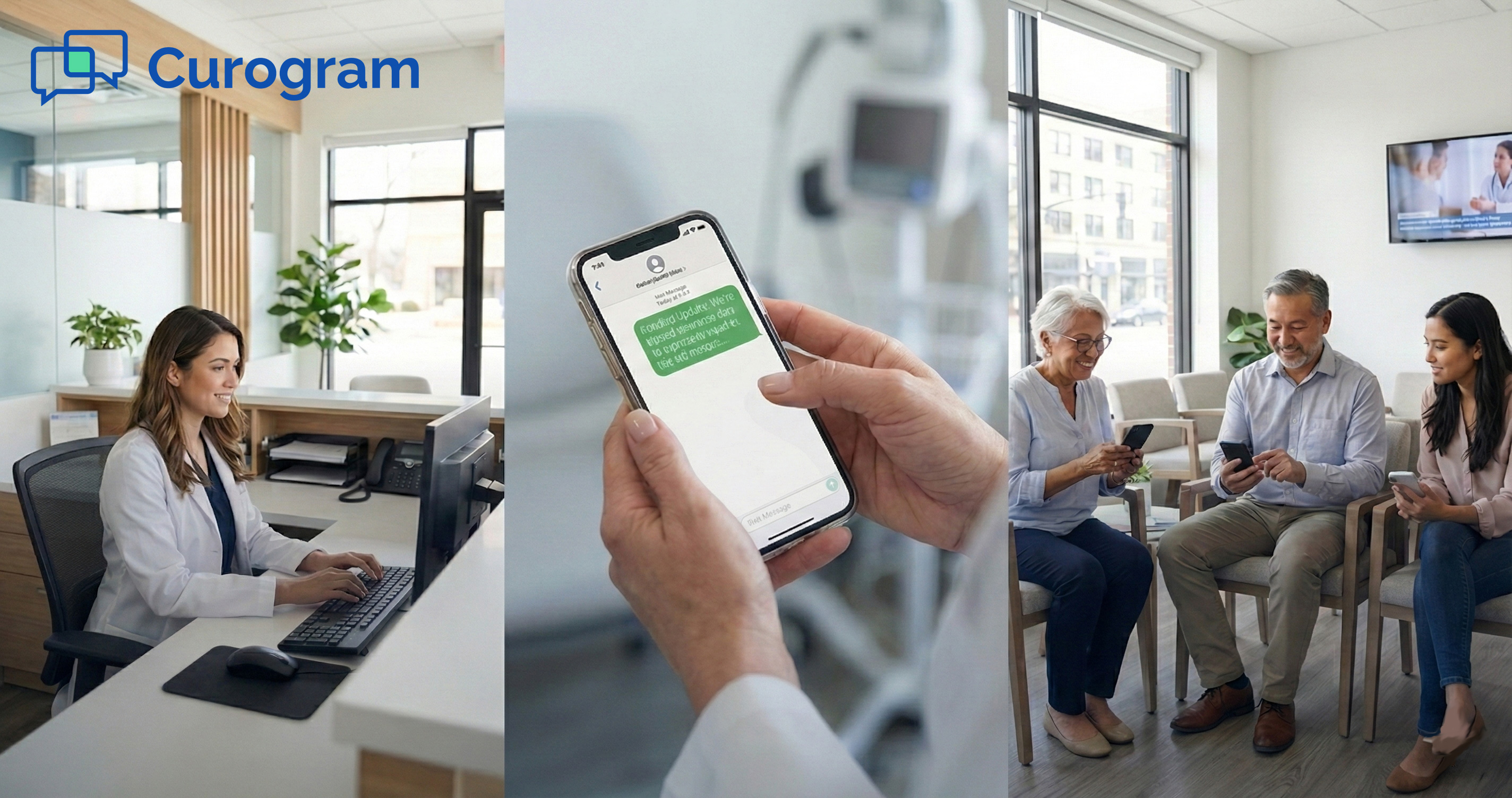
💡 Independent clinics maintain smooth operations by using practice updates for Elation Health clinics to send instant mass SMS alerts.By linking...
💡 Independent clinics can scale their population health efforts by sending automated health alerts for Elation Health practices via secure...