

8 min read

eClinicalWorks Mass Messaging | Population Health Campaigns via SMS

eClinicalWorks Mass Messaging | Population Health Campaigns via SMS
💡 eClinicalWorks mass messaging for population health campaigns lets enterprise networks send targeted SMS outreach to thousands of patients.

Filter by age, diagnosis, provider, or visit date. Reach patients for flu shots, chronic disease check-ins, screenings, and care gaps.

Traditional outreach relies on phone calls and email, which miss most patients. SMS reaches 95%+ of recipients.

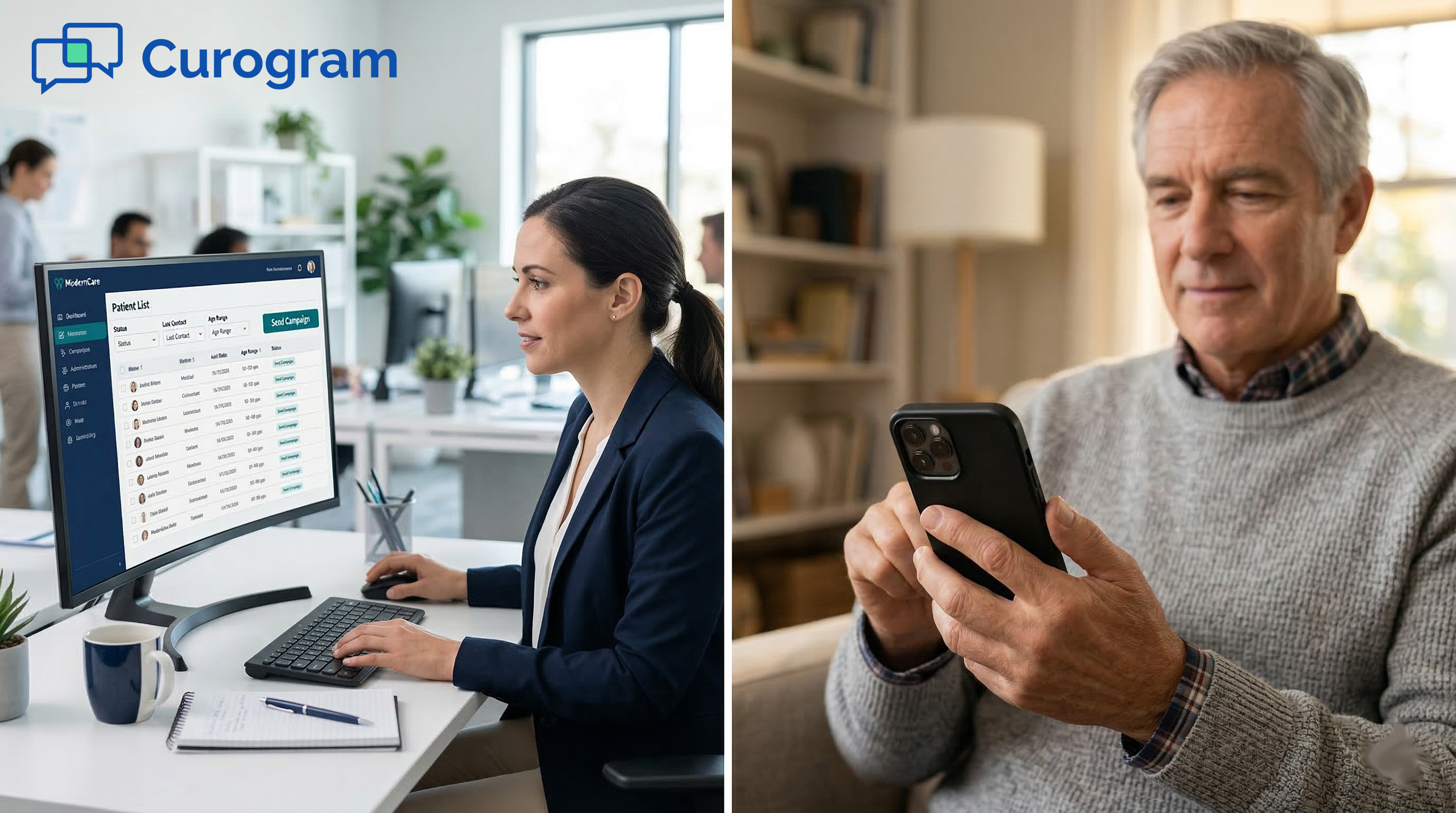
Curogram connects to eCW patient data, so teams can build and launch campaigns in minutes. Built-in HIPAA compliance, TCPA opt-out management, and two-way reply routing are included. No spreadsheet exports. No manual call lists.


Your eClinicalWorks system holds detailed data on tens of thousands of patients. You can see who needs a flu shot, who missed a screening, and who hasn't come back in over a year.

But knowing who needs care is only half the battle. The harder part? Actually reaching them.

Most enterprise eCW networks still rely on phone calls and email blasts to run population health campaigns. Staff spend weeks dialing through patient lists.

Voicemails go unanswered. Email open rates hover around 20 to 25%. By the time the campaign ends, a large chunk of the target group was never reached at all.

This is the gap that costs networks real money. Missed preventive screenings lower HEDIS scores. Unmanaged chronic conditions drive up emergency visits. Care gaps that could have been closed with a single text message turn into costly events down the line.

eClinicalWorks mass messaging for population health campaigns, powered by Curogram, closes that gap.

It turns your eCW patient data into targeted, trackable SMS outreach delivered in minutes, not weeks.

This article walks through why traditional outreach falls short, how Curogram's platform works, what real results look like, and how your team can get started.

The Villain: The Spreadsheet Blast

Enterprise eCW networks have more patient data than most teams know what to do with. The real problem isn't the data. It's what happens when you try to act on it.

Most outreach workflows today are slow, manual, and broken in ways that are easy to overlook until you see the numbers.

The Data-Action Gap

eClinicalWorks stores a wealth of structured patient data. Diagnoses, demographics, visit history, insurance status, care gaps, and chronic conditions are all in there. The EHR can generate detailed population health reports in a few clicks.

But generating a report and acting on it are two very different things. When an operations team spots 15,000 patients overdue for annual wellness visits, that list often sits in a queue.

There's no built-in way to reach those patients at scale without exporting the data and launching a manual campaign.

The eCW system does its job. The outreach infrastructure doesn't keep up.

Why the Gap Exists

EHRs are built to store and organize clinical data. They were not built to serve as outreach engines. Population health SMS outreach requires a different kind of tool: one that can take a filtered patient list and turn it into a live campaign, fast. That's the layer most enterprise eCW networks are missing.

The Manual Outreach Workflow

The typical eClinicalWorks patient recall messaging campaign at an enterprise network follows a predictable and painful sequence.

A coordinator runs a report, exports the list to a CSV, cleans the data in a spreadsheet, divides the list among call center agents, and tracks progress in a shared file.

Each agent makes 40 to 60 calls per day. They hit voicemail 60 to 70% of the time. A campaign targeting 10,000 patients can take three to four weeks of dedicated staff time.

By the time the last patient is called, the clinical window for some of them may have already closed.

The Real Cost of Manual Campaigns

It's not just the hours lost. It's the quality of the outcome. Staff are tired. Data goes stale. Patients who got a call on week one may have already scheduled elsewhere.

Teams have no clear view into what's working. The spreadsheet becomes a source of confusion, not clarity.

The Reach Bottleneck

Phone-based outreach doesn't just take too long. It reaches too few patients. Most people don't pick up calls from unknown numbers.

Voicemails go unheard. Email campaigns sent through third-party tools average 20 to 25% open rates in healthcare.

Healow app notifications only land with patients who downloaded the app and turned on push notifications. That's a small subset of most enterprise patient populations.

The result: a campaign targeting 10,000 patients may realistically reach only 2,000 to 3,000 through phone and email combined. That's a 70 to 80% miss rate.

Why SMS Changes the Math

Text messages are opened at rates above 95%. They arrive on a device patients already check dozens of times a day. They don't require an app, a login, or a callback.

Bulk patient texting that is HIPAA compliant delivers your message directly to the patient's pocket, on their terms.

The Opportunity Cost

For enterprise eCW networks in value-based care contracts, unreached patients represent direct revenue loss. Missed preventive screenings lower HEDIS scores. Unmanaged chronic conditions increase emergency utilization.

Care gaps that could have been closed with a timely message become costly clinical events. The population health coordinator sees the data, knows the need, and watches campaign after campaign fall short.

The tools just aren't built for the scale of the problem.

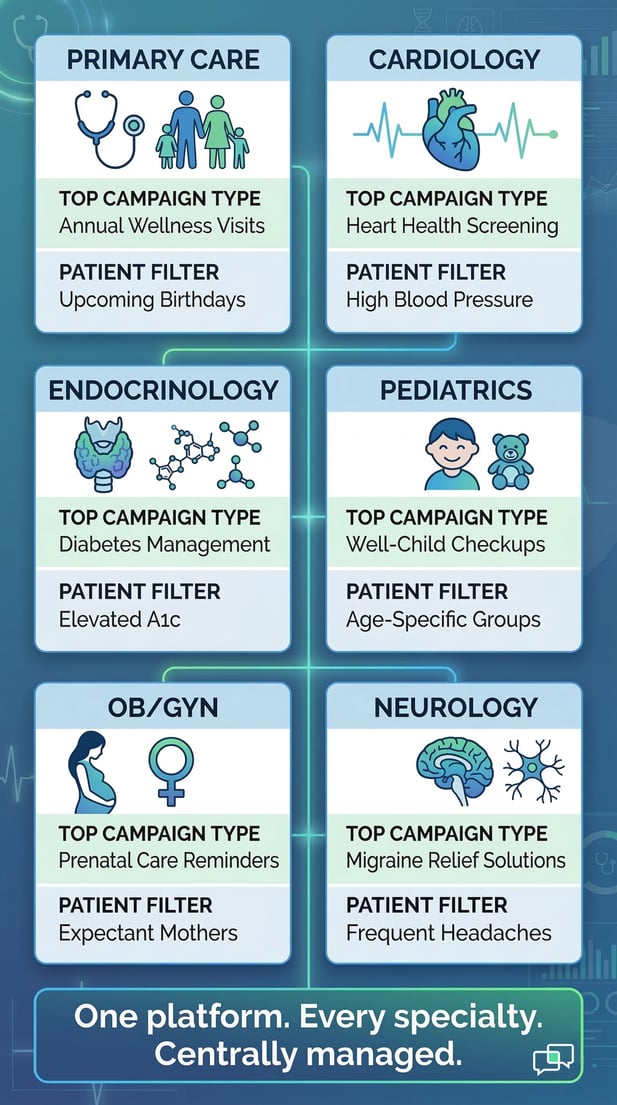
An infographic detailing tailored patient campaigns across multiple medical specialties

The Guide: The Population Health Engine

Curogram's Population Health Engine bridges the gap between eCW's patient data and proactive outreach. It doesn't replace your EHR.

It picks up where the EHR leaves off, giving operations teams a fast, reliable way to activate patient data at scale.

The Solution

Operations teams filter patient populations using the same clinical criteria available in eCW: age ranges, ICD-10 diagnosis codes, provider panels, location, last visit date, and insurance type. From there, they launch targeted SMS campaigns from a central dashboard.

No spreadsheet exports. No third-party email imports. No manual phone call lists.

The filtered patient list becomes a targeted text campaign in minutes.

How It Connects to eCW

Curogram connects to eCW's patient data through the API. Campaign filters reflect real-time patient information.

For networks already using eCW's population health modules, Curogram adds the outreach execution layer that the EHR's reporting tools have been waiting for.

The Targeted Campaign Builder

The Targeted Campaign Builder lets population health teams compose message templates with dynamic patient fields: first name, provider name, location, and appointment type. Teams can set delivery schedules (immediate, staggered, or time-optimized) and preview campaigns before launch.

Built-in TCPA compliance manages opt-out requests. Patients who reply STOP are removed from future campaigns. Delivery tracking shows real-time metrics: sent, delivered, failed, and responded.

Two-way reply handling routes patient responses to the right department through smart routing. Scheduling requests, questions, and opt-outs all go where they need to go, without manual sorting.

What the Dashboard Shows

Operations teams get a live view of campaign performance as messages go out. They can see how many patients received the message, how many clicked a scheduling link, and how many replied. That data informs future campaigns and helps teams improve outreach over time.

The Multi-Specialty Fit

Different specialties need different population health campaigns. A cardiology group needs lipid screening recalls. An endocrinology practice needs A1C reminders.

A primary care network needs annual wellness visit outreach. A pediatric group needs immunization series follow-ups.

Curogram's campaign builder supports specialty-specific templates, provider-specific messaging, and location-specific scheduling. All of it is managed centrally by the operations team. But to each patient, it feels personal.

The same platform handles a 500-patient recall for one specialist and a 30,000-patient flu campaign across the entire network.

Campaign Examples by Specialty

Specialty

Campaign Type

Audience Filter

Primary Care

Annual Wellness Reminder

Patients with no visit in 12+ months

Cardiology

Lipid Screening Recall

Patients with ICD-10 cardiovascular codes

Endocrinology

A1C Check-In

Diabetic patients overdue for lab work

Pediatrics

Immunization Reminder

Children under 5 with incomplete vaccine series

OB/GYN

Mammography Screening

Female patients 40+ with no recent imaging


eCW Care Gap Closure Via SMS

eCW care gap closure SMS campaigns work because they act on data that's already in the system. The EHR identifies the care gap. Curogram sends the message.

The patient books the visit. That cycle, repeated across thousands of patients, moves the needle on HEDIS scores and quality bonus eligibility.

Networks pursuing value-based care contracts can tie campaign results directly to quality metrics. That makes population health outreach a strategic asset, not just an admin task. 


The Success: From Weeks to Minutes, From Reports to Results

The shift from phone-based outreach to targeted health campaigns via SMS changes what's possible for an enterprise eCW network. It's not just faster. It's a fundamentally different kind of capability.

The Metric

SMS campaigns achieve open rates above 95%. Compare that to 20 to 25% for email and 30 to 40% answer rates for phone calls.

A campaign targeting 10,000 patients via text reaches more people in five minutes than a phone-based campaign reaches in three weeks.

Based on our internal data, 35% of patients who received an SMS recall scheduled an appointment within one month. One multi-location practice saw 1,240 patients booked from recall messages alone.

That kind of reach is simply not possible with a call center and a spreadsheet.

The Shift: From Reactive to Proactive

The real transformation is not just in speed. It's in how operations teams think about outreach. eCW mass text campaigns shift the model from reactive report generation to proactive population activation.

The population health coordinator's role changes. Instead of managing spreadsheet exports and call lists, they design targeted campaigns and analyze outcomes. Instead of hoping patients come in, they activate the patient population on demand.

eCW's structured data becomes a launchpad, not a library.

Before and After: A Side-by-Side View

Outreach Area

Before Curogram

After Curogram

Campaign Launch Time

3 to 4 weeks

Under 10 minutes

Average Reach Rate

20 to 30% of target population

95%+ open rate via SMS

Staff Hours per Campaign

Hundreds of hours

Under 1 hour

Opt-Out Tracking

Manual, error-prone

Automated and centralized

Response Routing

Ad hoc and inconsistent

Smart routing to right team

Campaign Insight

Spreadsheet tracking

Real-time dashboard metrics


The Outcome: Dana's Story

A 60-provider eCW network launches Curogram's mass messaging across all locations. The population health coordinator, Dana, runs the annual flu shot campaign.

She filters patients 65 and older across all providers, composes a personalized text with the patient's name, preferred location, and a direct scheduling link. She sends 14,000 messages in under 10 minutes.

Within 72 hours, 4,200 patients click the scheduling link. The same campaign via phone calls last year reached 3,100 patients over four weeks.

That same afternoon, Dana launches a diabetic A1C recall, a mammography screening reminder, and a hypertension medication adherence check-in. The network's quality scores improve measurably by the next reporting period.

Why This Matters for Value-Based Care

Enterprise networks in value-based contracts are scored on outcomes. Preventive screenings completed. Chronic conditions managed. Care gaps closed.

Every patient reached through a targeted health campaign enterprise EHR workflow is a step toward better scores and higher quality bonuses.

SMS outreach doesn't just save time. It directly supports the financial and clinical goals that define success in value-based care.


A medical administrative team analyzes patient outreach data on a laptop dashboard

Activate Your Patient Data

Enterprise eCW networks store the patient data needed for strong population health programs. The missing piece has been the outreach tool to act on that data at scale.

eClinicalWorks is for identifying which patients need outreach. Curogram is for reaching them. The EHR generates the intelligence. The Population Health Engine executes the action.

Stop letting population health reports sit in shared drives while care gaps widen. Launch your first targeted SMS campaign this week.

Filter one patient population in eCW (for example, patients 65 and older who are overdue for flu vaccination), send the campaign via Curogram, and measure response rates against your phone-based baseline.

Book a demo today. No long-term contract required.


Frequently Asked Questions

How does Curogram ensure mass patient texting stays HIPAA compliant?

Curogram is SOC 2 Type II certified and signs a Business Associate Agreement (BAA) with every organization. Mass messaging campaigns go through encrypted channels, and patient consent is managed automatically.

Campaign messages include general health reminders and scheduling prompts without exposing protected health information in the text itself. The clinical detail stays in eCW, while the outreach message lands in the patient's text inbox.

How does Curogram handle opt-outs and TCPA compliance for mass campaigns?

Patients can reply STOP to any campaign message and are automatically removed from future campaigns. Opt-out status is tracked centrally and applies across all locations and providers in the network.

Campaign messages include required identification and opt-out language. Consent records are maintained and fully auditable for regulatory compliance.

Why do SMS campaigns outperform phone and email outreach for population health?

Text messages are opened at rates above 95%, compared to 20 to 25% for email and 30 to 40% for phone calls. Patients are far less likely to answer a call from an unknown number than to read a text.

SMS also doesn't require a downloaded app or a login, so it reaches patients that healow notifications miss. For population-level outreach across tens of thousands of patients, SMS is the only channel that delivers at scale.

How does the campaign builder filter patients from eClinicalWorks data?

Curogram connects to eCW's patient data through the API, so campaign filters reflect real-time information. Operations teams can filter by age range, ICD-10 diagnosis code, provider panel, location, last visit date, and insurance type.

The filtered list becomes a live campaign without any manual exports. For networks using eCW's population health modules, Curogram adds the outreach execution layer the reporting tools were built to support.

Why should enterprise networks prioritize eCW care gap closure through SMS instead of traditional outreach?

Care gaps that go unaddressed translate into lower HEDIS scores, reduced quality bonuses, and higher emergency utilization. Phone and email outreach campaigns routinely miss 70 to 80% of the target patient population.

SMS campaigns close care gaps faster because they reach more patients in far less time. For enterprise networks in value-based care contracts, that speed and reach directly affect clinical and financial outcomes.

eCW Patient Recall Campaigns | Automate Operations Outreach via SMS

eCW Patient Recall Campaigns | Automate Operations Outreach via SMS

💡 eClinicalWorks operations targeted text campaigns for patient recall and let enterprise networks replace spreadsheet exports and phone marathons...
Read More
Fill Schedule Gaps in Prime Clinical | Revenue on Demand

Fill Schedule Gaps in Prime Clinical | Revenue on Demand

💡 To fill schedule gaps in Prime Clinical Systems, the most direct method is targeted broadcast messaging through Curogram. Practices filter...

Read More
Office Closures & Prime Clinical | Notify Patients Instantly

Office Closures & Prime Clinical | Notify Patients Instantly

💡 Broadcasting office closures for Prime Clinical Systems works best when you replace manual phone trees with automated mass text alerts. With the...

Read More