

eClinicalWorks Mass Messaging | Population Health Campaigns via SMS
💡 eClinicalWorks mass messaging for population health campaigns lets enterprise networks send targeted SMS outreach to thousands of patients.Filter...

9 min read
Jo Galvez
:
March 12, 2026
Your eCW reports are good. They tell you exactly which patients are overdue for care. The problem is what happens next.
eClinicalWorks operations targeted text campaigns for patient recall exist for one reason: the gap between knowing who needs care and actually reaching them is too wide.
Right now, that gap is filled with CSV exports, phone lists, shared spreadsheets, and weeks of manual follow-up. It is exhausting. And it does not scale.
Population health coordinators at large eCW networks know this pain well. They can run a report that shows 6,000 diabetic patients overdue for an A1C test. They know every single one of those patients needs to hear from the clinic.
But turning that report into real outreach? That takes weeks of coordination, dozens of staff hours, and a lot of phone calls that go to voicemail.
eCW patient recall automation changes that. Instead of exporting lists and dialing numbers, coordinators filter the patient population, write a short message, and send. The whole process takes minutes. Responses come in fast, route to the right team, and get tracked automatically.
This article walks through why the old way breaks down, how mass text outreach operations teams use in enterprise eCW networks actually works, and what real results look like when you stop calling and start texting.
The manual recall process is not just slow. It actively limits how much care your team can deliver. Here is why it breaks down at every step.
eClinicalWorks gives population health teams powerful tools. They can pull a list of every patient with diabetes who has not had an A1C in 90 days.
Every patient 65 and older who skipped a flu shot. Every woman over 40 who needs a mammogram. The reports are detailed and accurate.
But a report is not outreach. Between pulling the data and reaching the first patient, there is a long gap filled with manual work. Export the list. Clean duplicate entries. Format phone numbers. Remove patients who opted out.
Divide the list into batches. Assign batches to agents. Build a tracking spreadsheet. That process takes hours before a single call is made.
The clinical intelligence is there. The outreach infrastructure is not. This is the core problem with how most enterprise eCW networks run their recall programs.
Consider a 45-provider network running a diabetic recall campaign. The report shows 6,200 patients who need an A1C. After cleaning the list, it gets split among eight call center agents.
Three weeks later, only 4,100 patients have been attempted. Of those, fewer than 1,800 answered. The campaign used over 160 staff hours and reached just 29% of the target group.
Running a phone recall campaign means managing people, not just data. Agents work through their call lists in between other duties. Progress reports come in on Fridays.
Callbacks pile up. The population health coordinator spends more time managing the process than improving outcomes.
This is what we call the coordination tax. Every step added to the workflow costs time. The more steps, the more time lost. And in a large network, those steps multiply fast.
eCW bulk SMS filtering patients by diagnosis or visit history eliminates most of those steps. Instead of managing eight agents and a shared spreadsheet, one coordinator filters the patient list, writes the message, and sends. The coordination tax drops to near zero.
|
Task |
Manual Phone Workflow |
SMS Campaign Workflow |
|---|---|---|
|
Export and clean patient list |
2-3 hours |
Not needed |
|
Assign and brief call agents |
1-2 hours |
Not needed |
|
Outreach execution |
3 weeks / 160+ staff hours |
Minutes |
|
Track and consolidate results |
Ongoing (weekly reports) |
Real-time dashboard |
|
Patients reached |
~29% |
60%+ |
The manual recall workflow does not scale. When one coordinator needs to run flu shot outreach for 18,000 patients and a wellness visit recall for 22,000 patients in the same quarter, the math does not work. The call center cannot absorb that volume on top of daily tasks.
So campaigns get prioritized. One runs. The others wait. By the time the last campaign launches, the first group of patients is overdue again.
It is a recall treadmill that never catches up. Targeted patient recall at enterprise network scale requires a different approach entirely.
When teams can only run one campaign at a time, care gaps stay open. Flu vaccination rates lag. Chronic disease management suffers.
Population health coordinators face the quiet frustration of knowing what needs to happen and not having the tools to make it happen.
Population health coordinators are trained to close care gaps and improve outcomes. But the manual outreach model turns them into logistics managers. They spend the majority of their time on execution mechanics, not strategy.
The gap between what they know needs to happen and what they can actually execute is one of the biggest sources of frustration on population health teams at large eCW networks. When the right tools are in place, that frustration disappears. And so does a lot of staff turnover.
The goal was never to manage spreadsheets. It was to improve patient health at scale. Giving coordinators the right tools gives them their job back.

What if running a recall campaign took minutes instead of weeks? That is not an exaggeration. Here is how Curogram makes it work inside eCW.
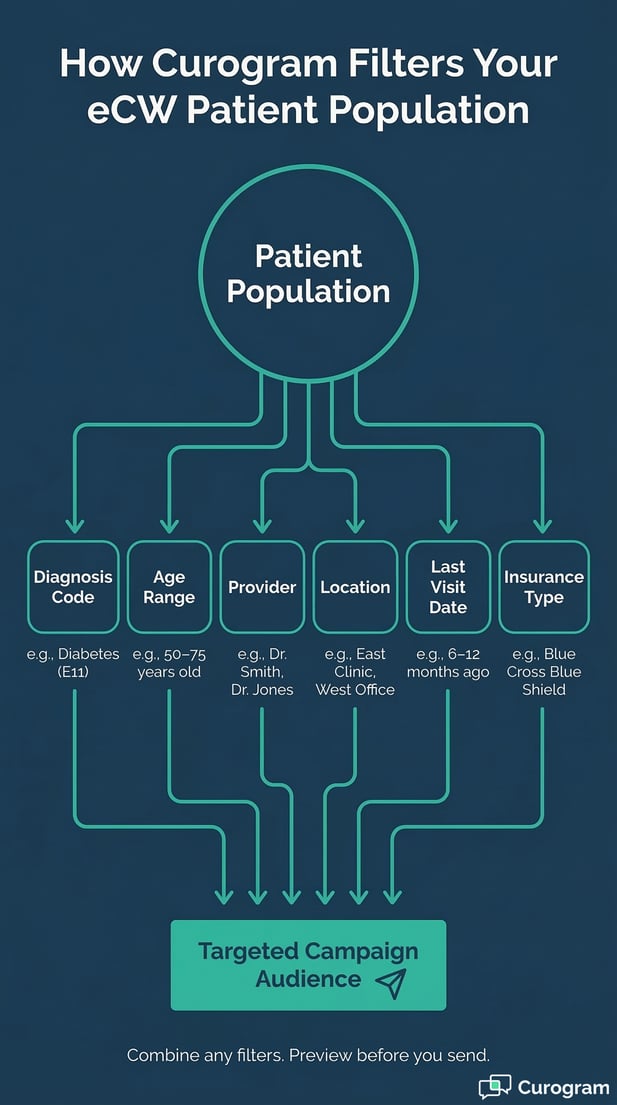
Curogram's campaign builder plugs into eClinicalWorks patient data and lets coordinators filter by any combination of diagnosis code, age range, provider, location, last visit date, and insurance type. No spreadsheet exports. No SQL queries. No IT involvement.
Once the filter is set, coordinators preview the patient population before sending. They compose a short, personalized message template. Then they launch.
The entire process, from pulling the list to sending the first text, takes minutes. That is the power of eCW care gap outreach automation done right.
The filter options mirror how care teams already segment patients. A population health coordinator does not think in SQL syntax. They think: "I need all diabetic patients over 50 who have not been seen in 90 days at the downtown clinic."
Curogram's interface lets them build that filter with dropdowns, not code.
Sending is just the start. What happens next matters just as much. Curogram's dashboard shows every message sent, delivered, failed, opened, and responded to, in real time.
Patient replies are categorized automatically. Scheduling requests route to the right team. Clinical questions go to the relevant department. Opt-outs are processed right away.
No replies get lost in a general inbox. This turns a one-way blast into a two-way conversation, without overwhelming any single team.
Smart routing is what separates a mass text campaign from a real outreach program. When a patient replies to a recall message with a question or a request to schedule, that response needs to land in the right place. Curogram makes sure it does.
Curogram connects to eCW through the API. That means campaign filters always reflect current patient information, not a list that was exported last Tuesday.
When a patient schedules after receiving a recall text, the campaign dashboard updates. No double entry. No lag.
For networks that track HEDIS measures, this creates a documented outreach trail. Every message sent, every response received, and every appointment booked from the campaign is logged. That supports quality reporting and payer contract requirements.
The difference between a live API connection and a spreadsheet export is accuracy. Patients who opted out yesterday are not in today's campaign. Patients who already scheduled are not getting a reminder they don't need. Live data keeps campaigns clean and patients happy.
Multi-location eCW networks need campaigns that fit their structure. Curogram supports location-level targeting, so the downtown clinic's flu reminder only goes to patients assigned there.
Provider-level segmentation means a recall can target only Dr. Martinez's panel. And role-based access lets a central coordinator design campaigns while location managers view results for their site.
The same platform handles a 200-patient specialist recall and a 30,000-patient network-wide outreach without any workflow changes. That is what population health coordinator text campaigns need to look like at enterprise scale.
Whether a team is running a small follow-up campaign for one provider or a network-wide flu push, the workflow is the same. Filter. Preview. Send. Track. No special setup. No added complexity. Just results.
Numbers tell the story best. Here is what changes when an enterprise eCW network moves from phone-based recall to targeted SMS campaigns.
Marcus, the population health coordinator for a 45-provider eCW network, ran his diabetic recall campaign the old way for years.
It took three weeks and over 160 staff hours to attempt contact with 6,200 patients. By the end, fewer than 30% had been reached.
With Curogram, the same 6,200 patients received a text in three minutes. The response rate jumped from 29% with phone calls to over 60% with SMS. Appointment bookings from the campaign tripled.
Based on our internal research, 35% of patients who receive an SMS recall schedule within a month, and over 1,200 patients were seen from recall messages in a single campaign cycle at one multi-location practice.
|
Metric |
Phone Campaign |
SMS Campaign |
|---|---|---|
|
Patients reached |
6,200 attempted |
6,200 delivered |
|
Time to execute |
3 weeks |
3 minutes |
|
Staff hours used |
160+ |
Under 1 |
|
Response rate |
~29% |
60%+ |
|
Appointments booked |
~900 |
Nearly 3x more |
When execution is automated, the role of the population health coordinator changes completely. Marcus no longer spends three weeks managing one campaign.
He launches four targeted campaigns on a Monday morning and spends the rest of the week analyzing outcomes, finding new care gaps, and planning the next set of interventions.
That is the shift eCW patient recall automation makes possible. The tool handles execution. The coordinator handles strategy. And the work they were hired to do finally gets done.
Filter the diabetic recall list. Send. Filter the wellness visit list. Send. Filter the flu shot list. Send. By 9 AM, four campaigns are live. By noon, responses are already coming in.
By end of day, the dashboard shows how many patients scheduled. All without a single phone call.
By the end of the quarter, Marcus has run 14 targeted campaigns across the network. That is more than the entire previous year's total.
Flu vaccination rates among patients 65 and older climb. Diabetic A1C completion rates improve. The network's HEDIS scores rise in the next reporting period.
Two payer contracts trigger quality bonuses. Leadership asks Marcus to present his workflow at the quarterly review. His answer is simple: "I stopped calling. I started texting."
HEDIS measures reward documented outreach. When a patient receives a recall text and schedules an appointment, both the outreach and the outcome are logged automatically.
That creates the kind of paper trail that supports quality reporting, without anyone doing extra documentation work.

Population health coordinators at enterprise eCW networks have the data. They know who needs care. What they often lack is a fast, clean way to act on it.
Every week spent on spreadsheet exports and phone call tracking is a week patients go without outreach. Every campaign delayed is a care gap left open.
The manual recall marathon is not just slow. It is actively working against the goals of your population health program.
eClinicalWorks gives teams the data to identify care gaps. Curogram gives them the tools to close those gaps at scale. The two tools work best together.
When recall campaigns are slow, patients miss care. When patients miss care, quality scores drop.
When quality scores drop, payer bonuses go uncollected. The cost of staying with the manual process is not just staff time. It shows up in revenue, outcomes, and retention.
eClinicalWorks is built to help teams find care gaps and generate population health reports. Curogram is built to help them act on those findings at enterprise scale.
The data lives in eCW. The outreach lives in Curogram. Together, they create a loop that keeps patients engaged and coming back for care.
eCW identifies the gap. Curogram closes it. The patient schedules. The visit is documented. The care gap is resolved.
That loop can now run for dozens of campaigns at once, across an entire network, with one coordinator running the show.
Your population health team was not hired to manage phone lists and spreadsheets. They were hired to improve outcomes. Give them tools that match that goal.
Book a demo today. The data will speak for itself.
Frequently Asked Questions
Curogram is SOC 2 Type II certified and operates under a signed Business Associate Agreement (BAA). Recall messages are designed to prompt action without disclosing protected health information in the text itself.
Opt-out handling is automatic, consent records are maintained, and required message identification is included in every campaign. Your compliance team can review templates before any campaign goes live.
Curogram's campaign builder is designed for operations and population health teams, not developers. Filters use dropdown menus and search fields, so coordinators select an age range, choose diagnosis codes from a searchable list, and set a date range for last visit.
No SQL queries, no eCW report exports, and no spreadsheet formatting are required. If your coordinator can generate a report in eCW, they can build a campaign in Curogram in less time.
Most people do not answer calls from numbers they don't recognize, but they do read texts. SMS campaigns reach patients on their own terms and let them respond when it works for them.
Based on our internal research, SMS recall campaigns achieve response rates above 60%, compared to roughly 29% for phone-based outreach. Patients can also reply directly to schedule, ask a question, or opt out, and those responses are routed to the right team automatically.
Patient replies are routed through Curogram's smart routing system, so they never pile up in a single inbox. Scheduling requests go to the scheduling team, clinical questions go to the relevant department, and opt-out requests are processed right away. Each reply is categorized so the right person can respond, turning a one-way campaign into a two-way conversation without overwhelming any single team.
Curogram logs every message sent, every response received, and every appointment booked from a recall campaign. For networks tracking HEDIS measures, this creates a documented outreach trail that supports quality reporting.
When a patient books an appointment after receiving a recall text, both the outreach and the outcome are recorded automatically. That documentation directly supports payer quality metrics and can help networks earn performance bonuses.
💡 eClinicalWorks mass messaging for population health campaigns lets enterprise networks send targeted SMS outreach to thousands of patients.Filter...
💡 To fill schedule gaps in Prime Clinical Systems, the most direct method is targeted broadcast messaging through Curogram. Practices filter...
💡 Broadcasting office closures for Prime Clinical Systems works best when you replace manual phone trees with automated mass text alerts. With the...