
.jpg?width=30&height=30&name=square-formal-photo%20(1).jpg) Mira Gwehn Revilla
Mira Gwehn Revilla
Set Up Reminders for Proven EHR Practice | Curogram
 Jo Galvez : Jun 9, 2026, 1:00:00 PM
Set up automated SMS reminders alongside Proven EHR. Eliminate 40 to 60 daily confirmation calls with 2-way text confirmations.

Your reminders go out right on schedule. Then nothing comes back. A client taps "reply" to say they need a new time, and the message lands nowhere. By morning, your front desk is dialing the whole list and hoping.
This is the gap most programs live with. You can reduce no-shows in Sigmund AURA behavioral health practices by adding automated reminders that actually confirm attendance. The fix is not a louder reminder. It is a two-way one.
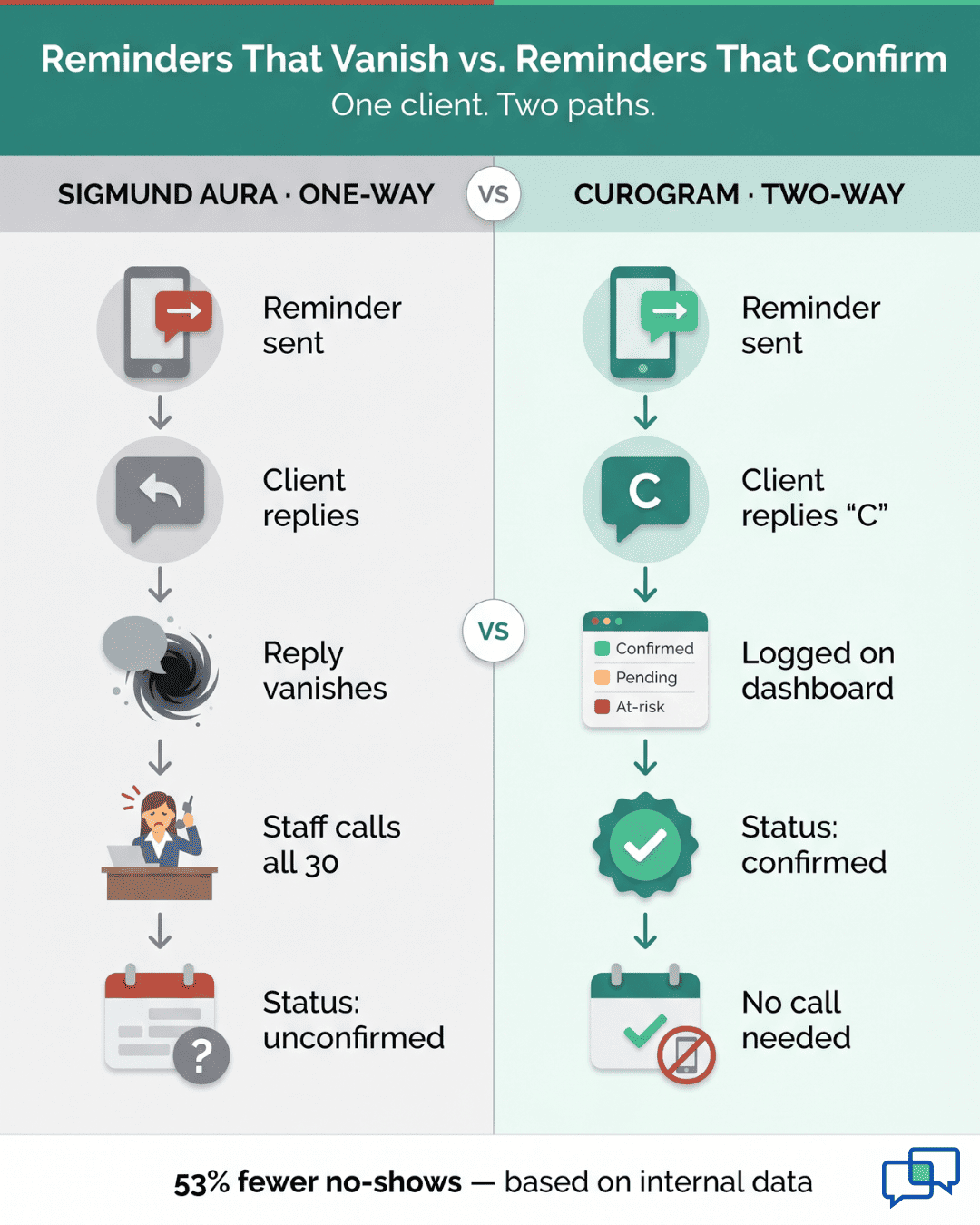
Sigmund AURA does send text reminders. But the appointment reminders use SMS in one direction only. Clients get the message, yet they cannot reply and be heard. Changing the timing or wording often means a vendor ticket and a wait.
That one-way design creates a blind spot. You never know who plans to show until they walk in, or don't. For behavioral health and SUD programs, that blind spot is costly. Each empty seat is lost revenue and, more importantly, a client slipping out of care.
Curogram closes the gap with automated 2-way reminders alongside Sigmund. Reminders go out on their own at set times. Clients reply with a single letter to confirm, reschedule, or cancel. Staff see the status on a live dashboard before the day starts.
The difference is simple but huge. A one-way blast announces a time. A two-way reminder confirms a person will be there. One leaves you guessing; the other lets you plan.
In this guide, we will break down why the built-in tools fall short. We will show how a confirmation layer changes your day. And we will share real numbers, based on our internal data, so you can see the math for your own program.
No-shows are more than a scheduling headache. In behavioral health, they tend to run high, and each miss sets off a chain reaction. We call this pattern the No-Show Spiral.
Here is how it starts. Clients may be in active use, facing transport problems, or dealing with unstable housing. Any of these can derail a planned visit. Sigmund AURA's built-in reminders exist, but they only point one way and depend on set configurations.
Picture a MAT program coordinator on a normal afternoon. She sends reminders for the next day's 30 medication sessions. The texts go out fine. Three clients try to reply to move their times, and those replies vanish into a black hole.
Now the coordinator has no confirmation data at all. She does not know who is coming. So the next morning, she calls all 30 clients by hand. Two-thirds go to voicemail. She marks them "unconfirmed" and braces for empty chairs.
That is the spiral in action. The tool that was meant to save time now creates more work. And the cost adds up fast.
Let's walk through simple example math for a mid-sized program. These are illustrative figures, not a quote for your clinic.
|
Factor |
Example value |
|
Sessions billed per month |
2,000 |
|
Average revenue per session |
$120 |
|
No-show rate |
25% |
|
Missed sessions per month |
500 |
|
Lost revenue per month |
$60,000 |
So a one-in-four no-show rate can drain about $60,000 a month. That is real money for a program already running on thin margins.
But the deeper damage is clinical, not just financial. Each missed SUD session breaks medication continuity. Each missed psychiatry follow-up raises the risk of a med problem. Each missed court-ordered session can trigger legal fallout the program cannot control.
This is why true SUD treatment no-show crisis solutions have to do more than send a text. The need is for behavioral health no-show reduction that works inside an EHR-driven workflow, not a louder version of the same one-way blast.
Meanwhile, the human toll lands on your team. The clinical director watches census swing week to week with no way to predict it. The operations director runs the numbers on a fix. Hiring one more front-desk coordinator to make calls might cost $40,000 a year.
That is $40,000 to solve a problem the software was supposed to handle. The quiet frustration sets in: we are paying staff to do what the system promised to automate. The spiral keeps turning, and nobody feels in control.
That feeling is the villain. Not the clients, and not your team. It is a reminder system that talks but never listens.
The fix is not to replace Sigmund. It is to add the one piece the built-in tools lack: a way for clients to reply and be heard. Curogram acts as a 2-Way Confirmation Engine that sits next to your current setup.
Here is how it works in plain terms. Reminders go out on their own at the times you choose, like 48 hours, 24 hours, and 2 hours before a visit. Each client gets a normal text message. They reply with one letter to confirm, reschedule, or cancel.
That single reply is the whole game. It turns a passive announcement into an active Sigmund AURA scheduling confirmation. Now you know who is coming before the day even begins.
Every reply feeds a live view your staff can scan in seconds. We call it the Smart Confirmation Dashboard. It sorts each day's visits into three clear buckets.
|
Status |
What it means |
Staff action |
|
Confirmed |
Client replied "C" |
None needed |
|
Pending |
No reply yet |
Light follow-up |
|
At-risk |
No response near visit time |
Targeted call |
The at-risk flag is the time-saver. Instead of calling all 100 clients, your team calls only the 20 who need it. You aim your effort where it matters and skip the rest.
Curogram runs next to Sigmund AURA's scheduling and needs no API access. You set the timing, the wording, and the cadence yourself through Curogram's own dashboard. No vendor ticket. No waiting on someone else to flip a switch.
Say you launch a new IOP track on Monday. You can adjust the reminder timing yourself and have it live by Tuesday. That self-service control is the heart of these automated 2-way reminders alongside Sigmund. You move at the speed of your program, not the vendor's queue.
Behavioral health is not retail, and the reminders should not act like it. Curogram is shaped around how your clients actually engage. For MAT programs with daily or near-daily visits, it supports higher-frequency reminder cadences without extra busywork.
For court-ordered clients, every confirmation builds a clear record. That trail can support your compliance reporting when you need to show who confirmed and when. It is documentation that works for you, not against you.
And for clients dealing with the fog of active use or new meds, simplicity is everything. A "reply C to confirm" text asks for almost no effort. Compare that to a portal login, a password reset, or a phone call. The lighter the ask, the more clients respond.
This is also where the appointment reminders use SMS the right way. The same channel can later carry a telehealth link or a quick note. One simple, trusted text thread instead of five disconnected tools.
The point of the engine is steady, two-way contact. You stop guessing and start knowing. That shift, repeated across every visit, is what pulls a program out of the spiral.
When reminders confirm instead of just announce, the whole rhythm of the week changes. The guessing stops. The data shows up before 8 a.m., and your team can act on it.
Start with the headline result. Curogram practices see no-show rates 53% lower than industry averages, based on our internal data. That is not a small trim. It is the difference between a full schedule and a patchy one.
One example makes it concrete. Atlas Medical Center cut its no-show rate from 14.2% to 4.91% in three months, based on our internal research. That is roughly three times better than the typical industry mark. The drop came from steady, two-way behavioral health session confirmation SMS, not extra staff.
Let's tie that to revenue with the earlier example. If a program loses about $60,000 a month at a 25% no-show rate, cutting that rate by half changes the picture fast.
|
Scenario |
No-show rate |
Monthly lost revenue |
Recovered |
|
Before |
25% |
$60,000 |
— |
|
After (~50% cut) |
12% |
~$29,000 |
~$31,000 |
For a 15-clinician program, that kind of recovery can land near $50,000 a month. The money was always there. It was just walking out the door, one empty chair at a time.
The bigger shift is in how the team feels. You move from the No-Show Spiral to a Predictable Census. Operations directors stop reacting to gaps each morning. They plan staffing, group sizes, and capacity with real confidence.
Picture a Monday with 120 visits booked across outpatient, IOP, and MAT. By 8 a.m., the dashboard shows 95 confirmed, 15 pending, and 10 rescheduled.
Staff make 15 focused calls instead of 120 blind ones. The day's no-show rate lands near 6%, and the week is predictable for the first time.

Why a Confirmation Layer Beats a Bigger Reminder
It is tempting to think the answer is more reminders. Send three texts instead of one. Add an email. Throw in a robocall. But volume is not the fix, and it can even annoy clients into tuning out.
The real fix is direction. A one-way reminder, sent five times, still tells you nothing about who is coming. A two-way reminder, sent once, gives you an answer you can act on. That answer is the asset.
Think of it like a question versus a billboard. A billboard shouts the same thing at everyone and waits. A question invites a reply and gives you data. Your reminders should ask, then listen.
This is why a thin confirmation layer outperforms a thick stack of alerts. It captures intent. It flags the at-risk few so your team can focus there. And it does this without forcing clients through apps or logins they will skip.
For SUD and behavioral health work, that focus matters even more. Your highest-risk clients are often the hardest to reach by phone. A simple text they can answer in three seconds meets them where they are. Confirmation, not noise, is what keeps them in care.
That one difference can mean $50,000 or more a month and dozens of clients who stay in treatment.
Think of the two systems as partners, not rivals. Sigmund AURA holds your clinical scheduling. Curogram adds the confirmation layer on top. One books the session; the other makes sure the client shows.
This is the honest gap in most behavioral health no-show reduction efforts. Teams keep sending louder one-way texts and keep getting silence back. The answer was never more volume. It was a reply you could act on.
So here is a quick exercise. Figure out what your no-show rate costs you this month. Use the simple math: missed sessions times your rate per session. The number is usually larger than people expect.
Now picture cutting that loss by about half. That is what a 53% drop in no-shows can look like for your program, based on our internal data. The same staff, the same EHR, just a smarter way to confirm.
You do not need a rip-and-replace project to get there. You need automated 2-way reminders working next to the tools you already use. No API headaches. No vendor wait.
Stop guessing who'll show up tomorrow. Book a quick demo and see Curogram's 2-way confirmation dashboard set up for your program.
 Jo Galvez : Jun 9, 2026, 1:00:00 PM
Set up automated SMS reminders alongside Proven EHR. Eliminate 40 to 60 daily confirmation calls with 2-way text confirmations.
 Jo Galvez : Jun 12, 2026, 1:00:00 PM
Reduce missed psychiatry, ketamine, and TMS appointments with two-way text confirmations that write back to Osmind.
 Jo Galvez : Jun 12, 2026, 10:00:00 AM
Proven EHR has no reminder system. Learn how Curogram's automated SMS reminders reduce behavioral health no-shows by 53%.