10 min read
SMS Reminders for Behavioral Health and SUD Treatment Adherence
Mira Gwehn Revilla
:
June 8, 2026
- Curogram practices see no-show rates 53% lower than the industry average, based on our internal data.
- Clients confirm with a one-letter reply, like "C" — no app needed.
- At-risk flagging tells staff who to call when a client does not reply.
- Reminders never name the diagnosis or program, supporting 42 CFR Part 2 reminder compliance.
- The system works alongside Sigmund AURA, with no API access required.
In behavioral health and addiction care, the hardest part is rarely the first visit. It is the second, the fifth, and even the tenth. No-show rates in these programs often run 20% to 50%. Each missed session can mean a missed dose, a setback, or relapse.
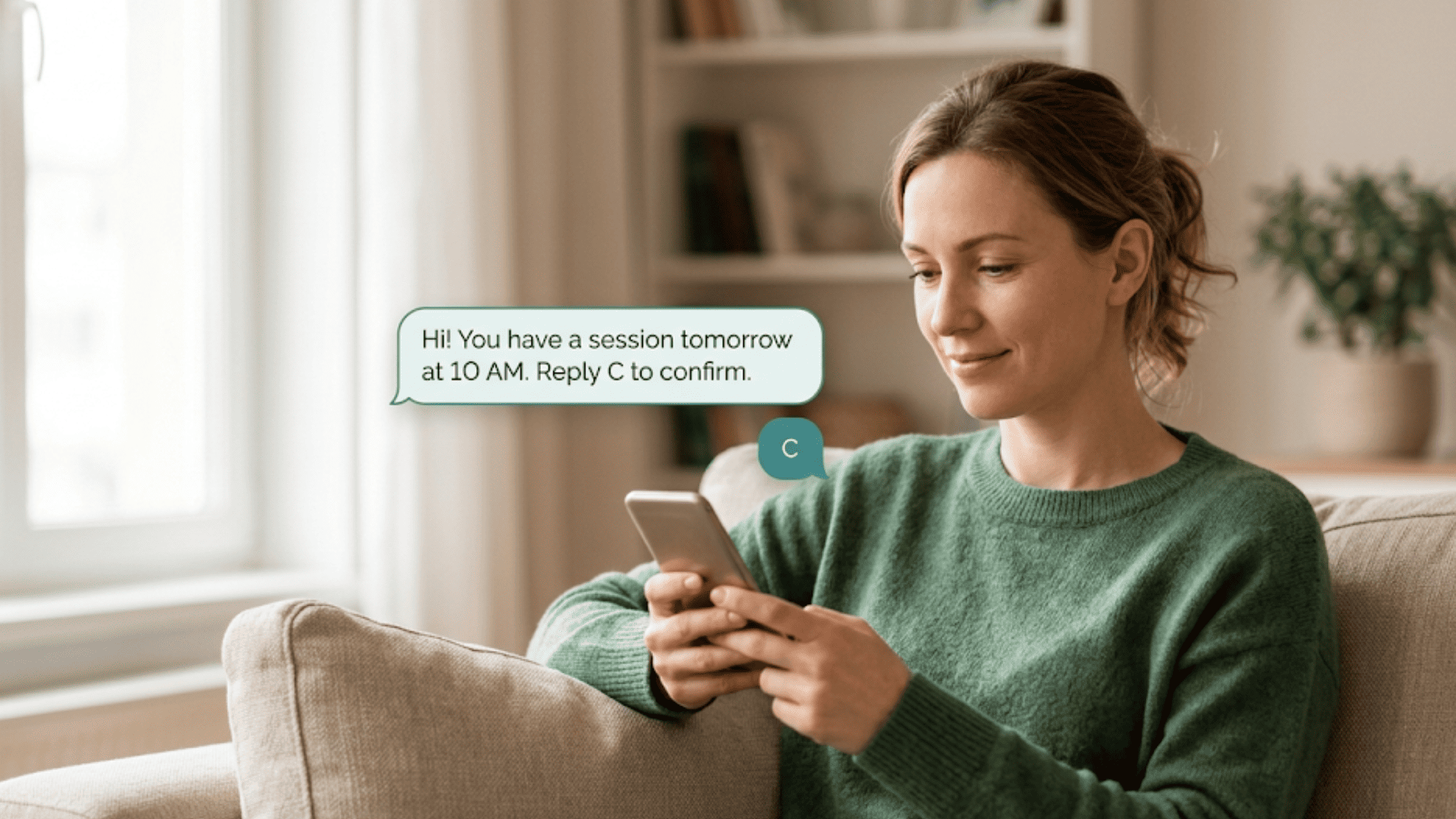
Behavioral health and SUD SMS reminders improve client treatment adherence better than any portal alert. They reach clients on the phone they already carry. There is no app to download and no login to recall. A client reads the text and taps one letter to confirm.
This matters most for the clients who are likely to slip away. Active addiction makes it hard to track time and plans. Housing problems mean lost phones or cut-off service. Depression drains the will to act on any message.
Sigmund AURA does send text reminders, but only one way. Clients cannot reply to confirm a session. Its cadence is rigid, so it does not bend to outpatient, IOP, or MAT needs. That gap is where clients fall through.
Curogram's 2-way SMS reminders close that gap. A client gets a text, replies "C," and the session is set. If no reply comes, staff get a flag and reach out. Each message guards privacy and never names the type of care.
The numbers back this up. Curogram practices see no-show rates 53% lower than the industry average, based on our internal data. Recovered slots can lift revenue by 10% to 20%. That is care that keeps going, session after session.
This article shows why SMS is the right channel here. It also shows how one text can keep a client in care. We will look at the barriers, the fix, and the proof. Each section ties back to one goal: keeping clients connected.
The Villain: The Silent Drop-Off
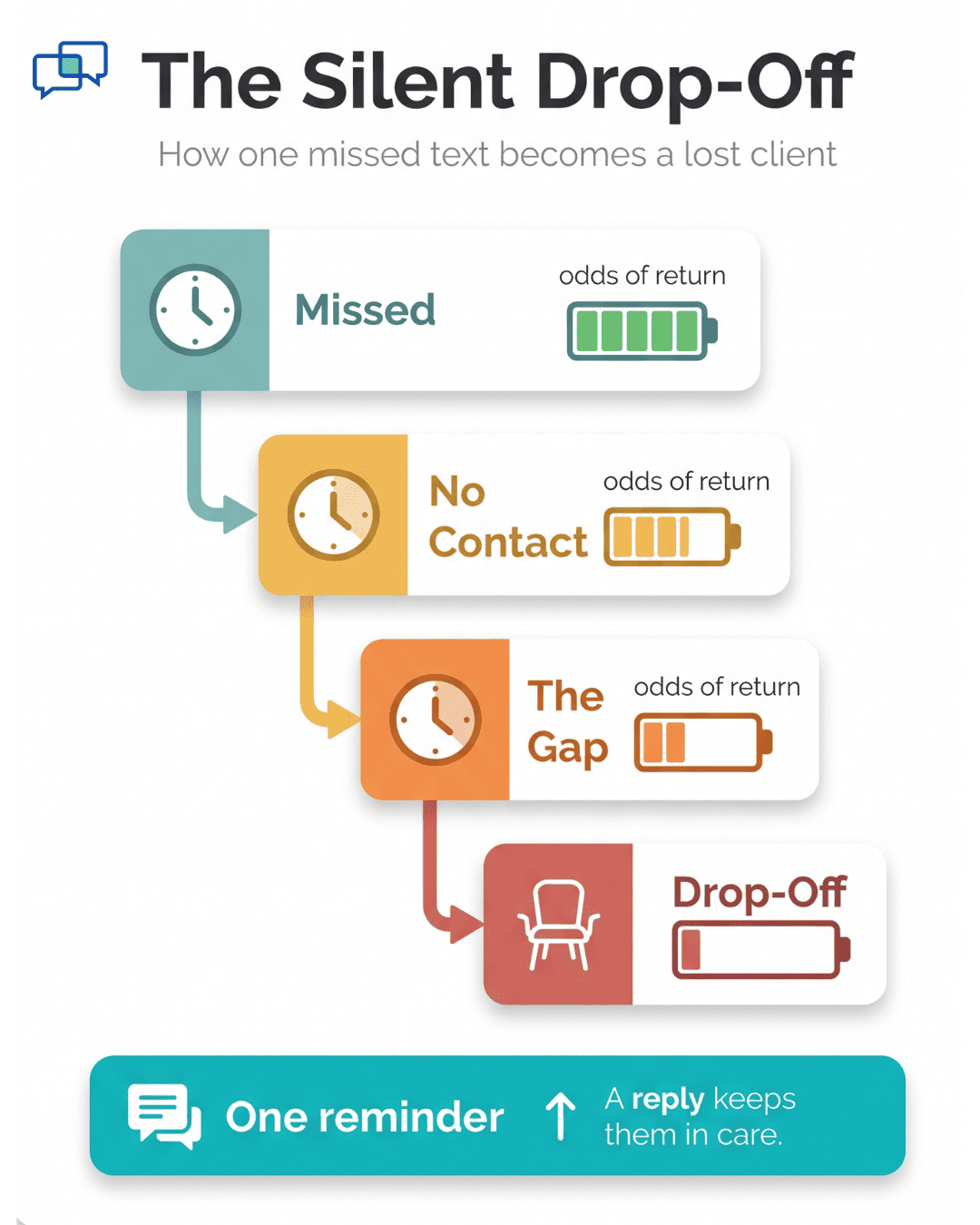
Most clients do not quit treatment on purpose. They drift. A session gets missed, then another, and the gap grows. We call this the silent drop-off, and it is the real threat to recovery.
Behavioral health and addiction clients face barriers that other patients rarely do. These barriers make a quiet exit easy and a steady return hard. The table below shows what gets in the way.
|
Barrier |
What it does to attendance |
|
Active addiction |
Hurts focus, memory, and time management |
|
Housing instability |
Limits phone access, transport, and daily routine |
|
Depression |
Drains the drive to act on any message |
|
Court-mandated care |
Adds doubt about treatment in the first place |
Here is how it plays out. A client in outpatient SUD counseling has a session set for Thursday. The reminder sits in Sigmund's portal, which they never open. By Thursday morning, the session has slipped their mind.
No one texts. No one calls until the slot is already empty. By the time staff follow up on Friday, the client has been using again for a day. Now shame makes it even harder to walk back in.
This is not rare. Federal data and behavioral health research point to no-show rates of 20% to 50% in these programs. Dropout rates can run 40% to 60% over a full course of care. Each exit is more than an empty chair.
The cost is clinical, not just financial. For MAT clients, a break in care can spark withdrawal and relapse. For court-mandated clients, a missed session can mean legal trouble. A single missed slot might cost a practice around $120, but the human cost is far higher.
Think about who feels it:
-
The therapist spent three months building trust, then learns the client is gone.
-
The front-desk coordinator marks "no-show" and moves on.
-
The clinical director reviews monthly numbers and asks what went wrong.
The pattern points to one root cause. These are not clients who stopped needing care. They are clients the message never reached. Strong mental health session adherence often comes down to texting that actually lands.
|
Now picture a second client: She is in early recovery and meets for a weekly group. She wants to stay, but she lost her charger and missed the portal alert for two weeks. Each missed week made the next one feel heavier. By week three, she had talked herself out of going back. |
Portals assume a lot. They assume a stable login, a charged phone, an app, and the focus to check it. For someone in early recovery, that is a tall order on a hard day. The channel fails, and the client slips away in silence.
There is also a staff cost most teams overlook. When the channel does not work, the front desk falls back on manual calls. They call everyone, even clients who would have shown up anyway. That wastes hours and still misses the people most at risk.
The math gets worse over time. One missed session rarely stays at one. It often turns into two, then a gap, then a full drop-off. The longer the silence, the lower the odds the client returns.
So the villain here is quiet, common, and very fixable. It is not a lack of care or a lack of will. It is a contact gap between sessions. The fix is not more effort from clients. It is a message that meets them where they already are — in their text inbox.

The Guide: The Reminder That Reaches Clients Where They Are
The fix starts with the channel, not more staff hours. A Curogram reminder arrives as a plain text message. It looks like every other text a client gets all day. There is no app to open and no portal to hunt through.
That choice is on purpose. The goal is the lowest possible effort for the client. They read one line and tap one letter to confirm. For someone juggling recovery, that simplicity is the whole point.
At the center is Curogram's 2-way confirmation with at-risk flagging. The system does not just send a reminder — it listens for a reply. When a client confirms, the slot is locked in. When a client stays silent, the system flags them as at-risk.
That flag changes how staff spend their time. Instead of calling the full schedule, they call only the few who did not reply. This is targeted outreach, not blanket dialing. It saves hours and reaches the people who need it most.
The table below shows the day-to-day difference.
|
Step |
Portal-only reminder |
Curogram 2-way SMS |
|
Delivery |
Alert sits inside a portal |
Text lands on the phone |
|
Client action |
Log in, find the message |
Read, reply "C" |
|
If no reply |
No signal to staff |
Client flagged as at-risk |
|
Staff effort |
Call everyone |
Call only flagged clients |
This is also how behavioral health client engagement through text reminders becomes practical. The client does not have to learn anything new. The practice does not have to chase the whole list. Both sides do less, and more sessions hold.
It fits the way these programs really run. Curogram lets you set different reminder timing for outpatient, IOP, and MAT clients. A daily MAT client and a weekly therapy client do not need the same cadence. You shape the rhythm to the program, not the other way around.
Privacy: Built In, Not Bolted On
Reminder messages name the session time only. They never list the diagnosis, the drug, or the program name. That design supports 42 CFR Part 2 reminder compliance, which sets stricter rules than standard HIPAA for substance use records.
So if a partner, roommate, or coworker glances at the phone, the text gives nothing away. It reads like any routine appointment note. The client keeps control of their story. For this population, that discretion is not a nice-to-have — it is the reason they reply at all.
The fit goes deeper for clients in early recovery. ADHD, depression, and brain fog can make any extra step feel like a wall. A "reply C to confirm" prompt sits below that wall. It asks for almost nothing, so clients actually do it.

Steady contact also does clinical work. A text from the program's number says, "We are expecting you." For SUD treatment continuity, SMS keeps the connection alive between visits. That thread is part of staying in care, not just a scheduling tool.
It all works alongside Sigmund AURA without needing API access. AURA still owns your scheduling and clinical records. Curogram adds the client-facing layer on top of it. The client sees one smooth flow; the handoff behind the scenes stays invisible.
Here is the full loop in plain terms. The client gets a text, taps one letter, and the visit is set. If they go quiet, staff get a heads-up and reach out. Nothing about the message reveals the nature of care.
That is the guide in this story. It is not a bigger system or a harder ask. It is a smarter channel that meets clients where they already live.
The Success: Clients Stay Connected, Treatment Continues
The proof is in the numbers, and the numbers are strong. Curogram practices see no-show rates 53% lower than the industry average, based on our internal data. That is not a small lift. For programs that lose 20% to 50% of slots, it is a turning point.
Consider Atlas Medical Center. Their no-show rate fell from 14.20% to 4.91% in just three months, based on our internal data. That is more than a 9-point drop. It also runs about 3X better than the industry average.
Behavioral health makes that gain even bigger. No-shows in these programs often start 2X to 3X higher than in general medical practices.
A higher starting point means more room to recover. So the same SMS approach can move the needle even further here.
The table below frames the swing in plain terms.
|
Measure |
Before |
After (Atlas) |
|
No-show rate |
14.20% |
4.91% |
|
Slots saved |
— |
About 9 in every 100 |
|
Compared to industry |
At average |
About 3X better |
Now let us turn that into a simple, practical example. Say a program runs 200 sessions a week at $120 each. At a 14% no-show rate, about 28 slots go empty each week. At a 5% rate, only about 10 slots go empty.
That gap is roughly 18 recovered sessions a week. At $120 each, that is about $2,160 weekly. Over a year, it adds up to more than $100,000 in recovered visits. This is an illustration, not a promise, but the logic holds.
The point is not only money, though. Each recovered slot is a client still in care. This is real no-show reduction, and addiction treatment SMS programs tend to gain the most. The people who are hardest to reach are often the people who respond best to a text.
There is a staffing payoff too. At-risk flagging means the front desk stops calling everyone. They focus on the short list of clients who did not reply. Recovered hours can go back into patient care instead of phone tag.
A text reminder is more than a scheduling nudge. It is a touchpoint. When a client sees a message from their program's number, they feel held in mind. In behavioral health, that small signal carries real weight.
This is why SMS appointment reminders support SUD treatment retention so well. Retention is not just a calendar event. It is a chain of kept connections over weeks and months. Each confirmed reply is one more link in that chain.
Why Curogram's 2-Way Texting Fits Recovery Care
Recovery care can ask a lot of clients on hard days. Curogram keeps its part simple on purpose. A reminder arrives as a plain text, the same kind clients read all day. There is nothing new to learn and nothing to install.
The "reply C to confirm" step is set to the lowest mental effort. For a client with ADHD, depression, or brain fog from substance use, that matters. One tap keeps the session on the books. No password, no menu, no portal hunt.
Take a Monday IOP client with a noon group. At 4 PM Sunday, a text lands and they reply "C." Two hours before group, a second text nudges them. They show up, and last week's progress continues.
The system also listens, not just speaks. When a client does not reply, Curogram flags them as at-risk. Staff then call the few who need it, not the whole list. This turns guesswork into focused, kind outreach.
It fits behavioral health client engagement through text reminders that respect privacy. Messages name the time only, never the diagnosis or program. That supports 42 CFR Part 2 reminder compliance by design. If someone else sees the text, it reveals nothing.
It also works alongside Sigmund AURA without API access. The client gets a text, replies, and the visit is confirmed. The tech behind it stays out of sight. The result is steady contact, not added complexity.
Small design choices drive big results. A one-letter reply beats a five-tap login every time. Less effort means more replies and more kept visits. That is how a simple tool protects real care.
So this is the heart of it. Curogram does not add steps to recovery — it removes them, one text at a time.
Conclusion: A Simple Text Keeps Clients in Care
Portal-based reminders fail the clients who need contact the most. Behavioral health and addiction clients face real barriers to showing up. A simple text removes those barriers in seconds. It reaches them where they already are, with no extra steps.
The lesson is simple. Meet clients on the device they already trust. SMS does that with no login, no app, and no friction. That is why text reminders outperform portal alerts for this group.
The roles here are clear and not in conflict. Sigmund AURA handles your scheduling, notes, and clinical records. Curogram handles the client-facing touchpoint that makes the visit happen. The chart records the session; the text makes sure the client arrives.
This is also how strong mental health session adherence through texting takes shape. Each confirmed reply keeps the thread between visits alive. For people in early recovery, that thread is part of the care. It is contact, not just a calendar nudge.
The payoff shows up across the whole practice. Fewer empty slots mean steadier revenue and fuller schedules. Clinicians keep the momentum they built with each client. Staff stop chasing everyone and focus only on at-risk replies.
Your clients want to come. They just need a reminder they will actually see. A simple "reply C to confirm" can change the outcome of a week. Over a month, those small wins reshape your census and your results.
Give your clients a reminder they'll actually see. Request a demo with our experts and we'll show you privacy-safe SMS confirmation built for SUD and behavioral health programs.
Frequently Asked Questions
Curogram messages name the session time and a confirmation prompt only. They never list the diagnosis, drug, or program name. So if someone else sees the text, it reveals nothing about the type of care, supporting 42 CFR Part 2 reminder compliance.
Texts land where clients already look every day. Portals require a login, an app, and the focus to check them. For someone in early recovery, that extra effort is often too much. A one-tap reply meets them at their lowest-effort moment.
Curogram flags that client as at-risk before the session. Staff then focus calls on the few who did not confirm, not the whole list. This targeted outreach saves hours and reaches the people most likely to drop off.
AURA keeps your scheduling and clinical records. Curogram adds the client-facing reminder layer on top, with no API access needed. The client gets a text, replies "C," and the visit is confirmed. The handoff behind the scenes stays invisible to them.
Each confirmed reply is a touchpoint that keeps clients connected between visits. That steady contact builds momentum and lowers the shame that drives drop-off. Over weeks, those small links support SUD treatment continuity and keep clients in care.