9 min read

Set Up Mass Messaging Recall Workflow Operations in Sigmund AURA

Set Up Mass Messaging Recall Workflow Operations in Sigmund AURA
💡 Sigmund AURA stores your inactive client list but offers no way to text those clients at scale. Curogram adds a mass messaging recall layer that reaches them all at once.
  • One staff member can recall 200+ dropped clients in about 10 minutes.
  • Segment by program type, last session date, or clinician.
  • Message templates stay 42 CFR Part 2 compliant.
  • No Sigmund AURA API access is needed.
  • Based on our internal data, SMS recall drove a 35% reconversion rate.
The result is simple. A three-week manual call list becomes a 10-minute campaign, and recall shifts from impossible to routine.

A list of dropped clients is not the problem. The problem is that no one can work through it fast enough. By the time a care coordinator finishes calling, the list has already grown longer than when she started.

Setting up a mass messaging recall workflow alongside Sigmund AURA fixes that math. Sigmund AURA is built to hold your clinical records. It tracks sessions, treatment notes, and who has dropped off the schedule. What it does not do is help you reach those people at scale.

So recall falls to one staff member with a phone and a growing list. She calls each name by hand. Most calls go to voicemail. She reaches a handful per hour, and connection rates stay low. The work is honest, but the numbers never add up.

Curogram changes the unit of work. Instead of one call at a time, a single send reaches the whole segment at once. The care coordinator pulls the inactive list, filters it, picks a compliant template, and presses send. Two hundred clients get a message in the time it once took to dial three.

This shift matters most in behavioral health and SUD treatment. Every day of delay lowers the chance a dropped client comes back. A faster reach is not just convenient. It is clinical.

This Sigmund AURA recall campaign setup guide walks through the whole process. You will see how to build a segment, stay 42 CFR Part 2 compliant, and track who reschedules. Based on our internal data, SMS recall produced a 35% reconversion rate, with 1,240 clients seen from recall messages alone.

No API access. No new clinical system. Just a faster way to bring people back.

The Villain: The Manual Recall Spiral

Picture the recall process most behavioral health practices actually run. A care coordinator opens Sigmund AURA, pulls a report, and sees the dropped clients. Then the "system" ends. From there, it is just her, a phone, and a list.

She calls the first name. Voicemail. She leaves a message and notes the attempt. She calls the next. Voicemail again. This is the manual recall spiral, and it traps even the most organized staff.

The Math That Never Works

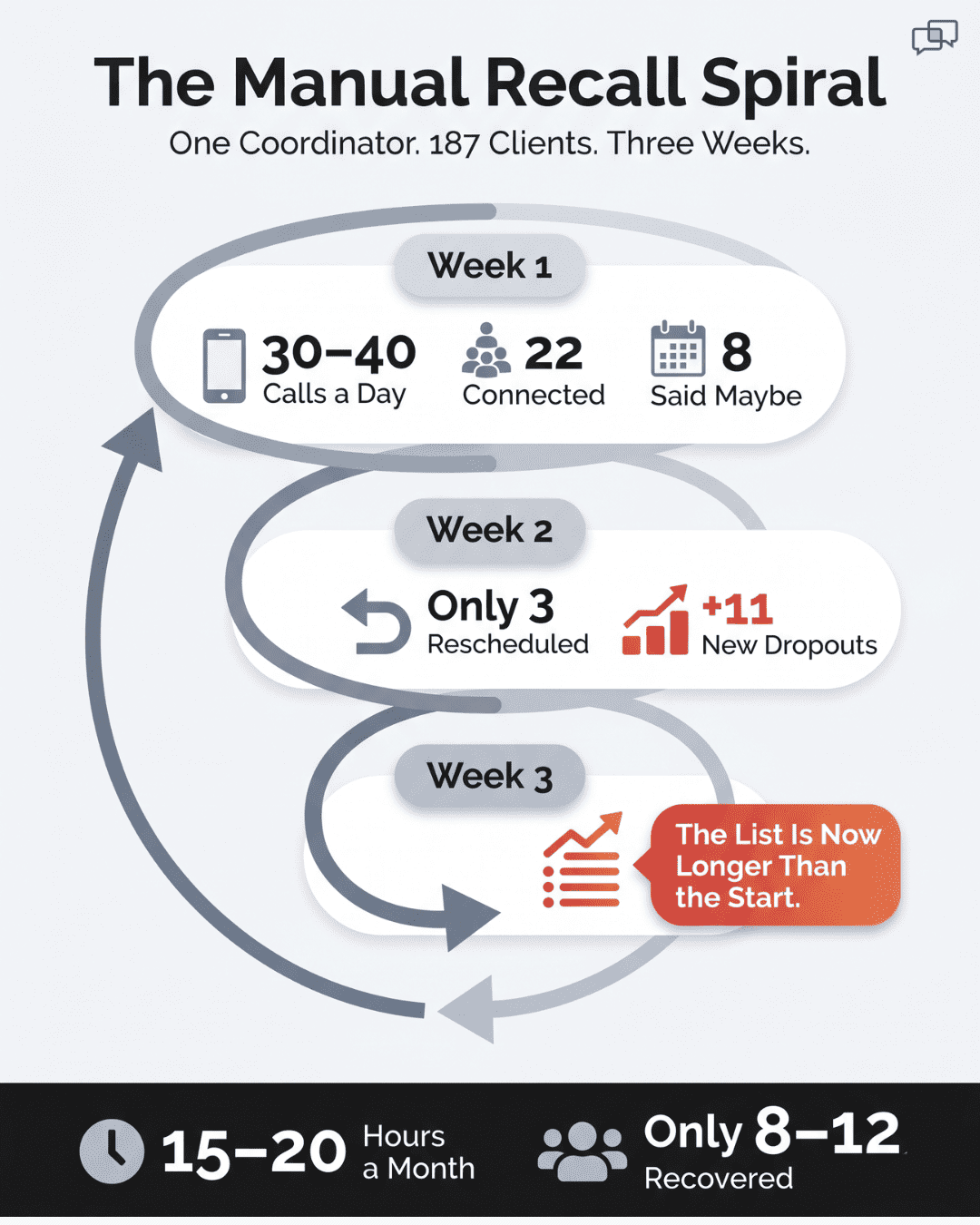
Say she starts Monday with 187 inactive clients. Between intakes, charting, and other duties, she can call 30 to 40 per day. At that pace, one pass through the list takes a full week.

By Friday, she has connected with maybe 22 clients. The rest went to voicemail or did not pick up. Of those 22, perhaps 8 said they would call back. The next week, only 3 actually do.

Here is the trap. While she worked that list, 11 more clients dropped off the active schedule. The list is now longer than when she began. She is running to stay in place.

Why Delay is so Costly

A call list does not just move slowly. It decays. Each day a client stays disengaged, the odds of return drop. In SUD treatment, that gap can mean the difference between re-engagement and relapse.

A three-week manual cycle means the first names are already 45 to 50 days out by the time anyone reaches them. The most at-risk clients sit at the bottom of the list. They are the last ones called, when they should be the first.

The Hidden Cost in Hours

Let's add it up. Manual recall eats roughly 15 to 20 hours per month. The net result is often only 8 to 12 clients recovered.

What the coordinator does

Time spent

Clients recovered

Phone calls, one client at a time

15–20 hrs/month

8–12/month


That is a brutal trade. Skilled staff spend a full work-week each month leaving voicemails, and most never connect.

Infographic showing one coordinator's 187-client manual recall list growing over three weeks

The Feeling Behind the Numbers

Ask any care coordinator and the story is the same. "I'm doing triage on a list I can never finish." She knows the names she cannot reach are the clients most likely to be struggling right now.

This is the real villain. Not bad effort, but a broken unit of work. As long as recall means one call at a time, the list will always win. Any mass messaging workflow for a behavioral health EHR has to break that one-at-a-time ceiling first.

The Guide: From Phone List to 10-Minute Campaign

The fix is not to call faster. It is to stop calling one at a time. Curogram replaces the phone list with a bulk send that reaches every dropped client at once.

Here the unit of work flips. One action no longer means one client. One action means the whole segment. That single change is what turns three weeks into ten minutes.

How the Recall Campaign Builder Works

Curogram's Recall Campaign Builder gives staff a clear, repeatable path. The care coordinator recall workflow in behavioral health follows five simple steps:

  1. Pull the segment. Reference your inactive client list from Sigmund AURA's reporting tools.
  2. Filter it. Narrow by last session date, program type, clinician, or custom tags.
  3. Pick a template. Choose or adjust a recall message built for 42 CFR Part 2 compliance.
  4. Preview it. Check the message on a sample record before anything sends.
  5. Send. Deliver to the full segment at once, then watch responses arrive.

Delivery confirmation, replies, and reconversion numbers all show up in one dashboard. The coordinator sees who got the text and who wrote back.

Why No Integration is Required

This is the part many teams expect to be hard. It is not. Mass texting inactive clients here needs no EHR integration at all. Curogram requires zero Sigmund AURA API access.

The flow stays clean. The coordinator references inactive clients in Sigmund's reports, builds the segment inside Curogram, and launches.

When a client texts back, the chat continues in Curogram's two-way messaging channel. Rescheduled sessions get booked through your existing scheduling steps. Curogram recall campaign configuration sits beside Sigmund, not inside it.

Built for SUD Compliance from the Start

Speed is useless if it creates risk. So the guardrails for bulk SMS recall operations in SUD treatment are built into the workflow, not bolted on later.

Templates leave out treatment type. They never name a substance, a program, or a diagnosis.

A compliant recall text reads like a plain check-in: "We haven't seen you recently and want to check in. Reply or call to schedule."

The preview step flags wording that could risk a disclosure problem. So a coordinator can move fast and stay safe at the same time. There is no trade-off between speed and 42 CFR Part 2 care.

What Changes for the Staff Member

Think about the same Monday from before. Instead of 187 calls stretched across a week, the coordinator builds one segment. She filters to clients who dropped in the last 60 days. She picks a template, previews it, and sends.

In about ten minutes, every client on that list has a message. Replies start coming in within the hour. She handles real conversations, not voicemail tag.

The list does not grow faster than she can work. For the first time, it shrinks.

The Success: One Staff Member, 200 Clients, 10 Minutes

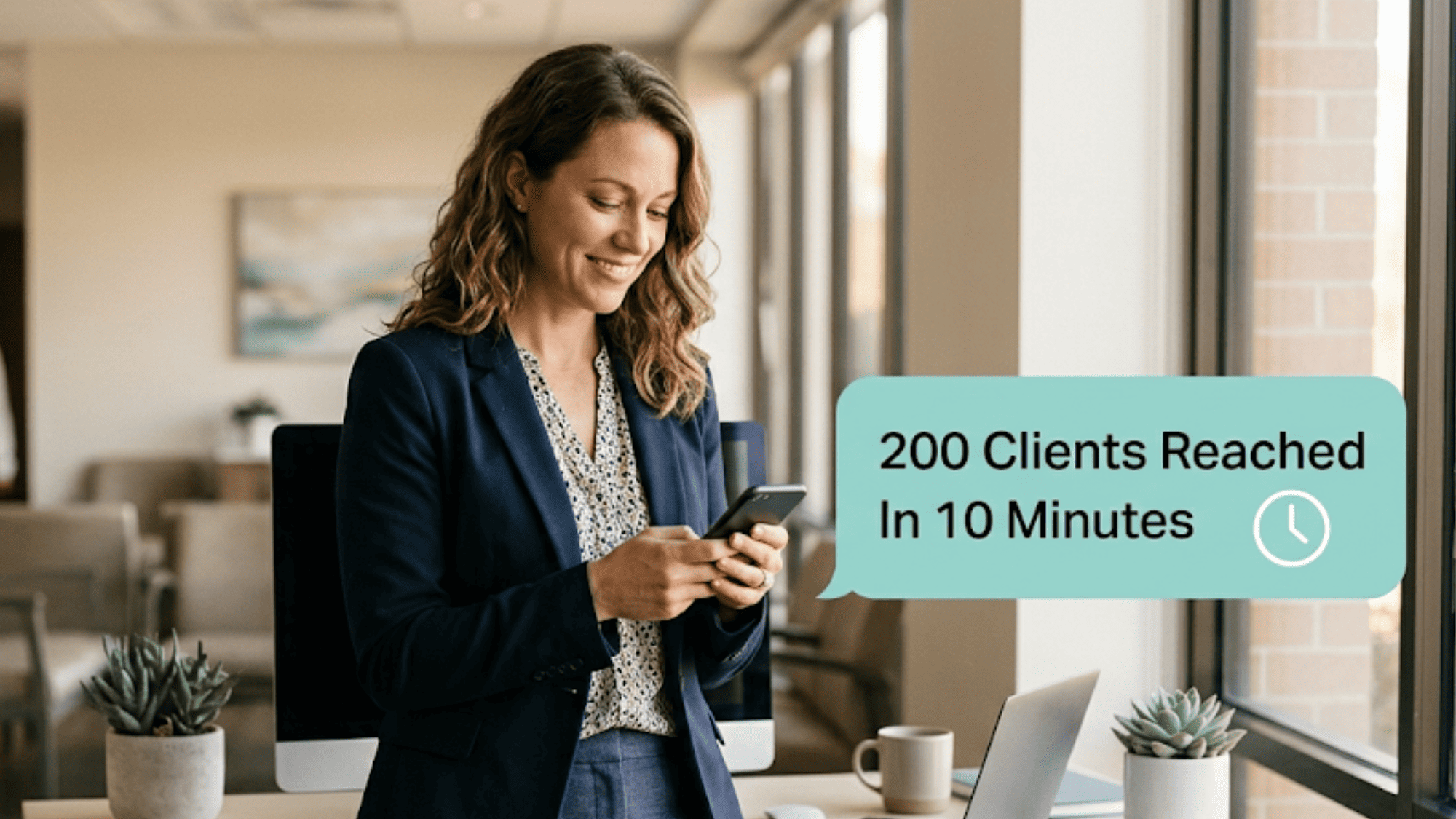
The win is easy to state. One staff member can now reach 200 clients in ten minutes. But the real story is what that does to the whole operation, week after week.

The Metric: A Brand-New Ratio

Start with the trade you are replacing. A manual pass through 200 names takes 25 to 40 hours of calls. A bulk send covers the same 200 in about 10 minutes.

Then look at returns. Based on our internal data, SMS recall drove a 35% reconversion rate. In one multi-location practice, 1,240 clients were seen from recall messages alone.

Apply that rate to a single 200-client send:

Step

Manual calls

Mass SMS recall

Time to reach 200 clients

25–40 hours

~10 minutes

Typical clients recovered/month

8–12

50–70

Staff hours/month on recall

15–20

~0.5


At a 35% rate, 200 dropped clients can turn into about 70 rescheduled sessions from one campaign. That is not a small gain. It is a different category of result.

A Simple Example You Can Run

Say your practice flags 200 inactive clients this month. Under manual calls, you might recover 10. Under a single mass send at a 35% rate, you could recover roughly 70.

That is 60 more clients back in care from the same list. Sixty more people who might have drifted otherwise. The list did not change. The method did.


The Shift: From Call List to Recall Operation

The deeper change is in how recall behaves. It stops being an ad hoc chore squeezed between other tasks. It becomes a scheduled function the practice can count on.

  • Old model: A coordinator chips away at names whenever she finds a free hour.

  • New model: Every 30 days, she runs a campaign. The cycle repeats on a clock, not on luck.

This matters because consistency compounds. A list worked once in a while keeps growing. A list cleared on a schedule keeps shrinking. Dropout becomes recoverable instead of permanent.

The Outcome: Time Goes Back to Care

Follow the same coordinator forward. She used to spend 15 to 20 hours a month on recall calls. Now she spends about 30 minutes a month running campaigns.

Her recovery climbs from 8 to 12 clients per month to 50 to 70. And the hours she gets back do not vanish. They flow into care coordination for active clients, the work she was actually hired to do.

The clinical director notices something new, too. The inactive list is finally getting shorter. For many practices, that is the first time they have ever seen it drop.

Why This Scales Without Adding Staff

Here is the quiet power of the model. Because one send equals one segment, volume stops being a staffing problem. A list of 200 and a list of 500 take nearly the same effort to message.

So growth does not break the system. A practice can add locations or programs and still run recall in minutes. The work no longer scales with the size of the list.

Bulk does not mean blind. The campaign builder lets you split sends by group. You can text IOP clients who dropped in the last 60 days separately from outpatient clients overdue for a check-in.

Targeted sends tend to land better than one broad blast. The timing and context feel more relevant, so more people reply. You get the reach of mass messaging with the feel of a personal nudge.


Care coordinator using mass SMS recall to reach 200 clients in 10 minutes with Curogram

Why Curogram Turns Recall Into a Repeatable Operation

Most tools promise to send more messages. Curogram does something more useful. It changes recall from a task you survive into a system you run.

The shift starts with the unit of work. A phone treats each client as a separate job. Curogram treats the whole segment as one job. That is why 200 clients take ten minutes, not three weeks.

But reach alone is not enough in behavioral health. Speed without safety creates risk. So Curogram builds 42 CFR Part 2 protection right into the send. Templates skip treatment type. The preview step flags risky wording before anything goes out.

Then there is the part that keeps the whole thing honest. Recall only works if you can see what worked. Curogram tracks delivery, replies, and reschedules in one dashboard. You stop guessing and start measuring.

This is also why Curogram sits beside Sigmund AURA, not on top of it. Your EHR keeps doing what it does well, holding clinical records. Curogram handles the outreach layer that decides whether dropped clients ever return to those records. No API access. No new clinical system to learn.

The result is a clean division of labor. Sigmund AURA stores the inactive list. Curogram empties it. One system documents care. The other recovers the clients who slipped away from it.

For a care coordinator, the day-to-day feels different, too. She is no longer doing triage on a list she can never finish. She runs a campaign, handles real replies, and moves on. Her time goes back to active clients.

Based on our internal data, that operation produced a 35% reconversion rate and brought 1,240 clients back through recall messages alone. That is what recall looks like when it becomes routine.

Conclusion: Recall Should Be a Campaign, Not a Call List

Recall fails for one reason. The work is stuck at one call at a time, and the list always grows faster than a phone can clear it.

Sigmund AURA shows you who dropped off. It does not give you a way to reach them at scale. So the job lands on one coordinator, a phone, and a list that never ends.

Curogram closes that gap. It turns the manual recall spiral into a 10-minute campaign. One staff member reaches 200 clients in the time it used to take to dial three.

The division of labor is clean. Sigmund AURA is for your clinical records and treatment history. Curogram is for the outreach that decides whether dropped clients return to those records. The EHR holds the inactive list. The campaign empties it.

The results back this up. Based on our internal data, SMS recall drove a 35% reconversion rate, with 1,240 clients seen from recall messages alone. That is recovery you can schedule, not hope for.

The deeper shift is in mindset. Recall stops being a chore squeezed between other tasks. It becomes a steady operation you run every 30 days. The list shrinks instead of growing.

For your most at-risk SUD clients, that speed is not a luxury. Every day of delay lowers the chance they come back. Reaching them on day one, not day fifty, changes outcomes.

Bring your current inactive client count to a demo call with Curogram. We will build a live recall campaign together and show you the reconversion tracking in real time.


Frequently Asked Questions

How does the recall workflow stay 42 CFR Part 2 compliant for SUD programs?

Templates use general check-in language and never name treatment type, substance, or program. A typical message reads like a wellness nudge. The preview step also flags any wording that could risk a disclosure problem before you send.

Why does a text bring back more dropped clients than a phone call?

Calls reach few clients per hour, and most go to voicemail. A text reaches the whole segment at once and lets clients reply on their own time. Based on our internal data, SMS recall reached a 35% reconversion rate.

How can one staff member realistically recall 200 clients in 10 minutes?

The work shifts from one call at a time to one send for the whole list. The coordinator pulls a segment, picks a template, previews it, and sends. Two hundred clients get the message at the same moment.

Why should recall run on a 30-day schedule instead of when staff find time?

Worked occasionally, the list keeps growing. Cleared on a set cycle, it shrinks. A scheduled operation also reaches at-risk clients sooner, which matters most in SUD care where delay lowers the chance of return.

What happens after a client replies to a recall text?

The reply lands in Curogram's two-way messaging channel. Staff can answer questions and schedule the next session in real time, inside one HIPAA-compliant platform. The thread is logged for continuity, and the text includes your phone number for callers.