10 min read
Sigmund AURA Client Recall Campaigns for Behavioral Health SUD
Mira Gwehn Revilla
:
June 15, 2026
- Layer Curogram's mass SMS onto Sigmund AURA — no API access needed.
- Segment dropped clients by program, last visit, or clinician.
- Send 42 CFR Part 2-compliant recall texts to hundreds at once.
- Based on our internal data, recall texts win back 35% of dropped clients.
- 1,240 clients returned through SMS recall alone.
Your inactive client list keeps growing. Names pile up week after week. These are clients who stopped showing up — and never said why.
In behavioral health and SUD care, this is the norm, not the exception. Research commonly reports that 40–60% of clients leave treatment early. They don't cancel. They just go quiet.
Sigmund AURA sees all of it. The EHR logs each missed session and every lapsed client. It knows exactly who slipped away. But it gives you no way to reach them at scale.
So the work falls on one person. A care coordinator pulls the list and starts dialing. By day's end, she has reached six people out of nearly 200. The math simply does not work.
Meanwhile, the clinical risk grows. For SUD clients, every week without contact can raise relapse risk. The clients are not unreachable. They are just unreached.
This is where Sigmund AURA client recall campaigns for behavioral health and SUD practices change the game. By layering Curogram's mass texting platform onto Sigmund, one staff member can reach hundreds of dropped clients at once. No phone tag. No portal messages that sit unread.
A recall text is simple and private. It invites the client to call or reply, without naming any treatment type. That keeps it compliant and easy to answer.
Based on our internal data, this approach wins back 35% of dropped clients. Across Curogram-powered practices, 1,240 clients returned from recall texts alone.
This guide breaks down how the recall engine works. You will meet the villain behind silent dropout. You will see how to fix it. And you will see what happens when lost clients start booking sessions again.
The Villain: The Silent Dropout
Most client loss in behavioral health is quiet. There is no angry call. There is no formal goodbye. The client simply stops scheduling and stops showing up.
In Sigmund AURA, this shows up as an inactive record. The last session was weeks or months ago. No future visit is booked. No outreach is logged. The EHR captures the dropout in full detail. It just cannot do anything about it.
The Reality: Tracking is not Reaching
Behavioral health and SUD programs see high dropout rates. Research commonly places the range at 40–60% of clients. These are not people who cancel. They go silent, one missed session at a time.
This is the core problem behind behavioral health dropout recovery: the EHR knows everything, yet reaches no one. Sigmund AURA was built to document care and handle billing. It was never built for bulk client outreach.
The Agitation: One Phone, One Staff Member
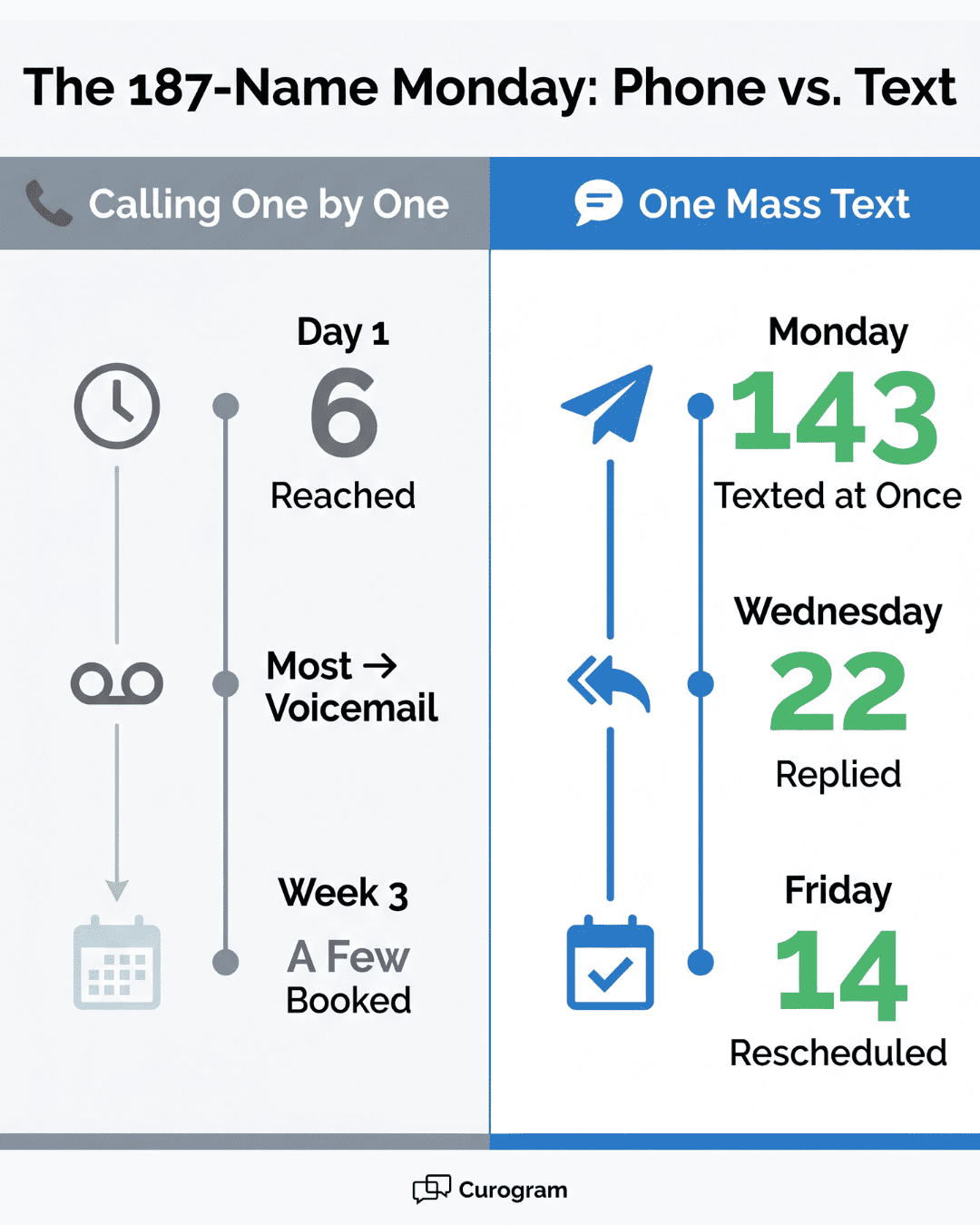
Picture a care coordinator on a Monday morning. She pulls a list of clients whose last visit was over 30 days ago. The list has 187 names.
She starts calling. Most calls go to voicemail. By the end of the day, she has reached six people. Three say they will call back. By Friday, none have.
Meanwhile, four more clients miss sessions that same week. The list does not shrink. It grows. She cannot call 187 people. She cannot even call 50.
The Consequence: Clinical Risk and Lost Revenue
Each dropped SUD client carries real danger. Time away from care can mean relapse, an ER visit, or worse. The cost is human first, and financial second.
The financial loss adds up fast, too. As a simple example, picture a session valued between $150 and $400. A practice that loses 200 clients a year could lose tens of thousands in session revenue. That is before counting clients who return in crisis instead of steady care.
Manual recall recovers only a sliver. Portal messages often go unread. Email open rates tend to sit low. The clients are not gone. They are simply unreached.
The Result: Knowing Who, But Having No Way
The clinical director opens the inactive report. She sees names she knows well. Clients who were making real progress. Clients in early recovery who needed steady contact to stay on track.
She asks what outreach has been done. The answer is honest and frustrating. "We're calling through the list, but we only reach a few each day. Most don't pick up. We have no way to text them all at once."
That is the trap. The team knows exactly who needs to come back. They just have no tool to tell them all.
The villain here is not a careless client or a lazy staff member. It is the silent gap between an EHR that tracks and a phone line that cannot scale. One side holds the data. The other side cannot keep up.
This gap is why dropped clients stay dropped. Not because no one cares. It happens because caring at scale needs the right channel.
Think about what that gap really costs. A client in early recovery misses two sessions. Nobody reaches them in time. By week three, they are hard to find. The window to re-engage them quietly closes.
Now multiply that by 187 names. Then add the next month's dropouts on top. The list becomes a running tally of lost chances. The silent dropout wins by default, simply because no one can speak to everyone at once.
The Guide: The Dropout Recovery Engine
Curogram turns the inactive list into an outreach engine. It gives Sigmund AURA practices a way to text dropped clients at scale. One staff member can do in minutes what used to take weeks.
The Solution: One List, One Send
The core idea is simple. Pull the inactive client list. Build a segment. Send one recall text to the whole group.
Staff can group clients by program type, such as IOP, outpatient, MAT, or group therapy. They can also sort by last session date or assigned clinician. Then they send a targeted text to that segment at once.
This is Sigmund AURA mass messaging for behavioral health done right. No calling one by one. No portal alerts that sit unread. No email blasts that few people open.
The Feature: Targeted Recall Campaigns
Curogram's "Targeted Recall Campaigns" tool guides the whole flow. Staff build a client segment from the inactive list. They write a short recall message. They preview it for compliance. Then they send to hundreds of clients in one action.
Each message lands as a normal text. Not an app alert. Not a portal note. Not an email in a crowded inbox. Clients reply right in the text thread, and the chat continues in Curogram's secure 2-way channel.

The Integration: Works Beside Sigmund, Not Inside It
Here is the part that makes adoption easy. Curogram runs alongside Sigmund AURA with no API access required. Staff reference their inactive list, build the segment in Curogram, and launch.
When a client replies and wants to reschedule, staff book the visit through your normal workflow. This is Sigmund AURA bulk texting client outreach without a complex tech project. Curogram adds the outreach layer. Sigmund stays the clinical record.
That split matters for busy teams. You do not migrate data. You do not retrain on a new EHR. You add one tool that handles the job Sigmund was never built to do.
The Behavioral Health Fit: Private by Design
SUD clients are protected under 42 CFR Part 2. Recall texts must never reveal treatment type. So 42 CFR Part 2 mass messaging for behavioral health needs careful wording.
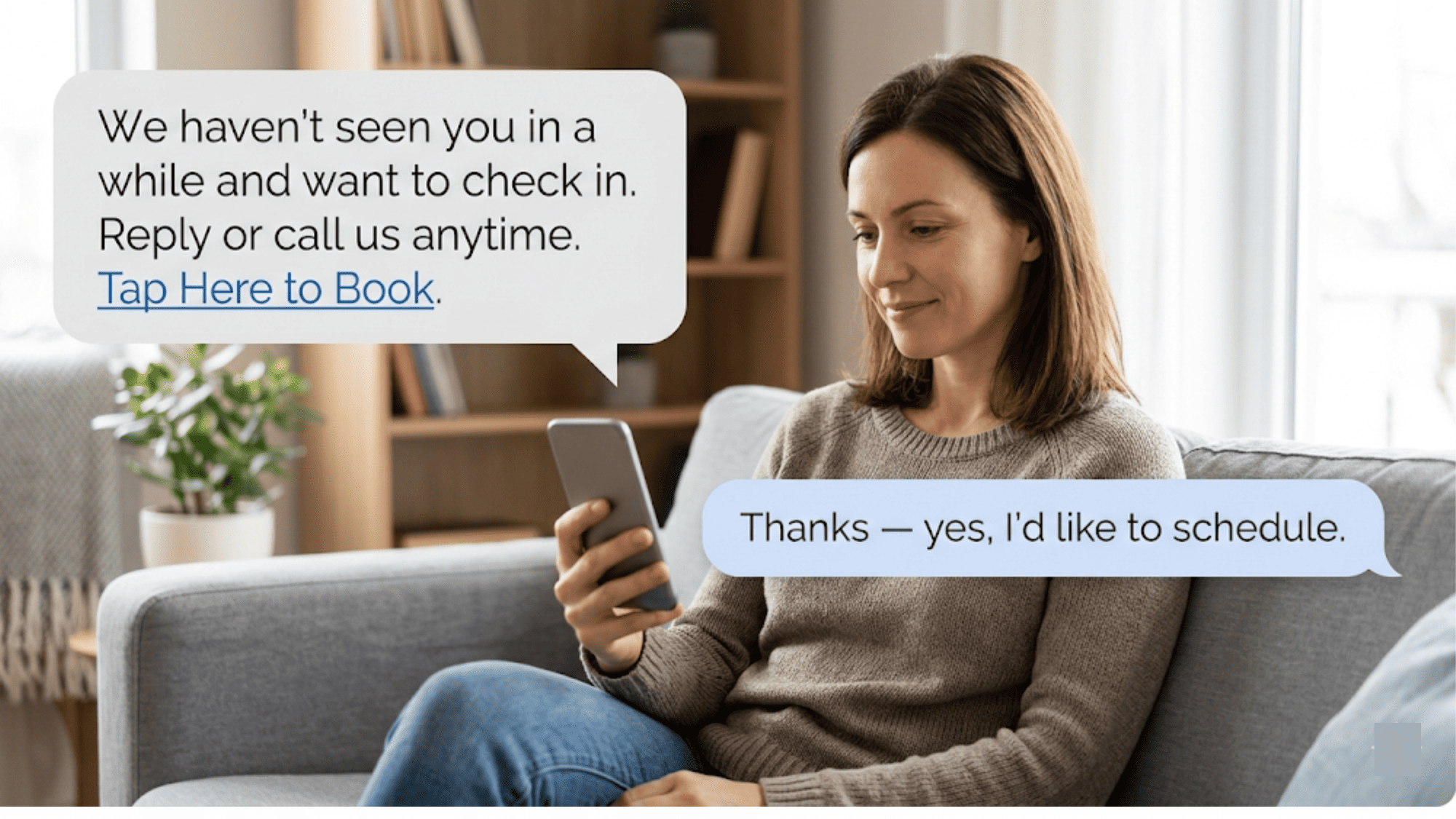
A compliant text is gentle and vague on purpose.
It might say: "We haven't seen you in a while and want to check in. Call us or reply to schedule."
It never says "your addiction treatment has lapsed."
Curogram's templates are built for this exact limit. That is what makes them HIPAA-compliant recall campaigns for SUD treatment, not just bulk texts. Every message runs on HIPAA and SOC 2 Type II certified infrastructure with full audit trails.
There is a human fit, too. Many clients with anxiety, depression, or trauma find a text easier than a call. A low-pressure message feels safe to answer. The channel matches the people you serve.
That is why SUD client recall SMS campaigns often work when calls and portals fail. A phone call can feel like pressure. A voicemail can feel like a demand. A short, kind text feels like an open door.
Put it together and the engine is clear. Sigmund flags who dropped out. Curogram reaches them all at once, in a private and compliant way. The client replies on their own terms. Staff book the session and care continues.
No tool can force a client to return. But this one removes every barrier that used to stand in the way. The list stops being a graveyard of lost names. It becomes a live source of recoverable sessions.
The Success: Dropped Clients Return, Treatment Continues, Revenue Recovers
When recall becomes scalable, dropout stops being permanent. The same inactive list that once felt hopeless turns into a steady source of returning clients. Here is what that shift looks like in practice.
The Metric: 35% Come Back
Based on our internal data, SMS recall campaigns drive a 35% reconversion rate. That means 35 out of every 100 dropped clients book a session after one recall text. Across Curogram-powered practices, 1,240 clients returned from recall messages alone.
Let that land for a moment. These were clients marked inactive. No future visit. No recent contact. One well-timed text brought a third of them back.
Now apply it to a real list size. Say a practice has 200 inactive clients. A single recall send could recover around 70 sessions. The table below shows simple, illustrative math at a few list sizes.
|
Inactive list size |
Clients recovered (35%) |
Illustrative revenue recovered ($150–$400/session) |
|
100 clients |
~35 sessions |
$5,250 – $14,000 |
|
200 clients |
~70 sessions |
$10,500 – $28,000 |
|
300 clients |
~105 sessions |
$15,750 – $42,000 |
The dollar figures above are example math, not internal data. The 35% rate is the verified part. Your real numbers will depend on your session value and list size. But the pattern holds: a single send pays for itself many times over.
The Shift: From Passive Acceptance to Active Recall
The biggest change is not the tool. It is the mindset. Most practices treat dropout as a fact of life. Clients leave. The list grows. Nothing happens.
Curogram replaces that with a simple habit. Recall becomes a scheduled task, like running payroll. Every 30 days, a staff member runs a campaign against the inactive list.
So dropout stops being a dead end. It becomes a recoverable event. A client who vanished in March can return in April with one text. The list is no longer a record of loss. It is a queue of second chances.
This shift also changes how staff feel about the work. Calling 187 people feels impossible, so it does not happen. Sending one text to 187 people feels easy, so it gets done. The right tool turns dread into routine.
The Outcome: A Real Monday
Picture how this plays out over one week. A care coordinator logs into Curogram on Monday morning. She segments the inactive list and finds 143 clients whose last session was 30 to 90 days ago.
She picks a recall template. She reviews it for 42 CFR Part 2 compliance, making sure it names no treatment type. Then she sends. The whole task takes about 10 minutes.
By Wednesday, 22 clients have replied. Some ask for an evening slot. Some just say "yes, please call me." A few share that things got hard and they stepped away. The text gave them a low-pressure way back.
By Friday, 14 clients have rescheduled sessions. The clinical director opens the recovery report. She sees familiar names returning to the calendar. Several were weeks away from being lost for good.
Compare the two paths. The phone-call approach would have stretched across three weeks and reached a handful of people. The recall campaign took 10 minutes and brought 14 clients back in five days. Same staff. Same list. A completely different result.

How Curogram Turns a 10-Minute Send Into Recovered Sessions
The magic is not in the message. It is in the workflow behind it. Curogram removes every step that used to stall recall, so one staff member can run the whole thing.
It starts with the segment. Instead of scrolling a list by hand, staff filter clients in a few clicks. They group by program type, last visit date, or clinician. The right audience is built in seconds, not hours.
Next comes the message. Curogram offers recall templates written for behavioral health and SUD rules. Each one invites a reply without naming any treatment type. Staff preview the text, confirm it is 42 CFR Part 2 safe, and move on.
Then comes the send. One action delivers the message to hundreds of clients at once. There is no dialing, no voicemail, and no waiting on hold. The work that once took three weeks now fits in a coffee break.
The replies land in one place. Clients answer in a secure 2-way text thread. Staff see every response in a single inbox and reply in real time. No client gets lost in a stack of voicemails.
Booking stays simple, too. When a client says yes, staff schedule the visit through their normal Sigmund AURA workflow. Curogram handles the outreach. Sigmund keeps the clinical record. Nothing about your charting changes.
Everything runs on secure, certified infrastructure. Curogram is HIPAA and SOC 2 Type II compliant, with full audit trails on every message. So scale never comes at the cost of privacy.
That is how 10 minutes turns into recovered sessions. The tool collapses a multi-week chore into a single, safe, repeatable task. Staff get their time back. Clients get a clear path home. And care continues for the people who need it most.
Conclusion: Your EHR Knows Who Dropped Out, Now You Can Reach Them
Here is the simple truth: Sigmund AURA tracks every client who drifts away from care. It logs the last session and flags the inactive record. What it cannot do is bring those clients back.
That gap is what costs practices the most. The data sits ready, but the outreach has nowhere to go. One care coordinator and one phone cannot close it. The list just keeps growing.
Curogram closes that gap. Its mass SMS recall campaigns turn inactive records into active outreach. One staff member segments the list, sends a compliant text, and reaches hundreds of clients at once.
The results speak plainly. Based on our internal data, recall texts win back 35% of dropped clients. Across Curogram-powered practices, 1,240 clients returned from these messages alone.
Think of the two tools as a team. Sigmund AURA holds your clinical history. Curogram handles the outreach that decides who returns to that history. The EHR stores the past. The recall campaign writes the next chapter.
This matters most in SUD care. Every week a client stays out of contact raises clinical risk. A fast, kind, private text can reach them before that window closes. It protects revenue and continuity of care at the same time.
So stop letting clients slip away in silence. The names on your inactive list are not gone. They are simply waiting to hear from you.
Stop letting dropped clients disappear in silence. Book a quick demo and we'll show you how Curogram's mass SMS recall brings 35% of them back — using your real inactive client count.
Frequently Asked Questions
The templates never name treatment type, substance use, or program details. A message simply invites a client to call or schedule, reading like a general check-in. Everything runs on HIPAA and SOC 2 Type II infrastructure with full audit trails.
A single staff member can text hundreds of clients in one action. They segment the inactive list by program type, last session date, or clinician, then send. At a 35% reconversion rate, a 200-client send recovers roughly 70 sessions.
Curogram works as a separate outreach layer beside Sigmund. Staff reference the inactive list, build a segment in Curogram, and launch the send. No API setup, no vendor coordination, and no changes to your existing EHR configuration are required.
Calls go to voicemail, and portal messages often go unread. A text lands where people already look every day. For clients with anxiety or trauma, a low-pressure text also feels far safer to answer than a phone call.
A monthly cycle works well for most practices. Every 30 days, run a campaign against clients whose last visit was 30 to 90 days ago. This catches new dropouts early, before short gaps in care become permanent losses.