
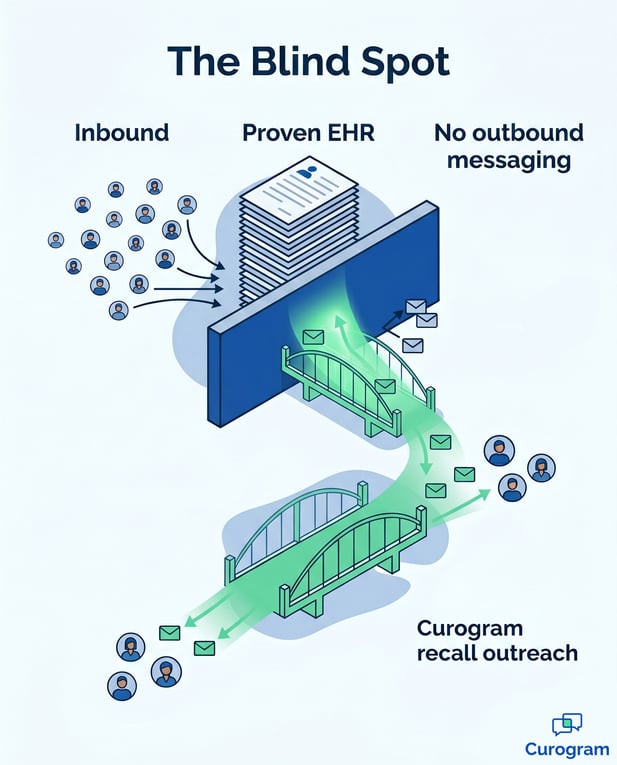


Curogram fills this gap. It runs Proven EHR client recall campaigns for behavioral health over SMS. Staff pick a group of inactive clients. A short, warm text then invites them back to care.
The proof is clear. One multi-location practice brought back 1,240 clients. Its recall texts hit a 35% reconversion rate.
Every message stays HIPAA compliant, SOC 2 Type II certified, and 42 CFR Part 2 compliant. Clients can opt in or opt out at any time, and their choice is always honored.
Your clients did not leave because they stopped needing help. They left because no one reached out.
In behavioral health, that silence carries weight. A missed session can signal relapse, crisis, or quiet disengagement.
Proven EHR is a strong clinical and billing system. It tracks every client who walks through your door. But it has one blind spot. It cannot send a single bulk text to the people who stop coming.
So the names just sit there. Hundreds of inactive clients live inside the database. Staff know these people still need care. Yet calling each one by hand is not realistic with a full schedule.
This gap is bigger than just lost revenue. Dropout in behavioral health is a real clinical event.
Clients who leave early face higher odds of relapse and harm. Each week of silence quietly raises that risk.
The cost piles up in the background. Empty session slots go unfilled week after week. Trusted clients slip out of view. The program then drifts from its core mission of steady care.
None of this means Proven EHR is the problem. It was built for clinical charts, not for outreach.
The fix is not a brand-new system. The fix is a tool that reaches clients where they already are.
There is a simple way to do that. SMS recall campaigns for behavioral health let you reach many clients at once.
A short, kind text can tell people you are still there for them. That single message can pull someone back from the edge.
This is where Curogram comes in. It adds the outreach layer that Proven EHR lacks.
With HIPAA-compliant mass messaging, you can reach dropped-out clients in minutes, not days. The rest of this guide shows you how it works.
The Villain: The Blind Spot – A Database Full of Clients No One Can Reach
Proven EHR does its job well. It logs visits, notes, and billing. But it was never built to reach out. When a client stops coming, the system has no way to call them back.
The Blind Spot Inside Proven EHR
The platform sees your clients, but it cannot speak to them.
A System That Tracks But Cannot Reach
Proven EHR knows who your clients are. It holds their full care history. Yet it offers no bulk text outreach at all. There is no broadcast SMS and no targeted message tool.
So when someone drifts away, the platform stays silent too. The record stays open while the person slips out of view.
The data is right there, but the door stays shut. Nothing nudges that client to come back.
Many teams assume the EHR can text clients. It cannot, at least not in bulk. So outreach falls to staff and sticky notes. That approach breaks down at any real scale.
Dropout Is A Clinical Event
In behavioral health, a no-show is more than an empty slot. It can mean relapse, crisis, or a client in trouble. Dropout rates here run 40% to 60%. That is a huge share of people slipping away.
Each missed session adds risk for that client. Symptoms can return when care stops. Small setbacks can grow into real harm. A quick check-in could change that path, but the system cannot send one.
This is what makes the blind spot so costly. The client most likely to vanish is often the most fragile. Silence is the last thing they need. A caring program wants to close that gap fast.
What The Silence Costs
The price of a quiet database shows up in two clear ways.
Revenue Walks Out The Door
Each inactive client is care that did not happen. It is also income the practice never sees. One by one, those losses add up fast. Empty slots could have held clients who still need help.
Most practices never see the full size of this loss. It hides inside the database, spread across hundreds of names.
The dollars are real, even when they go unnoticed. So is the care that never reaches those clients.
There is a second cost behind the first. Fewer return visits can strain the whole program. Budgets tighten when slots stay empty. Outreach is how you keep both care and revenue steady.
The Lost-To-Care Guilt
Clinical leaders feel this gap deeply. They carry guilt about the people they lost track of.
They know these clients need support. But without a tool to reach them at scale, their hands are tied.
The feeling is hard to shake. You run a program meant to help people heal. Yet you cannot even contact the ones who need you most. That weight stays with caring teams every day.
Good intentions are not enough on their own. Teams need a way to act at scale. Without one, the list of lost clients only grows. The guilt tends to grow right along with it.

The Guide: Curogram – The Re-Engagement Engine
Curogram does not replace Proven EHR. It works beside it. It adds mass messaging to your Proven EHR practice. Think of it as the re-engagement engine your clinical system lacks.
How The Re-Engagement Engine Works
Two simple steps turn a quiet list into real outreach.
Pick A Client Segment
You start in Curogram’s dashboard. There, you choose a group of clients to reach.
Common groups include those inactive for 90 days or more. You can also target SUD program dropouts or missed psychiatry follow-ups.
Each filter is built from your own data. You can sort by last visit date, program, or provider.
This lets you send the right message to the right group. No client gets a note that does not fit their care.
You stay in full control the whole time. You decide who hears from you and when. The dashboard makes each group easy to see. So your outreach is always clear and on purpose.
Send Warm Messages At Scale
Next, you pick a kind, ready-made template. One click sends it to hundreds of clients at once.
This brings behavioral health client re-engagement by SMS within reach. Anyone who replies is routed straight to your scheduling staff.
The tone stays warm, never pushy. The text feels like a check-in from a caring team.
Response tracking runs in the background. You can watch how many clients reply and rebook in real time.
Speed never means cold or generic. You can shape each template to fit the group. A returning client feels seen, not processed. That warmth is what makes people reply.
Built For Behavioral Health From Day One
The fit goes beyond easy setup. It respects the rules of your field.
No Proven EHR API Needed
Setup is simple. Curogram runs as its own communication layer. It needs no Proven EHR API to work. You can be up and running without a heavy tech project.
You can also set recalls to repeat on a cadence. Choose a 30, 60, or 90-day cycle that fits your program. The system then reaches out on its own. Your team stays focused on care, not on chasing lists.
This keeps your IT lift very light. There are no complex builds to manage. Your current Proven EHR setup stays just as it is. Curogram simply adds the outreach you were missing.
HIPAA and 42 CFR Part 2 Built In
Behavioral health has strict rules, and Curogram meets them. Messages are HIPAA-compliant and 42 CFR Part 2-compliant.
For SUD clients, the text never reveals the type of care. Every message is logged for clean compliance records.
Client choice comes first at every step. People can opt in or opt out whenever they want. Each opt-out is honored right away. So outreach stays both safe and respectful.
Audit trails give you proof when you need it. Each message has a clear, time-stamped record. That supports clean compliance reviews. It also gives your team real peace of mind.
The Success: 1,240 Clients Returned to Care
Numbers tell the story best. One multi-location practice put recall texts to work. The results were hard to ignore. A short message brought a wave of clients back.
The Numbers Behind The Recall Campaign
A single round of texts moved the needle fast.
A 35% Reconversion Rate
The practice sent recall texts to inactive clients. About 35% of them booked a session within a month.
That is the reconversion rate from one campaign. One text did what days of phone calls could not.
Think about what that rate means in practice. For every 100 clients reached, dozens came back. No new ad spend drove that result. It came from people the practice had already served.
That kind of return is rare in outreach. Most cold channels see far smaller numbers. The difference here is trust and timing. These were clients who already knew the practice.
1,240 Clients Back In Care
In total, 1,240 clients returned through recall texts alone. These were people who had fallen out of care.
A simple, warm message brought them back. These figures come from Curogram client data from clinical settings.
Behind each number is a real person. Someone who had gone quiet got a reason to return. That is the true value of the campaign. The revenue follows the care, not the other way around.
Scale is the quiet hero of this story. A team cannot call 1,240 people by hand. But one campaign can reach them all at once. That is the power of mass messaging.
|
Recall campaign result |
Outcome |
|
Appointment reconversion rate |
35% |
|
Clients returned to care |
1,240 |
|
Time to launch a campaign |
Minutes, not days |
From A Quiet Database To A Reconnected Program
The bigger win is what those numbers mean for care.
Treatment Continuity Restored
Recovery depends on staying in care. Recall texts close the gap that dropout creates. Clients at the highest risk get a hand back to safety. The program does what it set out to do.
Each return is a chance to prevent harm. A client back in care is a client being watched over. Small check-ins keep symptoms from growing. That is how a recall text protects more than revenue.
Continuity is the goal of good care. Gaps in treatment are where harm slips in. Recall texts help keep clients on track. That steady contact is its own form of safety.
Minutes To Launch, Not Days
Manual calls to hundreds of clients can eat up days. A recall campaign goes out in minutes. Staff spend less time dialing and more time helping. The effort drops while the reach grows.
This is the daily payoff for your team. Client recall for a Proven EHR behavioral health program becomes routine, not a chore.
You set the segment, send the text, and watch replies arrive. The hard part takes care of itself.
The time you save adds up across the year. Staff hours move from dialing to direct care. Clients get faster, warmer contact. The whole program runs leaner because of it.
Conclusion: Your Clients Did Not Leave Because They Do Not Need Help
Your clients did not leave because they stopped needing help. They left because no one reached out.
That truth sits at the heart of behavioral health. The people who go quiet are often the ones who need you most.
Proven EHR will keep doing what it does well. It will track records, notes, and billing with care. But it will not send the text that brings a client back. That is simply not its job.
Curogram fills that exact gap. It makes it easy to re-engage dropped out clients in your Proven EHR program.
Proven EHR holds your clinical records. Curogram holds your client relationships.
A database full of inactive clients is more than a missed chance. In behavioral health, it is a clinical duty. Each name is a person who once trusted your care. Reaching out is part of keeping that trust.
The proof speaks for itself. SMS recall campaigns brought back 1,240 clients in one practice.
A 35% reconversion rate followed a single round of texts. Those gains came from minutes of work, not days.
Recovery is rarely a straight line. People step away and then need a way back. A recall text is that way back, offered with care. It tells them the practice never stopped holding their place.
Your staff feels this shift, too. The guilt of lost clients starts to lift. They finally have a way to act. Caring for people at scale becomes real.
Picture your program a year from now. Fewer clients have quietly disappeared. More of them stay in steady care. The database becomes a living list, not a record of lost names.
The effort to start is small. You do not need new staff or a big budget. You need a segment, a message, and a moment to send it. The system handles the rest from there.
The choice in front of you is simple. You can let inactive clients stay out of reach. Or you can send one text that opens the door. The cost of silence is far higher than the effort.
Together, the two tools make sure no one slips through the cracks. Proven EHR sees who your clients are. Curogram reaches the ones who stopped coming. No client gets lost to silence.
Book a demo and see recall campaigns in action. You do not have to lose clients to silence anymore.
Frequently Asked Questions
They send a short, warm text to clients who have stopped coming. The message invites them back without pressure. Clients who reply are routed to the scheduling staff. The whole process runs from one dashboard.
Proven EHR is built for clinical records and billing. It has no broadcast SMS or bulk outreach tool. So it cannot reach clients who stop showing up. Curogram adds that missing outreach layer.
Messages stay HIPAA-compliant and 42 CFR Part 2-compliant. The text never reveals the type of care a client receives. Each message is logged for clean records. Clients can also opt out at any time.
You segment clients inside Curogram’s dashboard. Common filters include last visit date, program type, or provider. Many practices target clients inactive for 90 days or more. Each segment can get its own message.
In behavioral health, dropout is a clinical event, not just lost income. Clients who leave early face a higher risk of relapse and crisis. A timely text can restore care before things get worse. It also helps the practice fulfill its mission.