

8 min read

Text Brings BH Clients Back to Care | Curogram

Text Brings BH Clients Back to Care | Curogram
💡To re-engage behavioral health clients who dropped out of treatment, send SMS recall campaigns. A text reaches clients on the phone they already carry. There is no app, no portal, and no call they might dodge.

Most clients do not leave because they have stopped needing care. They leave because barriers pile up. A warm, brief text cuts through those barriers and reopens the door.

One multi-location practice brought back 1,240 clients this way. Its SMS recalls earned a 35% reconversion rate. All messages stay HIPAA and 42 CFR Part 2 compliant.

For clients who left due to stress, shame, or crisis, a simple text is often enough. It meets them where they are today and invites them back to care.

A client stops showing up. Weeks pass. Then months go by. No call, no message, and no sign of why they left.

In most fields, that is just a lost booking. In behavioral health, it can mean far more. A client who left three months ago may be in crisis today. Your practice has its number, yet no one reaches out.

This is the quiet problem at the heart of care. Clients rarely leave because they feel better or no longer need help. They leave because life got hard and barriers stacked up. Stress, shame, money, and time pile on at once.

Phone calls do not scale. Calling hundreds of inactive clients by hand is simply not possible. So the silence grows, and good people slip through the cracks every single week.

There is a better way to handle this. You can re-engage behavioral health clients who dropped out of treatment with SMS. A short, kind text meets them on the device they already hold. It asks for nothing but a reply.

This works because it lowers the barrier to almost zero. There is no waiting room, no login, and no awkward call. It is just a message that says you are still here for them.

The results speak for themselves. One multi-location practice used SMS recalls to bring back 1,240 clients. Its campaigns hit a 35% reconversion rate, based on Curogram client data from clinical settings.

That is the real power of reaching out. A simple text can restart treatment, recover revenue, and even prevent a crisis. It does all of this without pressure or judgment.

This article shows why clients drop out and how a text brings them back. You will see what to say, when to send it, and why it works so well. Let us begin.

The Villain: The Barrier Buildup – Why Clients Leave Treatment

Clients rarely vanish on purpose. They leave because hurdles build faster than they can manage.

Knowing those hurdles is the first step to bringing people back. Here is what really drives behavioral health dropout, and where SMS can help.

Life Gets in the Way

Instability Disrupts Routines

Life rarely stays still for long. A lost job, a move, or a breakup can upend any routine.

Therapy is often the first thing to fall away. When the week falls apart, the session slips too.

These shifts are rarely about the care itself. The client still needs support just as much as before.

But the calendar gets messy, and old habits break. Soon, the missed sessions turn into months of silence.

A practice can do little if it stays quiet, too. The longer the gap grows, the colder the trail feels. A timely nudge can stop that slow drift. It catches the client before the gap hardens.

Symptoms Rise and Fall

Mood shifts also pull clients away from care. Some feel better and assume they are done with treatment.

Others feel worse and lack the drive to show up. Both paths lead to the same empty chair.

This rise and fall is normal in recovery. Yet it often goes unspoken once a client stops coming. A gentle text can reach them during either dip. It reminds them that the door has not closed.

No one expects the client to explain the gap. The note simply checks in with warmth and care. That low bar is what makes it work. It turns a hard step into an easy one.

Then the Silence Sets In

Barriers Stack Up

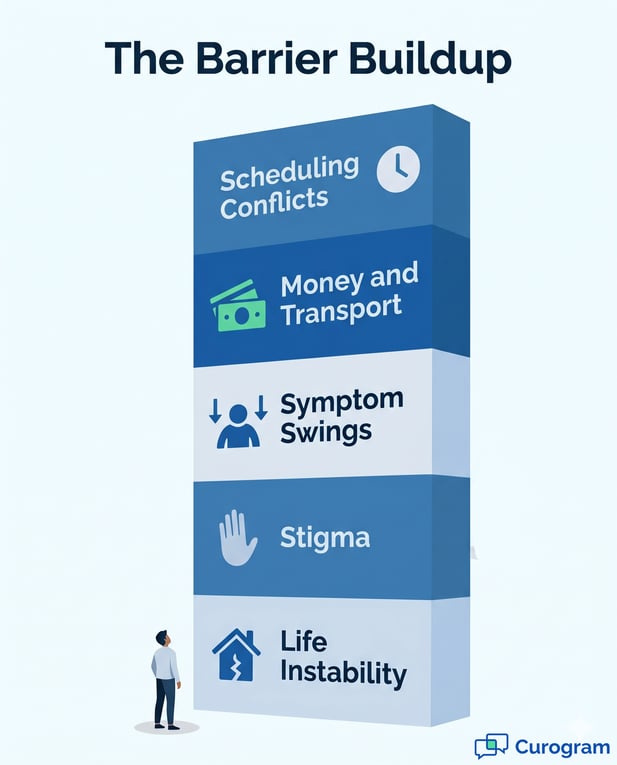
Single hurdles are rarely the whole cause. Stigma, gas money, childcare, and odd work hours all add up.

Each one is small, but together they feel like a wall. The client decides it is easier to just stop.

Shame can be the heaviest weight of all. Ongoing therapy or addiction care still carries a social stigma.

Over time, that quiet pressure builds and builds. It chooses to return feels even harder.

No One Reaches Out

Here is the part that stings the most. The practice has had the client's number all along. Yet without a tool to text at scale, no one sends a word. So the door stays shut, and the client stays gone.

This is exactly where behavioral health dropout re-engagement through SMS changes the story.

A single, scalable text can break the silence at last. It reaches many lost clients at once, not one slow call at a time. The path back finally reopens.


Barriers to behavioral health care: life instability, stigma, scheduling, and money

The Guide: Curogram – One Text, One Door Back to Care

So how do you reopen that door for good? You send one warm text from a number the client may know.

Curogram makes this simple, even across thousands of clients. Here is how a single message brings people back to care, step by step.

A Warm, Simple Message

What the Text Says

The message itself is short and kind. It might read that you have been thinking of them and are here whenever they are ready. There is no blame in the words and no clinical talk. It simply opens a door.

Tone matters as much as content here. The text comes from the practice number a client may recognize. That small touch makes the note feel personal, not spammy. A reply takes only a few seconds to send.

The aim is to feel like a person, not a form. Short words and a soft tone do most of the work. The client should sense real care behind the note. That feeling is what earns a reply.

No Pressure, No Clinical Talk

Notice what the text leaves out on purpose. It never says you missed your session. It names no program, no diagnosis, and no label. This protects the client and keeps the message warm.

This is how you re-engage therapy clients with a text message that feels human. The goal is to lower the wall, not add to it. So the words stay soft, plain, and free of judgment. The client decides the next step on their own terms.

Clinical phrases can scare a hesitant client off. Plain, kind words do the opposite instead. They make the return feel safe and simple. That is the whole point of the message.

Built to Work With Proven EHR

Responses Route to Scheduling

A reply does not vanish into a void. Recall texts live in Curogram's dashboard, right beside Proven EHR.

When a client answers, the message routes straight to scheduling. Staff book the session and handle the rest.

Curogram does not replace your Proven EHR system. It adds the outreach layer that Proven EHR alone lacks.

Your clinical records and billing stay right where they are. The two tools simply work better side by side.

Meeting Clients Where They Are Now

A text meets clients in their life today, not the one they left. For those who stopped due to shame or crisis, this matters a lot. A non-judgmental note is the lowest-barrier path back to care. It asks nothing more than a tap.

That is why a simple text can re-engage dropped-out clients so well. It fits the messy reality of how people actually live. No one has to relive why they left or explain themselves. They just step back through an open door. 


The Success: 35% Come Back When You Reach Out

Does a simple text really work in practice? The numbers say yes, and they say it clearly.

When practices reach out, a large share of clients respond. Here is the proof, and the SMS recall behavioral health client experience behind it.

The Numbers Behind the Reach-Out

35% Reconversion Rate

The result is hard to ignore. More than a third of contacted clients booked again.

That is a 35% reconversion rate from SMS recall campaigns. Each return marks a treatment plan resumed, based on Curogram client data from clinical settings.

Think about what that rate means at scale. For every 100 inactive clients texted, about 35 come back. That is care restored for dozens of people at once. No phone tree could match that speed or reach.

The math keeps working as the list grows. A larger group means more clients back in care. Each text costs little time to send. The return on that effort is hard to beat.

1,240 Clients Back in Care

Behind that figure sits a real, human count. One multi-location practice brought back 1,240 clients.

Each one is a person who had slipped away from care. Each return may be a crisis quietly averted.

These are not just rebooked slots on a calendar. They are people who needed help and got a way back. The text did not push or pry into their lives. It simply offered a door and let them choose.

That choice is what makes the count matter. No one was forced or pressured to return. They came back because the timing felt right. A single text gave them that chance.

Recall Result

Figure

SMS recall reconversion rate

35%

Clients returned to care

1,240

Outreach speed

Minutes, not days

Source: Curogram client data from clinical settings.

From Silence to Reconnection

A Critical Window Reopens

Timing carries real weight here. Clients who answer a recall re-enter care at a key moment.

The simple act of reaching out shifts their whole path. That is how a text brings clients back to treatment.

A client in a low spot may be hard to reach. A kind text can land right when they need it. It turns a moment of doubt into a booked session. That window can change the course of recovery.

Revenue and Outcomes Recover

The wins stack up on every side at once. Revenue returns as empty slots fill again. Clinical outcomes improve as steady care resumes. These gains shape the SMS recall behavioral health client experience.

The practice also fulfills its core mission. It reaches the very people who needed it most. Staff feel that relief, too, when lost clients return. One small text sets all of this in motion.

Candid close-up of an adult holding a smartphone outdoors with a calm, hopeful expression

Conclusion: Sometimes All It Takes Is a Text

Behavioral health clients rarely leave because they have stopped needing care. They leave because barriers piled up faster than they could clear.

Stress, stigma, money, and time all closed in at once. Then the silence followed, and no one reached back.

A simple text can break that silence for good. It meets the client on the phone already in their pocket.

It asks for nothing harsh, only a reply when they are ready. This is how a text brings clients back to treatment.

Proven EHR remembers every client who has walked through your door. It tracks their history, their care, and their billing with skill.

But it has no built-in way to reach those who stopped coming. That gap is where good intentions quietly stall.

Curogram fills that exact gap. It sends warm, brief recalls to inactive clients at scale. Responses route straight to your team, ready to book. Together, the two tools mean no client is truly lost to care.

Scale is the part that makes this real. You can reach hundreds of clients in minutes, not days. The work that once took weeks now takes one campaign. No one gets buried at the bottom of a call list.

The proof here is plain to see. One practice brought back 1,240 clients with simple texts. Its recalls reached a 35% reconversion rate. Those are not just numbers; they are people back in care.

Think about what that really means in practice. A client in crisis gets a lifeline they did not expect. A treatment plan resumes at just the right moment. A practice lives out the mission that drew it to this work.

Staff feel that shift, too, in a real way. They no longer carry guilt over clients they lost track of. They finally hold a tool that reaches people at scale. The whole program feels reconnected to its purpose.

Every recall also stays safe and private. Messages skip the diagnosis, the label, and the program name.

They honor each client's opt-out choice by default. Compliance and care move together, not apart.

Your clients did not leave because they stopped needing help. They left because no one reached out at the right time. You can change that with one short, kind message. Sometimes all it takes is a text.

Book a demo and see how Curogram completes your Proven EHR practice. 


Frequently Asked Questions

How do recall texts protect a client's privacy?

Recall texts leave out treatment type, diagnosis, and program name. A typical note simply says you have been thinking of them and are here when they are ready. This keeps messages 42 CFR Part 2 compliant for substance use care. Privacy stays intact while the door reopens.

How can clients opt out of recall messages?

Clients can reply to opt out at any time. Their choice is respected right away and saved for next time. Every campaign honors existing opt-out preferences by default. Consent stays automated and HIPAA and TCPA-compliant.

How soon after dropout should you send a recall text?

A tiered cadence works best for most programs. Many practices use 30-day, 60-day, and 90-day touch points. The right timing depends on your program and your client base. Curogram supports recurring schedules for each group.

Why does a simple text work better than a phone call?

A text lowers the barrier to almost nothing. There is no voicemail to dread and no live talk to brace for. Clients reply on their own time, with a single tap. That ease is why a simple text can re-engage dropped-out clients.

Why do clients leave behavioral health treatment at all?

Most clients leave because barriers build, not because they are well. Housing, jobs, stigma, and money troubles all add up fast. Some feel better and assume they are finished too soon. A kind text meets them where they are and invites them back.