No-Download Notenetic Telehealth for Behavioral Clients
💡 No-download telehealth for Notenetic behavioral health clients removes the four-step portal login that makes sessions fail in the final two...
6 min read
Aubreigh Lee Daculug
:
June 27, 2026
Your front desk coordinator has one quiet job in the five minutes before a telehealth session: keep the morning moving. Triage the inbox. Prep the schedule. Greet the new intake.
Then the phone rings.
It's a client trying to join her 10:00 session, and she can't remember her portal password.
So the coordinator drops everything. She walks the client through a reset, step by step, while the clock keeps ticking. The session starts at 10:00 whether or not the reset finishes.
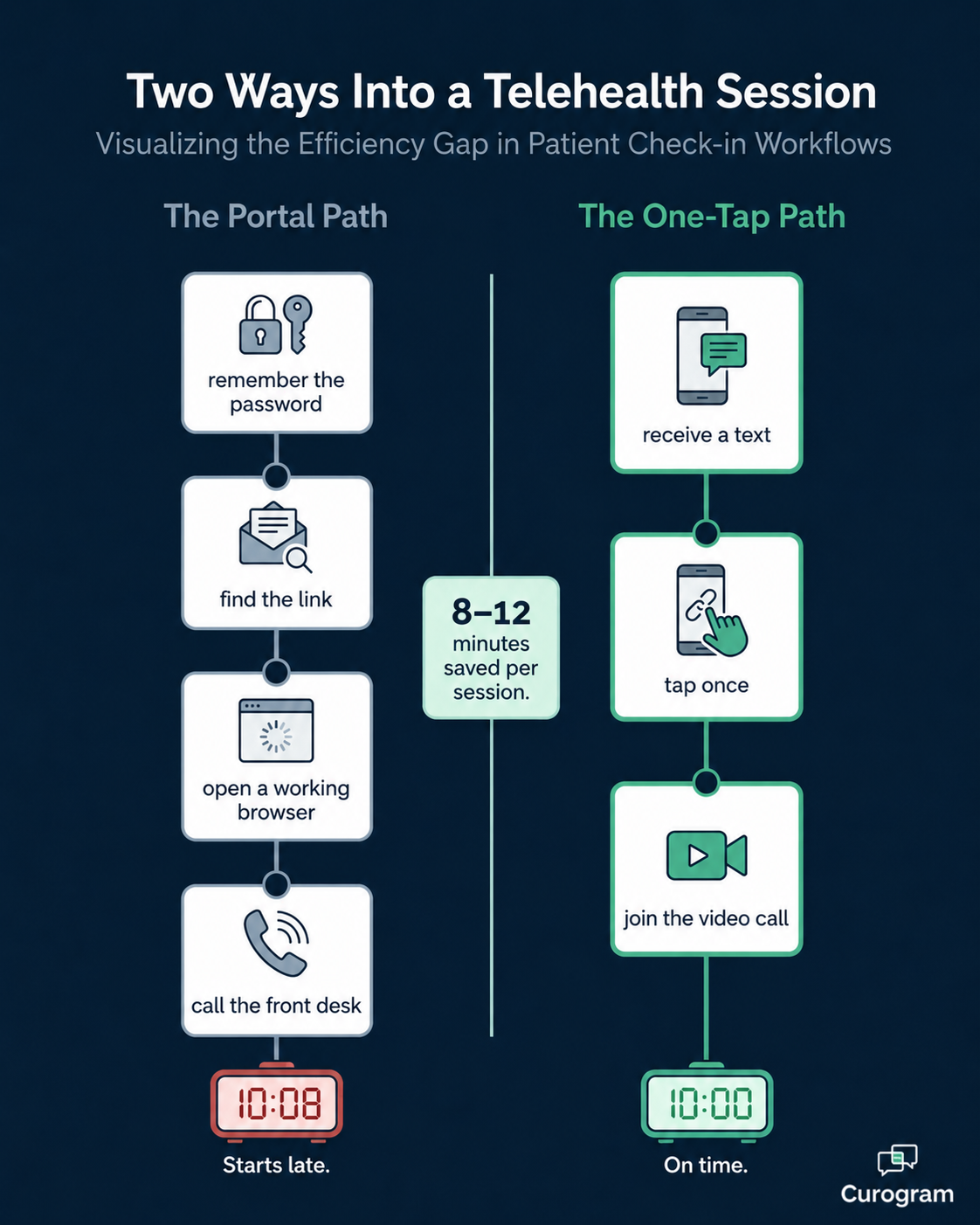
By 10:08, the client is rattled, the coordinator is behind, and the clinician has been watching an empty waiting room for eight long minutes.
This is the daily reality for many behavioral health practices. Notenetic's integrated telehealth video works beautifully once a session starts. The trouble isn't the video. It's the portal steps that sit between the client and the room.
Those steps land squarely on your staff. Forgot the password. Can't find the link. The browser won't cooperate.
Each one becomes a pre-session call in the worst possible window of the day.
It sounds like a small annoyance. It isn't.
A late telehealth start isn't only a scheduling hiccup. For trauma-informed work or medication management, those first minutes set the tone for the whole session. Lose them, and you lose pacing you can't easily win back.
The good news: this friction is fixable, and you don't have to replace Notenetic to fix it. You simply need to remove the access steps that turn coordinators into tech support, without touching the clinical side.
In this article, you'll see how a simple SMS launch reshapes the entire pre-session routine. It gives your behavioral health staff back the calmest, busiest five minutes of the day.
And it lets your clients walk into care on time, every single time they log on.
Every behavioral health telehealth coordinator workflow has the same weak point at session start, and it shows up at the same moment each day. A client tries to launch her session, hits a login wall, and reaches for the phone.
The Notenetic telehealth session itself is fine. The friction lives entirely in the steps before it.
Notenetic's native video is a real strength, and it's worth saying plainly. Once a session launches, the clinical experience holds up. Clients get clear audio and a stable room. The platform does its job.
The breakdown happens upstream, before the video ever loads.

To reach that room, a client has to clear three small hurdles:
Miss any one of them, and the only fast fix is a call to your front desk.
That call always seems to arrive at the worst time. It lands five minutes before the hour, when your coordinator is least free to take it.
Now multiply it. A practice running 30 telehealth sessions a week absorbs roughly 5 to 10 of these calls.
It doesn't sound dramatic on its own. But this is the telehealth front desk burden no one schedules for, and it strikes during the minutes your staff can least spare. It also pulls focus away from the clients standing right in front of them.
The clinical cost is harder to capture in a single number. A session that starts at 10:08 instead of 10:00 isn't just late. For behavioral health, it's a pacing problem that follows the clinician through the whole hour.

The fix isn't a new platform. It's a thin layer that sits beside Notenetic, removes the access step for the client, and lifts the tech support call off your coordinator's morning. Curogram plays that role as a session-launch layer.
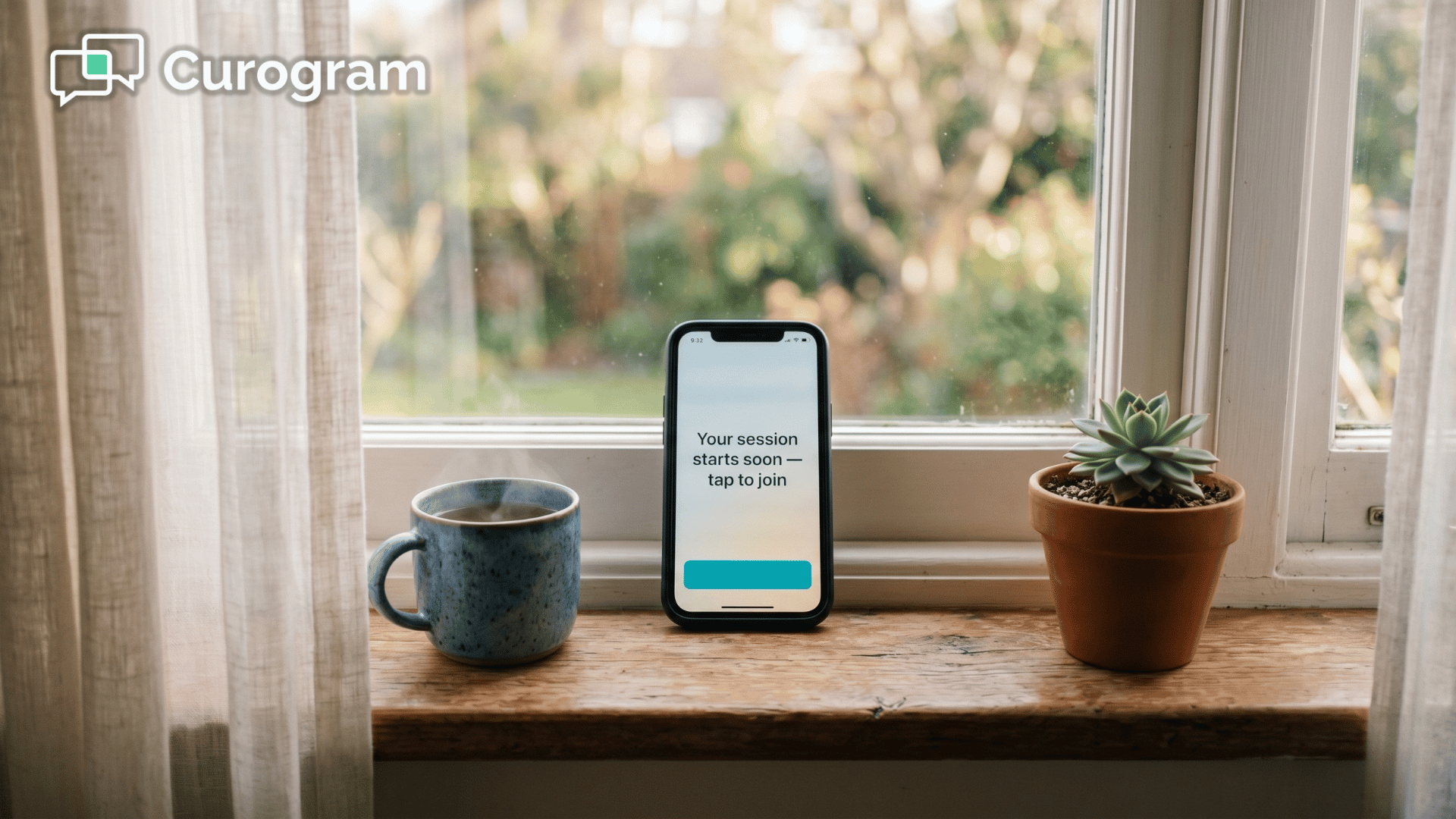
Curogram sends a HIPAA-compliant SMS 15 to 30 minutes before the appointment.
The message is short and human:
"Your 10:00 session with Dr. Chen starts soon. Tap here to join."
One tap drops the client straight into Notenetic's native video room. No portal. No password. No app to download.
8–12 minutes saved |
| The length of each pre-session call that one tap erases |
This is the part staff worry about, so let's be clear. The Notenetic video session launch your staff already use stays exactly the same. Clinicians join the same rooms, the same way they always have.
The change happens entirely on the client side, which keeps the Notenetic virtual session workflow intact for your care team.
Notenetic doesn't currently expose a public API, so the launch link is configured against the appointment list kept in Curogram and points to the Notenetic session. Practices that want to keep telehealth on the EHR can do exactly that.
The text itself rides on Curogram's 2-way HIPAA-compliant texting channel — the same thread that carries your appointment reminders.
The message body never contains PHI. It carries only a secure link.
For substance use programs serving clients under 42 CFR Part 2, the text is fully configurable to drop any treatment-specific language, so it reads as a neutral session reminder. Privacy stays protected while access gets easier.
When the login step disappears, the numbers move in a direction you can feel. Curogram clients average 53% below industry no-show rates across all specialties. Psychiatry-specific clients run even lower, at 11.03% against a 23% industry average.
That 12-point gap isn't an accident. Psychiatry leans heavily on telehealth, so access friction hits it hardest. Closing that gap is largely the difference between SMS-launched sessions and portal-launched ones.
For your team, fewer no-shows means fuller schedules and steadier revenue.
The day-to-day shift is just as real.
Those 5 to 10 weekly calls drop to 1 or 2 — the genuine exceptions that still need a person:
Everything else resolves with a single tap, long before the call would have come in.
Your coordinator recovers 1 to 2 hours a week. More importantly, she reclaims the worst five-minute window of the day for clinical-support work instead of password resets. That's a real gain in mental health practice telehealth efficiency, and it compounds across every session you run.
The whole pattern changes. Instead of bracing for a scramble before each appointment, your staff handle a handful of true exceptions while most clients simply tap once and walk in. This is what therapy practice tech support telehealth should look like: rare, not routine.
In practice, you stop grading your front desk by tickets closed and start grading it by clients who joined on time.
Here's the simple version. Notenetic's video is the strength. The access steps in front of it are the problem. Curogram removes those steps so your coordinators stop moonlighting as pre-session tech support.
Think about what that minute before the hour is really worth.
Right now it's spent on password resets and login walls. It could be spent greeting clients, steadying the schedule, or supporting the clinical team — the work only a person can do.
The pairing is what makes it click. Notenetic runs your video sessions. Curogram runs your clients' friction-free way into them. Together, behavioral health telehealth starts to feel like an attended modality, not a tech-support exercise.
And the proof is already on the board. Curogram clients average 53% below industry no-show rates, with psychiatry clients at 11.03% versus the 23% average. Those aren't just cleaner numbers.
They're fuller schedules, steadier revenue, and sessions that begin right on time.
You don't have to rip anything out to get there. Notenetic stays. Your clinical workflow stays. Clients who prefer the portal keep it.
Curogram simply adds a one-tap lane for the large majority who would rather text than troubleshoot their way into a session.
So change what you measure. Stop counting tech-support tickets closed. Start counting the clients who walked into their sessions on time, calm, and ready for the work ahead. That is the metric that actually reflects good care.
That's the shift waiting for your front desk, and it doesn't require a long-term contract to try.
Ready to see it work with your own practice? Schedule a Demo and watch a client join a Notenetic session in a single tap. In a few short minutes, you'll see exactly how the morning scramble disappears — and how much of your team's day comes right back with it.
No. Clinicians keep joining the same Notenetic video sessions they already use, the same way they always have. The change is entirely on the client-access side. Instead of navigating the portal to find and tap the session link, the client gets an SMS with a one-tap link that opens the same Notenetic video room.
Yes. Curogram is HIPAA-compliant, SOC 2 Type II certified, and signs a Business Associate Agreement with every practice. The SMS carries only a secure session link, never PHI in the message body. For clients under 42 CFR Part 2, the text is configurable to omit treatment-specific language and read as a neutral session reminder.
Yes. Curogram is an added access channel, never a forced one. Clients who can't or don't want to use SMS keep launching sessions through the Notenetic Client Portal exactly as they do today. You lose no existing capability; you simply add one-tap access for the large majority who benefit from it.
No. Because Notenetic doesn't currently expose a public API, the launch link is configured against the appointment list maintained in Curogram, with the URL pointing to the Notenetic session. Practices that prefer to keep telehealth on the EHR can do exactly that, with no integration build required on your side.
The session-launch SMS typically sends 15 to 30 minutes before the appointment, and that timing is configurable per practice. It rides on the same thread as your appointment reminders, so clients get one clean, familiar message flow instead of scattered notifications from different systems.
💡 No-download telehealth for Notenetic behavioral health clients removes the four-step portal login that makes sessions fail in the final two...
💡 Behavioral health clients pay their phone bill, their electric bill, and their rideshare receipts by tapping a link on their phone. SMS payment...
💡 Looking for a Notenetic client portal alternative? SMS messaging for mental health clients works because it meets people where they already are —...