
Notenetic Text-to-Pay for Behavioral Health Practices
 Aubreigh Lee Daculug : Jun 24, 2026, 9:00:00 AM
Paper statements collect 20%. Curogram's SMS pay links with Notenetic settle balances in 30 seconds—no awkward ask.
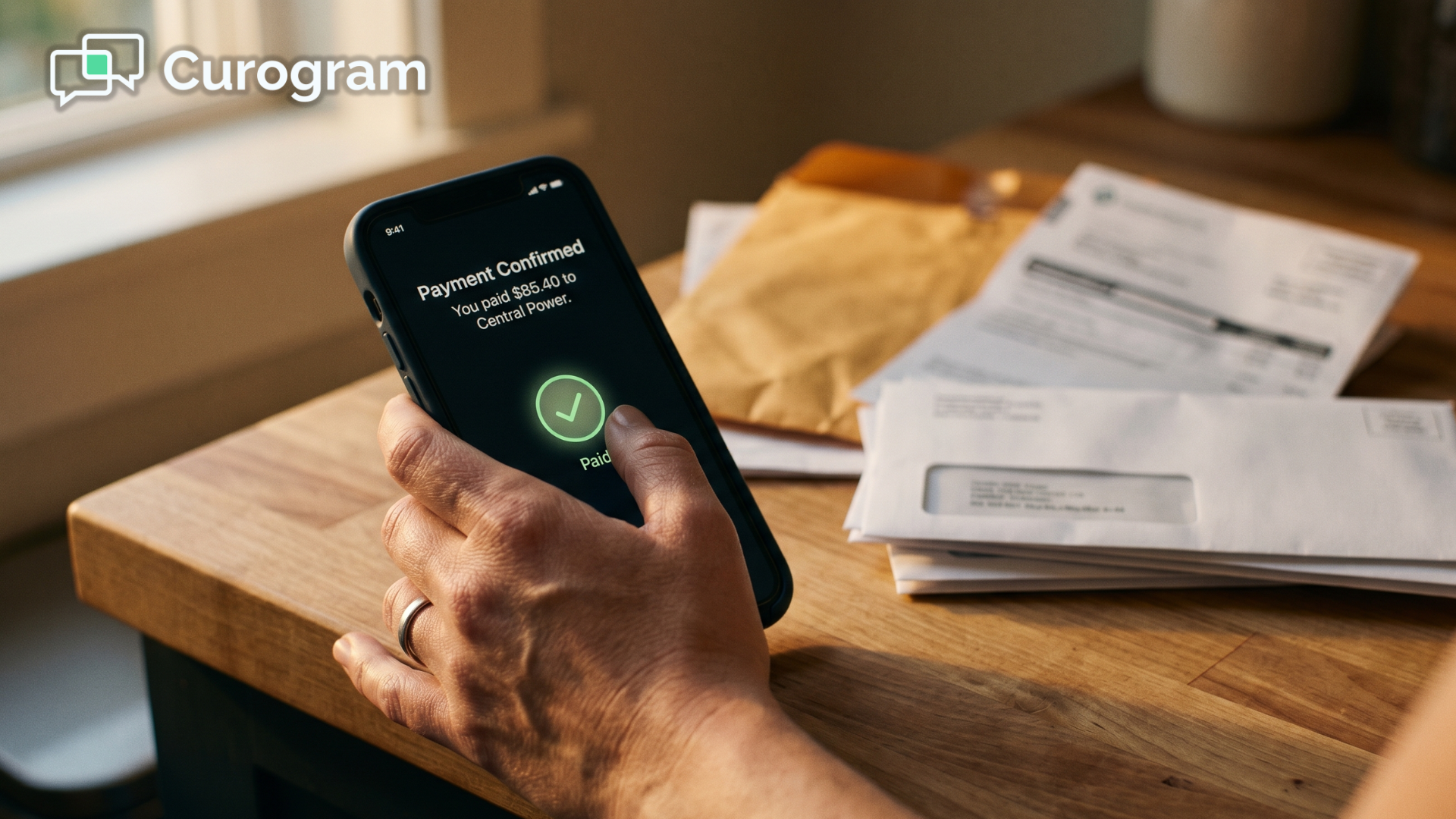
A client leaves her therapy session fully intending to pay. She nods when the coordinator mentions the $40 balance. Then life happens.
The paper statement lands on the kitchen counter under a stack of school forms. The portal reminder arrives weeks later, and she cannot remember her password. Three months pass, and the balance ages into a 90-day bucket. She still fully intends to pay.
This is the quiet gap that drains behavioral health practices. Not unwilling clients — willing ones, stuck in a billing system that does not match how they live.
Here is the strange part.
That same client paid her phone bill last Tuesday by tapping a text. She paid her electric bill through her bank app. She has not written a paper check in years.
So why does settling a therapy copay still feel like a chore from a decade ago?
The answer is friction. Every portal login, forgotten password, and mailed envelope adds a small mental tax. For mental health practice client billing, that tax hits harder than it looks, because clients managing anxiety or recovery carry it on top of everything else.
The result is money you earned but never collected.
Curogram's Text-to-Pay closes that gap. It works beside Notenetic and sends a secure SMS payment link the client taps once, settling the copay in under 30 seconds on the phone she already uses for everything. That one change can move a balance from someday to settled, on the client's own timeline.
This article breaks down why portal-and-paper collection fails behavioral health clients, how a text-based channel fixes it, and what a smoother flow means for your bottom line.
Let's start with the real villain here — the one your own clients quietly fight every single billing cycle.
The problem is rarely the money. It is the path to paying it. When the path has too many steps, even willing clients fall off it. Here is how that breakdown actually unfolds.
A psychiatry client leaves her medication appointment with a $40 copay due. She fully intends to pay, and she nods when staff mention the balance.
Two weeks later, the paper statement hides under the school forms.
A month later, the portal reminder arrives and she has forgotten her password. Three months later, the balance sits in a 90-day-aged bucket — and she still intends to pay.
The same client paid her phone bill last Tuesday by tapping a text link. She paid her electric bill through her bank app the week before. She has not written a paper check in three years.
Notenetic's portal-and-paper follow-up asks her to operate in a billing world that no longer matches the rest of her life. That mismatch is the friction.
For clients managing anxiety, depression, or active substance use treatment, the mental overhead is real. Remembering a password, finding a statement, and writing a check is a heavy lift.
Behavioral health clients are not less willing to pay. They are simply more burdened by the channel. This is why anxiety-friendly billing matters — the easier the path, the more clients complete it.
For substance use treatment clients governed by 42 CFR Part 2, privacy is not optional.
A paper statement from a recognizable treatment program in a shared mailbox is a real confidentiality risk.
A portal alert labeled with the program name is a flag for anyone glancing at the phone.
Protecting substance use treatment payment privacy means using a neutral, quiet channel instead. A plain text payment link gives away nothing.
So what does the fix look like in practice? It is not a new portal or a louder reminder. It is a channel that matches what your clients already do every day.
Curogram works as a HIPAA-compliant SMS layer beside Notenetic. Its Text-to-Pay feature lets clients pay therapy copay by text in a flow that feels familiar from the first tap.
Here is how it works:
No portal, no statement, no envelope, no check. That is what an easy copay payment looks like when the channel finally matches the client.
The compliance side holds up too. For 42 CFR Part 2 clients, the message is configurable to drop any treatment-specific language, so it reads as a neutral balance notice from a generic sender.
The link reveals nothing on a glance, and the transaction runs on PCI-compliant payment infrastructure.
There is a therapeutic benefit hiding in here as well. The money conversation no longer interrupts the clinical one, because the balance settles after the session, on the client's own schedule. The relationship stays focused on care, not collections.

Here is the part that matters for your numbers.
When you remove the login barrier, more clients finish paying — and they finish faster. The shift shows up in both collection rates and the behavioral health client payment experience.
| Collection method | Typical conversion | Steps for the client | Privacy on a shared device |
|---|---|---|---|
| Paper statement | As low as 20% | Open mail, write check, mail it back | Program name visible in mailbox |
| Client portal | Low to moderate | Find login, reset password, navigate | Program name visible on screen |
| SMS payment link | Routinely higher | Tap link, pay in 30 seconds | Neutral text, nothing revealed |
Text-to-pay consistently outperforms portal-based collection because it removes the login entirely.
So what does that lift actually mean?
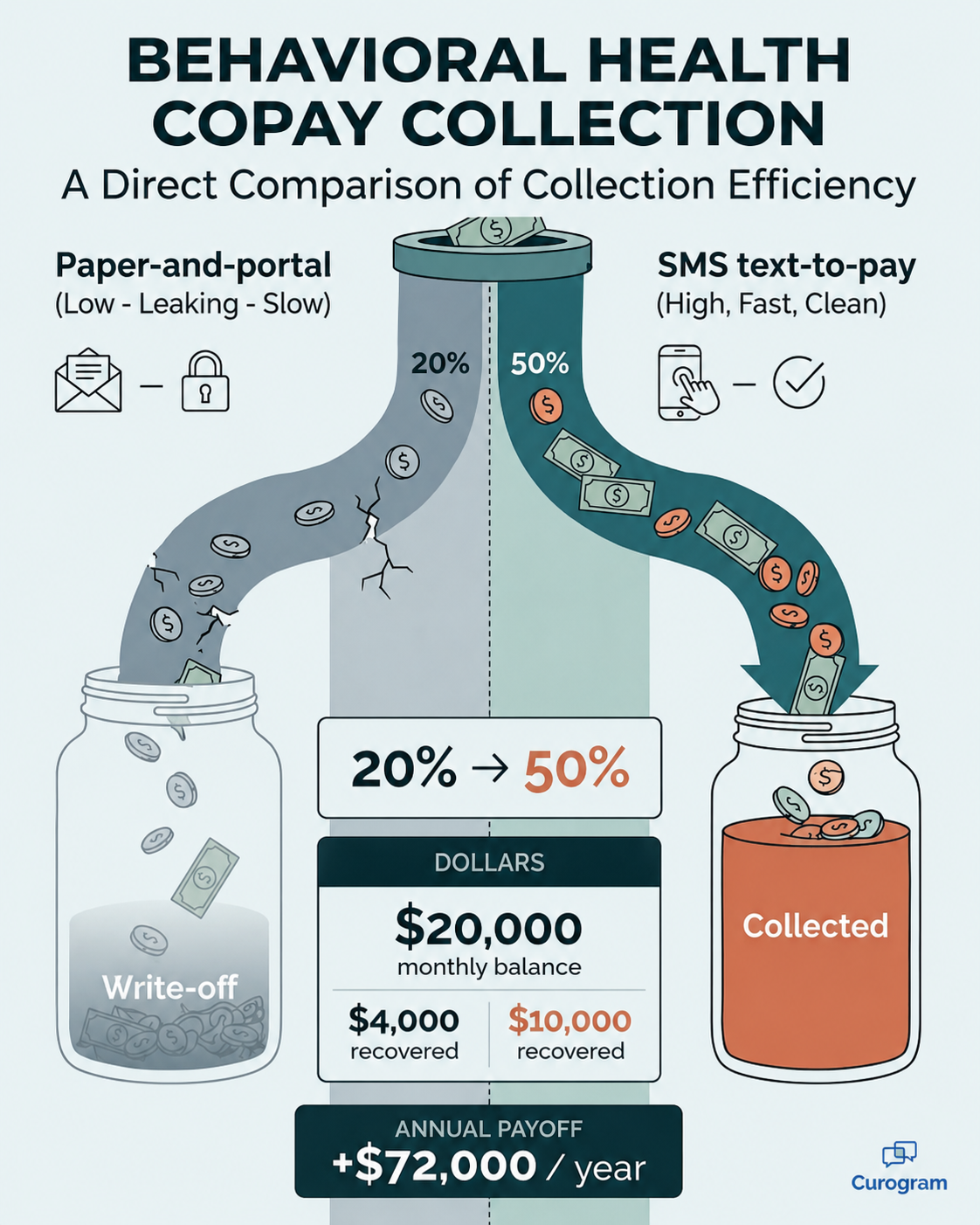
Let's run a simple example. Say your practice carries $20,000 in outstanding behavioral health balances each month. At a 20% paper-statement rate, you recover about $4,000, while the other $16,000 ages and often becomes write-off.
Now move that follow-up to text. Even a conservative jump to 50% recovers $10,000 a month. That is $6,000 in new monthly revenue, or roughly $72,000 a year — from balances you already earned but could not collect.
For your team, the win is bigger than cash. Fewer aged balances mean fewer awkward in-session money talks and less time chasing statements.
The therapeutic relationship stops carrying the small tax of an unsettled bill.
Text-to-Pay fixes the billing step. But it works best as part of a bigger pattern — meeting clients on their phone at every step, not only at checkout.
Think about the full arc of a client's time with your practice. They book a visit, fill out intake, get reminders, and pay a balance. When only one of those steps lives on their phone, the rest still feels clunky by comparison.
The fix is consistency. When the whole journey runs through one simple channel, every interaction starts to feel familiar and easy.
The same tap that settles a copay can also handle the moments around it:
That consistency is what clients remember. A practice that texts the way they already live feels organized and easy to deal with.
Curogram lets you offer that same low-friction feel across booking, forms, reminders, and payments — one channel, one habit, and far less friction for your team.
Behavioral health clients are not reluctant to pay. They are reluctant to log in to pay. That is a channel problem, not a willingness problem — and channel problems are fixable.
Notenetic is built to hold your record of the balance. Curogram is built to give clients a frictionless way to clear it. One tracks what is owed. The other makes settling it feel like paying any other bill in their life.
The payoff runs in two directions at once. The therapeutic relationship stops carrying the awkward money conversation. The balance sheet stops carrying the aged receivable.
And the experience your client feels is night and day. No more "where did I put that statement." Just a quick text, one tap, and done in 30 seconds.
This matters most for your most sensitive clients. For substance use treatment, a neutral text link protects privacy in a way a labeled portal alert or mailed statement never can. For clients managing anxiety, the lighter path is the one they actually finish. Protecting confidentiality and reducing administrative friction are no longer competing priorities.
So here is the simple ask. Stop expecting behavioral health clients to operate in a paper-and-portal billing world their daily life left behind a decade ago. Meet them where they already pay everything else.
You earned those balances. Your clients want to pay them. The only thing standing in the way is the path you offer.
Give them a path that takes 30 seconds and feels familiar, and watch how many more of them follow it to the end.
Ready to see it work with your behavioral health practice? Schedule a Demo and we will show you exactly how text-based collection fits beside Notenetic. No long-term contract — just a simpler, clearer way to get paid.
 Aubreigh Lee Daculug : Jun 24, 2026, 9:00:00 AM
Paper statements collect 20%. Curogram's SMS pay links with Notenetic settle balances in 30 seconds—no awkward ask.
 Aubreigh Lee Daculug : Jun 24, 2026, 1:00:00 PM
Paper statements collect 20%. Curogram's SMS pay links recover Notenetic balances while protecting the therapeutic alliance.

 Jo Galvez : Aug 19, 2026, 12:00:00 PM
Paper statements collect ~20%. Text-to-pay links clear BH copays and balances in seconds — no portal, no awkward ask. Book a demo.