
Notenetic SMS Copay Payment for Behavioral Health Clients
 Aubreigh Lee Daculug : Jun 24, 2026, 11:00:01 AM
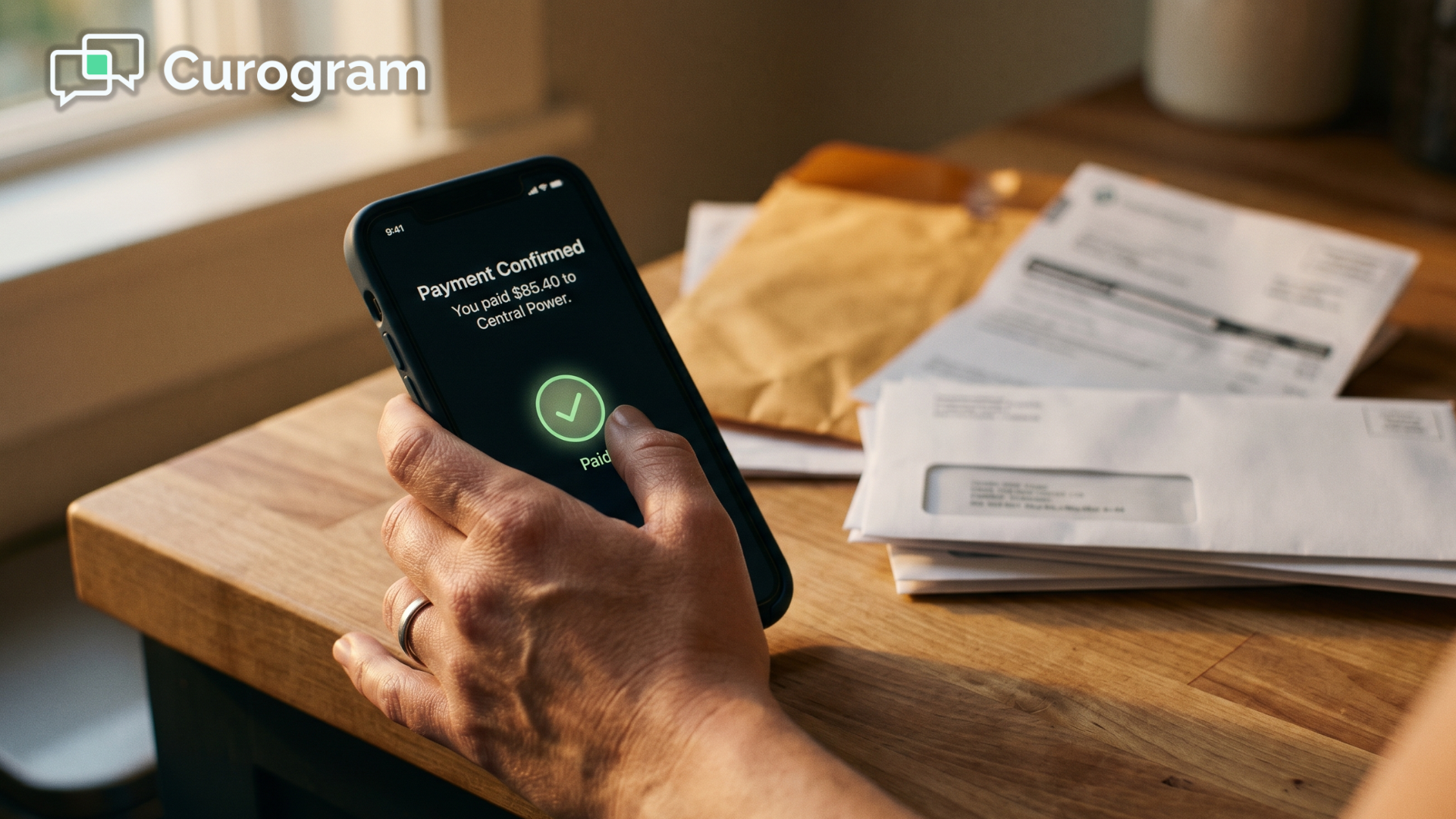
Clients pay phone bills by text. Curogram SMS links with Notenetic let them pay therapy copays in 30 seconds.
The session runs long. Your client just worked through something heavy — a panic spiral, a relapse, a memory they had buried for years. The hour ends. And now you have to ask them for $40.
It feels wrong. In a way, it is. You spent fifty minutes building trust, and the last thing they hear is a request for money.
This is the part of behavioral health billing nobody trained you for. The copay is not the problem. The asking is.
It sounds like a small thing. It is not.
So most practices avoid it. They skip the in-person ask and mail a paper statement, or they point the client to the portal and hope they log in.
Both routes leak money. Paper statements convert at rates as low as 20%, while costing $800–$1,000 a month to send. The portal does a bit better, but the login stops people cold.
Meanwhile, the balances pile up.
A copay that goes unpaid in the first 30 days has a 70–80% chance of aging into bad debt. You feel it most with the clients who can least afford another bill. For a practice carrying $5,000–$15,000 in monthly outstanding balances, that is real revenue slipping out the back door.
Notenetic recently added native payments, which helps a lot at checkout. But the follow-up — the balance owed after the visit — still runs through that same portal-and-paper loop. The gap never closes on its own.
That gap is exactly what Notenetic text-to-pay for behavioral health practice billing is built to close. Curogram runs alongside Notenetic, sending a secure text link the client taps and settles in under 30 seconds.
The awkward ask leaves the room. The revenue stays.
Here is how it works — without pushing harder on clients already managing financial stress.
In most of healthcare, asking for a copay is routine. In behavioral health, it is not.
You just spent fifty minutes with a client working through trauma, suicidality, or substance use. Then you have to switch gears and ask for money. It is jarring — for you and for them.
Therapists feel weird asking. Clients feel weird being asked. The trust you worked to build takes a small hit every time. This is what behavioral health copay collection really costs, and it carries a weight it never has after a routine physical.
Notenetic's native payment feature is solid for the moment of checkout.
The trouble starts after the visit, when balance follow-up runs through one of two channels — and neither works well:
That login barrier is the same one that quietly suppresses portal messages and intake forms across the rest of your workflow. The Notenetic outstanding balance workflow leaves a real gap between "balance owed" and "balance paid."
Here is what those channels actually return.
| Collection method | Typical conversion | Monthly cost |
|---|---|---|
| Paper statements | As low as 20% | $800–$1,000 |
| Portal payments | Better than paper | Gated by login |
| Secure text link | Highest of the three | Minimal |
Paper is the worst of both worlds — low return and high cost. The portal is cheaper but still locked behind a login. The text beats both.
Every balance that does not convert quickly starts to drift. A copay unpaid after 30 days has a 70–80% chance of aging into bad debt or a write-off.
For a practice carrying $5,000–$15,000 in monthly outstanding copays, that drift adds up fast. And you are understandably reluctant to push harder on clients managing their own financial stress. So the money just quietly leaks out the back door.
The fix is not to ask harder. It is to take the ask out of the room altogether.
Curogram works as a parallel layer alongside Notenetic. Think of it as the engagement layer that handles what the portal cannot — the balance that needs settling after the client walks out the door.
As the Curogram Brand Guidelines put it, text-to-pay increases patient balance conversions, which strengthens the balance sheet.
Here is what that looks like step by step.
No login. No paper. No checkout conversation. This is therapy practice balance recovery without the friction that usually kills it.
Notenetic does not currently offer a public API, so Text-to-Pay runs from the client and balance list kept in Curogram. Your billing coordinator reconciles back to Notenetic's billing module during the normal month-end close.
Notenetic stays the source of truth for your AR ledger. Curogram is simply the channel that turns that ledger into cash faster.
For practices that want mental health practice billing automation without a heavy integration project, this sidesteps the complexity entirely.

For substance use treatment clients under 42 CFR Part 2, the message is set up to leave out any treatment-specific language. The HIPAA payment text message reads as a neutral balance notice — not a flag for a treatment program.
The secure per-client link shows nothing to anyone glancing at the phone. The system respects the layered confidentiality your work demands.
Set up this way, the texts go out quietly in the background. So what actually changes once they do?
Move collection from paper and portal to text, and two things change at once. One you can measure. One you can feel.
Paper statements collect at around 20%. Text links routinely beat that, because the login barrier disappears. The client gets a normal text, taps once, and pays in 30 seconds.
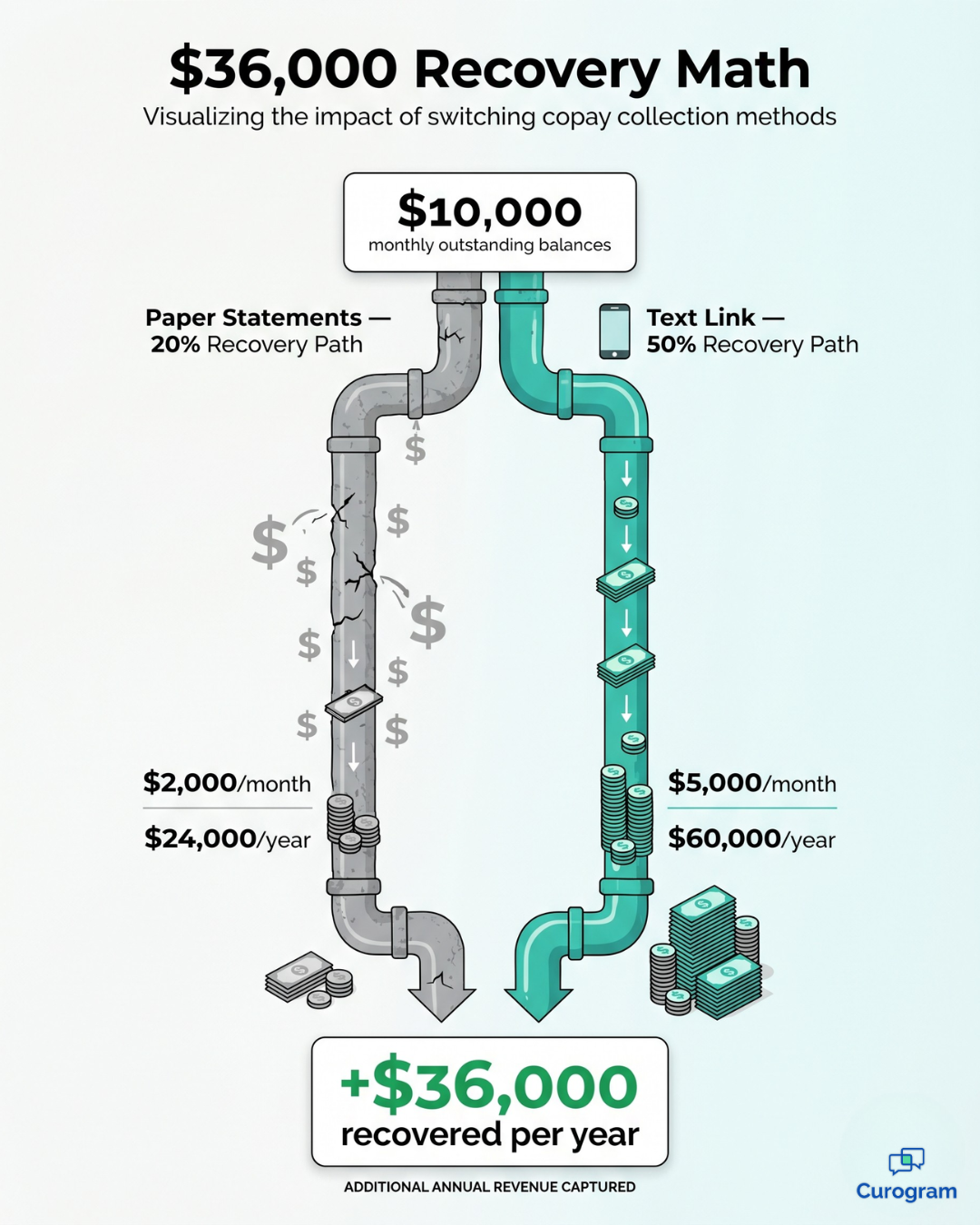
Let's put real numbers on it. Say your practice carries $10,000 in monthly outstanding balances. At a 20% paper rate, you recover $2,000 a month, or $24,000 a year. Push that toward a 50% text rate, and you recover $5,000 a month, or $60,000 a year.
That is an extra $36,000 a year, pulled from balances you had already earned. This is not marginal tuning. For your team, it is revenue you stop leaving on the table.
The harder-to-measure change matters just as much. The money conversation leaves the therapy room.
When it does, a few things go with it:
None of these ever showed up on a balance sheet. But all of them shape whether a client books the next visit. That is the quiet return on taking the ask out of the room.
The pattern shifts from "the awkward ask" and the paper-statement pile to something calmer. Balances settle by text in the days after the session, on the client's schedule, with no in-person friction and no drift.
Notenetic handles the point-of-service moment well. Curogram handles what comes next — the outstanding balance that would otherwise drift through portal logins and paper statements.
Think of it this way. Notenetic is your record of the balance owed. Curogram is their easy way to settle it.
That pairing protects two things at once: your balance sheet and your therapeutic alliance. Behavioral health practices rarely get to protect both. Paired with Notenetic, Text-to-Pay finally lets you.
So stop measuring billing success by statements mailed. Measure it by balances actually settled — and by therapy rooms freed from the money conversation.
The math is hard to argue with. A practice carrying $10,000 in monthly balances could recover an extra $36,000 a year just by shifting from paper to text. That is not a rounding error. That is a clinician's salary.
Your clients feel the difference too. No login wall. No statement in the mail. Just a quick, private text they can pay in 30 seconds, on their own time.
You do not have to push harder on people already managing financial stress. You just have to make paying easy. The awkward ask was never the only option — it was the one you were stuck with for too long.
Want to see what a 50% lift in collections would mean for your practice? For most behavioral health teams, the answer is bigger than they expect.
Schedule a Demo, and we will walk you through exactly how Curogram works alongside your behavioral health practice. No long-term contract. No heavy integration project.
 Aubreigh Lee Daculug : Jun 24, 2026, 11:00:01 AM
Clients pay phone bills by text. Curogram SMS links with Notenetic let them pay therapy copays in 30 seconds.
 Aubreigh Lee Daculug : Jun 24, 2026, 1:00:00 PM
Paper statements collect 20%. Curogram's SMS pay links recover Notenetic balances while protecting the therapeutic alliance.
 Aubreigh Lee Daculug : Apr 2, 2026, 12:00:00 PM
Paper statements cost $1 each and collect 20%. Curogram’s text-to-pay sends NextGen patients a secure link—two taps, paid, no portal, no paper.