
Notenetic Text-to-Pay for Behavioral Health Practices
 Aubreigh Lee Daculug : Jun 24, 2026, 9:00:00 AM
Paper statements collect 20%. Curogram's SMS pay links with Notenetic settle balances in 30 seconds—no awkward ask.

You know the bind every behavioral health billing team lives in.
Push too hard on a balance, and the client stops coming to therapy. A client who stops coming stops paying. So you soften the ask.
A polite statement here. A quiet portal message there.
It feels safer. It also leaves money on the table. And it costs you more than you think.
Think about this. A paper statement converts at roughly 20%. That means four out of every five land in a drawer, unread and unpaid. Meanwhile, your practice spends $800 to $1,000 a month to mail them.
Every week a balance sits unpaid, your odds of recovering it drop. A 30-day balance has a strong chance of being collected. A 90-day balance is far weaker. A 120-day balance is nearly gone.
This is the quiet tension inside mental health billing collection. You can't collect like a primary care office without bruising the relationship therapy depends on. But the gentle approach lets revenue slip away.
It sounds like a trade-off. It isn't.
The real problem was never how hard you ask. It's how the ask reaches the client.
Statements and portal logins add friction your clients won't push through. Most never open the envelope. Most never log in.
There's a better path. One that makes paying easy instead of making the ask louder. Curogram works alongside your existing Notenetic setup as a parallel recovery channel. It sends secure text payment links your clients actually use, with no change to how Notenetic runs.
This guide shows how a frictionless Notenetic balance collection workflow helps your behavioral health practice recover more, without the push that drives clients away. And none of it asks you to push harder.
You'll see the math, the workflow, and the shift it creates for your team.
Behavioral health billing sits in a spot no other specialty shares. The standard collection playbook doesn't just feel wrong here. It backfires.
Aggressive collections work fine in primary care. In therapy, they end relationships. A client who feels chased by your billing office stops showing up. And a client who stops showing up stops paying at all.
So the hard approach defeats itself.
To protect the relationship, you soften the ask. A polite statement. A portal message that may never be read. Maybe one voicemail.
It feels responsible. But it converts at about 20%. The rest drifts into aged buckets where recovery gets harder by the week.
Notenetic recently added in-platform payment acceptance, which helps at the point of service. That's a real win. But post-visit follow-up still runs through the Client Portal or paper statements.
Most behavioral health clients don't log into portals. Most don't open statements either. Your Notenetic accounts receivable workflow stays accurate, yet the recovery side leans on channels clients ignore.
Here's why speed matters so much.
Take a small-to-mid practice with $5,000 to $15,000 in monthly outstanding copays. The longer a therapy practice outstanding balance sits, the lower your odds of ever seeing it.
| Balance age | Rough recovery odds | What it means |
|---|---|---|
| 30 days | ~70% | Strong chance to collect |
| 90 days | ~30% | Odds have collapsed |
| 120+ days | Near zero | Bad-debt territory |
Every week stuck in paper-statement drift is real money lost. This is where behavioral health bad debt reduction starts. Not with harder calls, but with faster, easier recovery.
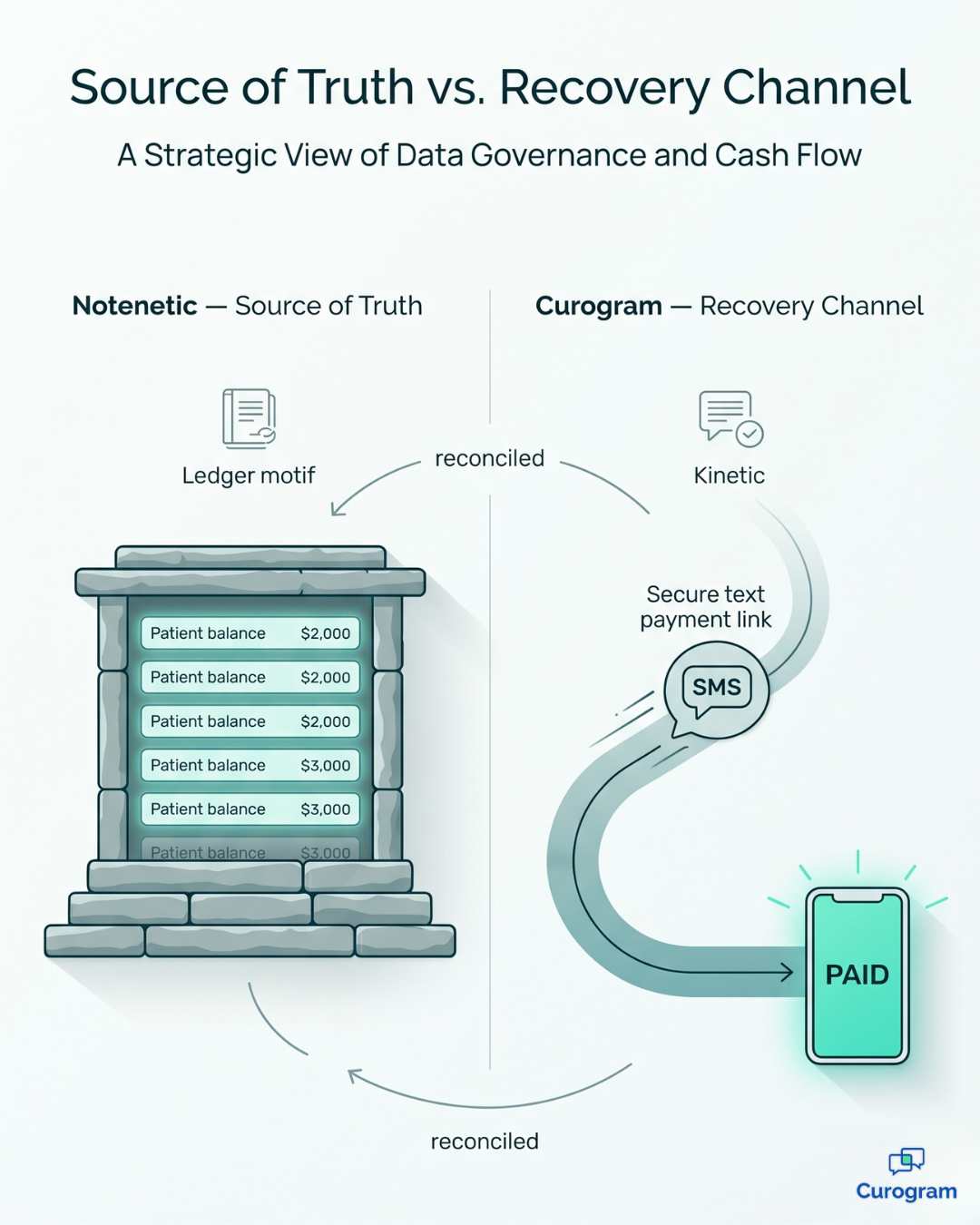
Curogram doesn't replace Notenetic. It works beside it as a recovery layer. Think of it as a second text channel that converts balances faster. It removes friction instead of adding pressure.
Here's the flow your Notenetic billing coordinator workflow gains:
Notenetic stays the source of truth for your ledger. Curogram is just the channel that collects. Your team marks those balances as paid in Notenetic during the same month-end routine you already run.
For most practices, the time saved on chasing paper and portal messages more than covers that step.
This system fits your world. It doesn't force a one-size-fits-all script on you. The wording changes by appointment type and by client. The tone stays neutral and human.
Clients under 42 CFR Part 2 can get payment notices that never name their treatment program. And clients facing real money strain can be flagged for review before any text goes out.
You can even send a payment-plan link instead of a full-balance link. The system supports the nuance behavioral health needs. It isn't built on the primary-care idea that every client handles money pressure the same way.
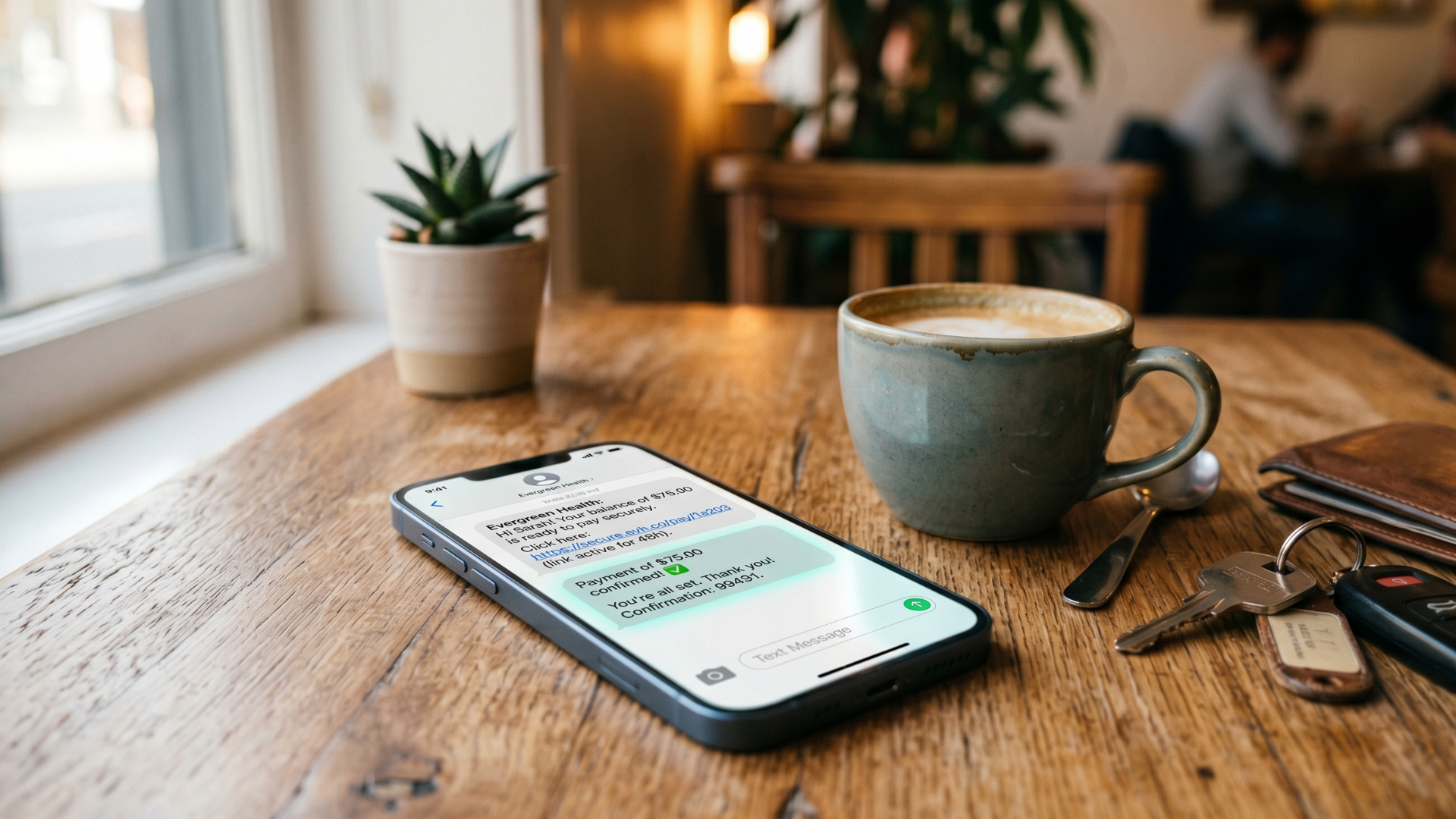
So what does removing friction actually do for your numbers?
Two wins land at once, and they stack:
These gains are independent. One lifts what you collect. The other cuts what you spend. You win on both sides.
Here's what that can look like. Imagine a practice with $10,000 in monthly outstanding balances.
| Channel | Conversion | Recovered monthly | Recovered yearly |
|---|---|---|---|
| Paper statements | 20% | $2,000 | $24,000 |
| Text payment links | 45% | $4,500 | $54,000 |
That's a sample, not a promise. But the gap is the point. Lifting conversion from 20% to 45% turns $2,000 a month into $4,500.
In practice, that's an extra $30,000 a year, plus up to $12,000 saved on statements. For your team, that's real revenue recovered without a single harder phone call.
The bigger change is in the role itself. Your billing coordinator stops being the reluctant reminder. They start driving behavioral health AR recovery through ease. Better numbers, softer ask.
Here's the worry behind every new billing tool: that it means a rebuild. A new system to learn. A workflow torn apart and stitched back together.
This isn't that.
Curogram sits on top of what you already run. Your Notenetic ledger stays exactly where it is. Your coordinators keep their habits. You're adding a channel, not replacing a system.
What stays the same:
What changes is the recovery step. Instead of mailing a statement and waiting, your team sends a text link and watches balances clear in days.
The rollout is light by design. There's no long migration and no data overhaul. Most practices fold Text-to-Pay into their existing caseload and see the difference in the first billing cycle.
That's the point of a parallel layer. It strengthens what already works instead of forcing you to start over.
Notenetic carries your ledger. Curogram converts it.
Together, they let you recover more revenue without the aggressive posture a behavioral health practice can't afford. One holds your record of what's owed. The other gives clients a frictionless way to settle it.
That pairing is the whole insight. You stop choosing between healthy collections and a healthy clinical bond. You get both.
So change what you measure. For years, billing success has been judged by call volume and statement counts. Those are the very things that strain the relationships therapy depends on.
They're the wrong numbers.
Measure aged-AR reduction instead. Watch how fast balances clear. And watch the complaints from clinicians about billing pressure. That number should fall, not climb.
When billing feels lighter, clients stay in care longer.
When paying takes one tap instead of a login or a stamp, your clients respond. Balances that once drifted into 90- and 120-day buckets get settled in days. Your team spends less time chasing and more time on the work that matters.
This isn't about collecting harder.
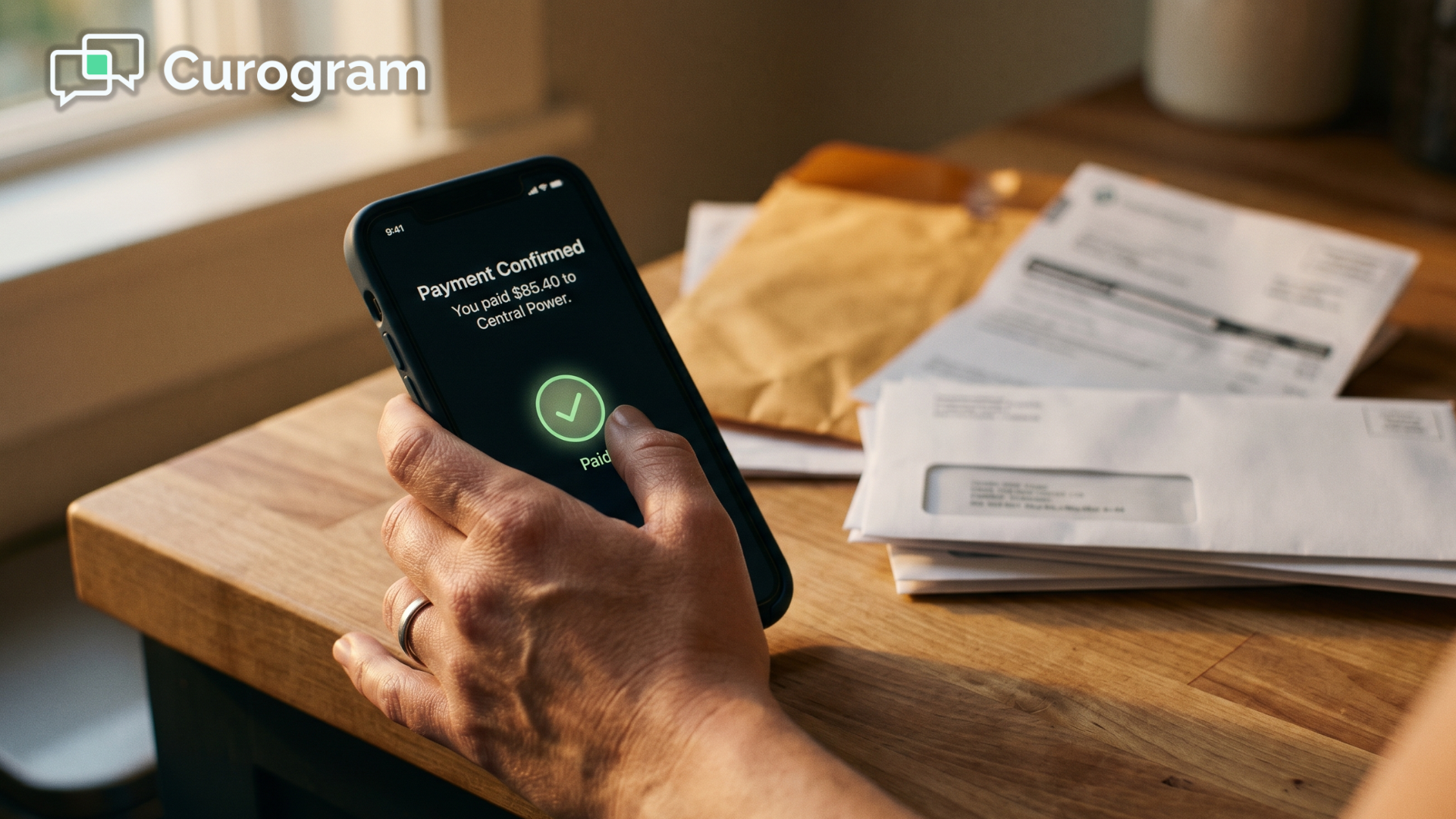
It's about collecting smarter. You meet clients where they already are, on their phones, with a payment that takes under 30 seconds. That small shift changes everything downstream.
Want to see how this fits your exact setup? The best next step is a short walkthrough. You'll see how Curogram runs alongside your Notenetic billing and where it strengthens recovery.
Curious what a real lift in collections could mean for your practice? Schedule a Demo and see how Curogram works with your behavioral health practice. It takes just a few minutes.
 Aubreigh Lee Daculug : Jun 24, 2026, 9:00:00 AM
Paper statements collect 20%. Curogram's SMS pay links with Notenetic settle balances in 30 seconds—no awkward ask.
 Aubreigh Lee Daculug : Jun 24, 2026, 11:00:01 AM
Clients pay phone bills by text. Curogram SMS links with Notenetic let them pay therapy copays in 30 seconds.

.jpg?width=30&name=square-formal-photo%20(1).jpg) Mira Gwehn Revilla : Jun 22, 2026, 8:00:01 AM
Mira Gwehn Revilla : Jun 22, 2026, 8:00:01 AM
Behavioral health clients pay copays faster when you text the bill, so see how SmartCare EHR practices use Curogram mobile text payments to collect...