
8 min read

Notenetic 2-Way Texting | The Direct Line to Your Clients

Notenetic 2-Way Texting | The Direct Line to Your Clients

💡 Notenetic 2-way texting for behavioral health practices isn't a built-in Notenetic feature.

The EHR's Client Portal handles messaging, but only behind a login and PIN — a real hurdle for clients managing anxiety, depression, or substance use. 

Curogram works alongside Notenetic as a parallel communication layer. It sends and receives HIPAA-compliant SMS straight to a client's phone. No app, no portal, no password to remember.   

The payoff is measurable. Curogram practices average 53% below industry no-show rates, and psychiatry clients run at 11.03% versus the 23% industry average.

Clients reply, and the conversation keeps going between sessions.


A client is stuck in traffic on the way to therapy. They want to send one quick message: "Running ten minutes late." Simple, right?

It isn't. To reach you, they have to remember your portal exists, find the link, log in, and enter a PIN they set up months ago. By the time they give up, the slot is gone and so is the revenue.

This is the quiet problem hiding inside many behavioral health practices. Notenetic is a strong EHR for documentation, billing, and scheduling. But its Client Portal asks clients to clear a login wall before they can say a single word.

For people managing anxiety, depression, or substance use disorders, that wall is more than an annoyance. It is the reason messages never get sent and appointments quietly disappear. Each unsent message is a small crack, and over a month those cracks add up to real lost revenue.

Here's the part that stings.

Your clients aren't ignoring you. They simply won't communicate through a system that fights them at the door.

That's where Notenetic 2-way texting for behavioral health practices changes the equation. Instead of routing every message through a portal, you meet clients on the channel they already use all day: text.

Curogram acts as a communication layer that runs right next to Notenetic. Your clinical record stays exactly where it belongs. Your client conversations move to a place clients actually check.

The results aren't small. Curogram practices average 53% below industry no-show rates, and psychiatry clients run at 11.03% against a 23% industry average. For your team, that's the difference between a full schedule and a half-empty waiting room.

In this article, you'll see why the portal quietly drains money, how a direct text channel works, and what changes when clients can finally just reply.

The Hidden Cost of a Login Wall

The Notenetic Client Portal is genuinely useful. It stores documents, shows upcoming appointments, and keeps threaded messages in one place. But every interaction asks the client to remember the portal exists, find the URL, log in, and re-enter a PIN.

For the people behavioral health practices serve most, that wall lands hardest:

  • Anxious clients, who avoid one more task that might go wrong.
  • Clients with executive-function challenges, who lose the thread between steps.
  • Substance use clients in treatment, who need the lowest-friction way to stay connected.

For each of them, the portal isn't a feature. It's a barrier — and in behavioral health, barriers show up as missed sessions.

Watch how it plays out. A client wants to ask whether they should still come in given heavy traffic. They open the portal, forget the PIN, tap "forgot password," check email, get distracted, and never finish the reset.

Now multiply that across 40 to 80 calls a day at a typical practice. Your front desk ends up playing phone tag with people who would have texted "running 10 min late" in three seconds flat.

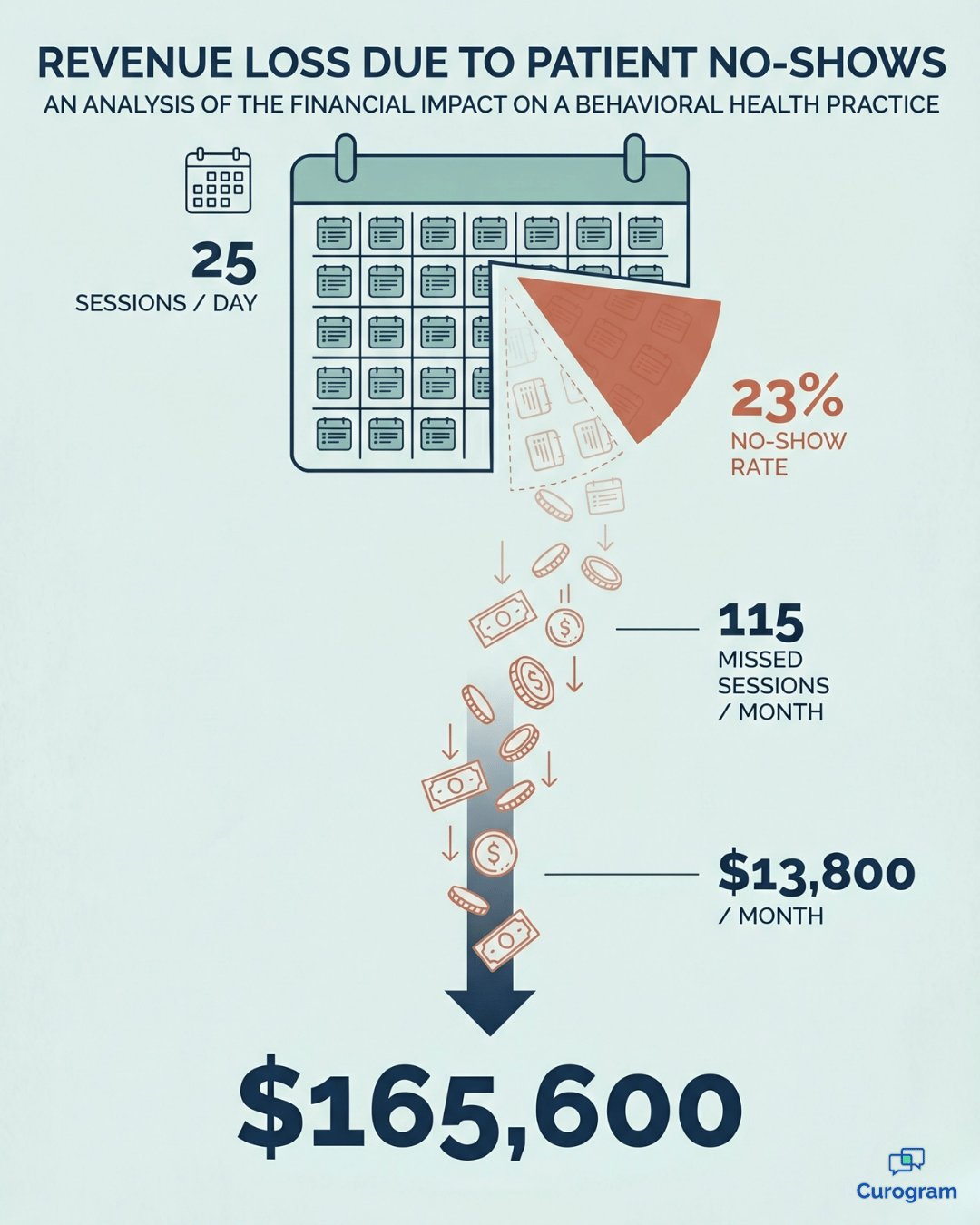
The cost isn't theoretical. Behavioral health no-show rates routinely run 20% to 30%, and some practices report 50%. Run the math on a single therapist with a full schedule to see what that quietly drains.

Say that therapist sees 25 clients a day across 20 working days, which adds up to 500 scheduled sessions a month. At a 23% no-show rate, 115 of those sessions simply vanish.

With each visit billed at $120, the gap is easy to picture.

$13,800 a month

Revenue lost to empty chairs for one full-schedule therapist — before you count the staff hours spent chasing confirmations.

Scale that to a group practice with several providers, and the monthly gap easily reaches $20,000 to $30,000.

The portal is the silent killer here. Not bad therapy, not bad scheduling — just a channel that doesn't fit the population.

So let's be clear about what's really happening.

It isn't that your clients don't want to communicate. It's that they don't want to communicate through that.

Behavioral health teams know this instinctively, but the EHR was never built to fix it.

A Direct Line That Lives Next to Notenetic

Curogram isn't a replacement for your EHR. It's a patient engagement layer that runs alongside Notenetic, so nothing about your chart of record has to change.

Infographic showing $165,600 in yearly revenue lost to behavioral health no-shows

Your record stays put — your conversations move

Your clinical documentation, intake notes, and progress notes stay where they belong, inside Notenetic. Your client communication moves to where clients actually live, which is SMS.

No replacement, no migration, no risk to the chart of record.

Think of it as a Notenetic Client Portal alternative for outreach specifically. The portal stays your secure home for documents. Curogram becomes the conversation.

How the texting actually works

Curogram's 2-way texting sends and receives messages through the practice's own dedicated number, not a clinician's personal phone. Every thread lives in the Curogram dashboard — searchable, auditable, and easy to hand off between staff.

This is the kind of two-way texting mental health clients actually answer, because it reaches them on the device already in their hand. It brings HIPAA-compliant client texting Notenetic leaves out of its native toolset, backed by SOC 2 Type II certification and a signed Business Associate Agreement.

Why no API is fine

Notenetic doesn't currently expose a public API, so Curogram runs as a parallel layer rather than a deep write-back integration.

For most small and mid-sized practices, that's exactly the right setup.

You keep Notenetic for what it does well — documentation, billing, and embedded telehealth. You add Curogram for what Notenetic doesn't do, which is proactive reach. The Notenetic communication tools cover the clinical side, and Curogram covers the human side.

Built for how behavioral health really talks

For therapy, psychiatry, social work, and substance use counseling, a text feels like a colleague checking in. It isn't a form letter or a sterile portal alert.

That's the heart of good behavioral health SMS messaging — brief, warm, and on the client's terms.

As a therapy practice texting platform, it also respects stricter rules. Programs serving clients under 42 CFR Part 2 can configure messages to leave out diagnosis or treatment specifics, keeping the channel compliant with that tighter confidentiality standard.

Therapist and client talking warmly, showing open patient communication

What Changes When Clients Can Just Reply

When the login wall comes down, the numbers move.

Psychiatry clients on Curogram see no-show rates of 11.03% against the 23% industry average — less than half.

Across all specialties, the platform composite runs 53% below industry no-show benchmarks.

The ripple effect reaches the front desk too. After rolling out Curogram's 2-way texting, River Valley Family Health Center cut its phone call volume by 24%. That's a quarter of the daily switchboard noise simply gone.

Put those gains in dollar terms and the stakes get concrete fast.

$165,600 a year

What one therapist's no-shows can quietly cost over twelve months — and the bulk of it is recoverable the moment clients can confirm with a single text.

Here's what that shift looks like in practice:

  • Front-desk staff stop being a switchboard and start being the direct line. They handle exceptions and warm handoffs instead of phone-tag confirmations.
  • Clinical staff stop wondering whether clients got the message, because the read receipts are right there in the thread.
  • Clients answer in seconds, because replying to a text takes no logins and no detours.

The everyday moments are where it pays off. A Thursday DBT group member confirms attendance with a single thumb-tap. A psychiatry client running ten minutes behind warns the intake coordinator before the slot gets handed to someone else.

A new substance use intake client asks a clarifying question without having to call a line that says "leave a message after the beep." Each of those tiny saves is a slot kept, a no-show avoided, and a relationship that holds steady between sessions.

For your team, that's the real return. Fewer empty chairs, quieter phones, and clients who stay engaged because reaching you finally feels effortless.

One Thread That Does More Than Confirm Appointments

Once the channel is open, it rarely stays limited to "running late." The same thread that handles a quick confirmation can quietly carry most of the outreach your practice does in a week.

Here's what a single text line can take on:

  • Automated appointment reminders that nudge clients a day or two ahead, trimming no-shows even further than a confirmation alone.
  • Recall messages that re-engage clients who've drifted off the schedule, reaching them before they fall out of care entirely.
  • One-tap telehealth, where the client taps a link in the thread and joins a video visit — no portal, no download, no separate login.
  • Intake reminders and form links sent before the first session, so new clients arrive ready instead of filling out paperwork in the lobby.
  • Practice-wide updates like a closure or a schedule change, sent to everyone at once instead of one call at a time.

Notice the pattern. None of these require a new app or a second system for the client to learn — they all ride the channel they already use.

You build the thread once, and it keeps earning its keep across reminders, recall, and video visits without adding a single login to the client's day.

Trade the Login Wall for a Real Conversation

Here's the simple truth. Your clients aren't avoiding you. They're avoiding a portal that asks too much before it lets them say anything at all.

Notenetic does its job well as a clinical record. It holds your notes, your billing, and your schedule in one secure place. But a passive portal was never going to fix an active problem, and behavioral health is nothing if not active.

Your clients need a channel that reaches out, not one that waits for them to log in.

That's the split worth remembering. Notenetic is built for your clinical record. Curogram is built for their communication preferences.

One holds the chart. The other holds the conversation. Put them side by side and you finally have the complete practice your clients deserve.

When you stop losing clients in a login screen, the numbers move in your favor. Fewer empty slots. Fewer rounds of phone tag. More clients who confirm, reply, and show up because answering you took three seconds instead of three steps.

The shift doesn't require a migration or a risky overhaul. Your chart of record stays untouched in Notenetic. You simply add a layer that meets clients where they already spend their day. There's no long-term contract either, which mirrors the flexibility your team already expects.

So stop letting a portal decide who gets through. Give your clients the direct line they'll actually use, and give your front desk their hours back.

The technology is ready and your clients live on their phones — the only thing left is a login screen.

Ready to see it work? Schedule a Demo to watch HIPAA-compliant 2-way texting run alongside a Notenetic-style workflow in real time.


Frequently Asked Questions

Is 2-way texting actually HIPAA-compliant for behavioral health clients?

Yes. Curogram is HIPAA-compliant and SOC 2 Type II certified, and we sign a Business Associate Agreement with every practice. For substance use treatment clients governed by 42 CFR Part 2, the platform supports configurations that leave diagnostic or treatment-specific language out of message bodies. That keeps you within the stricter confidentiality standard while still using text as your channel.

Will this conflict with Notenetic's Client Portal or create double entry for staff?

No. Curogram works as a parallel communication layer, so clinical documentation keeps living in Notenetic while Curogram handles SMS outreach from its own dashboard. Most practices find the portal becomes their record-of-truth for documents, and Curogram becomes the conversational channel. There's no replacement EHR to learn and no double data entry to manage.

What happens with client consent and opt-out for SMS?

Curogram captures TCPA-compliant consent at onboarding and includes an automatic opt-out on every message, usually "Reply STOP." Clients can opt back in whenever they want, and consent status is tracked at the client level. That way your staff never have to guess whether a given person is reachable by text.

Do we need Notenetic to have an open API for this to work?

No. Because Curogram runs as a parallel layer, it doesn't depend on a public Notenetic API. You keep Notenetic for documentation, billing, and embedded telehealth, and Curogram adds the direct text channel on top — no integration build required.

Will clients have to download anything to text us back?

No. That's the whole point. Messages arrive as plain SMS on the client's phone, so there's nothing to install, no portal to open, and no password to recover. They just read your message and reply, the same way they text anyone else.