

6 min read

Notenetic Portal vs. SMS: Why Clients Choose Text

Notenetic Portal vs. SMS: Why Clients Choose Text
💡 Looking for a Notenetic client portal alternative? SMS messaging for mental health clients works because it meets people where they already are — their own text thread.

Behavioral health clients rarely log into a portal, but most reply to a text within minutes.  

Curogram adds HIPAA-compliant 2-way texting alongside Notenetic, so therapy, psychiatry, and substance use clients respond without an app, an account, or a password.    

The proof shows up in the numbers. Curogram clients run 53% below industry no-show rates, with psychiatry clients at 11.03% versus a 23% average.


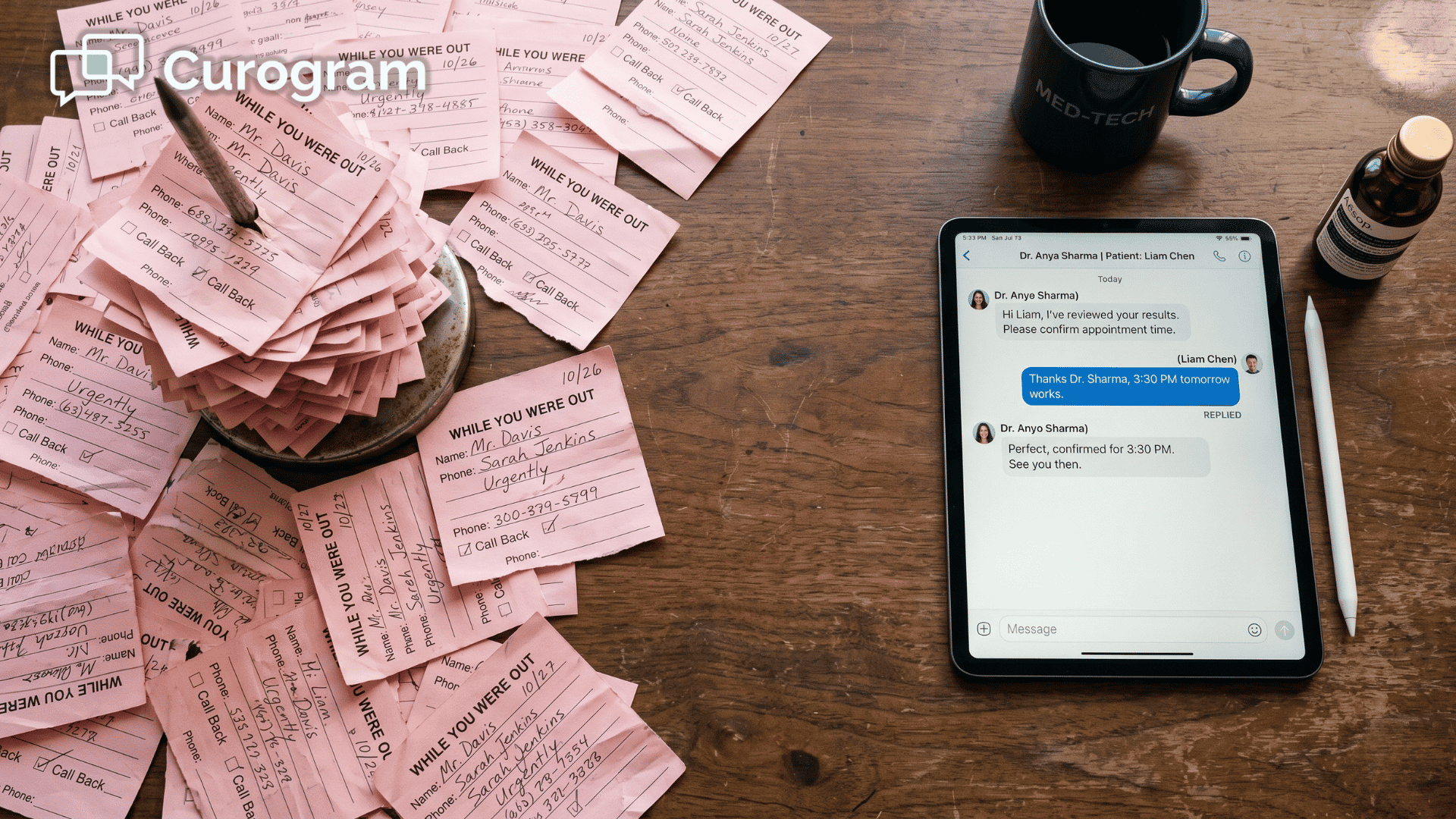
Your front desk does everything right. The welcome email goes out on time, the portal invite is clear, and the login link works exactly the way it should. And still, a surprising share of your new clients never sign in at all.

Here is the part that stings.

The clients who skip the portal are often the ones who need your practice the most. A new psychiatry client fully intends to set up her account, then hits "create password," freezes, and quietly tells herself she will finish registering later, once the day settles down. Later, of course, never quite arrives.

In behavioral health, a missed login is rarely just a missed login. It becomes a first session that never happens, a follow-up that slips through the cracks, and a client who drifts away from care before treatment truly begins.

The channel that was supposed to connect you ends up working like a wall instead.

And it's a strange wall, because your clients are not difficult to reach. They text their friends constantly, along with their dentist, their pharmacy, and their kid's school. The single place they consistently refuse to go is a portal labeled "mental health."

That label carries more weight than most software vendors are willing to admit. Opening a mental health portal in a crowded waiting room, a coffee shop, or in front of a partner can feel genuinely exposing.

A text message, by contrast, feels invisible — identical information delivered through a far more comfortable experience.

So the real question is not whether your clients can communicate. It's whether your current tools ask them to do it in a way that fits their actual lives, or one that quietly filters out the very people you most want to reach, long before they ever sit down with a clinician.

Why the Login Wall Quietly Filters Out Your Hardest-to-Reach Clients

Notenetic's Client Portal works exactly as designed. It's secure, logged, and threaded — everything a clinical system should be.

The problem isn't the portal's security. It's the gap between how the portal works and how your clients actually communicate.

Think about a typical new client. She texts everyone in her life with one thumb.

Then, just to say "running late," the portal asks her to:

  • Create an account she never asked for
  • Invent and recall a brand-new password
  • Log back in every time she has something quick to say

Any one of these is minor. Stacked together at a stressful moment, they're enough to make her quietly give up. And behavioral health clients often carry extra weight that makes that stack even heavier.

For someone managing anxiety, depression, or executive function challenges, a few small steps can be the reason a task never gets done. Mental health portal fatigue is real, and it usually shows up as silence.

There's a stigma layer too.

A labeled mental health portal on a home screen, or one that opens in public, can feel like a flag.

A text reveals nothing. To anyone glancing over, it looks like every other thread on the phone.

Then there's the quiet killer:

The one-way reminder. Plenty of systems can send a reminder but can't receive a reply. The client texts back "yes, I'll be there," and the message vanishes into nothing.

We call this the Black Hole Effect. The client tries to engage, hears nothing back, and decides the channel is broken.

Here's why that's so costly. In primary care, a broken channel costs an appointment. In behavioral health, it can cost a client — the very person who needed the session most, reading your silence as a closed door.

Infographic showing behavioral health no-show rates dropping from 23% to 11% with SMS

Meet Curogram: A Text Thread, Not a Login Screen

Curogram works as an invisible bridge between your practice and your clients. It adds a HIPAA-compliant SMS layer alongside Notenetic, so clients reach you on the channel they already use — without ever seeing a mental-health-labeled login.

How the texting actually works

Messages go out from your practice's dedicated number to the client's phone. The client just sees a normal text and replies like a normal text.

Behind the scenes, every message is encrypted in transit, logged in an audit-ready dashboard, and protected by SOC 2 Type II controls and a signed Business Associate Agreement. This is real no-app behavioral health communication — nothing to download, nothing to set up.

Built for stricter rules, too

Substance use treatment carries an extra layer of confidentiality under 42 CFR Part 2, which goes beyond standard HIPAA.

Curogram supports settings that keep diagnostic or treatment-specific details out of the message body. That way, substance use treatment texting stays open as a channel while still honoring the stricter standard.

Therapist and client in a calm, sunlit office during a behavioral health session

Why it fits behavioral health

Every clinician already knows the core idea here: the lower the friction, the more honest the engagement.

A client who can answer in two seconds will tell you she's running late.

A client facing a login often just disappears.

Stop playing phone tag! Reduce your call volume by 50% with Curogram's HIPAA-compliant 2-way texting platform.  

Curogram is built around that truth. It also respects Notenetic client communication preferences — clients who prefer the portal or a phone call can keep using them. Texting is an added channel, never a forced one.

The goal is anxiety-friendly client communication that supports the therapeutic relationship instead of testing it.

What Changes When Clients Can Just Text You Back

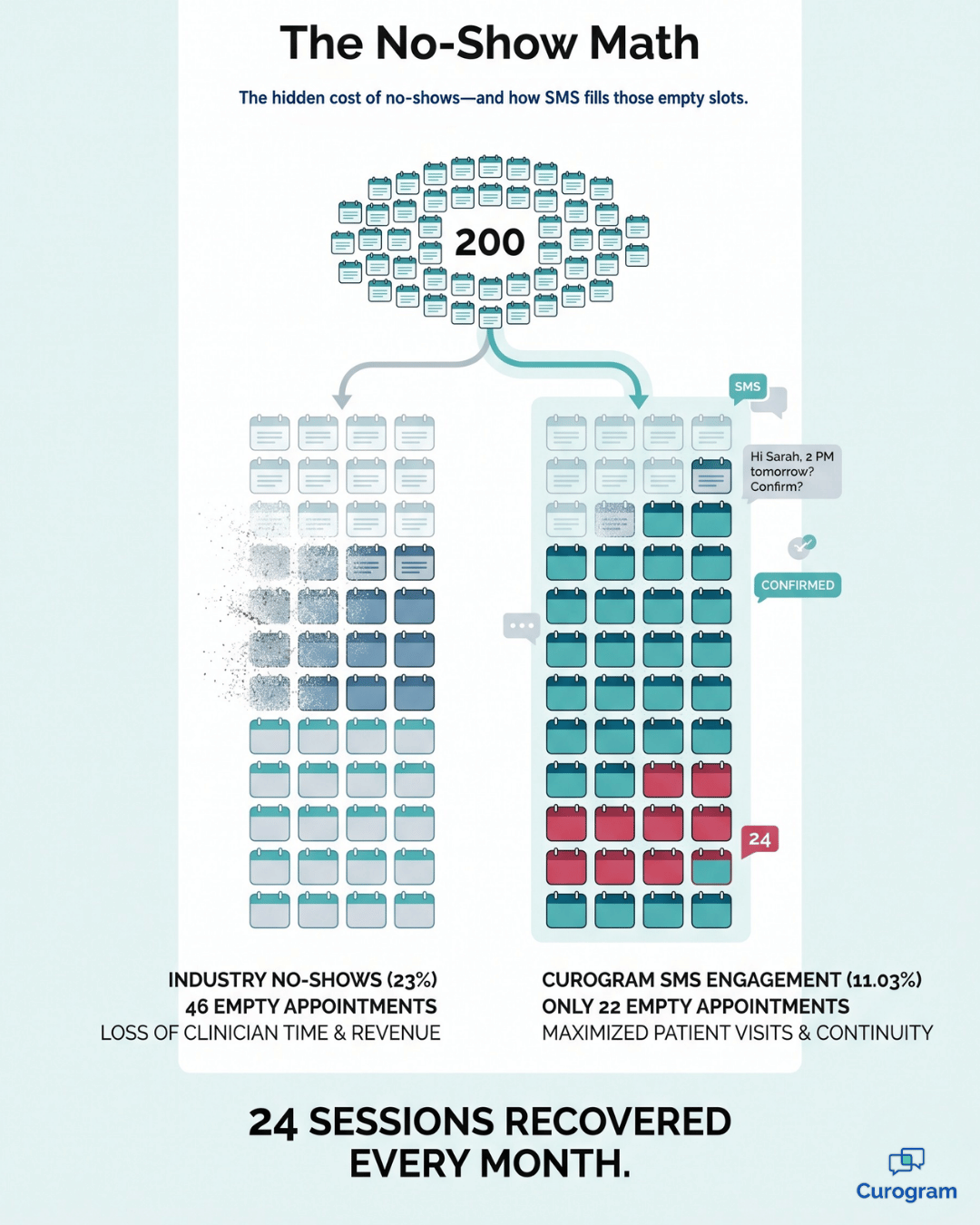
When the channel fits the client, the numbers move. Curogram clients run 53% below industry no-show benchmarks. For psychiatry specifically, no-show rates land at 11.03%, compared with a 23% industry average.

Here's what that means in plain terms. Say a psychiatry practice books 200 appointments a month.

A 23% no-show rate is about 46 empty slots.

At 11.03%, that drops to roughly 22 — about 24 sessions a month recovered. That's clients seen, revenue kept, and a schedule that holds together.

The shift behind those numbers is simple. Clients stop saying "I'll log in later," which usually means never. Instead, they use what we call the always-open channel — a thread they can answer anywhere.

In practice, behavioral health client engagement texting looks like this:

  1. A DBT group member confirms attendance with a single thumb-tap, no login required.
  2. A new substance use intake texts her clarifying question instead of quietly skipping the appointment.
  3. A psychiatry client sends "running 10 minutes late," and the clinician sees it before walking into the room.

None of these moments are dramatic. That's the point. Each one is a small choice to stay engaged, made easier because answering took two seconds.

For your team, that adds up fast. Fewer empty slots, fewer cold no-shows, and fewer clients lost in the gap between intake and first session.

The channel stops being a test the client has to pass and becomes a quiet line that's always open.

Bring the Channel to Them, Not Them to the Channel

The Client Portal works well for clients who log into portals. The trouble is that in behavioral health, those clients are usually in the minority. Most of your caseload lives in their text messages, not in a login screen.

So the fix isn't to push harder on portal adoption. It's to stop asking clients to adapt to your system and to bring your system to them instead.

That's the whole idea behind pairing Notenetic with Curogram. Notenetic holds your clinical record — the secure, structured home for everything you document.

Curogram handles the client's preferred channel — the simple text thread they'll actually answer. Together, they cover the full arc of the relationship, from the very first reminder to the session that follows it.

The difference isn't security. Both meet the same HIPAA standard. The real difference is access. A portal asks the client to come to you, while a text meets them where they already are, on the device in their pocket, with nothing to download and no password to forget.

For people managing anxiety, stigma, or simple overwhelm, that one design choice often decides whether a client engages or disappears. It's the space between a no-show and a session. Between a quiet exit and a relationship that holds.

You don't have to take that on faith. The clearest way to understand it is to see the conversation from your client's side and watch how easy it is for them to receive a message and reply.

Schedule a Demo and we'll show you exactly what that experience looks like, end to end. No long-term contract to sign and no pressure — just a clear view of how your clients would actually communicate with your practice.


Frequently Asked Questions

Is texting really safer than the Client Portal for behavioral health information?

Curogram is HIPAA-compliant and SOC 2 Type II certified, with a Business Associate Agreement in place at every practice — the same compliance bar as a HIPAA-grade portal. The real difference is access, not security. Clients are far more likely to receive and act on a text than on a message that sits behind a separate login. For substance use clients under 42 CFR Part 2, the platform supports settings that keep diagnostic or treatment-specific content out of the message body.

What if a client doesn't want to be texted, or shares a phone with a partner?

Curogram captures TCPA-compliant SMS consent at onboarding and adds an automatic "Reply STOP" opt-out to every message. Clients who share a device can opt out at any time and keep using the Client Portal or phone calls instead. Texting is an added channel, never a forced one. Your intake team can also flag a client's preferred contact method right in the Curogram dashboard.

Will my clients have to download an app or create an account?

No, and that's the entire point. Clients receive a standard SMS on their phone and reply the way they would to any other text. There's no app store, no portal account, and no password to forget. For a behavioral health population, that single design choice is often the line between a client engaging and a client disappearing.

Does this replace Notenetic?

No. Curogram works alongside Notenetic, not in place of it. Notenetic stays your system of record for clinical documentation, while Curogram handles the client-facing text conversation. You get the structure of your EHR and the reach of a channel clients actually use.

How quickly can our practice get started?

Most practices are up and running without a heavy IT lift, since there's nothing for clients to install. Your team learns one simple dashboard, consent is captured at onboarding, and messages start flowing from your dedicated number. A demo is the fastest way to see the setup and timeline for your specific workflow.