
Notenetic 2-Way Texting | The Direct Line to Your Clients
💡 Notenetic 2-way texting for behavioral health practices isn't a built-in Notenetic feature.The EHR's Client Portal handles messaging, but only...
Your front desk is busy. But ask yourself something honest: how much of that work actually moves a patient forward?
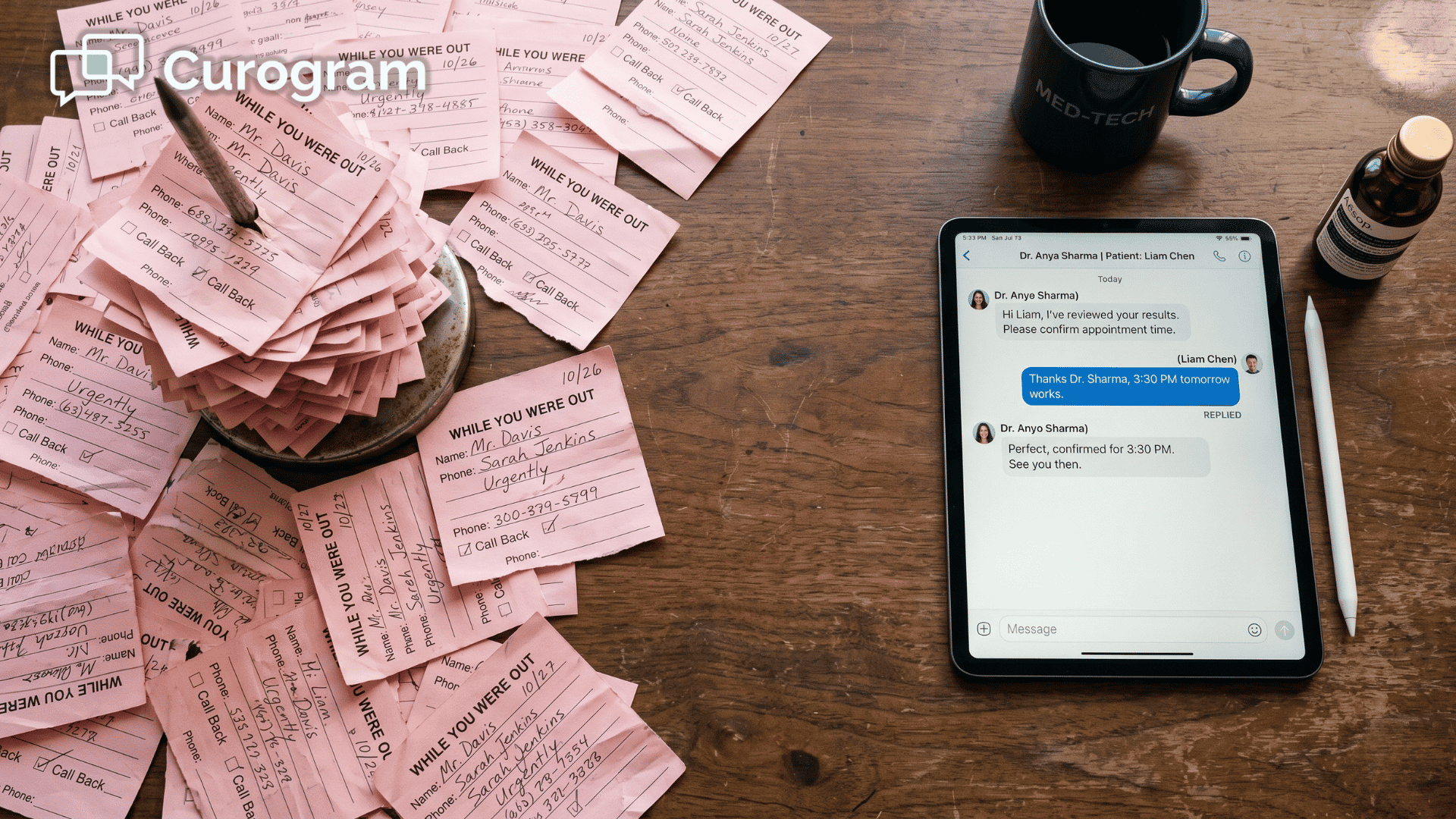
In a lot of behavioral health practices, the answer stings. A big chunk of each administrative day vanishes into one repetitive task — chasing people by phone.
Call the client. No answer. Leave a voicemail.
Call the cell. Voicemail again. Send a portal message and hope someone eventually reads it.
It sounds simple. It isn't.
Notenetic gives your team a clean, reliable way to run the schedule, document visits, and handle billing. What it doesn't give them is a fast way to reach the people on that schedule. The Client Portal only carries messages for clients who log in, and in behavioral health, that's a minority of any caseload on a given day.
So the coordination gap lands on your staff. They turn into a switchboard. They burn hours on confirmation calls that one text could resolve in seconds. And every minute lost to voicemail roulette is a minute stolen from the patients who genuinely need a human voice.
This is the quiet, expensive drag we call phone-tag therapy. It isn't dramatic. It just bleeds time, money, and morale, one unanswered call at a time.
There's a better way, and it doesn't mean replacing anything you rely on. HIPAA-compliant texting for behavioral health front desk staff using Notenetic adds a parallel SMS channel beside your current setup. Your team keeps working in Notenetic.
The inbound conversations simply shift from the phone to text.
One practice that made this move, River Valley Family Health Center, documented a 24% reduction in phone call volume. That shift reshaped how its whole front desk spent the day.
Below, you'll see exactly how that works, and what it could free up for your own team.
Phone-tag therapy is the internal drag that builds when a front desk has every tool to manage the schedule and no tool to reach the people on it. Notenetic handles records beautifully. It just leaves the conversation up to chance.
The Client Portal only works for clients who actually log in. In behavioral health, that's a small slice of any caseload on any given day. So your coordinators fall back on the phone, and the phone fights back.
A coordinator calls a Tuesday-morning client to confirm. No answer. Voicemail. Try the cell.
Voicemail again. Send a portal message and move on.
By the next morning the client hasn't shown, hasn't replied, and you're guessing whether to release the slot. Now repeat that for 25 clients a day across three clinicians.

Many behavioral health practices field 40 to 80+ calls daily, with a real goal of cutting routine inquiries in half.
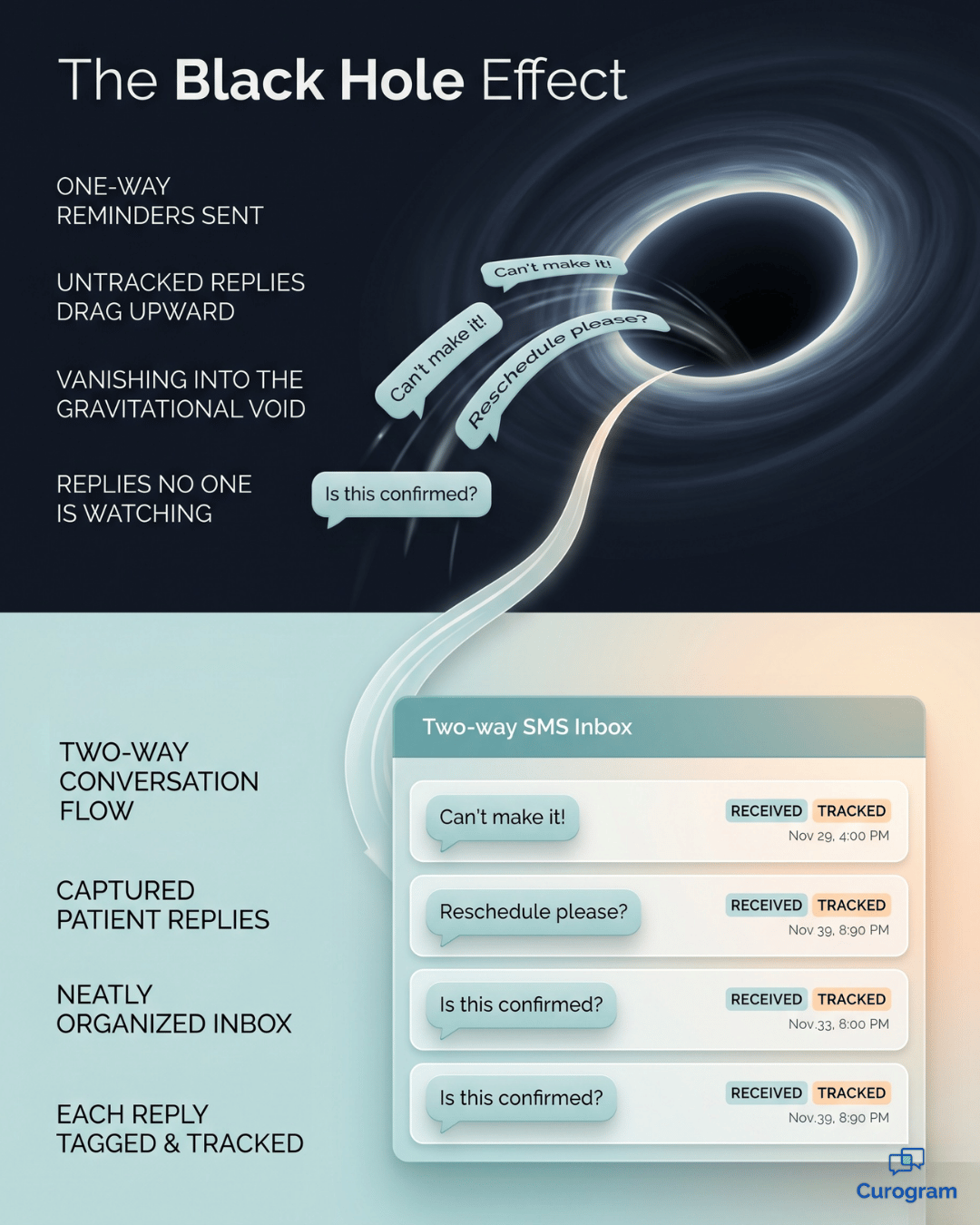
The deeper problem is what happens to the replies. One-way reminder tools let patients respond, but those responses vanish into a void no one is watching. Staff stay blind to client intent until it's too late to act.
This is where mental health practice call volume stops being a nuisance and starts being a cost. Every untracked reply is a slot you might lose, a no-show you didn't see coming, or a frustrated client who tried to reach you and couldn't.
Here's the part that rarely shows up in a report. Intake coordinators didn't take the job to babysit a phone.
They came to support the clinical mission.
Six hours a day of confirmation calls isn't just inefficient — it's a fast track to burnout. And burnout shows up later as turnover you have to backfill.

Once the problem is clear, the fix is almost boring in how direct it is. Curogram acts as a front desk force multiplier — a parallel SMS layer that turns inbound calls into two-way text threads. That frees your team to handle the 20% of cases that truly need a human voice.
The heart of it is HIPAA-compliant two-way texting. Every reply lands in one shared dashboard inbox, so any coordinator on shift can pick up a thread.
No more wondering whether a message is stuck on someone's personal phone. Every conversation lives in a searchable, audit-logged, BAA-covered system.
Just as important is how it fits your Notenetic front desk workflow. Curogram runs alongside Notenetic, not on top of it. Your team keeps scheduling, documentation, and billing inside Notenetic, exactly as it does today.
Confirmations, reschedules, and routine questions move to a two-way SMS thread, where the full message history and audit trail live alongside them.
There's no deep API integration to wrangle, which matters because Notenetic doesn't offer a public API. The clinical record stays exactly where it is. Only the inbound channel changes, shifting from voicemail roulette to text.
The day-to-day rhythm is just as plain:
This is especially decisive for substance use treatment teams and group therapy practices, where reaching many clients at once can swallow an entire shift. Behavioral health intake coordinator texting turns that one-by-one slog into a few quick threads.
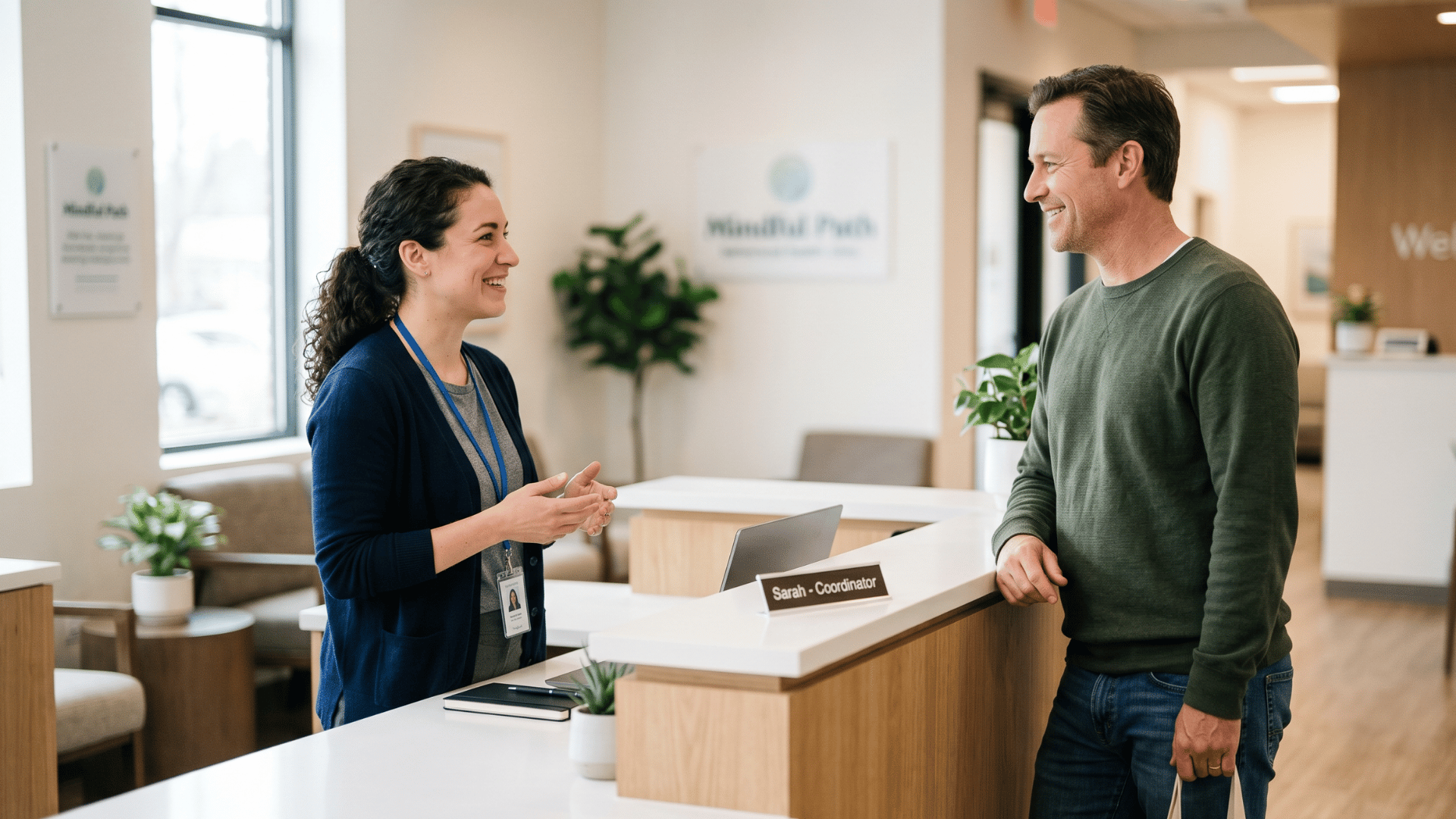
The coordinator who used to be the bottleneck becomes the dispatcher.
So what actually changes when the texting goes live? The role of the front desk shifts from reactive to in control.
River Valley Family Health Center reduced its phone call volume by 24% after adding Curogram beside its existing EMR setup. Its team pivoted from answering machines to patient coordinators, in the words of COO Jessica Sweet.
And because Curogram clients run 53% below industry no-show benchmarks, the no-show recovery calls that usually pile on top of routine ones start to disappear too.
Let's put that 24% in plain terms. Say one coordinator fields 60 calls a day, averaging four minutes each. That's four hours on the phone, every single day.
A 24% drop is roughly 14 fewer calls daily, or close to an hour back. Across a five-day week, that's nearly five hours returned.
Over a year, it adds up to almost six full workweeks freed for one coordinator — time you can redirect toward patients instead of dial tones.
That recovered time changes what the front desk does all day:
That's the shift from switchboard to coordinator. The team stops running confirmation roulette and starts running the direct line.
The same staff, freed to do the work they were actually hired for, is exactly what real Notenetic admin efficiency looks like. It's also how you genuinely reduce phone call volume in a behavioral health practice without adding headcount.
Here's the simplest way to think about the pairing.
Notenetic is built for your records. Curogram is built for their responses. One holds the clinical truth of your practice; the other holds the live conversation that keeps every appointment from slipping away.
When those two work side by side, a behavioral health front desk finally feels staffed instead of overrun. Your coordinators stop dialing voicemail boxes and start handling the exceptions that genuinely need a person.
Confirmations close themselves over text. Reschedules land before the slot is wasted. The schedule holds together because someone can actually reach the people on it.
So here's a small but powerful shift in thinking. Stop measuring your front desk by how many calls it survives in a day. Start measuring it by how many clients it actually reaches.
Phone-call throughput rewards busywork. Client reach rewards the outcome you care about — patients who show up, stay engaged, and keep their care on track.
And that change protects your revenue, too. Fewer missed slots and faster reschedules mean fewer empty chairs and less no-show recovery work piled onto an already stretched team. The math compounds quietly in your favor, week after week, without anyone working longer hours.
The best part is how little has to change to get there. You don't migrate your data. You don't retrain your clinicians.
You don't replace the system your practice already trusts. You simply add the channel that Notenetic was never designed to provide.
Schedule a Demo and watch how one coordinator can carry a full Notenetic caseload through a single SMS dashboard. Bring your own real numbers. We'll show you exactly where the hours, and the headaches, quietly disappear.
Every message comes from a practice-owned number running on HIPAA-compliant infrastructure — never a personal cell phone. The platform is SOC 2 Type II certified and works under a Business Associate Agreement (BAA) with your practice. Access is permission-based and fully audit-logged, so you always know who replied to whom and when. For substance use clients under 42 CFR Part 2, messages can be set up to leave out diagnostic or treatment-specific details.
No. Curogram is built to be light, and most coordinators are productive within their first shift. It's centered on a single shared inbox and feels more like the texting apps your staff already use than a clinical platform competing with Notenetic.
Curogram runs as a parallel communication layer beside Notenetic, not a deep write-back integration. Your documentation, scheduling, and billing all stay in Notenetic, while Curogram handles the SMS channel. For most small and mid-size behavioral health practices, that's the right architecture — fewer integration risks, no migration burden, and immediate front-desk relief.
Most practices are live within days, not months. Because Curogram sits next to Notenetic instead of burrowing into it, there's no data migration and no system to rebuild. Your front desk imports its client list, claims a practice number, and starts texting. The biggest decision is usually which routine messages to move off the phone first.
Texting becomes the default channel, not the only one — the phone stays open for anyone who prefers it. Clients can opt out at any time with a simple reply, and Curogram honors that request automatically. In behavioral health, the share of clients who respond by text tends to run high, so your team still spends far less time dialing. The goal isn't to force texting; it's to stop chasing the majority who would have answered a text anyway.
💡 Notenetic 2-way texting for behavioral health practices isn't a built-in Notenetic feature.The EHR's Client Portal handles messaging, but only...
💡 Opus EHR two-way texting for front desk staff efficiency behavioral health helps practices replace the daily phone tag cycle with quick SMS...
💡 Meditab IMS patient communication without portal login via secure texting lets practices reach patients through SMS — no app download, no...