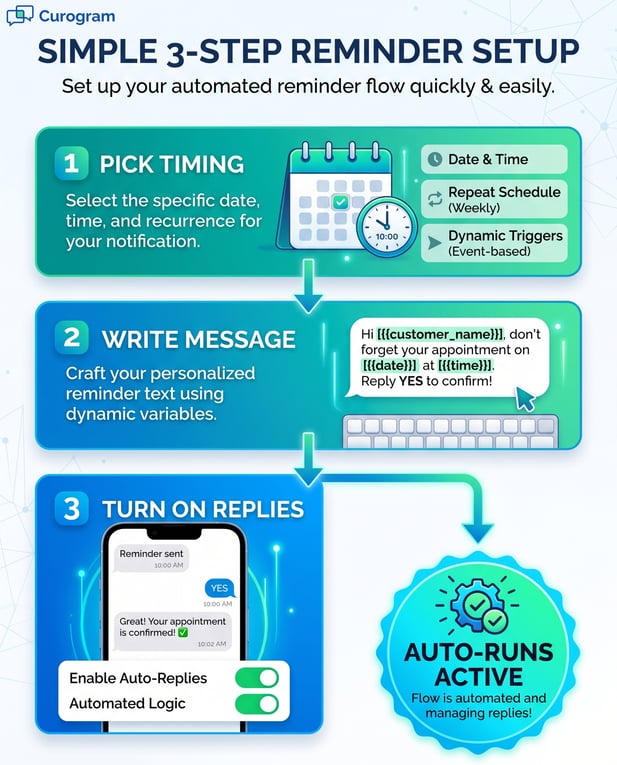
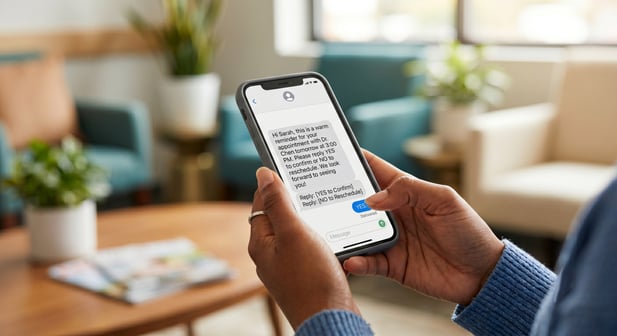
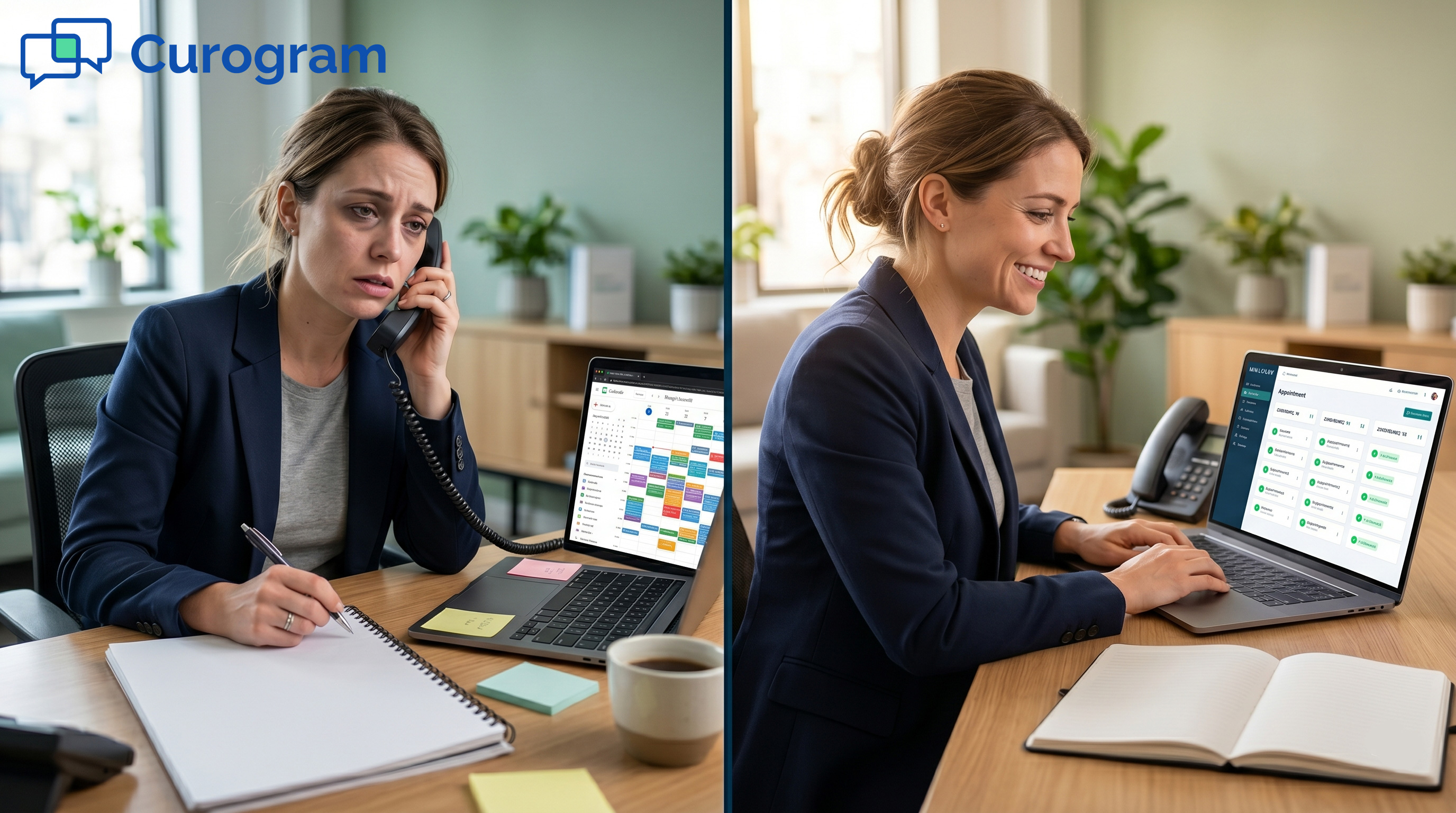
First, set your reminder timing, such as 48 hours, 24 hours, and 2 hours before a session. Next, write warm message templates. Then turn on reply options like confirm, reschedule, or cancel.
After setup, reminders send on their own before every session. Staff stop making 40 to 60 calls a day. One behavioral health practice cut its no-show rate from 14.2% to 4.91% in three months. This reflects Curogram client data from clinical settings.
Curogram is HIPAA, SOC 2 Type II, and 42 CFR Part 2 compliant.
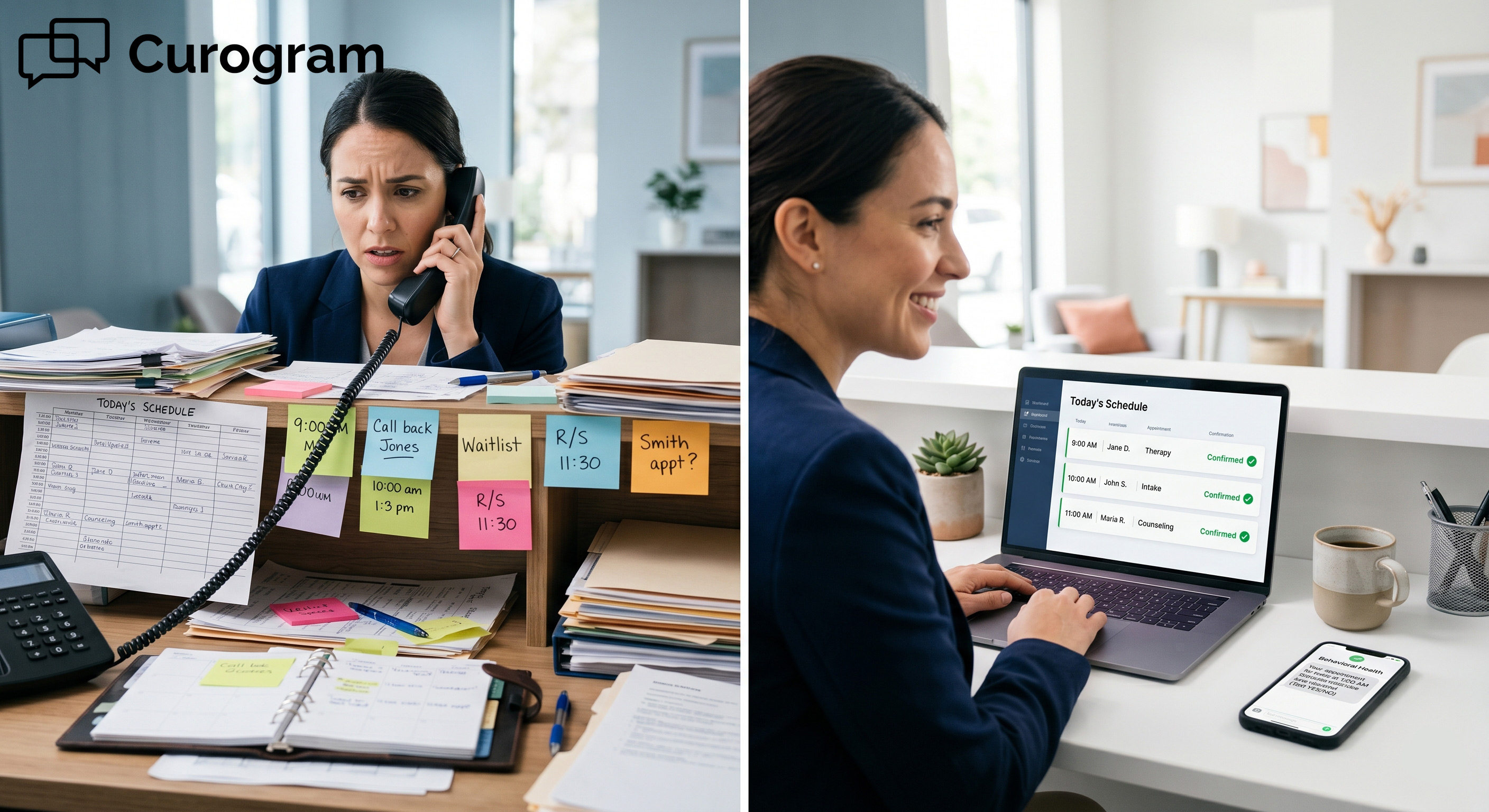
It’s only 9 a.m, but the phone in your center is already ringing out. A staff member dials a client, waits, and hears voicemail again. This is the daily grind in most behavioral health practices.
Your team may make 40 to 60 confirmation calls each day. Most go straight to voicemail. Few people call back. The work feels endless, and worse, it feels pointless.
Proven EHR is strong software. Its AI shapes clinician schedules with real care. But it has one blind spot. It cannot make a single client walk through the door.
That gap costs real money. No-show rates in behavioral health often run from 20% to 50%. Each empty chair is income lost, and your margins cannot absorb it. Clients also drift out of care when they simply forget a session.
Here is the good news. There is a better way to confirm sessions. You do not need to call 80 times a day. It is simpler than you expect.
You can set up automated reminders alongside Proven EHR and let them run. The system does the reaching out for you. Your team just watches the replies come in.
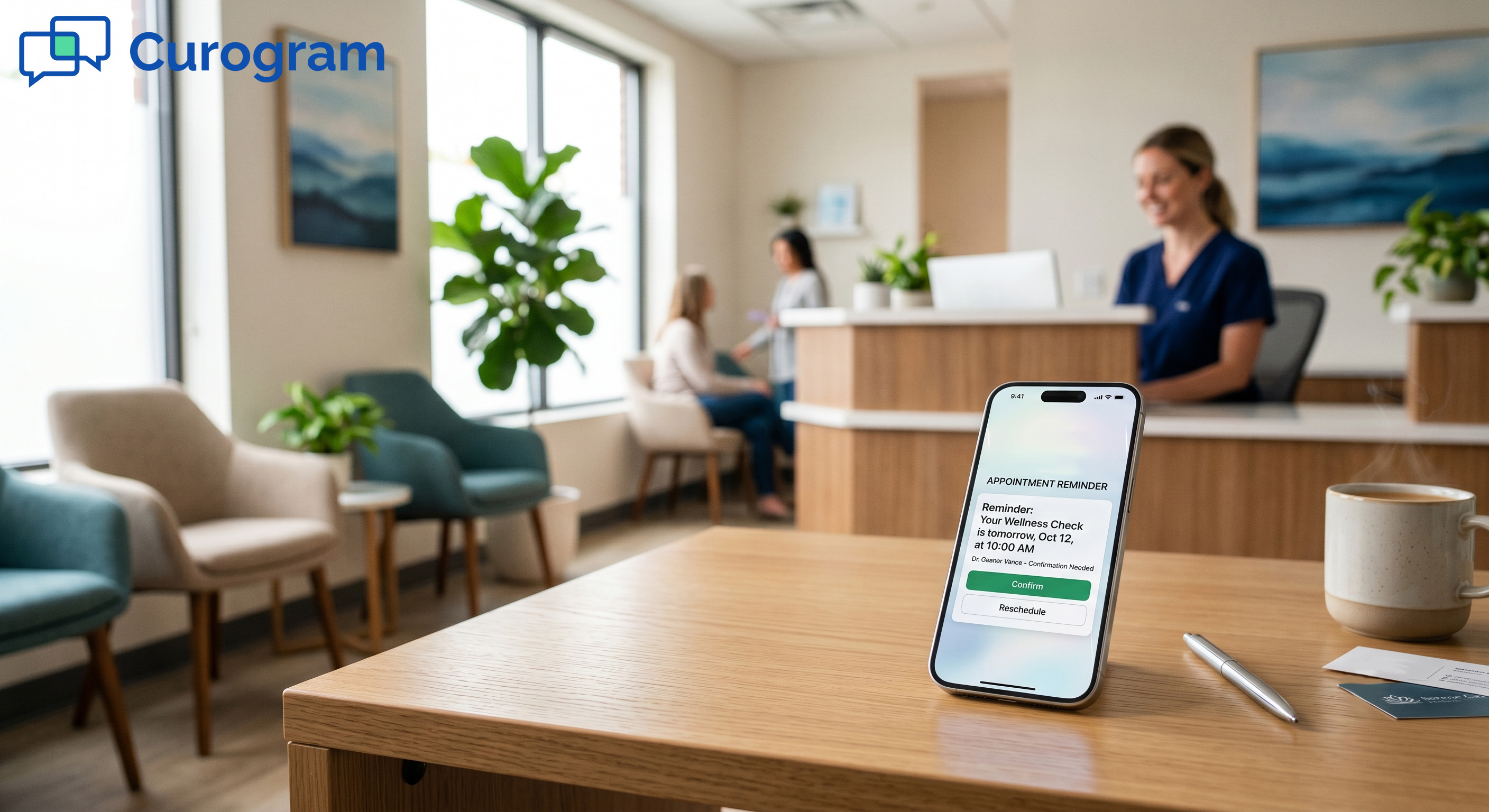
Curogram adds the reminder layer that Proven EHR lacks. It sends 2-way text reminders that confirm, cancel, or reschedule with one reply.
It works beside your EHR, not on top of it. No Proven API is required.
This guide walks you through the setup. You will learn how to pick timing, write messages, and turn on replies.
You will see how a clear no-show reduction workflow frees your staff. And you will see the results other practices reached.
Ready to trade the phone grind for a full schedule? Let's start with the problem. Then we will build the fix, step by step. The payoff begins on day one.
The Villain: The Confirmation Grind
The biggest threat to a full schedule is not your EHR. It is the manual confirmation routine.
Most practices still confirm sessions by phone. That choice quietly drains hours, money, and morale every single day.
The Problem: A Wall of Voicemails
Each morning, your front desk faces a long call list. They confirm sessions across outpatient, IOP, and MAT programs.
They may dial 40 to 60 clients a day. Most calls reach voicemail, and few clients ring back.
Clients screen unknown numbers, just like you do. So your call goes unseen. Even your best outreach never connects. The phone has quietly become the wrong tool.
So the chair sits empty, or it sits in doubt. Should the clinician prepare or expect a no-show?
Unconfirmed sessions create constant guesswork. That guesswork makes planning hard for the whole team.
This is the Confirmation Grind. It is the hidden villain in your day. It looks small at first. Over weeks, it steals both your schedule and your calm.
Hours Lost to the Phone
Manual calls eat 2 to 4 hours of front-desk time each day. That is time spent dialing, waiting, and leaving messages. It is time not spent helping clients in the room. Picture that loss across a full month.
Twenty workdays of lost hours pile up fast. That is nearly a part-time job spent on voicemail. Your team deserves better work than this. A smarter routine can give those hours back.
Now multiply that by every clinician you employ. The hours balloon across the whole practice. It is a quiet drain you rarely see on paper. Yet your team feels every minute of it.
The Cost Adds Up
A front-desk hire can cost $35,000 to $45,000 a year. Much of that wage goes to calls that yield little.
You pay good people to leave messages no one hears. There is a clearer, cheaper path.
Empty chairs cost even more. Each missed session is income you cannot earn back. Over a month, that gap grows into serious money. And those gaps repeat week after week.
Consider a 12-clinician practice. A 25% no-show rate can cost tens of thousands monthly. At $120 a session, the losses stack up quickly. That is revenue a simple reminder could have saved.
The Hidden Toll on Your Team
The grind wears people down. Call, voicemail, no callback, repeat. The loop feels futile, and your staff feels it daily. They know a single text could do the job in seconds.
Meanwhile, the clinical director watches clients slip away. People miss care because they lose track of a date. They have not stopped caring about their health. They simply never got a timely nudge.
None of this is your team's fault. They are stuck inside a manual process. Proven EHR did not ship a reminder tool. So the calls keep falling on people instead of software.
The right appointment confirmation setup for behavioral health can change that. It keeps clients informed without a single phone call.
You set it up once, and it runs beside Proven EHR. The grind turns into a calm, steady rhythm.

The Guide: Curogram – Set It Up Once, Confirm Sessions Forever
Now for the fix. Curogram adds the reminder layer Proven EHR is missing. It sends automated text reminders that clients actually read.
Best of all, you can set up automated reminders alongside Proven EHR in under an hour.
Think of it as a quiet engine. It runs in the background and confirms sessions for you. Proven EHR optimizes the schedule, while Curogram makes sure clients show up. The result is a fuller, calmer schedule.
How to Set It Up
The process is simple and fast. You work inside Curogram's dashboard, not deep code. No Proven API is required. The tool runs beside your EHR, fully on its own.
Setup does not touch your Proven EHR data. The two systems simply sit side by side. You keep your current workflow intact. Curogram adds the missing piece on top.
Your Proven EHR SMS reminder configuration follows three clear steps. First, choose when reminders go out. Next, write the words clients will see. Then turn on the reply options.
There is no heavy training curve. Most front-desk staff learn it in one short sitting. The screen is plain and friendly. If you can text, you can run it.
Pick Your Timing
Most practices send three reminders per session. A common rhythm is 48 hours, 24 hours, and 2 hours before the visit. Early notice helps clients plan around work and life. The final nudge catches anyone who forgot.
This timing is the heart of a strong no-show reduction workflow for a Proven practice. You can adjust the rhythm for each program.
A MAT client may need a different cadence than an outpatient client. Changes take only seconds.
Give Clients Easy Choices
Each reminder offers simple replies. Clients text C to confirm, R to reschedule, or X to cancel. One tap, and they are done. No call, no hold music, no hassle.
Your appointment confirmation setup for behavioral health should feel warm, not robotic. Curogram lets you write kind, clear messages. The tone stays gentle and human. That care matters in behavioral health.
Built for Every Program
Curogram supports many programs at once. You can automate session reminders alongside Proven EHR for outpatient, IOP, PHP, and MAT.
Each program gets its own timing and message. So every client hears the right words.
Reminders ride on the same 2-way HIPAA-compliant texting channel clients already trust. So each message feels familiar and safe.
When a client cancels, the slot does not just vanish. Curogram can ping your waitlist right away.
Your team watches one clear screen. They see who confirmed, who canceled, and who needs follow-up. No more guessing before each session. The front desk manages exceptions, not endless calls.
You can also message clients in bulk when needed. Send a closure notice or a weather alert in one go. Curogram also keeps data safe. It is HIPAA, SOC 2 Type II, and 42 CFR Part 2 compliant.
Every program stays organized in one place. You manage them all from a single view. Nothing falls through the cracks. Clients feel seen, not processed.
The Success: 2 to 4 Hours Daily Reclaimed
So what changes once reminders run on their own? A lot, and fast. Practices win back time, money, and calm. You do not need to take our word for it, since the data tells the story.
The Numbers Speak
The results are clear across many practices. Curogram clients see no-show rates 53% lower than the industry average, based on Curogram client data from clinical settings.
That gap turns empty chairs into kept sessions. It also turns lost income into recovered revenue.
One behavioral health practice cut its no-show rate from 14.2% to 4.91% in three months. That is 3X better than the typical rate, per Curogram client data from clinical settings. Steady reminders made the difference.
These gains are not luck. They come from steady, friendly nudges. Clients get reminded at the right moments. So they remember, and they show up.
Better numbers also build team confidence. Staff watch the schedule hold steady. They trust the system to do its job. That trust frees them to focus on care.
Confidence then spreads across the front desk. The whole office settles into a steadier pace.
Fewer Empty Chairs
Reliable reminders keep clients on track. More than 75% of sessions get confirmed across Curogram clients, based on Curogram client data from clinical settings.
Confirmed sessions mean fuller days. Fuller days mean stronger care and steadier revenue.
Think about what 53% fewer no-shows means. For a busy practice, that is many sessions saved each week.
Those saved sessions protect both care and cash flow. The effect compounds month after month.
The savings keep building over time. What starts as a few kept sessions becomes a fuller calendar.
Time Back for Care
Here is the shift staff feel most. Those 2 to 4 daily call hours come back. The team redirects that time to clients and growth. Work feels useful again, not futile.
Morale climbs when busywork drops. Staff trade dialing for real connection. They feel the value of their role. Burnout eases across the team.
Clients feel the difference too. They reach a calm, present team. Care improves when staff are not rushed. Everyone wins from the change.
From Manual to Automatic
The whole rhythm of the day changes. Every session has a confirmed status before the clinician walks in.
Cancelled slots fill from the waitlist on their own. The front desk handles a few exceptions, not the full list.
This is the move from manual to automatic. Your staff stops chasing clients by phone. They start supporting the clients in front of them. That is a better use of their skill and heart.
Your census can grow without new hires. The same team now serves more clients, with less stress.
Many practices see a 10% to 20% rise in revenue, per Curogram client data from clinical settings. That is a real win for the practice.
And if a client still slips through, client recalls can win them back. A short text can re-engage anyone overdue for care.
One clinic confirmed more than 1,100 sessions a month through automation. The same staff handled far more with ease.
Manual calls vs. automated reminders at a glance:
|
Daily reality |
Manual calls |
Automated reminders |
|---|---|---|
|
Confirmation method |
40 to 60 phone calls |
2-way text replies |
|
Staff time used |
2 to 4 hours daily |
A few minutes to check |
|
Typical no-show rate |
20% to 50% |
53% below average |
|
Empty slots |
Often stay empty |
Filled from the waitlist |
Conclusion: Automate the Grind, Focus on Care
The manual confirmation grind does not have to run your day. You can set it up once and confirm sessions forever.
A few smart settings replace dozens of daily calls. That is the whole promise here.
Think of the time you would save. Think of the clients who stay in care. The grind is a choice, and you can end it. The tools are ready when you are.
Remember the simple split. Proven EHR shapes and optimizes your schedule. Curogram makes sure clients actually show up. Together, they close the gap that costs you the most.
Your Proven EHR reminder setup becomes a true no-show reduction workflow. Reminders go out on time, every time. Clients confirm with one quick reply. Empty chairs fill from the waitlist on their own.
The setup does not disrupt your current system. Proven EHR keeps doing what it does well. Curogram simply works alongside it. No rip-and-replace, no API headaches, no downtime.
The payoff is real and proven. Practices win back 2 to 4 hours of staff time each day. No-show rates fall well below the industry average. Revenue and morale both climb.
Every confirmed session protects a client's progress. People heal best with steady, regular care. A missed week can set recovery back. Reminders quietly guard that steady care.
Your team should not spend hours on calls that a text can handle in seconds. That time belongs to your clients.
It belongs to the care only your people can give. Let the software handle the rest.
Your staff will notice the change first. The endless dialing stops almost overnight. Calmer days lead to better work. And better work shows up in client care.
Cost is easy to justify here. Recovered sessions pay for the tool quickly. Many practices see revenue climb within months. The math favors action over delay.
So reclaim your front desk today. Automate your confirmations and redirect that time to what matters most: client care. The change is faster and simpler than you think.
The best time to fix the grind is now. Every week of delay is revenue lost. Your clients and your team both deserve better. Take the first small step today.
Book a demo today and see how Curogram fits your behavioral health program.
Frequently Asked Questions
Setup usually takes less than an hour. You set your timing, write your message templates, and turn on reply options. Once saved, reminders run on their own for every session. No Proven API or coding is required.
Texts reach clients where they already look, on their phones. A friendly nudge at the right time jogs their memory. Clients can confirm or reschedule with one quick reply. Curogram clients see no-show rates 53% below the industry average, based on Curogram client data from clinical settings.
Most people ignore calls from unknown numbers. A short text feels less intrusive and easier to answer. Clients can reply on their own time, in seconds. That ease leads to higher confirmation rates across programs.
Curogram supports many programs at once. You set unique timing and message templates for outpatient, IOP, PHP, and MAT. Each client then gets words that fit their care. Changes take only seconds inside the dashboard.
The change logs in your dashboard right away. A canceled slot can trigger an instant waitlist notice. Staff can then fill the gap before it costs you. Confirmation status updates in real time, so your team always knows who is coming.