
7 min read

Reducing No-Shows for Osmind Psychiatric Practices

Reducing No-Shows for Osmind Psychiatric Practices
💡 Reducing no-shows for an Osmind psychiatric practice takes automated, two-way patient communication. Osmind tracks the clinical schedule, but it does not send the messages that keep patients on it. Curogram for Osmind fills that gap.

It adds multi-channel reminders, two-way text confirmations, and write-back into the EHR. Patients can confirm, reschedule, or ask a quick question by text. Staff see every reply in one place, and the EHR stays the single source of truth.

The payoff is real. Curogram's psychiatry clients average an 11.03% no-show rate, against a 23% industry norm. That is a 52% drop, based on our internal data and ProspyrMed 2024. Fewer missed visits means steadier treatment and protected revenue.

Picture a Monday morning. Four patients on the schedule never show. One missed a dose change, and another skipped a planned ketamine session. The empty chairs cost far more than lost time.

In psychiatry, a no-show is rarely just a gap. It can break a treatment course or stall a fragile recovery. That is why reducing missed visits matters so much. The good news is that Curogram for Osmind was built to help.

First, the scale. The average psychiatry no-show rate sits near 23%. Curogram's psychiatry clients average just 11.03%, based on our internal data and ProspyrMed 2024. That is a 52% drop in missed visits.

The money side stings too. Each missed visit costs about $200 on average. Across a year, no-shows can drain a practice of roughly $150,000. Those gaps grow quietly and fast.

For multi-session care, the stakes climb higher. A missed ketamine or TMS session can throw off a whole protocol.

Sometimes the course must restart from scratch. That is lost time for the patient and lost revenue for the practice.

Osmind does many things well. It holds your schedule, notes, and outcomes in one place.

But it does not send the reminders that keep patients on track. That job needs a tool made for two-way contact.

So how do you reduce no-shows for your Osmind psychiatric practice without more staff? The answer is automation that talks back.

Reminders go out on their own. Replies flow into one dashboard and write back into Osmind.

This guide breaks the issue down step by step. You will see why psychiatry no-shows hurt more than most. You will learn why one-way reminders fall short.

Then you will see how two-way reminders, real client wins, and a simple start can change your week and protect your bottom line.

The Psychiatry No-Show Problem: Higher Stakes Than General Medicine

No-shows happen in every clinic. But in psychiatry, the fallout runs deeper. A skipped visit can stall care, not just the schedule. Here is why the stakes feel higher.

Why a missed visit is also a clinical risk

A missed medication check is not a minor slip. The patient may skip a needed dose change. Some stay on a drug that no longer works. Others stop medication with no one watching.

Multi-session care raises the risk even more. A missed ketamine infusion breaks a planned series. A missed TMS session leaves a gap in a course built for daily visits. Each gap can force a reset.

Continuity is the heart of good psychiatric care. When a patient drops a session, momentum fades.

Symptoms can creep back before the next visit. A small gap today can mean a longer setback later.

The financial cost of empty chairs

The money loss is real and steady. Each missed visit costs about $200 on average, based on ProspyrMed and SovDoc 2024.

Over a year, no-shows can cost a practice near $150,000. That is a large hole to fill.

Measure

Industry average

Curogram psychiatry clients

Psychiatry no-show rate

23%

11.03%

Relative reduction

n/a

52% lower

Cost per missed visit

about $200

recovered

Based on our internal data and ProspyrMed / SovDoc 2024.

These losses are not one-time events. They repeat week after week if nothing changes. Each empty slot is care a patient did not get. It is also revenue your practice cannot recover.

Why One-Way Reminders Are Not Enough for Psychiatry

Many clinics already send reminders. But most go one way only. The message lands, and the patient can read it. Yet there is no easy way to reply.

One-way reminders leave patients stuck

A one-way text or email is a dead end. The patient cannot confirm inside the system. They cannot reschedule or ask a quick question. So they pick up the phone instead.

That choice floods the front desk. As one prospect put it, “Our front desk is fielding 80+ calls a day just for directions and confirmations.”

Patients who forget to call become no-shows. Patients who text back get silence.

Calls also cost time and money. Staff spend hours each week dialing patients. Many calls go to voicemail and lead nowhere. That effort rarely lifts the show rate.

Missed sessions compound the risk

For multi-session care, one-way reminders fall short fast. Ketamine and TMS plans rely on tight timing. A single missed session can force a protocol change. Some patients must even restart the course.

Without a reply path, small problems grow. A patient unsure about a visit may just skip it. A quick text back could have saved the slot.

One-way tools never give them that chance, and in psychiatry that silence carries real risk. 

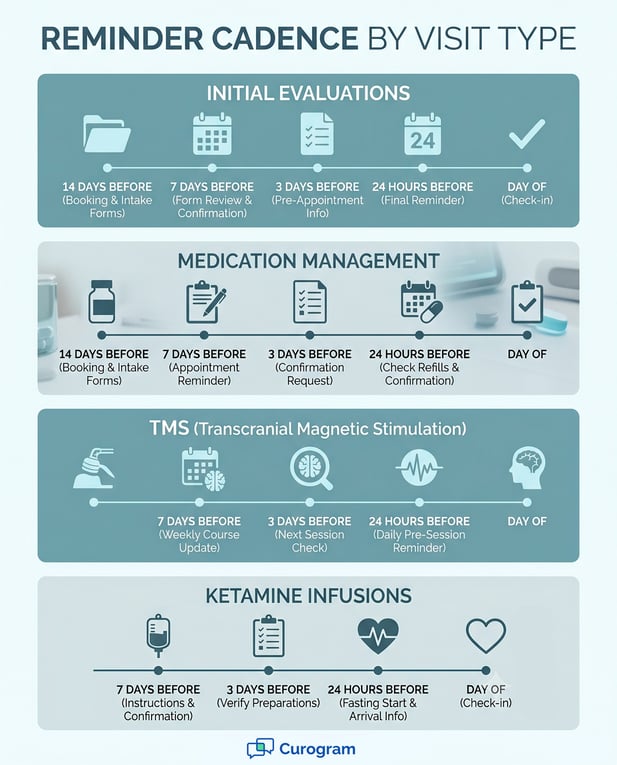
Infographic: Reminder schedule for evaluations, medication, TMS, & ketamine

How Automated Two-Way Reminders Reduce No-Shows on Osmind

Two-way reminders fix the gap one-way tools leave open. They sync with Osmind, reach patients on their terms, and let them reply.

The result is fewer empty chairs, less phone tag, and steadier care. Here is how the flow works.

Appointments sync and reminders fire on their own

Curogram connects to your Osmind EHR and reads your schedule. When an appointment is set, reminders trigger on their own. They go out by text, email, or voice. You choose the channel by appointment type.

Patients can reply right in the thread. They confirm, reschedule, or ask a short question. Staff see every reply in one Curogram dashboard. For more on this approach, see our guide to cutting no-shows.

Cadence built for each visit type

Not every visit needs the same nudge. A daily TMS course and a monthly med check call for different timing. Curogram lets you set a cadence for each type. Two common setups stand out.

Visit type

Reminder cadence

Ketamine infusion

48 hours before and morning of, with pre-session instructions

TMS (daily sessions)

Daily confirmation text, “reply C to confirm”

Medication management

72-hour and 24-hour reminder sequence

Initial psychiatric evaluation

1 week, 48 hours, and morning of, with an intake form link

Sample cadences. Curogram tailors timing to your practice and visit mix.

Ketamine and TMS sessions

These plans live or die by timing. A skipped ketamine infusion breaks a multi-session series. A daily TMS gap can stall a full course. So reminders run close and often to hold the line.

Medication management and evaluations

Monthly med checks need a gentle, early nudge. A 72-hour and 24-hour pair gives patients time to plan. First evaluations get more lead time plus an intake link. That helps new patients arrive prepared.

Write-back keeps one source of truth

Every reply writes back into Osmind. Confirmed and unconfirmed visits show right on the schedule. Providers see the real day at a glance. No one checks a second system.

The payoff shows up in real numbers. Covina Arthritic Clinic used automated two-way confirmations and now logs over 1,100 confirmed appointments a month, based on our internal data.

That kind of lift came with zero extra staff. Steady confirmations protect both patient care and practice revenue every single week.


What Lower No-Show Rates Mean for an Osmind Practice

Lower no-show rates do more than tidy a calendar. They protect revenue, care, and staff time. The gains show up across the whole practice. Here is what changes.

Protected revenue and steady care

Picture a practice that sees 20 patients a day. At a 23% no-show rate, it loses about 4.6 visits daily. At Curogram's 11.03% average, that drops to about 2.2. You recover roughly 2.4 visits a day, every day.

The math adds up over a year. Those recovered visits become real income. They also mean more patients getting care. Both your books and your patients win.

Care gets steadier too. Fewer missed ketamine and TMS sessions means more patients finish their plans. Med checks happen on time. Recovery stays on course.

A lighter load for your front desk

Your team stops chasing confirmations by phone. Those hours shift to work that matters more. Think intake, insurance checks, and patient support. The same staff handles more with less stress.

Morale climbs as the busywork drops. Staff burnout often starts with endless phone tasks. Cutting those calls gives your team room to focus. Happier staff tend to stay longer.

The schedule also gets honest. Write-back shows who has confirmed and who has not. Providers plan around the real day, not a hopeful guess. That clarity helps everyone breathe easier.

Medical receptionist smiling and assisting a patient checking in

Getting Started

Starting is simpler than most teams expect. Setup is quick, and training takes minutes. You can begin with your highest-risk visits first. Here is the path.

Setup and first steps

Setup runs about two to four weeks. Curogram's team builds the write-back link with Osmind for you. They also create reminder templates for your visit types. Staff training takes around 10 minutes.

Start where the risk is highest. Turn on two-way reminders for med management and ketamine or TMS visits first. Once those run smoothly, expand to every appointment type. You grow the system at your own pace.

Try it with your own Osmind instance

The best test is your own schedule. Book a free demo and watch the no-show reduction work inside your Osmind instance.

Want to go further? See how Curogram serves behavioral health clinics. Each clinic gets a setup built around its visit types. Most teams notice calmer mornings fast.


Frequently Asked Questions

How do two-way reminders reduce no-shows for an Osmind psychiatric practice?

They sync with your Osmind schedule and send reminders by text, email, or voice. Patients can confirm or reschedule in the same thread. Every reply writes back into Osmind, so staff act fast. Fewer forgotten visits means fewer empty chairs.

Why are psychiatry no-shows more costly than no-shows in general medicine?

A missed psychiatric visit can break a treatment plan, not just a schedule. Patients may skip a dose change or gap a ketamine or TMS series. That can stall recovery or force a restart. The clinical and financial costs both run higher.

How long does it take to set up Curogram with Osmind?

Setup usually takes about two to four weeks. Curogram's team handles the write-back link and builds your reminder templates. Staff training takes only around 10 minutes. Most teams start with their highest-risk visits first.

Why is one-way reminding not enough for multi-session care like TMS?

One-way reminders give patients no way to reply or reschedule. For daily TMS or ketamine plans, timing is tight and gaps cost a lot. A patient who cannot confirm may simply skip the visit. Two-way contact closes that gap.

How much can a practice expect no-show rates to drop?

Curogram's psychiatry clients average an 11.03% no-show rate, against a 23% norm. That is about a 52% drop, based on our internal data and ProspyrMed 2024. Results vary by practice and visit mix. Still, the trend is a clear and steady decline.


Reducing No-Shows in Psychiatric Practices on Valant

Reducing No-Shows in Psychiatric Practices on Valant

💡 To reduce no-shows, psychiatry practices on Valant need more than portal reminders. Valant sends reminders through its patient portal. But many...

Read More
Automated Appointment Reminders for Osmind | Keep Infusion Chairs Full

Automated Appointment Reminders for Osmind | Keep Infusion Chairs Full

💡 Curogram delivers automated appointment reminders for Osmind ketamine TMS practices through SMS — not app push notifications. Patients confirm,...

Read More
Set Up Reminders for Proven EHR Practice | Curogram

Set Up Reminders for Proven EHR Practice | Curogram

💡 Setting up automated reminders for a Proven EHR practice starts with Curogram. You add an SMS reminder layer beside your EHR. No Proven API is...

Read More