
Osmind EHR was designed specifically for psychiatry, ketamine-assisted therapy, TMS, and other interventional mental health treatments.
It handles clinical documentation that general-market EHRs struggle with: structured treatment protocols for ketamine and TMS sessions, medication management with e-prescribing, outcome tracking tied to PHQ-9 and GAD-7, and insurance billing workflows tailored to psychiatric practice.
For practices offering novel therapeutics — IV ketamine, Spravato, repetitive TMS — Osmind provides the specialized charting and protocol tracking that makes compliance documentation straightforward. The platform understands the difference between a ketamine infusion session note and a standard therapy progress note, and structures the clinical record accordingly.
The gap for Osmind users is not in the clinical record — it's in everything that happens between visits: reminders patients can respond to, two-way texting from the practice number, intake completed before arrival, and systematic outreach to patients who've dropped off the schedule.
.png)
 Write-Back Integration — the #1 Technical Stall Point.
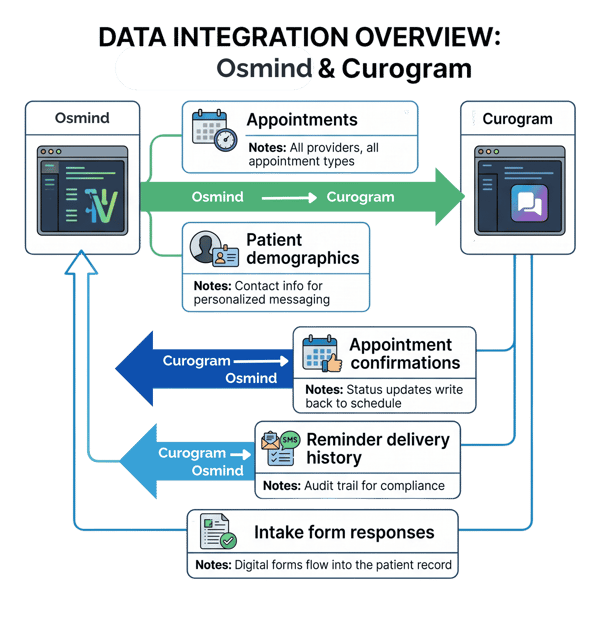
When Osmind practices evaluate third-party communication tools, the first question is always about data flow: does information from the communication platform write back to the EHR, or does it create a parallel system staff have to manage separately? For practices already managing medications, protocols, and clinical notes in Osmind, a tool that doesn't sync back is a non-starter — it doubles the administrative burden instead of reducing it.
"We're re-entering the same patient data into three different systems."— Psychiatry practice · Curogram discovery call

 Two-Way HIPAA-Compliant Texting.
Osmind doesn't offer native two-way patient texting. When a patient texts to ask about an appointment, confirm a session, or follow up on a prescription, that message has no destination inside Osmind. Most practices default to personal cell phones or one-way reminder services. In a psychiatry setting where continuity of communication supports treatment adherence, that void has clinical consequences beyond missed appointments.
"Patients reply to our reminder texts and the messages go into a void."— Psychiatry practice · Curogram demo

 Patient Recall for Lapsed Psychiatric Patients.
Psychiatric patients lapse from care at higher rates than most specialties. Medication stabilization leads patients to believe they no longer need treatment; stigma resurfaces; life circumstances shift. Osmind tracks the clinical record but doesn't automate outreach to patients who haven't scheduled a follow-up. Manual recall consumes hours and yields a passive return rate of roughly 5–10%.
35% Lapsed patients reconverted within 30 days — 1,240 patients, ~$248K revenue recovered at ~$12/reactivation. SRC · Curogram client data · Optima Medical

 Reputation Management.
Psychiatry practices face a particular reputation challenge: patients are less likely to leave unsolicited Google reviews due to the sensitive nature of mental health treatment. Without an automated, appropriately timed review request, most psychiatry practices accumulate reviews slowly — leaving their online profile to be shaped by a small and unrepresentative sample.
721% Review growth at Optima Medical — 993 → 8,159 reviews in 16 months · 90% 5★ SRC · Curogram client data · eCW

.png?width=1545&height=2000&name=Osmind+Curogram%20Integration%20Spec%20(1545%20x%202000%20px).png)
Two-Way HIPAA Texting from Your Practice Number
Patients text your existing office number. Staff respond from the Curogram dashboard. Every message is encrypted, logged, and covered under a signed BAA. Replaces the personal-cell-phone workaround and creates a documented communication channel that supports treatment continuity — logistics, refill questions, and pre-visit coordination in one auditable thread.

Automated Reminders — Customizable by Session Type
Multi-channel reminders via text, email, and voice, configurable by appointment type: initial psychiatric evaluation, medication management follow-up, ketamine infusion session, TMS treatment, or therapy. Psychiatry on Curogram averages 11.03% no-shows vs. the 23% industry average.

Digital Intake with Clinical Screening Tools
Intake forms sent via text link before the first visit. Patients complete PHQ-9, GAD-7, demographic info, insurance verification, and consent from their phone. Responses write back to the Osmind patient record — no manual re-entry, no separate intake system.

Patient Recall — Re-engaging Lapsed Psychiatric Patients
Automated SMS campaigns identify and reach patients who haven't scheduled a follow-up within a configurable window. For psychiatry practices, recall is both a revenue and clinical responsibility — lapsed patients often need medication continuity.

Automated Google Review Requests
Post-visit review requests sent automatically via text, timed appropriately for psychiatric care. Optima Medical grew from 993 to 8,159 Google reviews in 16 months — a 721% increase with a 90% five-star rate across all locations.