

9 min read

TherapyNotes Appointment Reminders: Reduce No-Shows with Automated SMS

TherapyNotes Appointment Reminders: Reduce No-Shows with Automated SMS
💡 TherapyNotes automated appointment reminders SMS behavioral health workflows sharply lower no-show rates through Curogram's 2-way text confirmation system. The platform works alongside TherapyNotes without API access or data migration.

Behavioral health practices using TherapyNotes lose an estimated $60,000 each month to empty sessions. Curogram replaces manual confirmation calls with automated SMS reminders sent at preset intervals.

Clients reply by text to confirm, cancel, or reschedule. Practices using Curogram see no-show rates 53% lower than industry averages, recovering thousands in lost session revenue each month.

Your clients want to show up. Most of them, anyway.

But behavioral health is different from a routine physical. A client with anxiety may stare at a portal email for hours. A client with depression may not have the energy to log in and tap confirm.

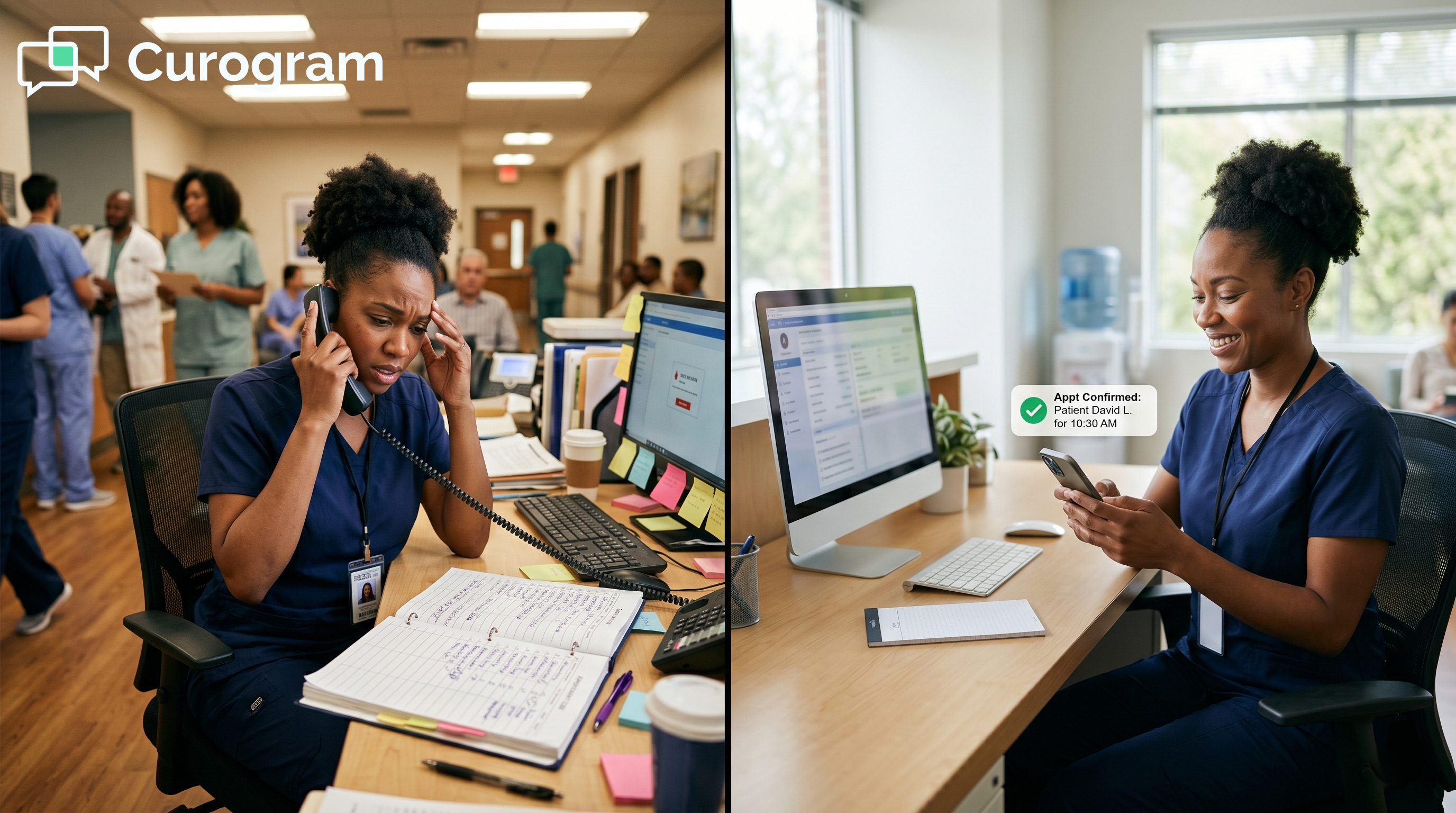
By Tuesday morning, your front desk has dialed 60 numbers. Half went to voicemail. Three clients meant to cancel but never picked up the phone.

Those empty slots add up fast. A 10-clinician practice can lose $60,000 each month to unfilled sessions. That is not a small leak. That is a flood.

TherapyNotes runs your clinical schedule well. But its built-in reminders stop at basic emails through TherapyPortal. There is no 2-way SMS. No real-time response capture. No quick view of who has confirmed.

Meanwhile, your staff burns 2 to 3 hours each day on confirmation calls. That time should go to clients, intake, and billing follow-up. Not voicemail roulette.

Curogram closes that gap. Our text reminders for therapy practices send out at the right time, capture replies, and only flag what needs human attention. The result is fewer empty chairs and a calmer front desk.

Switching EHRs to fix this feels like too big a swing. Hiring more admin staff to make more calls treats the symptom, not the cause.

There has to be a better way to confirm sessions than dialing every client every day.

There is. The fix is not bigger. It is smarter. An automated SMS layer that sits on top of TherapyNotes catches what the portal misses.

This guide walks you through the no-show spiral, how an automated safety net stops it, and what your week looks like once Monday's schedule is already 85% confirmed before staff sip their first coffee. 

The Villain: The No-Show Spiral

TherapyNotes is strong where it counts for clinical work. The note templates, claim flows, and scheduling logic earned their place in mid-market behavioral health.

But the reminder layer was built for a calmer era of patient behavior, and clients have moved on to text.

The gap is small in theory and huge in practice. Email is fine for newsletters. It is not fine for getting a client with anxiety to confirm a Tuesday session.

The Portal Paradox in Behavioral Health

TherapyPortal sends an email. The client sees it sitting in a crowded inbox. Logging in feels like one more task on a hard day. So they swipe past it and tell themselves they will deal with it later.

The clients most likely to skip a portal are also the ones most likely to no-show. Anxiety, ADHD, and depression all sap the energy needed for multi-step actions. That is the portal paradox at work.

A text is different. It pops up. It needs one tap. Reply YES, and you are done. That is why text reminders for therapy practices outperform email by a wide margin.

The Manual Confirmation Grind

Picture a Tuesday morning at a 10-clinician practice. The schedule shows 80 to 120 sessions for the week. Staff starts dialing at 8 a.m.

Each call takes 3 to 4 minutes. Most hit voicemail. A few hours later, fewer than half are confirmed. The schedule still has gaps that no one knows about yet.

Hidden Cancellations

Three clients planned to cancel but never picked up. Their sessions stay marked as confirmed until they fail to arrive. The clinician waits. The slot sits empty. There is no time to refill it from the waitlist.

Burned-Out Front Desk

Staff spend 25% to 40% of their day on outbound calls. That same time could go to live clients in the lobby, billing follow-up, or insurance work. Instead, it goes to voicemail loops, and turnover rises.

The True Cost of Empty Sessions

Industry no-show rates in behavioral health sit between 20% and 23%. For a 10-clinician practice with 250 weekly sessions at $120 each, a 20% rate means 50 missed sessions per week. That is $24,000 per month and nearly $288,000 per year in lost revenue.

But the clinical cost matters too. A client who misses two sessions in a row is far more likely to drop out of care.

Symptoms regress. Crisis risk rises. The financial gap and the care gap are the same gap.

The cost compounds in less obvious ways, too. A clinician with two empty hours in a row loses momentum and energy.

Other clients in care that week feel the ripple when the practice cannot reach them quickly. The leak is wider than the missed dollars suggest.

Here is what the no-show spiral looks like in dollars:

Practice Size

No-Show Rate (20%)

Monthly Revenue Lost

5 clinicians

25 sessions/week

$12,000

10 clinicians

50 sessions/week

$24,000

20 clinicians

100 sessions/week

$48,000

Estimates based on 250 weekly sessions per 10 clinicians at $120 average reimbursement.

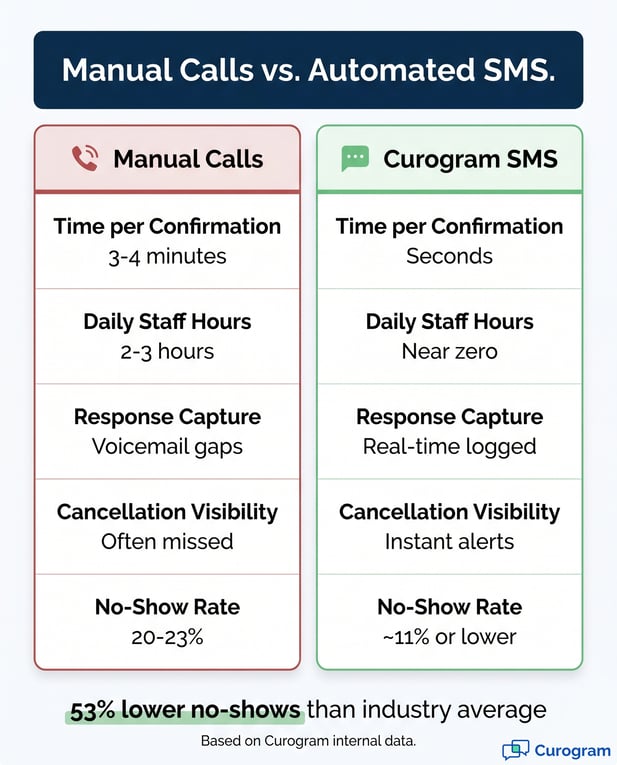
Infographic showing Automated SMS has fewer no-shows and lower costs than manual phone calls

The Guide: The Automated Safety Net

You do not need to switch EHRs to fix this. You need a layer that handles confirmations while TherapyNotes keeps doing what it does best.

That layer is Curogram's TherapyNotes SMS confirmation system, and it sits on top of your existing workflow without any data move.

Think of it as a safety net. The schedule lives where it always has. The texting, the replies, and the alerts happen in a tool built to do exactly that.

Both systems stay in their lane, and the client never sees the seams.

How 2-Way SMS Confirmations Actually Work

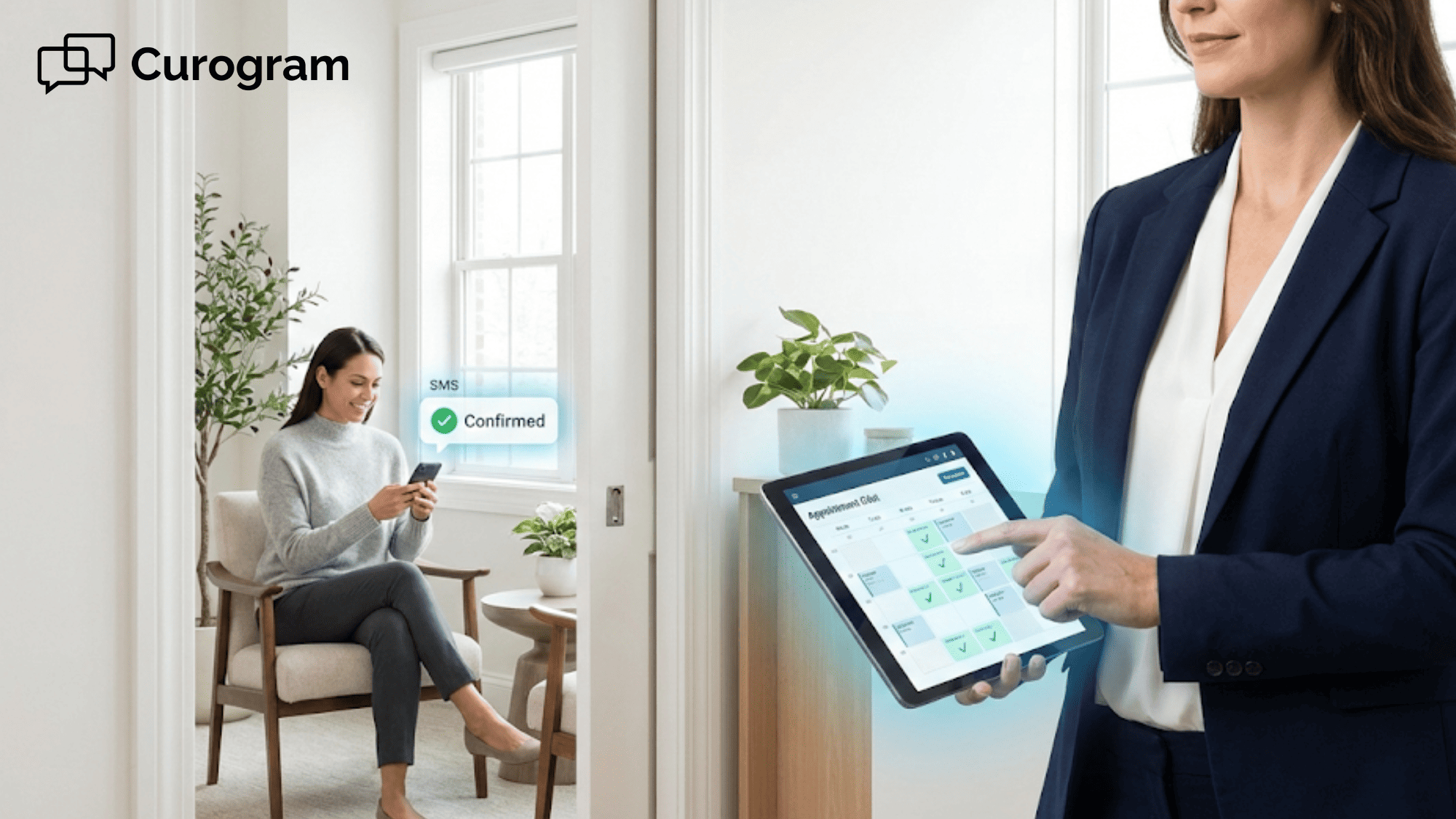
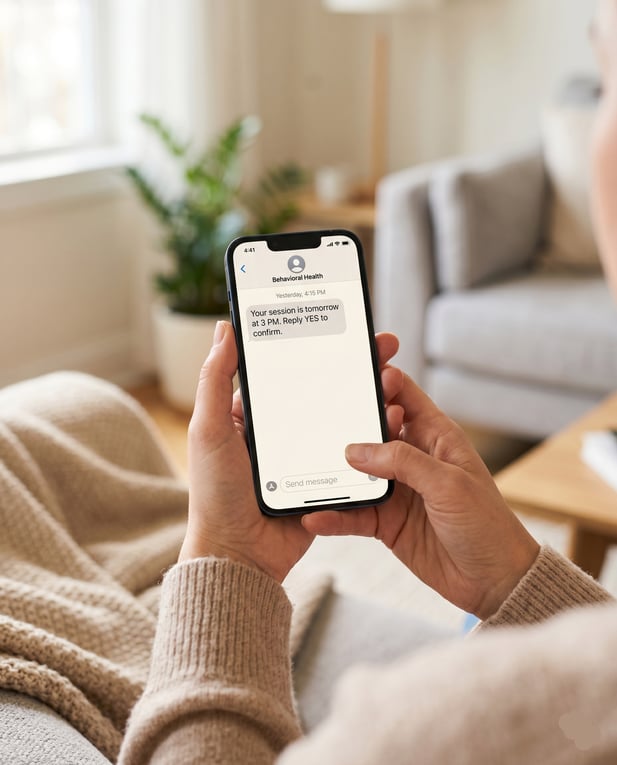
Curogram sends a text at the times you choose. Common picks are 48 hours, 24 hours, and 2 hours before a session. Each message is short, clear, and asks for one tap to confirm.

Clients reply YES, CANCEL, or CHANGE. The system logs the answer in real time. Staff only step in when a client asks to reschedule or when no reply comes in after the final reminder.

Smart Escalation

If a client does not reply to the first text, Curogram sends a follow-up. If silence holds, the system flags that session for a quick staff touch.

Every client gets multiple chances to engage before staff lifts a phone.

Customizable Templates

Message wording, timing, and tone can shift by appointment type. An intake session can sound warmer.

A recurring therapy session can stay short and routine. You set the rules once, and the automated session reminders therapists rely on run on their own.

Works Alongside TherapyNotes, No API Needed

Many practices worry about EHR migration or risky integrations. Curogram avoids both. Staff keep managing the clinical schedule inside TherapyNotes.

The TherapyNotes scheduling reminders gap gets filled by Curogram in the background. No data migration.

No retraining on core clinical workflows. The two systems work as a pair, with each handling what it does best.

Setup is light. Most practices are sending live reminders within a few days, not weeks. There is no IT project, no developer hand-off, and no risk to your existing EHR setup.

Built for Behavioral Health Compliance

Behavioral health texting must meet a higher bar than general healthcare. HIPAA is just the start.

SOC 2 Type II and 42 CFR Part 2 substance-use rules also apply, and they shape every message your platform sends.

Curogram is built to meet all three. Reminder text stays generic and consent-based. Sensitive details are kept inside secure links.

That keeps your behavioral health appointment confirmation automation safe and audit-ready from day one.

This matters more than it sounds. A reminder system that mishandles a single PHI field can put a whole practice at risk.

Curogram was built around these rules from the start, not bolted on later, so your team can text clients with full confidence.


The Success: Every Session Confirmed Before Your Staff Arrive

Here is what the shift looks like in real practices. The confirmation grind stops. The dashboard does the watching. Your team handles the few exceptions instead of the entire schedule.

The change is not slow either. Most practices feel it within the first month. Staff stop dreading Monday morning.

Clinicians stop waiting in empty rooms. Owners stop watching the same revenue leak month after month.

The Numbers: A 53% Drop in No-Shows

Curogram practices see no-show rates 53% lower than industry averages, based on our internal data. Atlas Medical Center dropped from 14.2% to 4.91% in just 3 months. That is 3 times better than the industry average.

For a behavioral health practice with a 23% no-show rate, falling to roughly 11% recovers about $30,000 each month in a mid-market setting. That money was already earned. It just was not collected.

Add up a full year, and the gain is meaningful. Most owners can fund a new hire, a new tool, or a real raise for current staff from the recovered revenue alone. The practice gets healthier in every direction at once.

Confirmation Capacity at Scale

Volume is no longer a wall. Covina Arthritic Clinic confirms more than 1,100 appointments each month through Curogram's automated workflow, according to our internal data. That kind of throughput is simply impossible with manual phone calls.

Confirmation Rate Across All Clients

Curogram clients see a 75%+ average appointment confirmation rate across specialties, based on our internal data.

For behavioral health, that means most of your week is already locked in before staff even start their shift.

Here is the contrast between manual calls and Curogram's automated workflow:

Workflow Element

Manual Calls

Curogram SMS

Time per confirmation

3-4 minutes

Seconds

Daily staff hours used

2-3 hours

Near zero

Response capture

Voicemail gaps

Real-time logged

Cancellation visibility

Often missed

Instant alerts

No-show rate

20-23%

~11% or lower


The Shift: From Phones to Exceptions

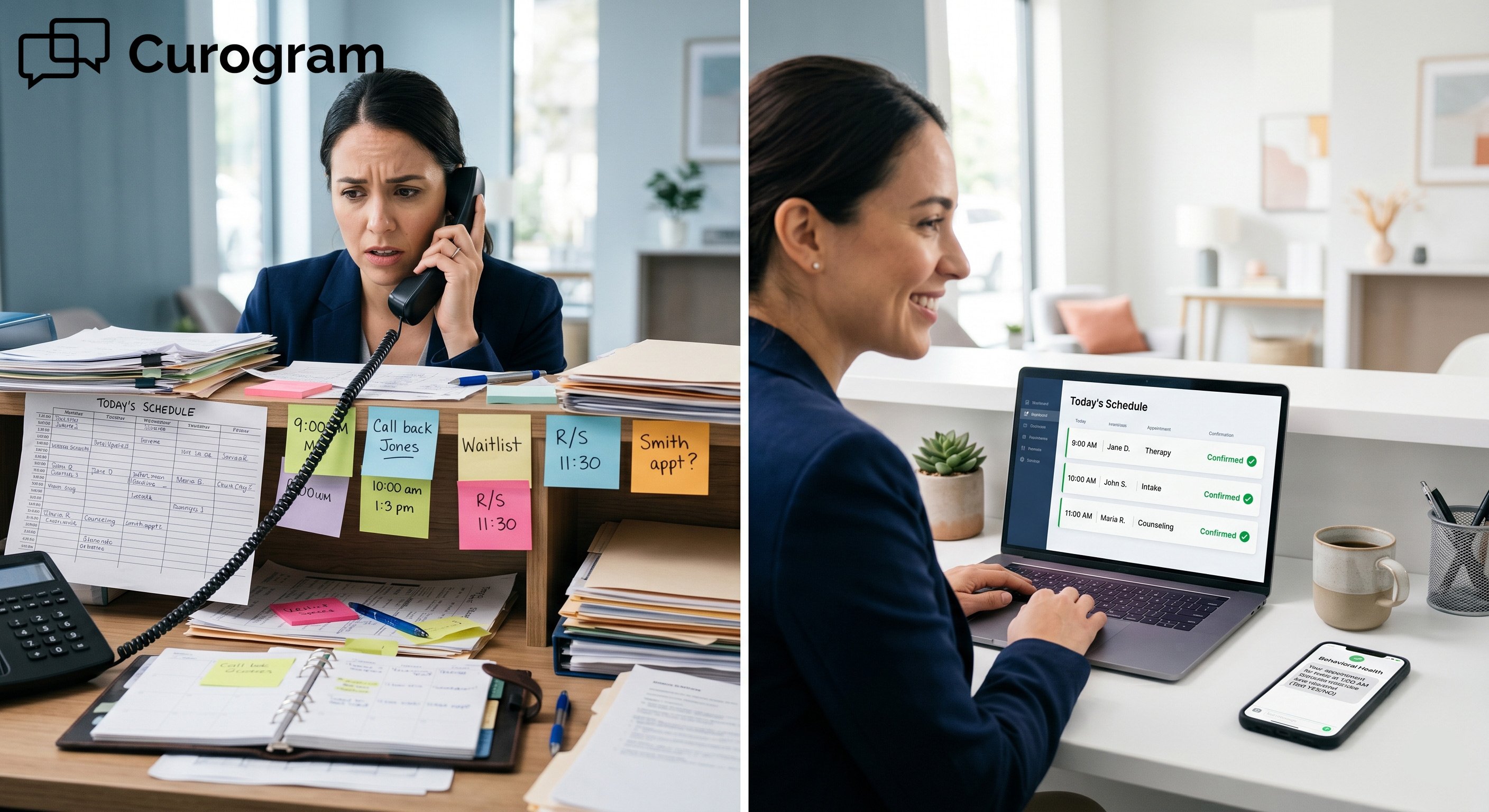
Monday at 8 a.m. used to mean a list of 60 numbers to dial. Now Monday starts with a dashboard.

Most sessions for the week are already confirmed from weekend reminders. Staff scan the open exceptions and handle them in minutes.

By Wednesday noon, Thursday's schedule is mostly locked in. Three cancellations have already triggered waitlist backfills.

Two clients have not replied yet, so the system queues one last reminder for 5 p.m. that day.

This is what it means to reduce no-shows TherapyNotes practices have lived with for years. Confirmations stop being a daily grind. They become a quiet background process you barely notice.

The downstream effects are bigger than the headline number. Clients feel the practice is on top of things.

Clinicians feel respected when their schedule actually fills. Staff feel useful when they help real people instead of leaving voicemails.

That is the real shift. The schedule moves from fragile to solid. The practice stops absorbing losses it could not see coming. And the team stops burning out on work that a simple text could handle.

A smartphone in hand with a message about a schedule reminder

ConclusionStop Calling. Start Confirming.

Every empty session is revenue you earned but never collected. It is also a client who slipped out of care.

Both costs add up faster than most owners expect. A few empty hours per clinician per week scales into tens of thousands per month. The clinical cost is even harder to measure but just as real.

TherapyNotes is great at building your schedule. It was never built to protect it. That is a different job, and it needs a different tool.

Curogram is that tool. Our 2-way SMS confirmation system sends reminders, captures replies, and flags only what needs human attention. It works alongside TherapyNotes without any API access or data migration.

There is no big lift on your end. No vendor onboarding marathon. No staff overhaul. You keep the EHR you already trust and add a layer that does the one thing it was never built to do.

The shift is not small. Practices using Curogram see no-show rates 53% lower than industry averages, based on our internal data.

A mid-market behavioral health practice can recover $30,000 or more each month in lost session revenue.

Your staff stop chasing clients and start serving them. Your clients stop missing care they wanted in the first place. Your schedule stops bleeding.

The ripple effect reaches every part of the practice. Billing closes cleaner. Clinicians stay sharper. Owners stop firefighting and start planning the next move.

The change does not require an EHR switch. It does not require new clinical training. It is one layer added on top of what you already have, and it pays for itself in recovered sessions within weeks.

Before you hire another front-desk staff member to make more phone calls, see what an automated safety net can do for your practice. The math is usually clearer than people expect.

Most practice owners are surprised by their own no-show numbers when they finally see them on one page. The drag on revenue, on staff energy, and on clinical outcomes is bigger than the daily grind makes it feel.

An automated system does not fix everything overnight. But it does fix the one thing that has been quietly bleeding your practice for years. That is a fair trade for 15 minutes of your time.

Behavioral health work is hard enough without losing money and momentum to empty chairs. Your clinicians chose this field to help people heal, not to wait in silent rooms. Your front desk chose this job to support clients, not to leave 60 voicemails before lunch.

Give them all a better way to spend their day. The tools to do it are ready now. The math already favors you.

Book your personalized demo today. Stop calling. Start confirming. Your clients are already on their phones. Meet them where they are.


Frequently Asked Questions

How do automated SMS reminders work with my existing TherapyNotes schedule?

Curogram pulls appointment data from TherapyNotes and sends texts at the intervals you choose. Staff keep building the clinical schedule in TherapyNotes as they always have. The reminder layer runs in the background. No data migration or API access is required to start.

Why do clients reply to texts but ignore portal emails?

Texts need one tap and two seconds of attention. Portal emails need a login, a password, and several clicks. For clients managing anxiety, depression, or ADHD, that extra friction is often enough to skip the task. Lower friction equals higher confirmation rates, especially in behavioral health.

How quickly will I see a drop in no-shows after starting?

Most practices see meaningful change within the first 30 to 60 days. Atlas Medical Center went from 14.2% to 4.91% in 3 months, based on our internal data. The exact pace depends on your starting no-show rate, specialty mix, and how soon you turn on the full reminder cadence.

What happens if a client texts back to cancel or reschedule?

The 2-way system captures the reply instantly. Your front desk gets a real-time alert and can offer a new time or pull a name from the waitlist. The slot does not sit empty waiting to be discovered the next morning. Cancellations become refills instead of revenue losses.

Why is HIPAA compliance harder for behavioral health texting?

Behavioral health communication must follow HIPAA, SOC 2 Type II, and 42 CFR Part 2 substance-use rules at the same time. That means message content stays generic, consent must be tracked, and audit trails are required. Curogram is built around these layered rules, so your reminders stay safe by default.