

9 min read
Why Therapy Clients No-Show: Automated Text Reminders for TherapyNotes
Jo Galvez
:
June 5, 2026
Curogram sends warm, 2-way SMS reminders that clients can answer in seconds. There is no portal login. There is no callback. There is no app to install.
Practices using this setup see no-show rates 53% lower than the industry average, based on our internal data.
When you remove the friction, clients show up. When clients show up, care stays on track.
A client with anxiety opens their inbox on Sunday night. There are 47 unread emails waiting. One of them says, “Log in to confirm your session.”
They mean to confirm. They really do. But the message slips down the list, buried under the rest. By Tuesday morning, the slot sits empty, and your front desk is on the phone.
This is not a bad client. This is a broken process.
Behavioral health no-shows rarely come from people who do not care. They come from people whose conditions make extra steps feel huge.
A portal login asks for focus. A phone callback asks for nerve. A text reply asks for a few seconds.
That gap is where most therapy attendance gets lost. It is also where automated reminders for counseling clients can change the story.
The right reminder meets the client where they already are. It uses the channel they already check all day.
If you understand why therapy clients miss appointments, you can fix it. The answer is not louder reminders or stricter cancellation rules. The answer is easier yeses, sent on the channel clients actually open.
In this article, we will walk through three things. First, why the no-show spiral starts. Second, how Curogram acts as a Care Continuity Protector for TherapyNotes practices. Third, what changes when portals give way to simple texts.
Behavioral health no-show prevention texting works best when it feels human, not robotic. The goal is not to harass the client.
The goal is to make it easy for them to say yes. A short, warm text does that better than any portal email.
By the end, you will see why text reminders reduce therapy no-shows in a way no portal ever could.
The Villain: The No-Show Spiral
To grasp why therapy clients miss appointments, you have to step into their shoes. The reason is rarely “they forgot.”
Each step in the confirmation chain asks for energy that the client does not have. When the steps stack up, the client drops off. They do not want to, but the path is too steep.
The Barrier: A Quiet Drop-Off That No One Sees
A therapy client with generalized anxiety gets an email on Monday. The subject reads, “You have a session this week. Log in to TherapyPortal to confirm.” The email sits in a pile of 47 others.
They open it. They mean to act. Then a wave of dread shows up about logging in. They close the tab.
The next day, the practice calls. The call rolls to voicemail.
The client sees the missed call later. A pang of guilt hits. They tell themselves they will call back after lunch.
They do not. By session day, the slot is empty, and the cycle of shame begins again.
The Agitation: A System That Asks Too Much
This is the norm, not the rare case. Behavioral health clients often struggle with task starts and follow-through. These are the very skills a portal demands.
When Each Step Becomes a Wall
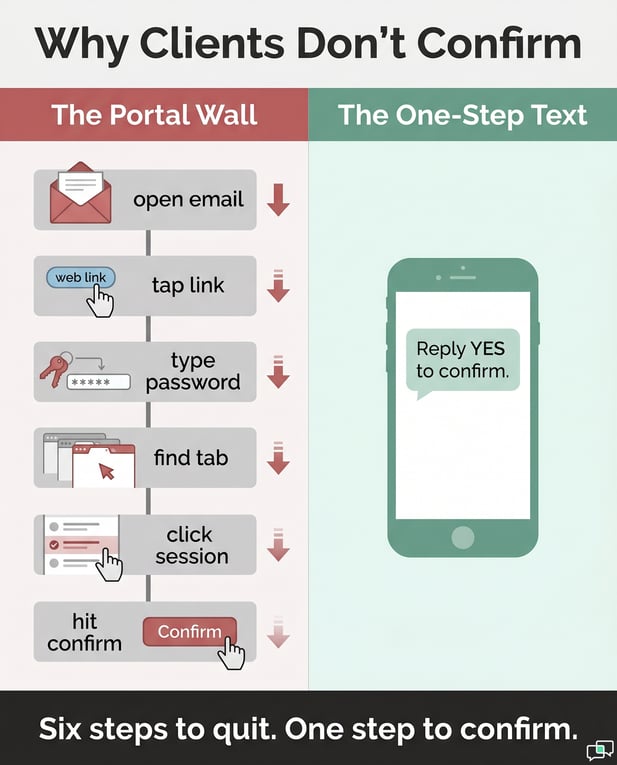
A portal flow has six steps.
- Open email.
- Tap link.
- Type the password.
- Find the right tab.
- Click the session.
- Hit confirm.
Every step is a place to quit.
For someone with ADHD, step three may be where the brain wanders. For someone with depression, step one may feel heavy. The client wanted to come. The system made saying yes too hard.
The Math of Missed Sessions
No-show rates in behavioral health sit at 20% to 23% on average. Psychiatry is even worse. For new clients in sessions two through five, the rate is higher still.
Each miss raises the odds of full dropout by 15% to 20%. Those early weeks are when treatment matters most.
The Reality: A Painful Loop
Here is the hard part. The same conditions that bring clients to you, anxiety, ADHD, depression, are the same ones that make portals feel impossible. You built a practice to remove barriers to care.
But the confirmation step has quietly become one of the biggest blocks of all. A portal login is not a small ask for a client in crisis. It is a wall.
That is the no-show spiral. It is not about lazy clients. It is about friction stacked against people whose conditions punish friction the hardest.
The fix is not more emails. The fix is fewer steps to say yes. When you cut the steps, the spiral stops on its own.
Most practices try to fix this by adding more reminders. They sent two emails instead of one. They make a second call. They pin a sticky note to the calendar.
None of it works the way they hope. More noise on the wrong channel does not solve the wrong channel.
You can ping a client ten times on a portal that they will not open. The result is the same as one ping. The lift comes from switching channels, not from adding volume.

The Guide: The Care Continuity Protector
The way to break the spiral is to drop the steps. Curogram acts as the Care Continuity Protector for TherapyNotes practices.
It meets clients on the one channel they always check. The action is simple: read a text, reply YES.
The Solution: A Reply That Takes Three Seconds
When a reminder is a text, the math changes. There is no portal. There is no app. There is no callback chain.
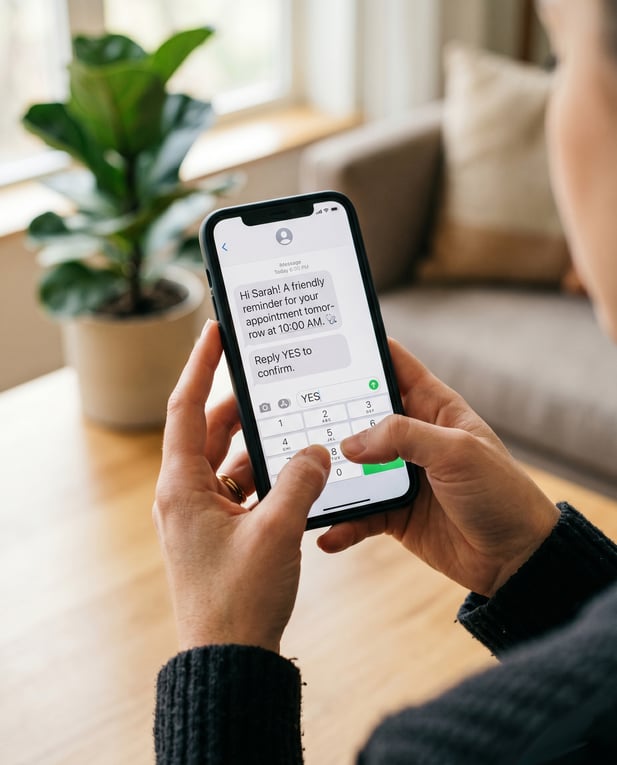
The client reads, “Hi Sam, your Thursday session with Dr. Lee is at 10 AM. Reply YES to confirm.”
They tap. They are done.
The session is locked in before they put the phone down.
This is the heart of how to reduce therapy client no-shows. TherapyNotes automated text reminders cut the steps to one.
The Feature: Gentle Persistence Done Right
One text is not always enough. Some clients miss the first ping. Some forget by the next day. That is why Curogram uses what we call gentle persistence.
A Rhythm That Respects the Client
The first reminder goes out a few days before the session. If there is no reply, a second one follows. A same-day prompt rounds it out.
Each message is warm and short. There is no scolding. There is no guilt. The tone stays steady, like a kind nudge from a friend.
Timing You Control
Practices set their own pace. A new client with a 72-hour reminder gets more lead time. A weekly client with a 24-hour reminder gets a tighter touch.
You pick the gap. You pick the words. Curogram handles the rest.
The Integration: Works With TherapyNotes, Not Against It
Curogram sits alongside your TherapyNotes setup. You keep your charts, your notes, and your billing where they are. The client never sees a second system.
They just see a text from your office that feels personal. TherapyNotes client retention SMS works because it does not ask the client to learn anything new.
The Mental Health Fit: Why Texts Beat Portals
This is not just smoother. It is more clinical, in the best sense. You remove a barrier to the care your client signed up for.
TherapyNotes client engagement automation is what makes it scale. One therapist can keep dozens of clients steady without spending an hour a day on the phone. The platform does the touchpoint work. The clinician does the clinical work.
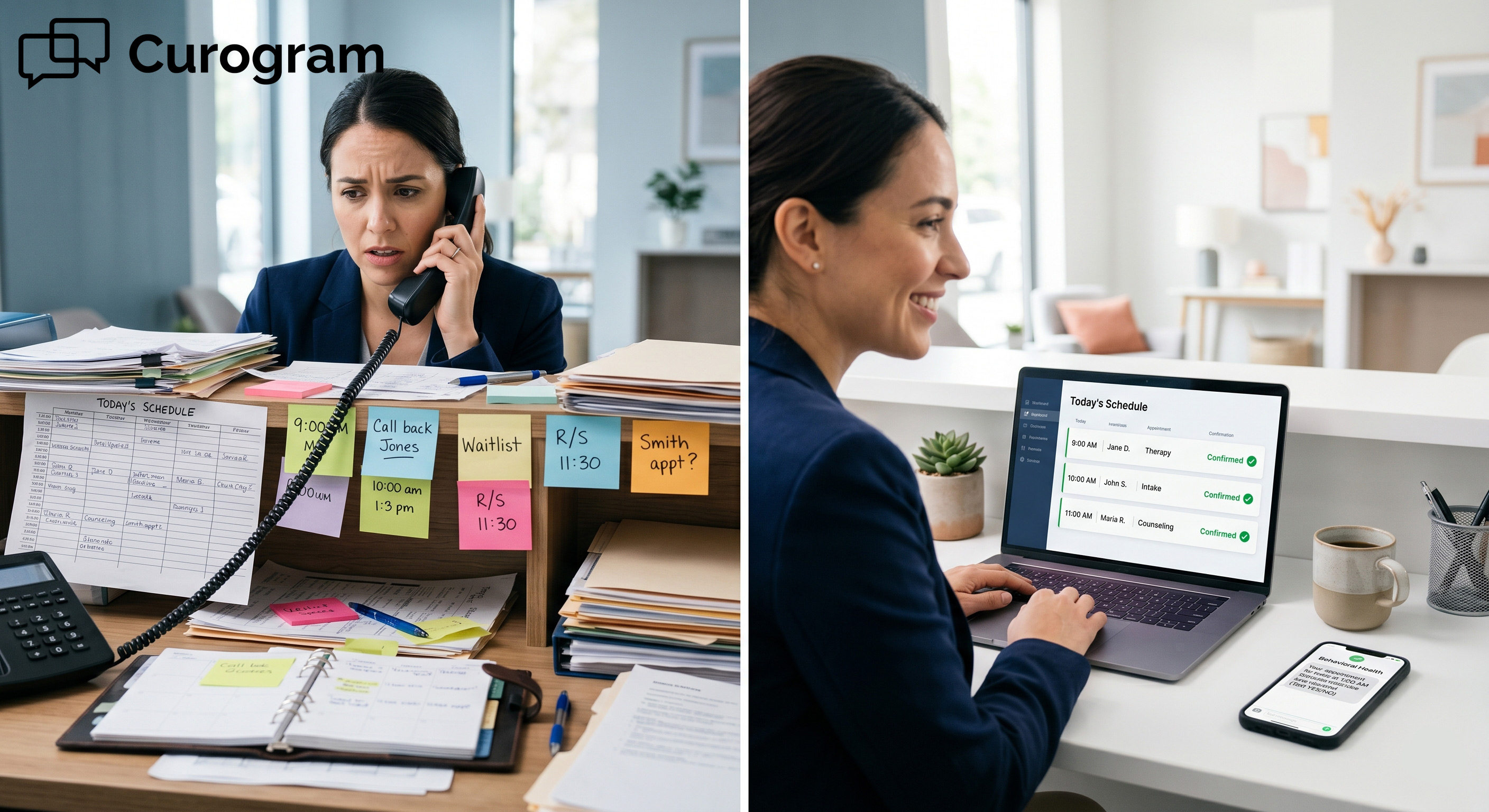
There is also a quiet upside for staff. The front desk stops drowning in voicemail callbacks. They get their day back for tasks that need a human voice.
The Success: Clients Show Up When You Make It Easy to Say Yes
When you swap portals for texts, the numbers move. But the bigger shift is human.
Sessions get easier to keep. Clients stay in care longer. Therapists see the same faces week after week.
The Metric: Numbers That Speak For Themselves
Practices on Curogram see no-show rates 53% lower than the industry average. Atlas Medical Center, an approved case study, hit 4.91%. The industry norm sits near 20%.
That is not a small lift. That is a third of the misses gone. Based on our internal data, over 75% of Curogram clients confirm by SMS with no staff effort.
A Quick Look At The Shift
|
Metric |
Industry Average |
Curogram Practices |
|---|---|---|
|
No-show rate (general) |
20% |
~9% |
|
Psychiatry no-show rate |
23% |
~11% |
|
Auto-confirm rate via SMS |
n/a |
75%+ |
|
Manual confirm calls per day |
50 to 80 |
Near zero |
Numbers reflect Curogram client data from clinical settings.
Real Practice Examples
At Atlas Medical Center, the rate dropped from 14.20% to 4.91% in three months. That is 3X better than the industry norm.
Other Curogram practices have seen up to 75% drops in missed visits, based on our internal data.
The Shift: The Easy Yes
We call this moment the Easy Yes. It is the point where confirming a therapy session feels like confirming dinner with a friend.
No friction. No load. Just a quick tap and a moment of relief.
Why The Easy Yes Matters Clinically
The hardest part of therapy for many clients is not the work in session. It is the step of getting there. When you cut the friction at that step, you protect the whole arc of care.
A client who shows up in week two is more likely to show up in week six. A client who shows up in week six is more likely to finish a full course of care.
What It Feels Like For Staff
Staff stops chasing voicemails. They open their day to a schedule that is already 80% confirmed. They use the saved time on warm welcomes, not cold calls.
The mood at the front desk shifts. The mood in the waiting room shifts. Care feels like care again.
The Outcome: A Client You Almost Lost
Picture a new client with social anxiety. She finishes her first session and walks out, unsure if she will come back. Two days later, a text lands on her phone.
“Hi Maya, your next session with Sarah is Thursday at 10 AM. Reply YES to confirm or CHANGE to reschedule.” She taps YES in three seconds.
Thursday morning, a short ping arrives. “See you today at 10 AM!” She walks in on time, ready to work.
Six weeks pass. She has not missed a single session. Her treatment is moving. The bond with her therapist is forming.
None of it would have happened if confirming had asked for more than she could give.
This is what text reminders to reduce therapy no-shows look like in real life. Not a stat. A client who kept her care.
Conclusion: Remove the Barrier. Protect the Relationship.
Behavioral health clients miss sessions for a reason no portal will ever solve. They miss them because the way you ask for a confirmation is harder than it should be. Texts fix that.
A text meets the client where they already are. It asks for one tap. It does not test their focus, their nerve, or their bandwidth.
TherapyNotes is built to protect your clinical records. That is its job, and it does it well. Curogram is built to protect your clients’ bond to care. The two work side by side, each doing what it does best.
When confirmation is easy, attendance stops being a question. It becomes the default.
The empty slots fade. The revenue dip closes. The therapist sees the same client week after week, and the work moves forward.
There is one more piece worth saying. Every no-show is a client who wanted to come but could not get past the system. Meet them in their text thread. Watch the schedule fill in.
If you have been pushing portal links and chasing voicemails, you have been doing the work the hard way. Behavioral health no-show prevention texting is the easier way.
It is also the kinder way. The client is not the problem. The friction is the problem.
You do not need a bigger reminder. You need a simpler one. You need a channel that fits how clients live, not how systems are built.
Curogram brings that channel to your TherapyNotes practice. Setup is quick. Staff training takes about 10 minutes. The first text can go out within days, not months.
The shift shows up fast on the schedule. Empty slots fill in. Last-minute cancellations still happen, but they trigger a waitlist text, and the gap gets filled. The schedule becomes a living thing, not a graveyard of missed slots.
It also shows up in your numbers. Atlas Medical Center cut its no-show rate from 14.20% to 4.91% in three months. That kind of swing changes the financial picture of a small or mid-sized practice in a single quarter.
But the real win is one you cannot put on a dashboard. It is the client who almost gave up after session two. She stayed because the next reminder was easy to answer.
It is the therapist who stopped losing sleep over a thinning caseload. It is the front desk staffer who got their afternoons back.
Ready to see what a confirmed schedule looks like? Book your personalized demo today.
Frequently Asked Questions
Curogram lets you set your own tone. You can add the therapist’s first name, warm phrases, and even session-type-specific lines. Clients read it as a personal note from their therapist’s office, not a script. The 2-way reply option means they can write back like they would to a friend.
Portals ask for focus, memory, and follow-through. These are the very skills many clients struggle with. A text asks for a tap, which is huge for someone with anxiety, ADHD, or depression. That smaller ask is why text reminders reduce therapy no-shows.
Curogram uses standard SMS, not app pings. Any phone that can send and receive texts works fine. There is no app to install and no data plan needed. Older flip phones can receive and reply to reminders just like new ones.
The first few sessions set the tone for the whole course of care. A miss in week two or three raises the chance of full dropout by 15% to 20%. Steady early attendance builds trust with the therapist and momentum in the work. That is when TherapyNotes client engagement automation pays off the most.
Most practices are sending live reminders within a few days. Staff training runs about 10 minutes. The system works alongside your TherapyNotes setup with no heavy lift on your team. You keep your charts and billing where they are, and Curogram handles the texting layer.