
Automated Reminders for Modmed Practices | Cut No-Shows by 65%
💡 Automated appointment reminders and confirmations for Modmed specialty practices are available through Curogram, an independent patient...
7 min read
Aubreigh Lee Daculug
:
June 17, 2026
Most behavioral health practices can't tell you their no-show rate without checking. That's not carelessness. It's surrender.
Somewhere along the way, empty appointment slots turned into background noise. They became an accepted cost of keeping the doors open, no different from rent or the coffee in your waiting room.
The schedule says 25 clients. Eighteen show up. Nobody flinches anymore.
Here's the problem.
Those missing seven seats aren't free. At $120 a session, a 23% no-show rate quietly drains $12,000 to $15,000 out of a solo practice every month. That adds up to six figures a year, lost in 50-minute blocks that sit empty and dark, year after year.
And in behavioral health, the damage runs deeper than dollars. A missed session during a fragile stretch of trauma work or substance use treatment isn't just a gap in the calendar. It's a break in continuity of care that your EHR can't see coming.
The cost shows up twice — once on the books, and once in the room.
So why does this keep happening?
A lot of the time, the answer is the tool itself. If you've gone searching for Notenetic appointment reminders to reduce behavioral health no-shows, you've probably already hit a wall. They simply aren't a native feature.
Notenetic handles scheduling and documentation well. But it ships with no automated reminders, no confirmation loop, and no easy way to refill a slot the moment someone drops it.
That leaves most practices doing one of three things. They hope clients log into the portal, call each one by hand, or just take whatever the morning happens to bring. None of those approaches prevent no-shows. They only absorb them.
There's a better way. And it doesn't mean ripping out Notenetic or retraining your entire team.
Let's break it all down.
Ask a practice owner for their no-show rate and watch what happens. Most pause, then guess. They've stopped tracking it the way a restaurant stops tracking melted ice — it just feels like part of being open.
The data says that's an expensive habit. No-show rates in behavioral health routinely land between 20% and 30%. DialogHealth's 2024 figures put the psychiatry no-show rate at 23%, more than double what a well-run practice can reach.
Here's where Notenetic leaves a gap.
Its scheduling and documentation tools are genuinely strong, but the platform offers no automated SMS reminders Notenetic users can switch on, and no built-in confirmation flow.
So practices fall back on one of three workarounds:
None of those are prevention — they're acceptance. And acceptance, repeated week after week, has a price tag most owners have never added up.
Now look at what that acceptance actually costs.
| Practice size | No-show rate | Lost revenue (monthly) | Lost revenue (yearly) |
|---|---|---|---|
| Solo clinician | 23% | $12,000–$15,000 | $144,000–$180,000 |
| Mid-sized group | 23% | $20,000–$30,000 | $240,000–$360,000 |
This means a single clinician can lose the price of a new hire every year, paid invisibly in empty chairs. For a group practice, the No-Show Tax can rival a major line item on the budget — except no one ever approved it.
The clinical cost is harder to put in a spreadsheet, but it's just as real. In behavioral health, a missed visit doesn't only dent revenue. It breaks continuity of care.
A no-show during a substance use treatment phase, an active safety protocol, or a delicate point in trauma work isn't a scheduling hiccup.
It's a clinical risk the EHR can't flag and the front desk can't catch in time. That's the part of the tax that never shows up on the books.

The fix isn't a bigger EHR. It's a layer that sits next to the one you already have and does the one job Notenetic was never built to do: get clients to actually show up.
That's where Curogram comes in. It works as a parallel SMS layer alongside Notenetic, running a fully automated reminder sequence and turning every confirm, cancel, or reschedule into a single inbound text.
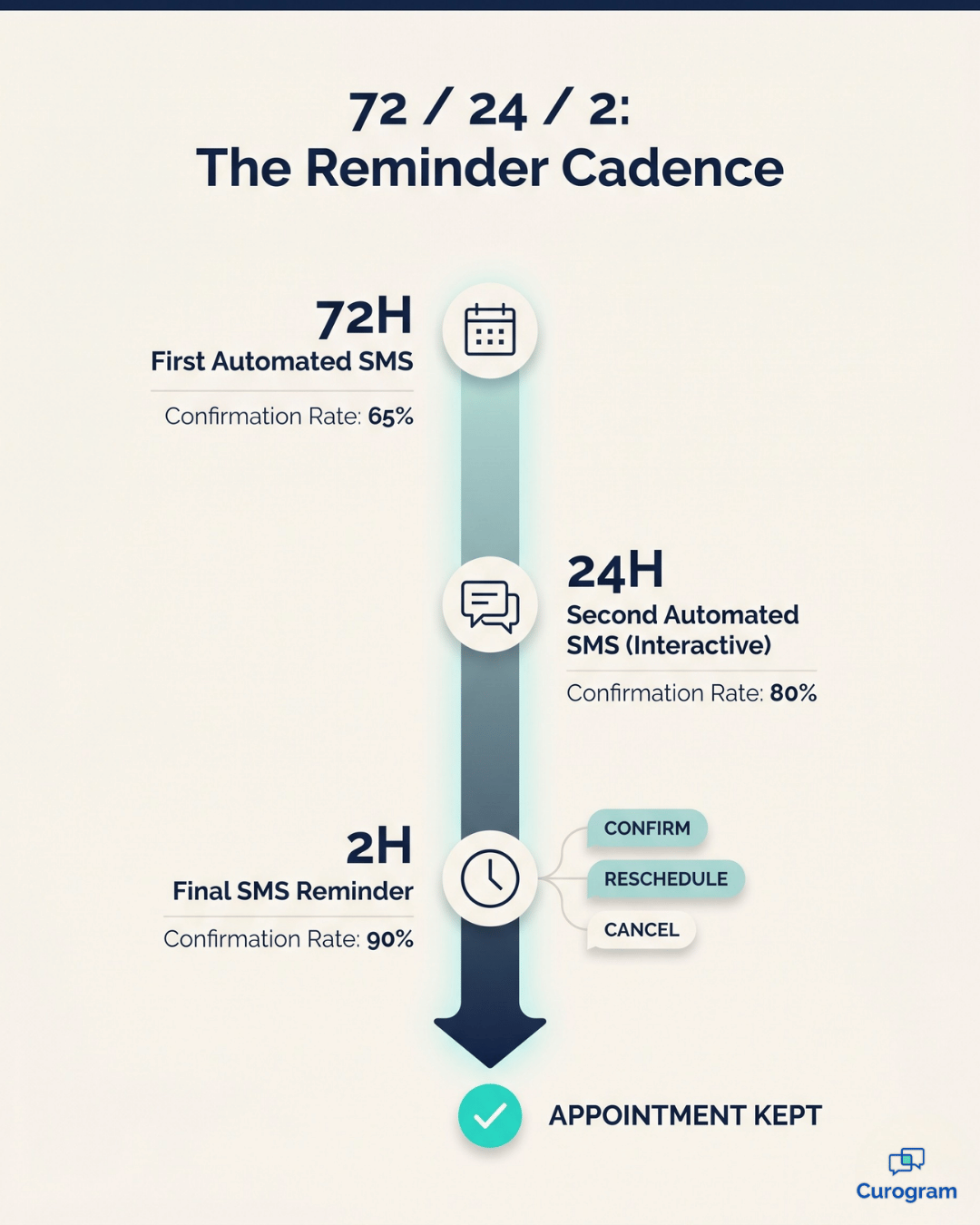
Curogram sends HIPAA-compliant reminders at the intervals you choose — most practices use a 72-hour, 24-hour, and 2-hour rhythm before each visit. Each message is two-way.
A client confirms, cancels, or asks to reschedule with one quick reply.
Every thread lives in the Curogram dashboard, audit-logged and covered by your Business Associate Agreement.
This is the 2-way SMS confirmation Notenetic doesn't offer on its own — the difference between a reminder that talks and a reminder that listens.
Here's an honest detail most vendors skip.
Notenetic doesn't currently expose a public API, so Curogram doesn't claim a deep write-back connection. It runs as a parallel communication layer instead.
The reminder sequence works from the client list you keep in Curogram, while your team continues to schedule, document, and bill inside Notenetic. You get practical Notenetic schedule automation without migration, retraining, or any risk to your chart of record.
For most small and mid-sized practices, that trade is exactly right. You get immediate results with zero disruption.

A reminder text in this setting doesn't feel cold.
A therapy appointment confirmation reads less like a transaction and more like proof the practice remembered them.
For psychiatry clients juggling executive-function challenges, that 2-hour nudge is often the line between showing up and forgetting entirely. And for substance use treatment clients protected under 42 CFR Part 2, reminder content can be configured to leave out any diagnostic or treatment-specific language.
The message reads as a plain appointment note, never a flag.
Numbers tell the story best here, so let's start with one. Atlas Medical Center runs on DrChrono. In 90 days, it dropped from a 14.26% no-show rate to just 4.91% using Curogram's automated reminder sequence.
That's a 65.5% reduction, and it lands 74% below the roughly 19% primary care average.
The behavioral health version is just as striking. Curogram's psychiatry-specific clients now run at 11.03% against the 23% industry average. That's behavioral health no-show reduction you can see on a monthly report, not a vague promise.
So what does a confirmed morning actually look like?
Three things tend to change fast:
The schedule moves from hopeful to dependable. Instead of a coordinator burning the first hour chasing confirmations, the reminders did that work while the office was dark.
The per-clinician math is where it gets personal. A provider averaging 18 attended sessions out of 25 booked starts seeing 22 or 23. Multiply that across a group, and the No-Show Tax doesn't just shrink — it starts running in reverse.
Not through aggressive outreach, but through one well-timed text the night before.
Notenetic gives your practice the schedule. It just doesn't give you the mechanism that makes the schedule actually hold.
That's the honest split. Notenetic is built for your clinical record — the notes, the billing, and the documentation that has to be airtight. Curogram is built for their follow-through — the well-timed nudge that gets a client through the door on the right day.
Neither one is trying to replace the other.
Think about what that shift is really worth.
A clinician who attended 18 of 25 booked sessions now sees 22 or 23. The morning huddle stops opening with a guessing game. Cancellations clear before 9 AM, and the open slot goes to someone on the waitlist instead of sitting empty.
This isn't about working harder or making more phone calls. It's one well-timed text the night before, running quietly in the background while your team stays focused on care. The reminders handle the chasing, so your coordinators no longer have to.
You've likely been paying the No-Show Tax for years. It's invisible by design, hidden inside empty 50-minute blocks that never made it onto a single report. Most behavioral health practices stop paying it within their first month on Curogram. Not because they chased clients harder, but because the system finally did it for them.
Here's the part worth knowing before you decide.
There's no long-term contract, which mirrors Notenetic's own flexibility. You can watch the whole thing work against your own schedule, your own client list, and your own real numbers, before committing to anything.
Schedule a Demo built specifically for behavioral health, and see exactly how well Curogram fits beside Notenetic without ever touching your chart of record.
Yes. Curogram is HIPAA-compliant, SOC 2 Type II certified, and signs a Business Associate Agreement with every practice it works with. For substance use treatment clients protected under 42 CFR Part 2, reminder content can be set to leave out diagnostic or treatment-specific language. The message simply reads as a neutral appointment note, not a flag that someone is in a treatment program.
Curogram runs as a parallel communication layer rather than a deep write-back integration. The reminder sequence works from the client and appointment list you maintain in Curogram, while clinical notes, billing, and scheduling stay inside Notenetic. For most small and mid-sized behavioral health practices, that setup is exactly right. It sidesteps integration headaches and delivers fast no-show recovery without ever touching your chart of record.
Every Curogram reminder is two-way, so a client can confirm, cancel, or ask to reschedule with one reply. Cancellations alert your team in real time, which means coordinators can release the slot to a waitlisted client well before the appointment. Opt-out is built into every message — usually a simple "Reply STOP" — and consent is captured in a TCPA-compliant way at onboarding.
Pricing scales to the size of your practice and the features you turn on, so a solo clinician pays far less than a multi-provider group. There's no long-term contract, which mirrors Notenetic's own flexibility. For most practices, the math works out fast, since winning back even a few missed sessions each week tends to cover the cost several times over. A behavioral-health-specific demo is the quickest way to get an exact number for your setup.
Most practices are sending reminders within days, not weeks. Because Curogram runs as a parallel layer, there's no integration to build and no chart-of-record migration to manage. Your team imports its client list, sets the reminder cadence — commonly 72-hour, 24-hour, and 2-hour — and the sequence starts working. There's no clinician retraining either, since documentation and billing stay right where they are in Notenetic.
💡 Automated appointment reminders and confirmations for Modmed specialty practices are available through Curogram, an independent patient...
💡 Notenetic 2-way texting for behavioral health practices isn't a built-in Notenetic feature.The EHR's Client Portal handles messaging, but only...
💡 SmartCare EHR manages scheduling, but it does not send automated texts that clients confirm. Curogram fills that gap and drives real no-show...