Skip to the main content.

8 min read

Why Unanswered Patient Messages Drive the No-Show Healthcare Gap

Why Unanswered Patient Messages Drive the No-Show Healthcare Gap
 💡 A patient sends a message before her visit. No one replies. Two days later, she does not show up. This is not bad luck — it is a chain reaction.
When practices ignore messages, trust drops. When trust drops, patients stop confirming. When confirmation rates fall, no-shows rise. The connection between unanswered patient messages and no-shows in healthcare is real and measurable.

Slow replies tell patients that their visit does not matter. Disengaged patients are far more likely to skip care. Based on our internal data, Curogram clients see 75%+ confirmation rates. They also see no-show rates that are 53% lower than the industry average.

This article shows how response time, confirmation rate, and no-show rate link together. You will also learn three clear ways to break the chain inside your practice.

A patient books a visit online. Two days before the visit, she has a question. "Do I need to fast? What should I bring?" She sends the message and waits.

The practice is busy that day. The phones ring all morning. The front desk is buried in tasks. Her message sits in the queue.

By the time someone replies, her visit has already passed. She did not show up. Most practices write this off as bad luck. The truth is very different.

The missed visit started with that missed message. This is the unanswered patient messages no-show connection healthcare teams keep missing. It is one of the costliest blind spots in modern scheduling.

Slow replies do more than annoy patients. They chip away at trust. A patient who feels ignored is less likely to confirm or show up. The longer the silence, the bigger the drop in care.

This is the heart of the patient communication response time no-show rate problem. It is not about one missed text. It is about a chain of small signals that push patients away over time.

The good news is simple. The chain is visible. The even better news is that it can be fixed.

Based on our internal data, Curogram clients see no-show rates 53% lower than the industry average. Some have cut no-shows from 14.20% down to under 5% in just three months. The lever is response time.

In this article, you will see how messages, trust, and visits are linked. You will learn how slow replies fuel ignored messages and patient disengagement. Most of all, you will get three clear levers to break the chain in your own practice today.

The Message That Never Got a Reply

Picture a normal day at a busy clinic. A patient books a visit online for Thursday. On Tuesday, she sends a short text. "Do I need to fast before my visit?"

The note lands in the front desk inbox. Phones are ringing and walk-ins line the lobby. By the time someone opens her message, it is Thursday at 11 a.m. Her visit was at 10 a.m., and she did not come.

Was this her fault? On paper, yes. In real life, the trail leads back to that one ignored text. She felt unsure, felt brushed off, and so she skipped.

This is the front desk response time and no-show correlation in plain terms. Slow replies push patients away. Fast replies pull them in. The same patient with a quick answer would likely have shown up on time.

The pattern shows up in many types of clinics. Based on our internal data, primary care offices using slow, manual replies sit near the industry rate of 19% no-shows. Practices using fast two-way texting drop closer to 14% or even lower.

The gap is not random. It tracks with how fast staff reply to patient messages. The shorter the wait, the higher the show-up rate at the door.

The link is strongest in the 48 to 72 hours before a visit. That is when most pre-visit questions arrive. A patient asks, the clock starts, and if the reply comes too late, she has already moved on.

The fix is rarely a new scheduling tool. The fix lives inside the message inbox. It is in the time it takes for the front desk to hit reply. That silent gap is where every no-show story begins.

The Causal Chain — From Ignored Message to Empty Slot

The chain from message to no-show has three clear links. Each one builds on the one before. Together, they explain how a quiet inbox turns into an empty exam room.

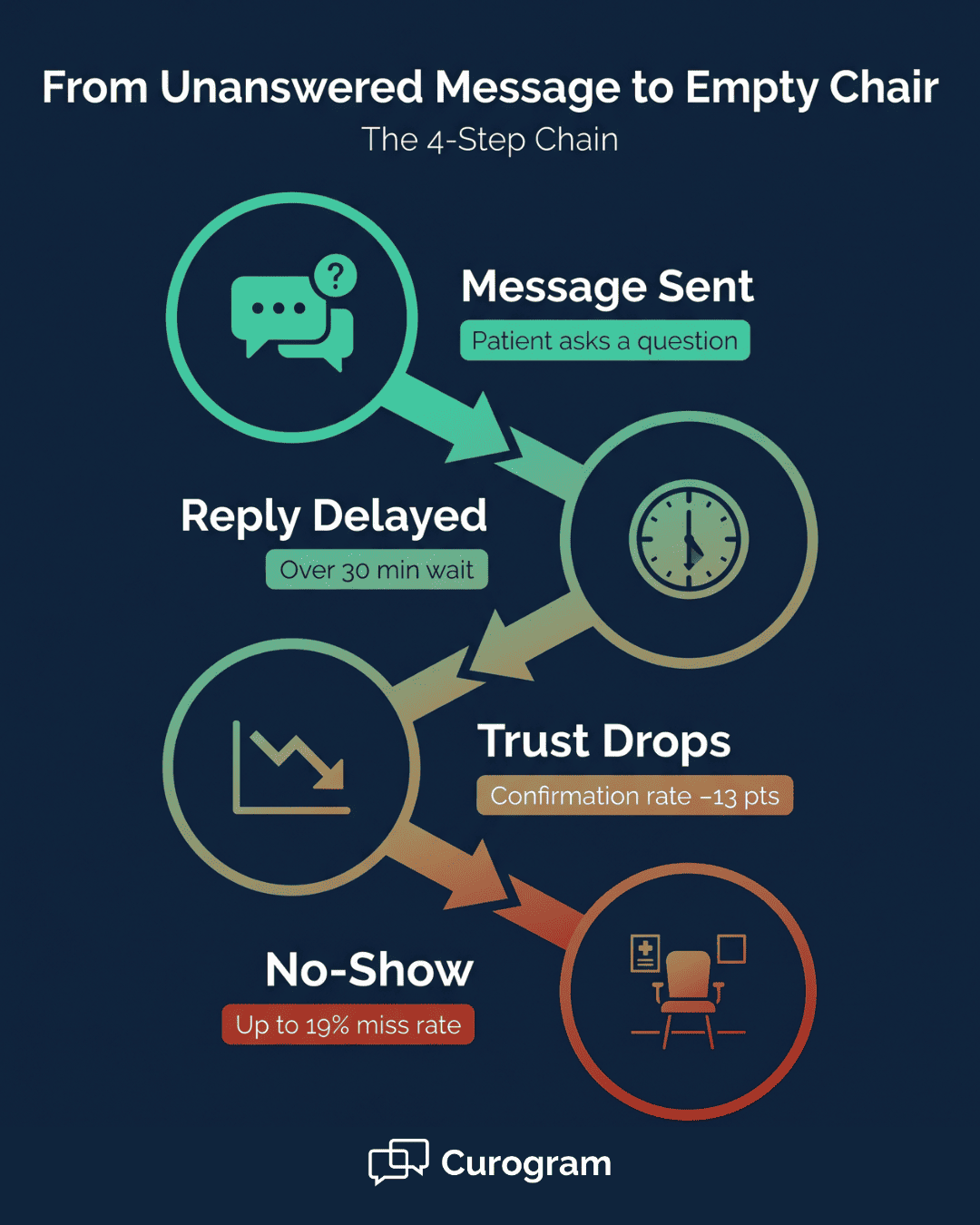
  • Link 1: An ignored message creates a trust deficit. A patient asks a real question and hears silence. The hidden message to the patient is that the practice does not care. That doubt sticks, even after the reply finally arrives.

  • Link 2: The trust deficit lowers confirmation rates. When the practice sends a reminder or asks for a yes/no reply, the patient responds slowly or not at all. Practices with strong two-way texting hit 75%+ confirmation rates. Practices without it often sit near 50% or less.

  • Link 3: Low confirmation rates predict more no-shows. Confirmation rate is the early warning signal. When it drops this week, no-shows climb two to four weeks later. The cycle keeps going until someone breaks it.

This chain is not a theory. It can be measured in real time. Practices can layer reply time, confirmation rate, and no-show data on one dashboard. The pattern is clear when you look.

Here is what it can look like in real life: A multi-site clinic notices reply times jump from 12 minutes to 45 minutes one week. Two weeks later, confirmation rates dip from 78% to 65%. Three weeks after that, no-shows climb from 8% to 13%. Each link pulled the next.

Vertical flow infographic showing how unanswered patient messages lead to no-shows in healthcare

When practices fix the first link, the others fall in line. Improve reply time, and confirmation rate climbs. Climb confirmation rate, and no-shows drop. This is why medical practice messaging for no-show prevention starts at the inbox, not the schedule. Speed of reply is not just kindness — it is a tool for revenue.

What Response Time Data Reveals About No-Show Risk

Response time by itself is a staff metric. Stacked against no-show data, it becomes a revenue metric. The story shifts from "are we keeping up?" to "are we losing money in silence?"

Picture this. A practice notices reply times spike on Monday mornings and Friday afternoons. Each spike lasts about two hours. On its own, that looks like a normal staffing issue.

Now overlay the no-show heatmap. The same practice sees that visits booked in those same windows have higher no-show rates. A simple breakdown might look like this:

Time Slot

Median Reply Time

No-Show Rate

Monday 8–10 a.m.

52 min

16%

Friday 3–5 p.m.

47 min

18%

Mid-week midday

14 min

9%


This is not a coincidence. Patients who send messages during peak hours wait longer for replies. They confirm less. They show up less. The slow patient response and appointment attendance gap is built right into those hours.

Three patterns show up most often:

  • Monday morning rush: New-week messages pile up while staff catch up.
  • Friday afternoon drop-off: Staff are tired and replies slow before the weekend.
  • Lunch hour gaps: The inbox sits idle while patients keep texting.

Each pattern points to a slot with elevated no-show risk. Each one is fixable with a small staffing or automation change.

The numbers add up fast. Say a practice runs 200 visits a day at a 14% no-show rate. That is 28 missed visits each day. Dropping to 9% saves 10 visits a day. Based on our internal data, recovered visits can drive a 10–20% revenue lift.

This is the shift many leaders miss. A 30-minute drop in Monday morning reply time is not just a feel-good fix. It pulls a real cohort of patients back into chairs and rebuilds revenue at the same time.

Interrupting the Chain — Three Operational Levers

Each link in the chain has a clear lever you can pull. Most practices need all three, but you can start with one. Even small changes show up in no-show data within weeks.

Lever 1: Make response time a key metric

Most clinics do not measure reply speed at all. Without a number on the board, the first link stays hidden. Set a simple target, like "median reply under 20 minutes." Share the score weekly.

When staff see the metric, they act on it. When leaders see the metric, they plan around it. Visibility is the first fix, and it costs almost nothing.

Lever 2: Match staffing to message volume

Most practices schedule by visit count, not message volume. That mismatch fuels the spikes we saw in section 3. Pull two weeks of reply data and find your peak hours.

Then shift one or two staff hours to cover those peaks. Many clinics find they do not need more people — they just need different shift starts. This is the simplest cure for the patient communication response time no-show rate gap.

Lever 3: Automate the easy parts

Not every reply needs a human. A simple "we got your message, a team member will reply within 2 hours" note can be auto-sent. Pair this with smart appointment reminders that ask for a one-tap confirmation.

Based on our internal data, practices using EHR-integrated two-way texting hit 75%+ confirmation rates. They do this without adding staff time. Auto-confirmations free your team to handle the messages that really need a human touch.

These three levers work as a set. Visibility shows the problem. Staffing fixes most of it. Automation closes the rest. Together, they turn a silent inbox into a tool for no-show prevention.

Front desk staff handling phone calls and patient messages at a busy medical clinic reception


Closing the Loop — From Message to Confirmed Appointment

Closing the loop means every message gets a timely reply. That does not mean every reply is custom or long. It means every patient hears back fast enough to feel seen.

A simple auto-reply does most of the heavy lifting. "Thanks! We got your message. A team member will follow up within 2 hours." This short note defuses the trust deficit before it forms. The human reply comes later.

A live dashboard makes the loop visible to the whole team. It tracks three numbers side by side:

  1. Response time how fast the front desk replies.
  2. Confirmation ratehow many patients confirm visits.
  3. No-show rate how many visits go empty.

When response time spikes, managers see it within hours, not weeks. They can shift staff that same day. When confirmation rate dips, they know no-shows will follow. They can call or text at-risk patients before the visit.

This is the shift from reactive to proactive. Most practices learn about no-shows only when chairs are empty. The new model spots them when reply times slip — days before the visit.

Here is the math in one easy case. A 200-visit-per-day clinic at 14% no-shows loses about 28 visits daily. Drop that to 7%, and the number falls to 14. Over a year, that is thousands of recovered visits and a major revenue lift.

This is the core of medical practice messaging and no-show prevention. The unanswered text is the warning light. The fast, kind reply is the brake.

When the loop closes, three things happen at once. Patients feel heard. Staff feel less frantic. Revenue climbs because more chairs stay full. The inbox stops being a leak and starts being a lever.

Conclusion

Every no-show has a backstory. Most of the time, that story does not start at the front door of your clinic. It starts in a quiet inbox days before the visit.

A patient sends a question. The clock starts ticking. If silence wins, trust drops, and the patient stops confirming. If she stops confirming, she stops showing up.

This is the simple truth at the heart of the unanswered patient messages no-show connection healthcare teams need to act on. It is not about one missed text. It is about a chain of small signals that slowly move patients away from care.

The good news is that the chain has only three links. Each one has a clear, low-cost fix. Each fix builds on the last to break the cycle.

First, measure reply speed. You cannot fix what you do not track. Visibility is where it all starts.

Second, match staffing to message volume, not just visit count. Most peak-hour gaps come from staffing built for the wrong problem.

Third, automate the easy replies and confirmations. Save human time for the messages that truly need it.

These three levers work in any specialty. They work in solo clinics and in large multi-site groups. They show results in weeks, not years.

The numbers back it up. Based on our internal data, Curogram clients see 75%+ confirmation rates and no-show rates 53% lower than the industry average. Some have cut no-shows from 14.20% to under 5% in three months. Many see a 10–20% revenue lift from recovered visits.

Your inbox is more than a help desk. It is a leading indicator of your no-show rate. When you treat it that way, every reply becomes a small act of revenue protection.

See how fast replies cut no-shows by 53%. Schedule a demo and watch your message-to-confirmation flow in action.


Frequently Asked Questions

How quickly does response time improvement translate to fewer no-shows?

Confirmation rates often climb within 1–2 weeks of faster replies. No-show rates lag by another 1–3 weeks. Most practices see the full impact in 2–4 weeks. Specialist clinics with longer lead times take a bit longer.

Why do unanswered messages affect no-show rates more than reminders alone?

Reminders push information out, but silence sends its own message. Patients read that silence as low care. That feeling shapes how they treat the visit itself, while a reminder only nudges memory at the last moment.

How can a small practice track response time without buying new software?

Start with a manual log. For one week, have staff mark each patient message with arrival and reply times. Even a basic spreadsheet will show your median reply time and your worst hours within just a few days.

Why does the 48–72 hour window before a visit matter most for messaging?

That window holds most pre-visit questions. A late reply here leaves doubts unresolved right when the patient is deciding to attend. Quick answers in this stretch protect the visit and the relationship at the same time.

How do automated confirmations help when patients still need real human replies?

Automated confirmations handle yes/no checks at scale. They free your team to focus on real questions. Patients feel heard right away, while staff time goes to messages that need clinical judgment or a personal touch.