
How Curogram Helped Increase COVID-19 Vaccinations
 Carylee Gali : 4/11/22, 7:00 AM
Telemedicine software solutions such as Curogram help increase COVID-19 vaccinations by facilitating virtual consultations and secured messaging...
5 min read

Most comparison pages pick a winner before they check anything. We rewrote this one against what both vendors publish today. Two of our own claims did not survive it.
TeleVox does have digital intake forms. It takes patient payments. And it holds a security badge, HITRUST, that plenty of practices rate above SOC 2. A buyer finds all of that out in the second demo anyway.
Our case is about fit, and it is narrower than it used to be. TeleVox leads with voice and IVR. Curogram leads with text, and the front desk runs it rather than IT. Channel and ownership settle more searches than any feature row.
A patient engagement platform sits between your EHR and the patient's phone. It reads the schedule. It sends the message. Then it puts the reply where staff will see it.
Six jobs show up in almost every search. Appointment reminders, two-way texting, digital intake forms, payment requests, recall outreach, and broadcasts for the day something changes.
EHR integration sits under all six. If the platform can't read today's schedule, none of them fire on their own.
Both vendors do most of those. Mass texting is the one most practices underuse, so read a walkthrough like how Practice Fusion users run mass messaging first. Knowing the workflow you want makes the sales call shorter.
Price is not the first question. Ask who the tool was built for. Then check how many of those six jobs your staff still do by hand.
TeleVox has worked in healthcare since 1992, and the channel mix shows it. Voice is still a full product there, not a leftover.
West Corporation bought TeleVox in 2007. That parent became Intrado in 2019, then changed its name again to West Technology Group in November 2022. Apollo Global Management controls it today.
TeleVox bought Odeza in 2023, and the current brand on its site is WestCX. Apollo has been running a sale process, with initial bids called for, so the owner could change again.
Its site claims more than 2,000 clients. The names it leads with are health systems: Emory Healthcare, Ochsner, UC Health. It also sells Practice Edition to smaller offices, so do not write it off as enterprise-only.
Its published capability list covers eCheck-In for intake questionnaires, Copay and Billing for payments, and Two-Way Campaigns with Staff-to-Patient Live Chat. Broadcasts plus Recall and Care Gap Management round it out. TeleVox is HITRUST certified.
One gap stands out. As of September 2026, we found no video visit product on TeleVox's site. A practice that wants telehealth would buy it from someone else.
TeleVox added a Planned Outreach Program for small practices in July 2025, with prebuilt campaigns by specialty. Under the WestCX brand, it launched AI products in late 2025 and expanded RCS messaging with Twilio in March 2026.
The direction is clear enough: richer messaging, more automation, still anchored to voice and IVR. A practice evaluating it should ask how much of that stack its own team would ever switch on.
Curogram keeps each patient in one text thread, sent from your own office number. The EHR stays the system of record.
Curogram Highlight: A Text-First Layer on the EMR You Already RunCurogram's 2-Way HIPAA Compliant Texting works with 70+ EMR and practice management systems, including eClinicalWorks, athenahealth, NextGen, DrChrono, Tebra, and Practice Fusion. Appointments import on their own, so nobody builds a list by hand. From that one connection, video visits run in the browser with no app download. Secure forms collect intake before arrival, and text-to-pay sends a balance link tied to the visit. Staff training runs in minutes, because the screen behaves like ordinary texting. Broadcasts cover the morning a provider calls out. One office manager can reach every booked patient in about 90 seconds. That is the workflow behind mass text alerts for provider absences. Results we can name: Atlas Medical Center cut no-shows from 14.20% to 4.91% in three months, based on our internal data. Curogram is SOC 2 Type II certified. |

Curogram is a layer, not a replacement. Charting, billing, and scheduling stay where they are. Nobody migrates data, and no chart moves.
That is why most groups start with one workflow, usually reminders, and add forms or payments a month later. Each addition rides the same EMR connection, so it is a setting rather than a project.
Checked against what each vendor published in September 2026. Where a vendor lists nothing, we say so rather than claim the feature is missing.
|
Capability |
TeleVox |
Curogram |
|---|---|---|
|
Two-way texting |
Yes, Two-Way Campaigns and Staff-to-Patient Live Chat |
Yes, one thread per patient from your practice number |
|
Video visits |
Not listed in public materials |
Included, browser-based, no app download |
|
Digital intake forms |
Yes, eCheck-In questionnaires |
Yes, secure forms tied to appointment type |
|
Patient payments |
Yes, Copay and Billing |
Yes, text-to-pay linked to the visit |
|
Voice channel |
Automated voice calls across the visit cycle |
Missed call and voicemail to text |
|
Security certification |
HITRUST certified |
SOC 2 Type II certified |
|
Built around |
Health systems, plus Practice Edition for smaller offices |
Independent and multi-location practices |
Feature rows tie more often than either vendor admits. Three things still decide it. Which channel your patients answer, what compliance asks for, and how much you need video visits on the same contract.
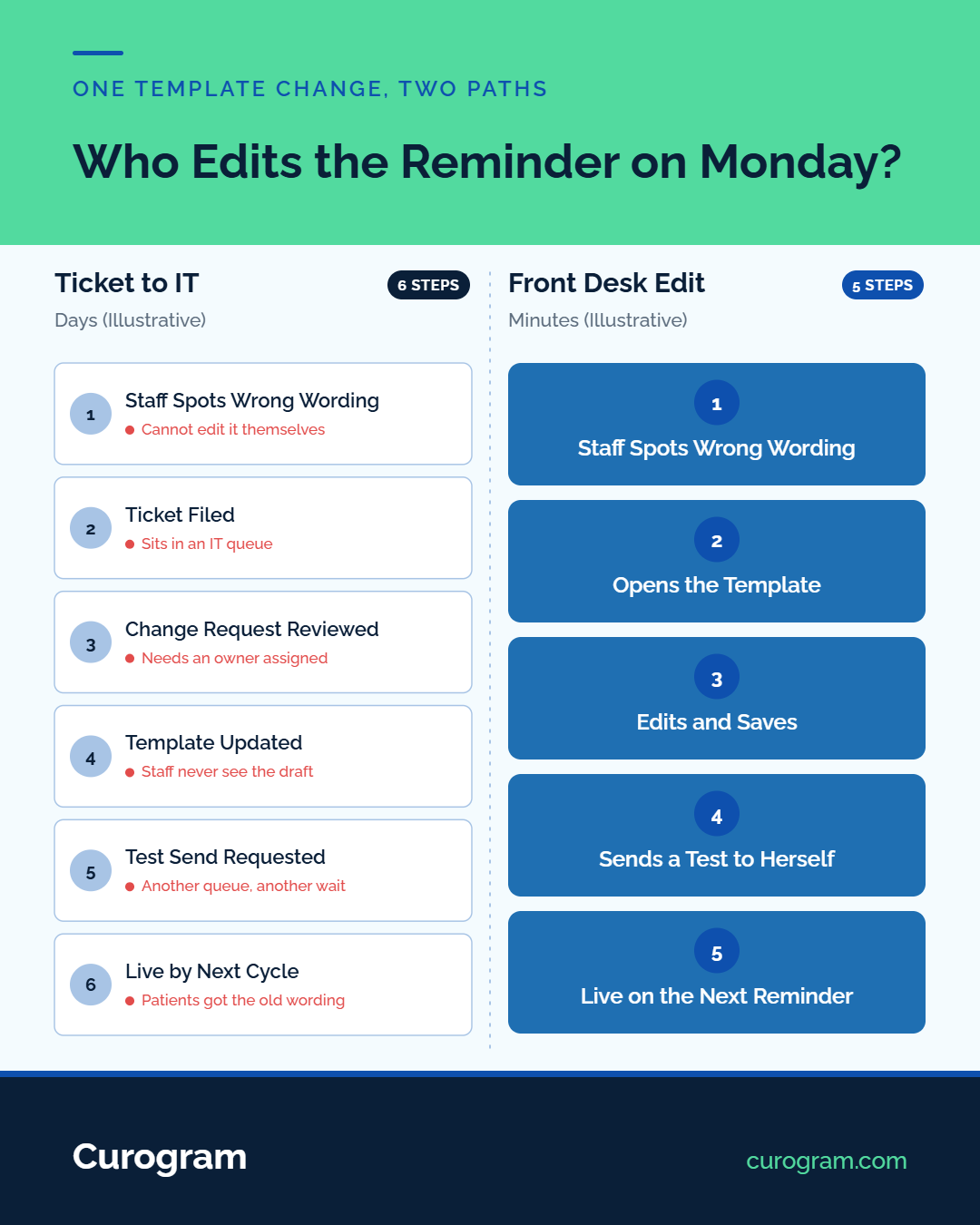
Four questions settle most of this faster than a feature grid.
Price campaign work on its own. If you run recalls and seasonal outreach, look at what mass texting in Cloud 9 does for bookings first. Reminders alone rarely move revenue much.
TeleVox is a strong outreach tool, and it is still shipping. A practice with a phone-heavy panel could pick it and be right. We would rather say that than pretend the feature list is thin.
For an independent or multi-location practice, the fit usually runs the other way. If you want texting, forms, payments, and video visits off one EMR connection, with the front desk in control, Curogram is the closer match.
Book a Curogram demo and bring your TeleVox quote.
 Carylee Gali : 4/11/22, 7:00 AM
Telemedicine software solutions such as Curogram help increase COVID-19 vaccinations by facilitating virtual consultations and secured messaging...

 Michael Hsu : 2/15/22, 8:52 AM
Telemedicine benefits broken down by experts. Learn how to streamline your telemedicine practice and harness the benefits of telehealth.

 Jo Galvez : 9/26/26, 8:00 AM
Learn how to choose a HIPAA-compliant patient texting platform for multi-location physician groups. Compare features, compliance, and integration for...