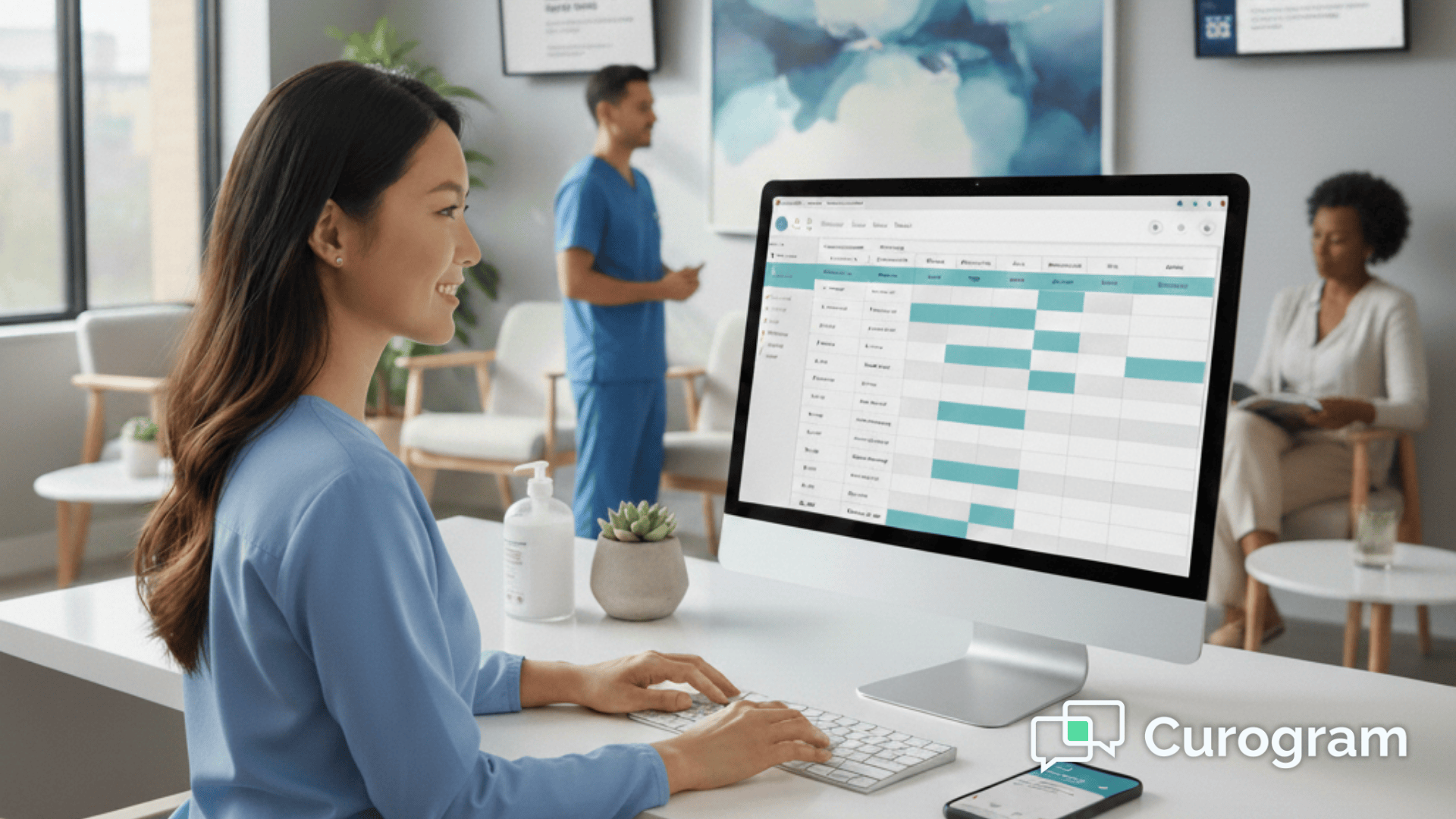
Skip to the main content.

10 min read

How to Automate 5-Star Google Reviews for Doctors: Workflow Guide

How to Automate 5-Star Google Reviews for Doctors: Workflow Guide
💡 Medical practices can simplify virtual care by using a telehealth solution that connects directly to their EMR. With SMS-based automated workflows, patients receive a secure text link to join HIPAA compliant telehealth video visits without downloading any apps.

Smart automation handles appointment reminders, visit links, and follow-ups so staff spend less time on the phone. This approach reduces no-shows, speeds up check-in, and keeps clinical workflows running smoothly.

Curogram's virtual care platform offers multi-user telemedicine, deep EMR integration, and app-free access for patients of all ages. The result is higher adoption rates, better patient satisfaction, and a more efficient practice.

It is 8:47 a.m. on a Monday. Your front desk has already fielded 30 phone calls, half of them from patients trying to figure out how to log into their telehealth appointment. One patient gave up entirely. Another called back three times because the app kept crashing. Your office manager is silently questioning every technology decision the practice has ever made.

If that scene sounds familiar, you are not imagining things. Telehealth was supposed to make care more accessible, but for a lot of medical practices, the tools they adopted during the pandemic have quietly become their biggest headache. The video call itself works fine.

Everything around it — the logins, the disconnected data, the compliance guesswork — is where things fall apart.

Here is what makes it worse: most practices assume the fix is more technology. A fancier app. An AI chatbot. Another vendor with another dashboard. But the real issue is not a lack of features. It is a lack of connection — between your telehealth tool, your EMR, your staff workflows, and the patients who just want to see their doctor without a 10-step onboarding process.

The right telehealth solution for medical practices does not ask anyone to change the way they work. It fits into the rhythm your team already has and makes it better. That is what we are going to walk through in this guide — what is actually broken in virtual care today, why smart automation beats flashy AI, and how the right virtual care platform can turn telehealth from a pain point into a genuine competitive advantage.

Whether you run a two-provider family practice or oversee a network of 50 clinics, there is a path to virtual care that is simpler than what you have now.

Why Disconnected Virtual Care Tools Set Your Practice Up to Fail

There is a reason so many practices quietly stopped offering telehealth after the pandemic rush ended. The tools they were handed were never designed to work inside a real medical workflow. They were built fast, shipped faster, and left practices to figure out the rest on their own.

The Patient Drop-Off Problem

Think about what you are asking a patient to do before they even see a provider. Download an app they have never heard of. Create a username. Set a password. Verify their email. Enter their insurance information — again.

For a 68-year-old managing multiple medications or a young parent juggling two kids at home, those extra steps are enough to make them hang up and reschedule an in-person visit instead.

The numbers back this up. Up to 25% of telehealth appointments end in a no-show, and a significant share of those are not patients who forgot — they are patients who could not get through the front door of the technology. That is lost revenue and lost care, both at the same time.

The Double-Entry Trap

When your telehealth tool does not connect to your EMR, your staff pays the price.

The daily reality looks something like this:

  • A front desk coordinator books a virtual visit in the telehealth system, then re-types the same details into the medical record.
  • The provider finishes a video call and has to manually transfer notes into the chart.
  • Lab orders discussed during the visit need to be entered separately because the two systems do not share data.

Every one of those handoffs takes time, and every one creates a chance for error. It is the kind of invisible drag that does not show up on a spreadsheet but eats into your team's energy and your patients' trust.

The Compliance Question Nobody Wants to Answer

Then there is the HIPAA piece. Running HIPAA compliant telehealth is not optional, and it is not simple. Every video link, every text reminder, every piece of patient data that moves between systems needs to meet federal privacy standards.

If your telehealth tool was bolted on as an afterthought, your team is probably spending more time worrying about compliance than actually delivering care.

The combined weight of these issues is why so many practices have a telehealth tool on paper but barely use it in reality. That does not have to be the story. The right telehealth solution for medical practices eliminates these friction points before they ever reach your staff or your patients.

How Smart Workflow Automation Delivers the Access Patients Actually Need

Every healthcare conference right now has a session about AI. Predictive scheduling. Chatbot triage. Ambient listening that writes your notes for you. It is exciting, and some of it will eventually matter. But here is what most practices actually need today — a way to get patients into a virtual visit without turning it into a technology project.

Smart workflow automation is the unglamorous workhorse that makes that happen. It does not try to predict the future or replace clinical judgment. It just handles the repetitive, time-consuming tasks that slow your team down and frustrate your patients.

How It Works in Practice

When a patient needs a follow-up, the system sends them a secure text message with a link to join a video visit. One tap. No app. No login. They are in a virtual waiting room in under 30 seconds.

Behind the scenes, the automation is doing work your staff would otherwise handle manually. Appointment reminders go out on schedule without anyone pressing send. Visit links are delivered at exactly the right time. Post-visit surveys collect patient feedback automatically.

All of it runs quietly in the background while your front desk focuses on the people walking through your door.

Curogram built its virtual care platform around this kind of practical automation. The SMS-based approach means patients join from whatever phone or computer they already have.

For patients in rural or underserved communities with limited bandwidth, that lightweight design is the difference between seeing a provider and going without.

Connection Over Automation

There is something else that matters here, and it is easy to overlook when the conversation is all about technology. Patients do not want to feel like they are interacting with a machine. They want to feel like their doctor's office is reaching out to them, personally, through a channel they already use every day — text messaging.

That is why a virtual care platform built around SMS feels fundamentally different from a chatbot or a patient portal notification. The message comes from your practice's number. It sounds like your office. It is simple, direct, and human.

That kind of connection builds trust, and trust is the thing that keeps patients coming back. No AI feature can manufacture it.

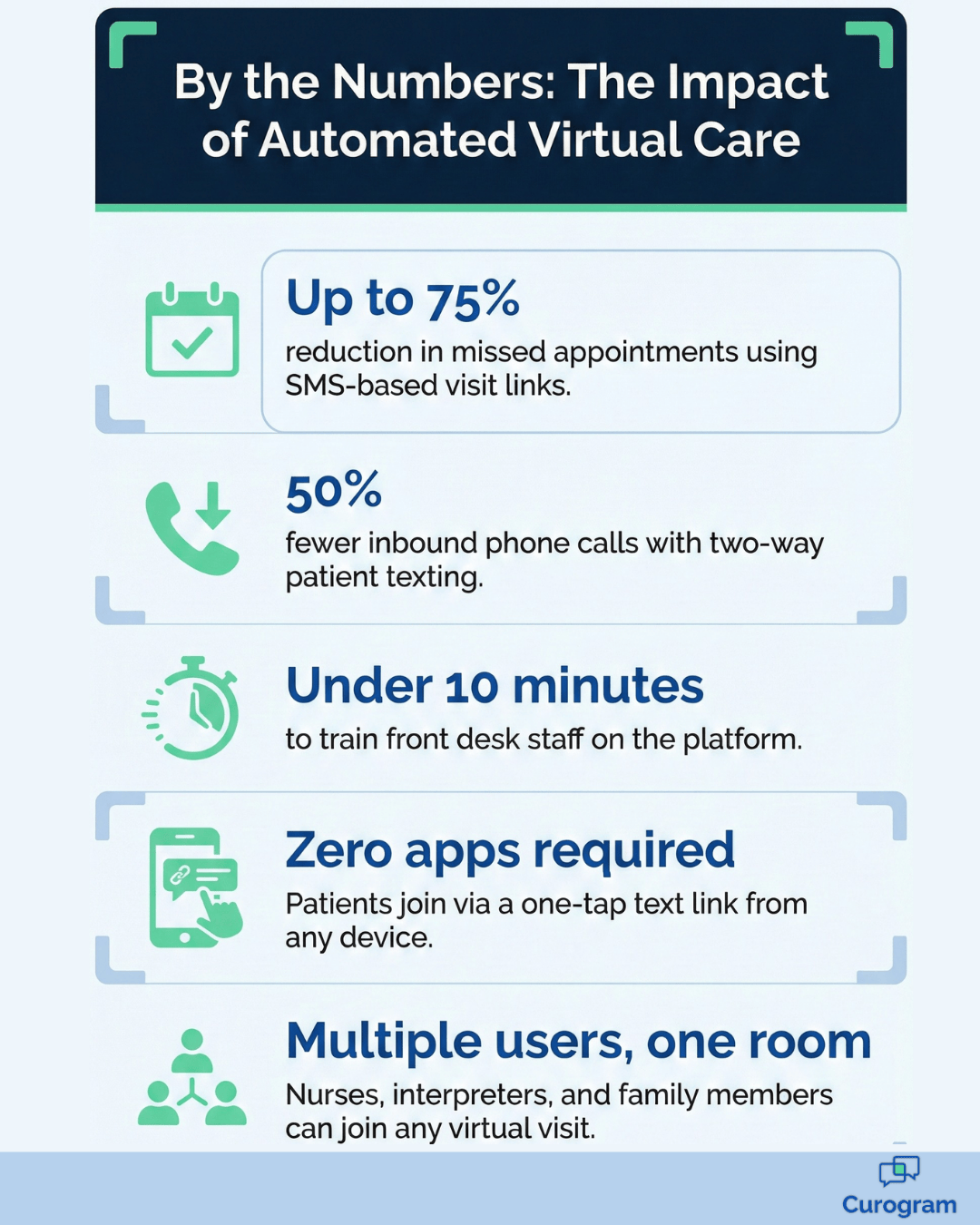
Infographic showing statistics on the impact of automated virtual care.

What Makes Curogram's Telehealth Platform Different from the Rest

If you have tried one or two telehealth tools and come away disappointed, you already know that not all platforms are built the same way. The features that actually matter are the ones that disappear into your workflow — the ones your staff stops noticing because everything just works.

Curogram was designed around three capabilities that solve the problems practices run into most often.

HIPAA Compliant Video Visits That Do Not Require a Workaround

Every Curogram video session runs through an encrypted connection that meets federal privacy requirements and current telehealth security guidelines. Patients join through a secure link sent to their phone, and visit data stays protected at every step. There is no need to layer a separate compliance tool on top of your telehealth setup.

For practice managers who lie awake thinking about security audits, this matters. HIPAA compliant texting should be the default, not something you have to engineer yourself. With Curogram, it is built into every interaction from the start.

Multi-User Telemedicine for the Way Care Actually Happens

A real clinical encounter is rarely just one provider and one patient on a screen. A nurse might need to join to go over vitals. An interpreter might be needed for a patient whose first language is not English. A family member might want to be part of the conversation to help coordinate care at home.

Curogram's multi-user telemedicine feature handles all of this in a single virtual room. Everyone joins through the same simple link, at the same time, without scheduling separate calls or bouncing between platforms. It is the kind of flexibility that turns a telehealth visit from a limited transaction into something that actually mirrors in-person care.

EMR Integration That Keeps Your Chart as the Single Source of Truth

This is the one that changes daily life for your staff more than anything else. When your telehealth platform plugs directly into your EMR, data stops living in two places.

Here is what that looks like:

  • Appointment details land in your EMR the moment a visit is booked.
  • Notes and follow-up tasks sync automatically once the call ends.
  • Your chart remains the one place everyone looks — no toggling, no re-entry.

This is what EMR integrated virtual visits are supposed to feel like. Your team works in the system they already know, and the telehealth layer operates seamlessly alongside it. No new dashboards to check. No information falling through the cracks.


The Real-World Impact of Automated Virtual Care on Revenue and Patient Trust

We have talked a lot about workflow and technology. Now let us talk about what actually changes when this all comes together — the outcomes that show up in your revenue, your patient relationships, and your team's morale.

Your Schedule Fills Up Instead of Falling Apart

When patients can join a visit by tapping a text link, the excuses for no-shows disappear. No forgotten passwords. No app that will not load. No 15-minute troubleshooting call with your front desk. Some practices using SMS-based virtual visit workflows report no-show reductions of up to 75%. Every appointment that actually happens is revenue you would have otherwise lost.

Patients Start Reaching Out Instead of Disappearing

Two-way texting opens a channel that patients actually want to use. They can confirm an appointment, ask a quick follow-up question, or let you know they are running late — all without picking up the phone or navigating a portal.

That kind of low-friction communication changes the relationship. Patients stop being passive recipients of care and start engaging with your practice between visits. They feel heard. They feel connected. And practices with high patient engagement consistently see stronger retention, better outcomes, and more referrals.

Your Front Desk Gets to Do Meaningful Work Again

This is the part that does not get enough attention. When your team spends two hours a day making reminder calls, troubleshooting login issues, and manually entering appointment data, they are not doing the work they were hired to do.

Automation gives that time back:

  • SMS confirmations replace outbound phone calls.
  • Visit links go out on their own, minutes before the appointment.
  • Post-visit follow-ups happen automatically, no checklist required.

For practices running lean — and most are — those recovered hours are not a luxury. They are the difference between a team that is overwhelmed and one that feels like it can actually keep up.

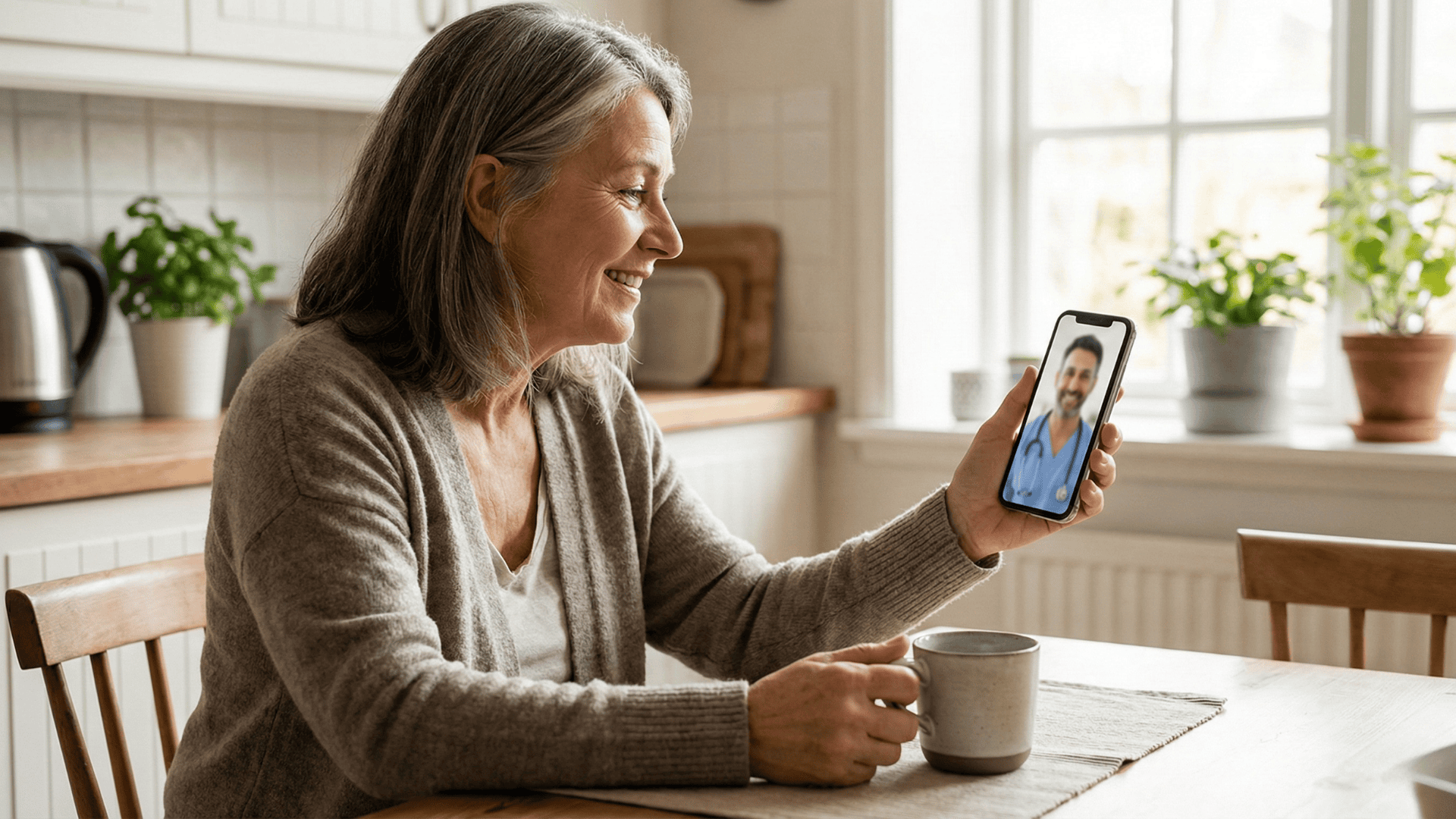
Patient at home smiling during a telehealth video call with a doctor.

Adapting Telehealth to Fit Specialized Practice Workflows

Large Healthcare Organizations

Scale creates a unique problem: you need every site doing things the same way without micromanaging each one. A telehealth solution for medical practices at this level has to support standardized visit templates, messaging rules, and reporting across dozens or hundreds of locations.

Curogram gives administrators that kind of centralized control. Set up your protocols once, roll them out everywhere, and know that every provider is using the same HIPAA compliant telehealth tools.

When your virtual care platform ties into your enterprise EMR, compliance oversight stops being a site-by-site scramble and becomes something you can actually manage from one place. At scale, EMR integrated virtual visits are the only way to keep data consistent and clinicians on the same page.

Specialized Practices

A dermatologist's telehealth needs look nothing like a gastroenterologist's. One might need patients to upload images of a skin concern before a video visit. The other might use virtual check-ins after a procedure where an office visit would be overkill.

Cookie-cutter telehealth platforms struggle here because they try to push every specialty through the same workflow. Curogram lets providers customize visit types, intake questionnaires, and follow-up sequences to match the way their practice actually operates.

And when a specialist needs to loop in a referring physician or care coordinator during the call, multi-user telemedicine makes that possible without a second meeting.

Remote and Underserved Areas

For patients who live an hour from the nearest specialist — or in neighborhoods where the local clinic is stretched thin — virtual care is not a convenience. It is the only realistic way to get seen.

A mobile-first telehealth solution for medical practices reaches these patients where they are. Because Curogram's visit links open in a standard web browser, patients do not need a new phone or a fast internet connection. They just need a text message and a willingness to tap a link. That simplicity is what makes virtual care work for the communities that need it most.


Adapting Telehealth to Fit Specialized Practice Workflows

No two practices operate the same way, and a telehealth setup that ignores those differences creates friction instead of fixing it. The needs of a 200-provider hospital network are nothing like those of a solo dermatologist or a rural clinic serving patients hours from care.

A telehealth solution has to adapt across all of these settings without forcing a one-size-fits-all workflow.

For large healthcare organizations, the challenge is consistency at scale. Dozens or hundreds of locations need the same visit protocols, messaging rules, and compliance standards.

Curogram provides centralized control—set templates once, deploy them everywhere, and ensure every provider uses the same HIPAA-compliant tools. With EMR-integrated virtual visits, oversight becomes centralized instead of a site-by-site scramble.

Specialty practices face different demands. Dermatologists may need photo uploads before visits. Gastroenterologists often use telehealth for post-procedure check-ins. Orthopedic surgeons may want care coordinators on the call. Rigid platforms fall short here. Curogram lets practices customize visit types, intake forms, and follow-ups, and supports multi-user telemedicine when collaboration is needed.

In some communities, virtual care isn’t optional—it’s essential. Rural patients may live hours from specialists, and understaffed clinics serve high-need populations. A mobile-first telehealth solution meets patients where they are.

With browser-based visit links that open from a simple text message, Curogram removes technical barriers and makes virtual care accessible to those who need it most.


Conclusion

Virtual care does not have to be complicated. It does not have to mean more apps for patients to download, more systems for staff to juggle, or more compliance headaches for you to lose sleep over. When your telehealth solution for medical practices plugs into your EMR, sends patients a one-tap text link, and keeps every interaction HIPAA compliant, the entire experience gets easier — for your staff, your patients, and you.

That is exactly what Curogram was built to deliver. Smart automation takes the repetitive work off your team's plate. Multi-user telemedicine brings the right people into the room, no matter where they are. Deep EMR integration keeps your chart as the single source of truth so nothing falls through the cracks. Together, these capabilities turn virtual visits from a source of daily friction into a natural extension of the care you already provide.

Practices that make this shift see real results — fewer no-shows, higher patient satisfaction, and a front desk team that finally has room to breathe. More importantly, they see patients who actually want to use telehealth because the experience is simple, personal, and secure.

If you are ready to stop wrestling with disconnected tools and start delivering virtual care that works the way your practice does, we would love to show you how.

Book a demo today and see firsthand how Curogram can simplify your workflow, expand your reach, and give your patients the connected experience they deserve.


Frequently Asked Questions:

Is Curogram's telehealth HIPAA-compliant?

Yes. Every video visit runs through an encrypted, secure connection that meets federal HIPAA standards. Patient data is protected at every stage — from the initial text invitation to the visit itself and any follow-up notes. Your practice does not need to add third-party security tools to stay compliant.Yes. Every video visit runs through an encrypted, secure connection that meets federal HIPAA standards. Patient data is protected at every stage — from the initial text invitation to the visit itself and any follow-up notes. Your practice does not need to add third-party security tools to stay compliant.


Do patients need to download an app?

No. Patients join by tapping a secure link sent to their phone via text. The visit opens in their regular web browser, so there is nothing to download and no account to set up. It works for patients of all ages and comfort levels with technology.


How does it integrate with our current EMR?

Curogram connects directly with a wide range of EMR systems, including popular platforms like Athenahealth. Appointment data, visit details, and patient information sync automatically so your workflows stay efficient and your EMR remains your single source of truth.


Can multiple people join the same telehealth visit?

Yes. Curogram's multi-user telemedicine feature allows nurses, interpreters, family members, or other providers to enter the same virtual room at the same time. Everyone joins through the same simple link, which makes coordinated care easy — even when participants are in different locations.


How does automated telehealth help reduce no-shows?

Patients receive SMS reminders and a one-tap visit link directly on their phone, which removes the friction that causes most missed appointments. There is no app to troubleshoot, no portal to remember, and no login to reset. Practices using this approach have reported no-show reductions of up to 75%.


How to Automate 5-Star Google Reviews for Doctors: Workflow Guide

How to Automate 5-Star Google Reviews for Doctors: Workflow Guide

💡 Telehealth revenue optimization means setting up your virtual care system so it earns more money and wastes less time. Practices do this by...
Read More
How to Automate 5-Star Google Reviews for Doctors: Workflow Guide

How to Automate 5-Star Google Reviews for Doctors: Workflow Guide

💡 A virtual care clinical workflow works best when you use automated SMS-based visit links. These links remove patient login problems and app...

Read More
Smart Appointment Reminders That Reduce No-Shows Fast

Smart Appointment Reminders That Reduce No-Shows Fast

💡 Medical practices lose thousands of dollars every month from missed appointments. Automated appointment reminders help solve this problem by...

Read More