
9 min read
Top Patient Satisfaction Survey Companies in 2026
Alvin Amoroso : Updated on August 8, 2026
Enterprise platforms such as Qualtrics and Medallia focus on analytics across large systems. Practice-level engagement tools, including Curogram, send surveys by text right after the visit and route happy patients toward Google reviews. Pricing runs from a few hundred dollars a month for one clinic into six figures for a health system.
Three questions settle most decisions: does CMS require a certified vendor for your setting, does the tool connect with your EMR, and will someone on staff actually read the results each week?
Your front desk has about an hour between the morning rush and the lunch block. In that hour, someone is supposed to open the survey dashboard, find the 2-star responses, and call the patient who sat in the waiting room for 50 minutes on Tuesday. That call almost never gets made.
Most survey programs die there. The vendor you choose matters less for its question library than for whether it puts a specific patient's complaint in front of a specific person while there's still time to fix it.
CMS reshuffled the rules again this year. The updated HCAHPS survey went live with January 2025 discharges, web-first delivery modes came with it, and the 2026 Overall Hospital Quality Star Rating expanded the Patient Experience group. So the shortlist you built in 2023 is probably stale.
Below: what these partners actually do for a practice, the five things worth checking before you sign, and eight companies worth a demo call in 2026.
Why Partnering with Patient Satisfaction Survey Companies is Crucial for Modern Healthcare
Feedback that sits in a spreadsheet changes nothing. The value of working with patient satisfaction survey companies comes from what happens in the 48 hours after a patient hits submit.
Improving Patient Outcomes and Care Quality
Ask a patient two days after a knee replacement whether they understood their discharge instructions, and you get a usable answer. Ask six weeks later, and you get a shrug.
Survey vendors help you pin feedback to one visit, one provider, and one site. That's how a practice finds out that one physician's post-op instructions confuse patients, or that Spanish-speaking patients rate follow-up calls far lower than English speakers.
Those are fixable problems. They only surface when the survey is tied to the visit record instead of floating free as an anonymous form.
Boosting HCAHPS and CAHPS Scores
Hospitals don't get a choice here. CMS requires an approved vendor, and the program keeps moving.
Patients discharged on or after January 1, 2025 receive the updated HCAHPS survey. Available modes now include Mail-Only, Phone-Only, Mail-Phone, Web-Mail, Web-Phone, and Web-Mail-Phone, with adjustments drawn from a large randomized mode experiment CMS ran in 2021.
The 2026 Overall Hospital Quality Star Rating brought more change. HCAHPS moved from 8 measures to 10, since Cleanliness and Quietness were split apart, as were Hospital Rating and Willingness to Recommend. CMS also folded five OAS CAHPS measures into the Patient Experience group. Care Compare now displays 11 HCAHPS Star Ratings: one for each of the 10 measures, plus a summary rating.
If your scores drive reimbursement, read our guide on how to improve your HCAHPS score alongside this list.
Enhancing Your Practice's Reputation and Attracting New Patients
Star ratings work as a filter first. They only work as praise later. RepuGen's 2025 survey of 1,212 patients found that 70% will not consider a provider rated below 4 stars, and 40% treat reviews older than one to two years as outdated.
That makes review volume a recurring task, not a campaign. A practice that earned 4.8 stars three years ago and stopped asking looks stale to a patient scrolling Google Maps.
Survey tools that ask for feedback first, then invite satisfied patients to post publicly, keep that flow steady. Based on our internal data, one multi-location practice using automated post-appointment surveys tied to Google Reviews collected 1,064 new 5-star reviews in three months, with 90% of responding patients leaving five stars.
Identifying Operational Inefficiencies
Staff stop noticing the things they work around every day. Patients don't.
Free-text comments are where the real day-to-day data hides. Three patients in one week mentioning that nobody answered the billing line is a staffing problem, not a rating problem.
Wait times, hold times, unclear bills, and the booking call that took four tries all show up in comments. They show up there long before they show up in your churn numbers.

Key Factors to Consider When Choosing Patient Survey Companies
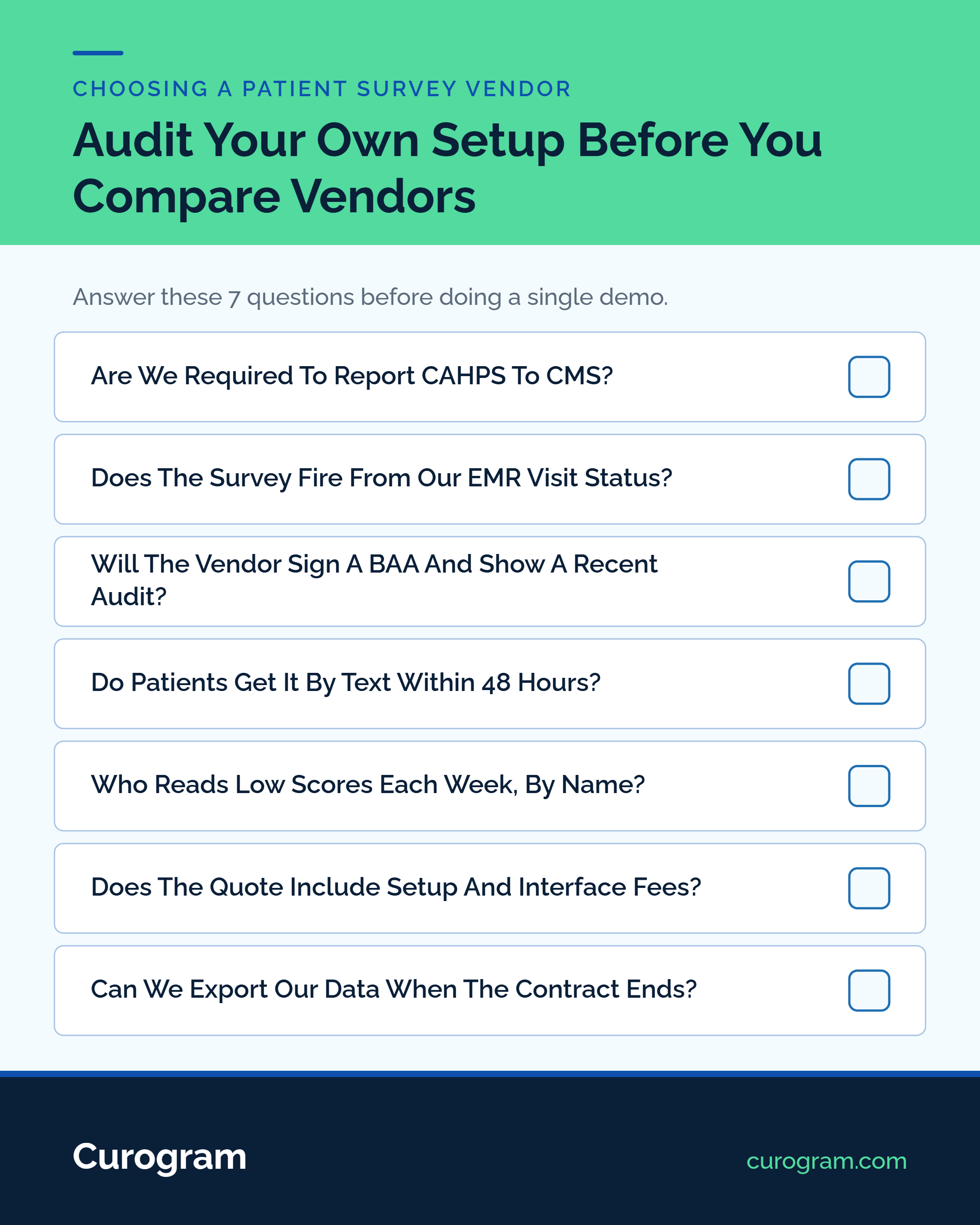
Vendor demos all look the same. These five checks separate them.
Survey Methodology and Delivery Channels
Delivery channel drives response rate more than question wording does. A paper survey mailed to a 34-year-old gets ignored. A text sent 90 minutes after the visit gets opened.
Ask how the vendor sends surveys: SMS, email, web link, phone, QR code at checkout, paper for those who still want it. Ask what happens when a patient starts the survey on a phone and finishes on a laptop.
Length matters too. Five questions get answered. Twenty-five questions get abandoned at question six.
Data Analysis and Reporting
Dashboards are easy to build and hard to use. What you want is a report that names the problem and the person who can fix it.
Look for live results, tone scoring on open comments, peer benchmarks, and role-based views. A clinic manager should see their site. The CFO should see the roll-up.
Press Ganey pushed this further in early 2026 with Narrative HX, an AI tool that sums up raw written feedback. Henry Ford Health was among the first to use it.
Compliance with HIPAA and Data Security
Survey responses tied to a visit are protected health information. Treat this as a hard gate.
Any vendor you shortlist should sign a Business Associate Agreement, encrypt data in transit and at rest, and show you a recent outside audit. Curogram is HIPAA compliant and SOC 2 Type II certified. Other vendors on this list state HIPAA compliance and will sign a BAA. Check current status and audit dates with each company.
Ask one more question: where do responses live after the contract ends, and can you export them?
Integration with Your EHR/EMR Systems
Manual survey lists die within a month. Someone forgets to pull the report, and the program quietly stops.
An automatic trigger solves it. The survey fires when the visit is marked complete in your EMR, which means it needs to connect with Epic, Oracle Health (formerly Cerner), Veradigm (formerly Allscripts), athenahealth, NextGen, or whatever you run.
Confirm the specific version and the specific trigger. A vendor that connects with athenahealth may only pull demographics, not appointment status, and appointment status is what you need.
Cost, ROI, and Scalability
Pricing models vary enough that quotes rarely line up. Some charge a flat monthly fee, some price per survey, and some tier by patient volume. CAHPS vendors often bill per sampled patient.
A single clinic can spend a few hundred dollars a month. A health system running required CAHPS programs across service lines can spend six figures a year.
Ask for the total including setup, EMR interface fees, and per-message costs. Then ask what happens to the price when you open location number four.
The Top 8 Patient Satisfaction Survey Companies in 2026
We ranked by fit, not by company size. A 2,000-bed system and a five-provider dermatology group need almost nothing in common from a survey vendor.
|
Company |
Best Fit |
CAHPS Focus |
|---|---|---|
|
Curogram |
Practices wanting surveys inside their texting workflow |
Not a CAHPS vendor |
|
Press Ganey |
Hospitals and large health systems |
Yes |
|
NRC Health |
Systems tracking loyalty over time |
Yes |
|
Qualtrics (SurveyVitals) |
Ambulatory groups, ASCs, MIPS reporters |
Yes |
|
Medallia |
Enterprise, multi-industry organizations |
Not a CAHPS focus |
|
Phreesia |
Groups already running Phreesia intake |
Not a CAHPS focus |
|
RepuGen |
Private practices and urgent care |
Not a CAHPS focus |
|
Birdeye |
Multi-location consumer-facing clinics |
Not a CAHPS focus |
Confirm current CMS survey vendor approval directly with each company before contracting.
1. Curogram
Surveys here are one piece of a patient communication platform rather than a standalone product. Curogram sends the survey by text after the visit, collects the response in the same thread the patient already uses for reminders and forms, then invites satisfied patients to post a public review.
The platform connects with your existing EMR and acts as a complement to it, never a replacement. Two-way HIPAA-compliant texting, appointment reminders, digital intake forms, text-to-pay, review requests, and telemedicine run through the same inbox your front desk already has open.
Curogram is HIPAA-compliant and SOC 2 Type II certified. Based on our internal data, practices using automated reminders alongside feedback workflows have cut no-show rates from 14.20% to 4.91% within three months.
Best suited to practices that want fewer vendors, not more dashboards.
2. Press Ganey
For hospitals, this is the default. Press Ganey holds the largest patient experience benchmarking database in the country, which matters because a raw HCAHPS score means little without a peer comparison.
Their delivery spans mail, phone, email, text, apps, and web. In 2026 they added Narrative HX for AI summaries of free-text comments.
The trade-off is scale. Press Ganey is built for organizations with a dedicated patient experience team and a procurement cycle, and pricing reflects that.
3. NRC Health
NRC Health built its position around live feedback and loyalty tracking rather than one-time score reports. Their Human Understanding work follows how patients see you across repeat visits.
KLAS research has consistently placed NRC Health second to Press Ganey among customers using a vendor for CAHPS benchmarking.
Health systems that want long-term loyalty data, not just quarterly compliance numbers, tend to land here.
4. Qualtrics (including SurveyVitals)
Qualtrics acquired SurveyVitals, and that acquisition is the reason this entry belongs on a healthcare list at all. SurveyVitals is approved to administer CAHPS for MIPS, OAS CAHPS, CG-CAHPS, HCAHPS, Hospice CAHPS, HHCAHPS, and ICH-CAHPS.
That pairing gives you big-system analytics on one side and CMS-approved survey delivery on the other. Text iQ handles open-comment analysis.
Ambulatory surgery centers and medical groups reporting CAHPS for MIPS get the most out of this pairing.
5. Medallia
Medallia comes from outside healthcare and takes a wider view of customer experience. The platform picks up signals at scale, including call center audio and web behavior alongside surveys.
Healthcare is one market among many for them, which cuts both ways. You get strong analytics and weaker clinic-specific workflows.
Big groups that already run Medallia elsewhere have a fair case for adding patient feedback to it.
6. Phreesia
Phreesia starts at check-in. Because intake already runs through the platform, the survey can fire off the same appointment record. No second link needed.
Groups running Epic or athenahealth get the cleanest setup, since Phreesia is already sitting in that workflow.
If intake is not on Phreesia, the value case gets thinner. This is a strong add-on, and a costly starting point.
7. RepuGen
Built just for healthcare reputation, RepuGen pairs post-visit SMS and email surveys with review requests across Google, Healthgrades, Yelp, and RateMDs. Their ReviewBalancer routes patients toward whichever platform needs coverage.
Service recovery is the real feature. A low score sets off an alert, so staff can reach the patient before the review goes public.
The company finished its yearly HIPAA audit in July 2026. It reports links to more than 100 EHR and practice management systems.
8. Birdeye
Birdeye serves many markets, and healthcare is one of its bigger ones. Surveys, review requests, listings, and messaging all sit in one dashboard.
Multi-site clinics that compete on local search use it heavily.
Watch the EHR question here. How deep the link goes varies by system, and broad tools often keep survey data outside the chart.
Understanding the Core Principles of Patient Satisfaction
Frameworks are only useful if they help you sort comments into buckets someone owns. Both of these do.
What are the 4 Pillars of Patient Satisfaction?
1. Clinical Quality: How the patient sees the care itself, including provider skill, treatment results, and whether they got better.
2. Service and Operations: Everything around the care. Easy booking, wait time, a clean office, and a clear bill.
3. Communication and Empathy: Whether staff listened, spoke plainly, and answered the question the patient really asked.
4. Patient Engagement: How much say the patient had in choices, and what help they got after walking out the door.
Sort free-text comments into these four buckets and you learn fast whether the problem is clinical or not. Most practices find it isn't.
Exploring the 5 P's of Patient Satisfaction
1. People: Staff attitude and manner, from the person answering the phone to the doctor.
2. Place: The physical space. Clean rooms, comfort, parking, easy access.
3. Process: How smoothly registration, waiting, exam, and checkout run.
4. Product: The clinical services themselves and how effective they are.
5. Price: Clear pricing, and whether the bill matched what the patient was told.
Note that some organizations use a different 5 P's set.

Conclusion: Making the Right Choice for Your Practice's Future
Choosing from the many patient satisfaction survey companies is a strategic decision that will reverberate through your entire organization. The right partner will empower you with the insights needed to not only meet but exceed patient expectations.
By focusing on providers with robust technology, a commitment to security, and the ability to turn complex data into a clear action plan, you can foster a culture of continuous improvement. Use this guide as a starting point, conduct your own due diligence, and select the company that will best help you achieve a new level of excellence in patient care.
Want to witness how much surveys can improve patient satisfaction? Schedule a demo with Curogram to find out.
Frequently Asked Questions
Setting decides it. Hospitals, home health agencies, hospices, and surgery centers reporting to CMS must hire an approved vendor, so that rule comes first.
Clinics and specialty groups with no CMS filing to make are usually better served by a tool that fires surveys from the workflow they already have. Some groups run both: a certified vendor for the required filing, and a lighter tool for weekly feedback.
Timing and length cause most of it. A survey that lands four weeks later reaches a patient who forgot the front desk, and a 25-question form gets dropped partway through. The channel matters just as much, since a mailed form to younger patients rarely comes back. Short text-based surveys sent within a day of the visit consistently pull the highest response.
Within 24 to 48 hours works for most clinics, while the details are still fresh. Inpatient surveys follow CMS protocols and go out after discharge on a set schedule. Surgery-based practices sometimes wait until the patient is past the first recovery days, since early pain skews answers. Test two windows against your own response rates before settling.
A well-written survey nobody sends produces zero data. The link is what makes the survey fire when the visit is marked complete, which removes the daily manual step that kills most programs by week three. It also ties answers to the right provider and site, so feedback lands with the person who can act on it. Confirm the trigger, not just the connection.
A single-location clinic typically runs a few hundred dollars per month for a basic setup. Multi-site groups with tone scoring, review tools, and EMR links land in the low thousands per month.
Hospitals running required CAHPS programs across service lines can spend well into six figures a year. Ask for quotes that include setup fees, link charges, and per-message costs, since those line items move the total more than the base fee does.
Types of Patient Satisfaction Surveys and their Uses to Improve Healthcare and Patient Retention
💡 Patient satisfaction surveys are not interchangeable. Each type answers a different question, and sending the wrong one leaves you with data...
1 min read
55+ Patient Satisfaction Survey Questions, Templates and Strategies
💡 A patient satisfaction survey is a short, structured set of questions that measures how patients experienced your practice, from booking the...