
The Benefits of Patient Satisfaction | Curogram Blog
 Jess Koslow : 2/21/22, 7:00 AM
Understand the benefits of patient satisfaction and see how one clinic reduced no-shows from 14.20% to 4.91% by changing how confirmations were sent...
8 min read
A patient goes home on a Tuesday afternoon. She waited 40 minutes for her discharge paperwork, and nobody told her why. Three weeks later, a survey asks whether staff responded quickly when she needed help. She remembers the wait.
She does not remember the night nurse who checked on her twice at 2 a.m. That gap, between what your staff did and what the patient recalls, is what HCAHPS measures.
Hospitals tracked satisfaction long before CMS got involved. HCAHPS made it standard, public, and tied to reimbursement. Since 2002, it has been the yardstick every hospital gets compared against.
The survey itself changed, and plenty of improvement plans still target the old version. Discharges on or after January 1, 2025 get an updated survey with new questions, two new composites, and web delivery for the first time. If your rounding script was built to hit the call-button question, it is aimed at a question CMS retired.
Below we cover what the survey looks like now, why the score carries so much weight, and five changes worth making.
HCAHPS stands for Hospital Consumer Assessment of Healthcare Providers and Systems. CMS built it with the Agency for Healthcare Research and Quality starting in 2002. It is still the national standard for collecting and publicly reporting patient experience of care.
The current survey has 32 items. Twenty-two cover key parts of the stay. Three route patients past questions that do not apply. The last seven adjust for patient mix and support reports Congress requires.
Those 22 items roll up into these composites:
Two more items ask for an overall rating and whether the patient would recommend the hospital.
Care coordination and restfulness are the new ones. Restfulness replaced the single quietness question with a wider set about what breaks up rest. CMS also cut items. The call-button question is gone, and so is the one asking whether the patient came in through the emergency room.
|
Element |
Legacy survey |
Updated survey (Jan 1, 2025 discharges forward) |
|---|---|---|
|
Total items |
29 |
32 |
|
Approved modes |
4 |
6, including three web-first |
|
Collection window |
42 calendar days |
49 calendar days |
|
Supplemental items |
No cap |
12 maximum |
|
Proxy responses |
Not allowed |
Allowed |
|
New composites |
None |
Care Coordination, Restfulness of Hospital Environment |
Six modes are approved: Mail Only, Phone Only, Mail-Phone, Web-Mail, Web-Phone, and Web-Mail-Phone. The last three are the web-first options. They went live with January 2025 discharges. CMS set their score adjustments from a large randomized mode experiment run in 2021.
Sampling rules did not loosen. Surveys go to a random sample of adult inpatients who stayed overnight. They are fielded between 48 hours and six weeks after discharge. Hospitals need 300 completed surveys in a reporting period for public scores, which is why smaller hospitals oversample.
Two admin changes matter for your vendor contract. The collection window grew from 42 to 49 calendar days. Supplemental questions are capped at 12, added to the end. Hospitals must also report which language a patient preferred and use the official Spanish translation where it applies.
Full sampling, coding, and file submission rules live in the HCAHPS Quality Assurance Guidelines on the official HCAHPS website. CMS is not putting out a new version in 2026, though an addendum took effect with July 1, 2026 discharges.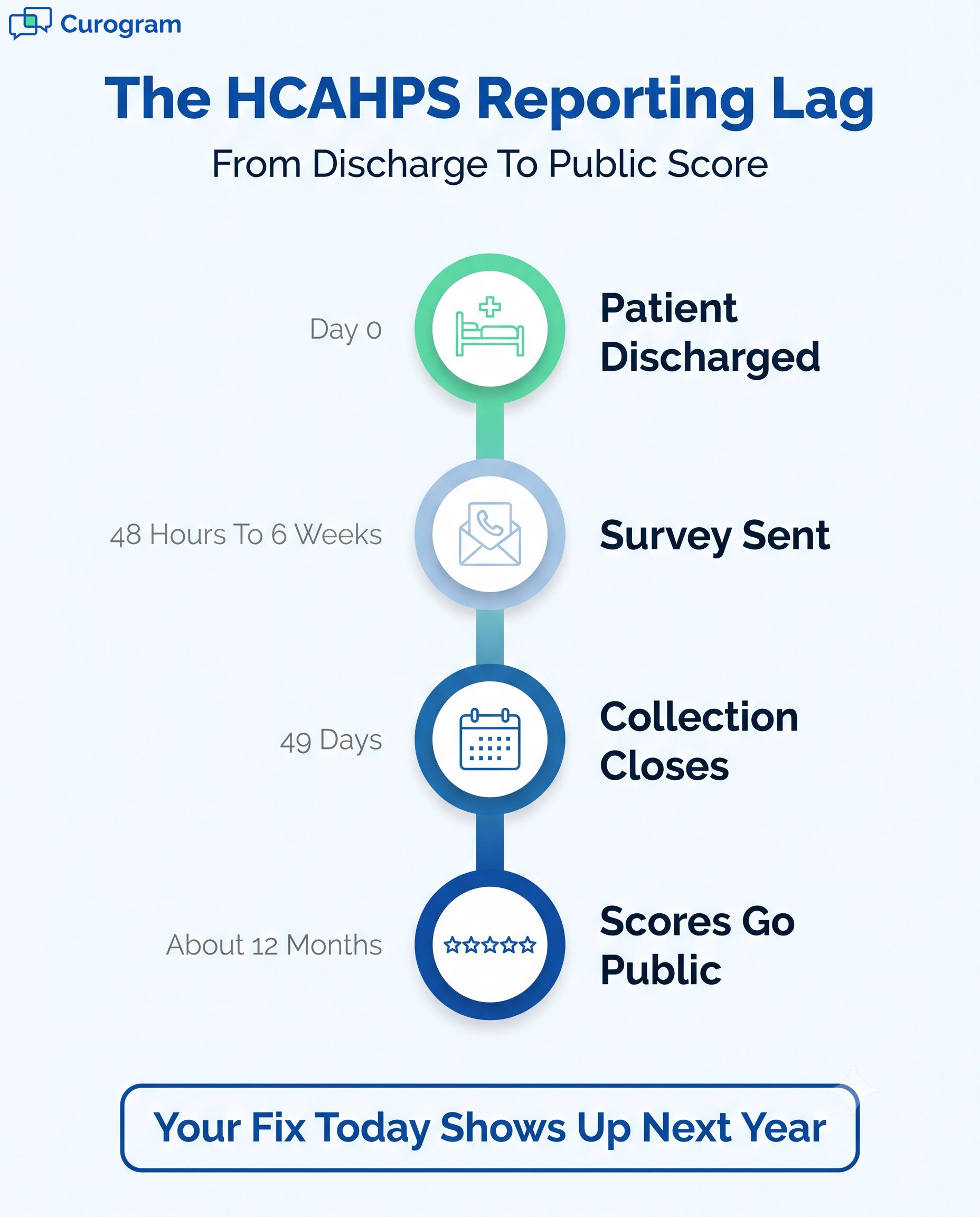
Hospitals collected satisfaction data for years without much riding on it. HCAHPS attached money and publicity to the numbers.
HCAHPS results feed the Person and Community Engagement domain of Hospital Value-Based Purchasing. CMS holds back a slice of Medicare payment and hands it out based on how you score. A weak patient experience number costs real dollars and potential clients even when clinical quality is strong.
CMS published one crosswalk mapping the new questions into that domain for FY2027 through FY2029. A second crosswalk covers FY2030 forward. The questions and the scoring map are both moving, so a two-year-old plan may be chasing the wrong composite.
Star ratings add a second layer. Care Compare shows nine HCAHPS star ratings: one for each of the eight public measures, plus a summary. CMS refreshes them every quarter.
Nobody needs permission to look up your scores.
A patient weighing two hospitals across town can pull both star ratings in under a minute through the Hospital Compare database, now published as Care Compare. It is the same habit as checking Google reviews before picking a dentist, applied to a hospital stay.
That comparison rarely happens on its own. Based on our internal research, 90% of new patient leads look at a Google Business Profile before they ever reach a website. Your Care Compare rating and your Google rating get read in the same sitting, and the Google one usually loads first.
Scores also lag badly. The January 2026 Care Compare refresh reported on discharges from April 2024 through March 2025. A fix you make this quarter will not show up publicly for about a year. That is why hospitals need a faster internal signal than the official survey gives them.
Understanding the survey is step one. Changing what happens on the floor is the part that moves numbers. These five are ordered by how much control you have over them.
Most hospitals have competent staff and good equipment. Neither shows up in a survey answer unless the patient felt looked after. What patients rate is how their needs got handled, not the credentials on the wall.
One department running a patient-centered model will not move a score. The survey asks about the whole stay, so a strong medical floor gets averaged against a rushed radiology hand-off and a front desk that never explained the wait.
The concrete version costs nothing. Put a whiteboard in every room with today's plan and the name of the nurse on shift. Run bedside shift report instead of handing off at the station. Round hourly on pain, position, bathroom needs, and whether the call button is within reach.
Frequency decides these questions. Most core items ask how often something happened, and top-box scoring counts only "Always." A nurse who explained things clearly four times out of five earns nothing on that item.
So set the touchpoints rather than leaving them to memory:
Teach-back is the cheapest item on that list and the most reliable. Asking a patient to explain their own discharge instructions surfaces the gap while you can still fix it. It also feeds the discharge information composite.

Patient-facing communication depends on staff-facing communication working first. A nurse who pages a hospitalist and waits 20 minutes cannot answer the patient's question. The patient scores that delay as unresponsive staff.
Internal messaging through a secure and easy-to-use platform closes that loop. Text the hospitalist, get an answer in two minutes, walk back into the room with it. The patient never learns there was a question.
The same setup carries outward. Discharge instructions sent to a phone stay readable after the patient gets home, unlike a folder handed over during a groggy afternoon. Language preference stored once follows the patient through every message.
Web-first survey modes make this worth more than it used to be. Patients already getting your texts know the channel when a survey link shows up in it.
Patients do not sort staff by job title. The transport aide, the housekeeper, and the dietary tech all count as hospital staff on the survey. Any one of them can sink a responsiveness score by walking past a lit call light.
Train the whole workforce on what the survey asks and why. AIDET gives you a script anyone in the building can use: acknowledge the patient, introduce yourself, give a duration, explain what you are doing, and thank them. It takes about ten seconds.
Share unit-level scores monthly with the people who earned them. An aggregate number sitting in an administrator's dashboard changes nothing. A nurse manager who can see her floor's communication score against last quarter has something to act on.
The Restfulness composite widened the target here. It used to be one question about night quiet. Now it covers the broader set of things that break up rest, so handing out earplugs covers less ground than it did two years ago.
Walk your own units after 9 p.m. and write down what you hear. Overhead paging, cart wheels squeaking on one stretch of hallway, alarm volumes nobody has adjusted since installation, talk at the nurses' station that carries four rooms down.
Most of those have cheap fixes. Rubber wheel replacements, a paging cutoff after a set hour, dimmed hallway lights during quiet hours. Cleanliness works the same way, since the survey asks about the room and bathroom, not the lobby.
Curogram does not administer HCAHPS. That has to run through a CMS-approved survey vendor under the Quality Assurance Guidelines. What it covers is the gap between discharge and the day results reach Care Compare, about a year later.
Curogram connects with almost any EMR and adds two-way texting on top of what you already run. Automated post-visit surveys go out by text within hours of discharge, while the stay is still fresh. Answers come back in a channel patients check. The platform is HIPAA-compliant and SOC 2 Type II certified, and it complements your EHR rather than replacing it.
Two numbers from our own client data. Automated reminders hold a confirmation rate above 75% across current clients. One multi-location practice used automated post-visit surveys tied to Google Reviews and collected 1,064 new five-star reviews in three months. Of the patients who responded, 90% left five stars.
Neither number is an HCAHPS score. They do show how patients respond, which is the wall most hospitals hit when they try to hear back faster than the official survey allows.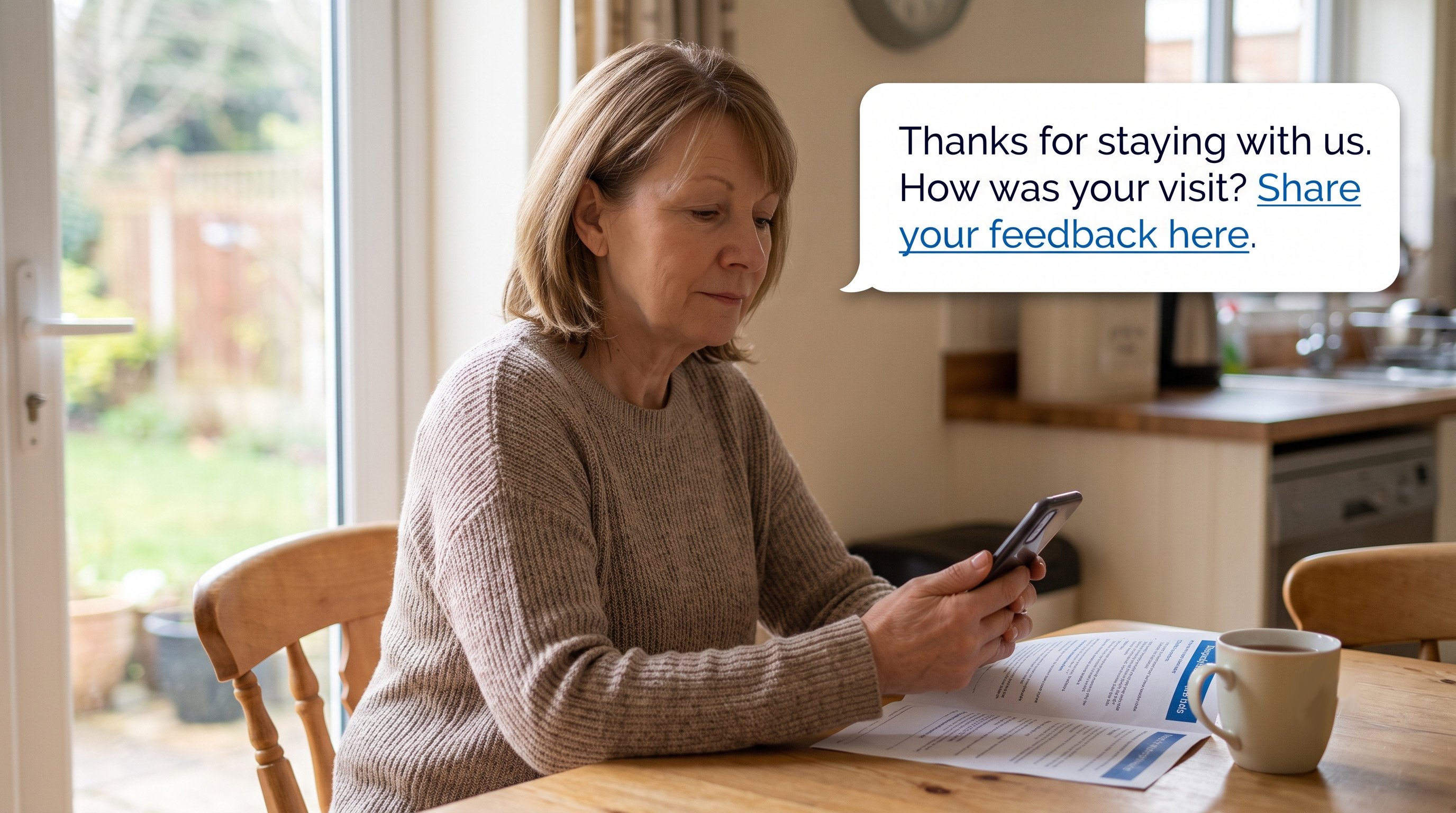
Improving your HCAHPS score is slow work, and the reporting lag makes it feel slower. Public results run about a year behind the discharges they describe. Anything you change this quarter shows up on Care Compare next summer.
That lag argues for starting with the changes that need no budget approval. Bedside shift report, teach-back at discharge, and a paging cutoff after 9 p.m. cost nothing but attention. They also hit three different composites at once.
Check your improvement plan against the current survey before anything else. If it was written before 2025, some of it targets questions CMS retired, and none of it addresses care coordination or restfulness. Both are new, and most hospitals have no workflow for either yet. Care coordination is the harder one, since it spans units and no single manager owns it.
Then look at where your scores actually sit. Pull the individual question top-box scores from the latest public report and find your three weakest items. Not your weakest composite, your weakest questions. Composites average away the specific failure dragging them down.
Give each of those three a named owner and a monthly check-in. Patient experience is the easiest quality domain to let drift, because no shift stops when it slips. A name and a date on the calendar is what keeps it moving.
Last, build a feedback loop faster than the survey gives you. Ask discharged patients directly, in a channel they use, within a few days of going home. You will hear about the squeaky cart and the unexplained wait months before CMS reports them back to you.
If you want help closing that gap, our team can show you what post-discharge messaging looks like in practice.
Want to see how automated post-discharge messaging would fit your workflow? Book a demo with our team, and we will walk through it against your current discharge process.
 Jess Koslow : 2/21/22, 7:00 AM
Understand the benefits of patient satisfaction and see how one clinic reduced no-shows from 14.20% to 4.91% by changing how confirmations were sent...

What is patient-centric healthcare? The 2001 definition, the six elements, how CMS now scores it, and the one test that separates it from good...

Unlock better care with our complete guide to the patient experience survey. Learn to create, analyze, and act on feedback and improve patient...