
 Jess Koslow
1 min read
5 Ways to Improve Your HCAHPS Score
💡Improving your HCAHPS score takes five changes. Build patient-centered care into daily work, not one department. Contact patients on a set...

Atlas Medical Center cut its no-show rate from 14.20% to 4.91% in three months. Nobody hired a patient experience director.
No one rewrote the mission statement or ran a culture workshop. The clinic changed how appointment confirmations went out, and roughly one in ten slots that used to sit empty started holding patients.
That gap between what practices think drives satisfaction and what actually moves it is worth sitting with. Patient satisfaction is largely a logistics problem, and most of the score gets decided before a provider enters the room.
Consider what a patient is rating. Whether the intake form showed up two days early or arrived as a clipboard at the window. Whether anyone answered the phone. Whether the reminder came by text or not at all. Whether someone followed up after the lab result landed.
The stakes scale with the setting. Hospitals put 2% of their Medicare payments on the line every year through Value-Based Purchasing, and patient experience decides a full quarter of that outcome.
Outpatient practices face something less formal and more immediate: a public star rating that 90% of new patient leads check before they ever open your website, based on our internal data.
Both come down to the same handful of touchpoints — booking, intake, reminders, payment, follow-up, and the review request afterward.
This article covers what high satisfaction actually earns a practice, which parts of the experience move the numbers, how to measure results without an HCAHPS score, and the compliance rules that govern texting patients and responding to their reviews.
Earning and maintaining high patient satisfaction scores benefits your medical organization and your patients in several ways.
Patients switch providers easily now, and one bad visit is often all it takes. The ones who stay do two things that show up directly on your schedule. They book the checkup or the follow-up. Then they actually arrive for it.
Attendance is where loyalty turns into revenue. Covina Arthritic Clinic confirms more than 1,100 appointments every month, based on our internal data. Atlas Medical Center dropped its no-show rate from 14.20% to 4.91% in three months.
Satisfied patients also talk, and that conversation has moved online.
Based on our internal research, 90% of new patient leads check your Google Business Profile before they ever open your website. One multi-location client collected 1,064 new 5-star reviews in three months, with roughly 90% of responding patients leaving five stars.
The reverse is just as visible. A patient who felt rushed at checkout writes that review too, and it sits at the top of your profile for the next person searching your specialty.
Profit follows attendance. A slot that goes empty at 10:15 still costs you the room, the staff hour, and the provider's time. There's no way to bill it back later.
Satisfaction shows up on the ledger through three separate paths, and each one is measurable:
| Where the money shows up | What we've seen |
|---|---|
| Slots that hold | 75%+ appointment confirmation rate across our platform |
| Patients who come back | 35% of lapsed patients rebooked, totaling 1,240 recovered |
| Fewer gaps overall | No-show rates 53% below the industry average |
Those figures are based on our internal data.
Insurers and Medicare watch the same signal. Hospitals see it most directly, since Accenture's 2016 study matched six years of hospital margin data against HCAHPS scores and found that top performers grew both margins and revenue faster than average, with revenue outpacing rising costs. A 10% score improvement tracked with 70% margin growth over that period.
Clinics don't get HCAHPS scores. What you get instead is a public star rating, and it's read by every prospective patient and every referral partner before they call.
Medicare puts a slice of hospital payment on the line every year.
CMS withholds 2% of participating hospitals' Medicare payments under the Hospital Value-Based Purchasing program, then uses that pool to fund incentive payments based on performance. For fiscal year 2026, the pool is estimated at $1.7 billion.
Hospitals earn the money back. Score well and you can end up ahead of the 2%. Score poorly and you keep less than you gave up.
Patient experience decides a full quarter of that outcome:
| VBP domain | Weight |
|---|---|
| Clinical Outcomes | 25% |
| Person and Community Engagement (HCAHPS) | 25% |
| Safety | 25% |
| Efficiency and Cost Reduction | 25% |
All four domains carry equal weight in the Total Performance Score. Person and Community Engagement is built from the HCAHPS dimensions, so how patients rate communication, discharge information, and staff responsiveness moves real dollars.
One boundary worth knowing: this program applies to inpatient hospital payments. Independent clinics and physician groups aren't scored under it, though their Medicare payments run through separate quality programs.
Ask a front desk coordinator which part of the day wears them down. It's rarely the patient standing at the window. It's the phone ringing while three people wait in line and a fourth needs to move a Thursday appointment.
Every call your team answers by hand is attention pulled off the person in front of them. Patient-focused care and staff sanity run on the same clock.
Two-way texting pulls that volume down. Practices on our platform reduce phone call volume by as much as 50% and raise staff productivity by 30% or more, based on our internal data. Same team, same headcount, far fewer interruptions.
Short training helps as much as the tool itself. Front desk staff pick up our software in about 10 minutes, so nobody loses a shift wrestling with an unfamiliar screen. A system your team can actually run is a system they stop resenting.
Staff who stay start recognizing names on the schedule. They remember which patient needs the interpreter, which one always runs late, which one asked about the bill last visit. A new hire reading that chart cold can't match it.
Your schedule sells time. Phone minutes and empty slots are where most of it disappears.
Online booking and patient messaging pull routine work off the phone.
Practices on our platform cut staff phone time by as much as 50% and raise productivity by 30% or more, based on our internal data. Headcount stays flat. The calls that vanish are the ones asking what time an appointment starts.
Front desk hours go somewhere better: verifying coverage before the visit, working the aging billing queue, calling back the patient whose lab result landed this morning.
No-shows take the other half. A 2:30 slot that empties at 2:31 can't be resold. Twenty slots is most of a provider day. Our platform reduces no-show rates by up to 75%, based on our internal data.
Late cancellations cost the same slot with more warning. A patient who cancels Tuesday for a Thursday visit hands your front desk two days to fill it.
Your rating is the first thing a prospective patient sees. Based on our internal data, 90% of new patient leads check your Google Business Profile before they ever open your website.
Hospitals carry a second public record. HCAHPS results are published on Medicare's Care Compare site, where anyone can look up how patients rated a given hospital.
Those scores describe the facility, not the individual physician, and outpatient clinics aren't included at all. For most practices, the star rating and the reviews beneath it are the whole public file.
Automated post-visit messages are how that file gets built. Send the same request to every eligible patient. Filtering for the happy ones before asking for a public review is review gating, and Google's policies prohibit it.
Consistency is what produces volume. One multi-location client gathered 1,064 new 5-star reviews in three months, with roughly 90% of responding patients leaving five stars. Another rebuilt a 1.67 rating to a 5.0 over 22 months. Both figures come from our internal data.
And finally, happy patients will recommend you to friends and family. When it comes to referrals, word-of-mouth is the gold standard.
A patient who trusts your office answers the phone when you call. That's the whole mechanism. Care plans only work when the patient comes back for the next step.
Chronic conditions make the stakes plain. Diabetes management needs an A1C check roughly every three months. A hypertension adjustment needs a follow-up to confirm the new dose is holding. Miss those visits and the treatment stops being treatment.
Recall messaging is what closes the gap. One multi-location client sent SMS recalls to patients overdue for follow-up care. 35% booked an appointment within a month, and 1,240 patients were seen from those messages alone, based on our internal data.
Those visits are where outcomes get made. A patient sitting in your exam room can have a dose adjusted, a lab reordered, or a symptom caught early. A patient who never rebooked gets none of that.
Satisfaction and adherence tend to move together, though the research on how strongly is still contested. What's measurable on your end is simpler: whether the follow-up happened.
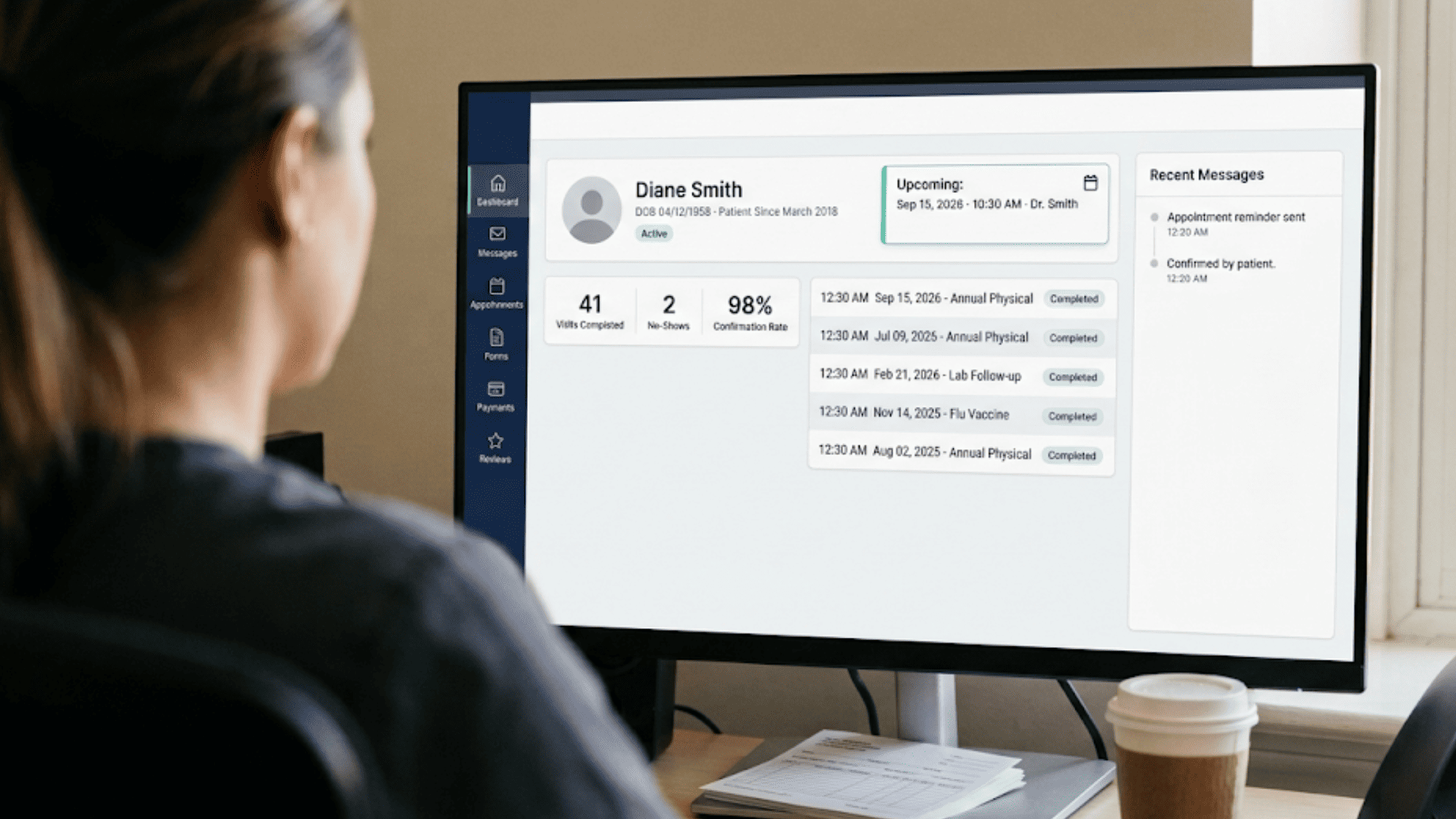
If these patient satisfaction benefits sound like music to your ears, you can take steps to create the experience your patients will rave about.
Some of the common issues that lead to subpar patient experiences include poor communication, long wait times, and impersonal care. Fortunately, you address most of these issues easily.
Waiting starts before the exam room. A patient arrives at 9:45 for a 10:00 appointment, gets handed a clipboard, and spends 12 minutes copying an insurance card number they already gave you last year.
Digital intake moves that work off the clipboard. Forms go out by text two days ahead, the patient fills them in at home, and the answers land in the chart before anyone unlocks the front door. Check-in becomes an ID verification instead of a paperwork session.
Telehealth removes a different block of time. No drive, no parking garage, no sitting in a room with six other people. For a patient managing a chronic condition on a rural route, the trip itself is often the barrier, not the visit.
Both changes take minutes off the same place in the schedule — the gap between arrival and provider contact. Provider time doesn't shrink. What shrinks is everything the patient was doing while nobody was treating them.
Worth checking on your own numbers: pull the average interval between check-in timestamp and rooming timestamp in your EHR. That figure tells you whether paperwork or provider backup is the real cause.
Age shapes the habit more than anything else. A 72-year-old picks up the phone without a second thought. Plenty of patients under 40 will watch it ring, then text back forty minutes later.
Guessing which one is sitting in your schedule is where practices lose people. A 2022 cross-national survey found that 37% of the US population had exchanged SMS messages with their providers in the past year, while 41% had accessed their medical records online.
Text still carries the schedule. Practices on our platform hold a 75%+ appointment confirmation rate, based on our internal data, and almost none of those confirmations involve a phone call.
For appointment logistics, secure text messaging is becoming essential. First, ask your patients how they prefer to be contacted, then make sure to use that method.
Ask at registration, then record the answer somewhere your front desk actually looks. Preferred channel belongs in a chart field, not on a sticky note.
Preference alone doesn't clear you to text. TCPA sets two tiers, and appointment reminders and marketing blasts sit in different ones:
| Message type | Consent required |
|---|---|
| Reminders, results, care instructions | Prior express consent |
| Promotions, service offers, campaigns | Prior express written consent |
Capture that consent on the intake form and keep the record. A preference field tells you how to reach a patient. The consent record is what makes the outreach lawful.
Booking by phone only works during business hours. A patient who decides at 9 p.m. that their cough needs looking at has one option: remember to call tomorrow between other obligations. Most don't.
Online scheduling that syncs with your calendar removes the callback loop. Patients see live availability instead of leaving a voicemail and waiting for someone to ring them back with three options.
Request-and-confirm protects complex visit types that need triage. Direct book fills routine slots faster. Most practices run both, split by appointment type.
Cancellations are where the calendar actually earns back money. A 3:15 slot opens at 11 a.m. when someone calls off, and waiting for a patient to happen upon it online rarely works. Text the waitlist instead. The message goes to everyone eligible at once, and the first reply takes the slot.
Same-day openings move fastest when the patient already wanted to be seen sooner. Flag those patients when they book their original appointment.
Your patients already manage banking, groceries, and flights from a phone. Then they reach your front desk and get handed a clipboard and a callback promise.
Digitizing works best one step at a time, in the order patients hit them. Each step below removes a phone call, a piece of paper, or a delay in getting paid:
The payment step is where most practices leave money sitting. A statement mailed to a patient waits for them to find a checkbook. A text link gets paid from the couch.
Paper forms cost twice: printing and storage on your end, plus the waiting-room minutes on theirs.
Most patients forget the exam room conversation before they reach the parking lot. Twelve minutes of explanation, a new prescription, two lifestyle changes, and one instruction about when to call — none of it written down.
Education sticks when it arrives after the visit, in writing, in pieces the patient can act on. A text two days after a diabetes appointment reminding them what an A1C measures does more than a rushed explanation while the provider is typing.
Match the material to what the patient is actually deciding:
| Moment | What to send |
|---|---|
| Before a procedure | Prep steps and what to expect |
| After a new prescription | What it treats and common side effects |
| After discharge | Which symptoms warrant a call |
| Between chronic care visits | Why the next lab matters |
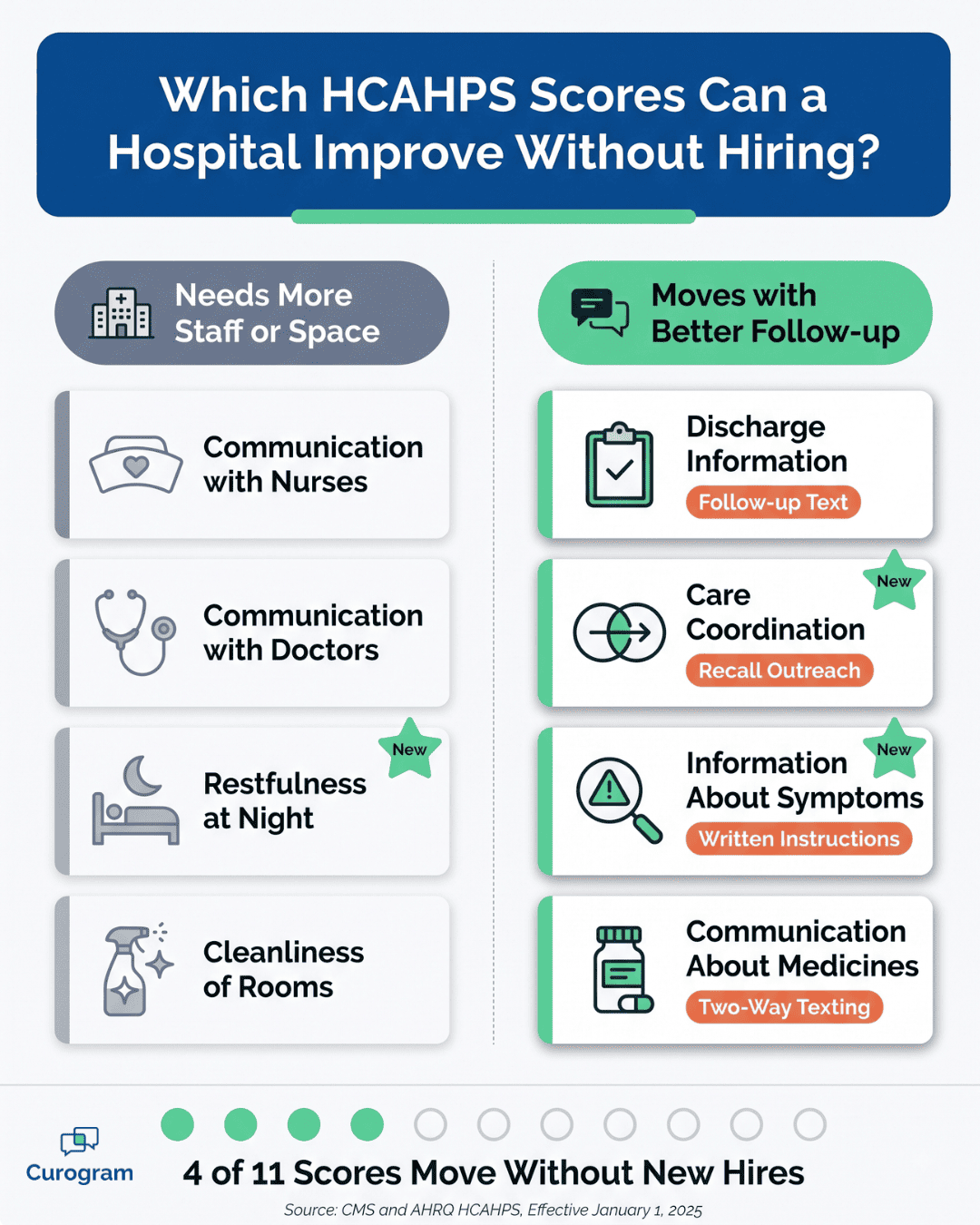
That last discharge item now carries reimbursement weight. Information About Symptoms became a scored HCAHPS measure on January 1, 2025, and it asks whether patients received written information about symptoms to watch for.
A patient who understands why a follow-up matters books it. One who was told to "come back in three months" often doesn't.
Your patients’ health and well-being should be at the center of everything you and your staff do. Patient-focused care takes into account your patients’ values and individual preferences, as well as their health needs.
Education and technological updates that streamline their experience contribute to patient-focused care, ultimately improving the patient experience and your patient satisfaction scores.
You can’t know how you’re performing if you don’t collect and track patient satisfaction data. You have several options to choose from:
HCAHPS is the national survey of hospital patient experience, run by CMS. It goes to a random sample of adult patients after discharge, by mail, phone, web, or a combination of those. Results are published on the Compare tool at Medicare.gov and refreshed quarterly.
Over 4,400 hospitals participate, and nearly two million patients complete the survey each year. Scores rest on four consecutive quarters of responses, and an IPPS hospital needs at least 300 completed surveys across those quarters before its results get reported publicly.
One boundary decides whether any of this applies to you. HCAHPS follows an inpatient discharge. An outpatient procedure doesn't trigger it. Neither does an ER visit that sent the patient home, or a Tuesday appointment at a family medicine clinic.
Most practices reading this will never receive an HCAHPS score. Your measurement comes from the two sources covered next: surveys you run yourself, and the reviews patients leave in public.
No inpatient discharges means no HCAHPS survey to run. Your own post-visit survey fills that gap, and you control every part of it.
Timing decides whether anyone answers. Send within a few hours of the visit, while the patient still remembers who roomed them and how long the wait ran. A survey that arrives four days later gets a shrug.
Keep it to three or four questions. Nobody finishes twelve on a phone.
Three that earn their place:
The third one produces your only free-text feedback, and it's where the useful complaints live — the parking situation, the front desk tone, the twenty minutes in the room after vitals.
Deliver by text with a tap-through link. Portal messages sit unread. Based on our internal data, automated post-visit surveys produced 1,064 new 5-star reviews for one multi-location client in 3 months.
One rule governs what happens next: every patient who gets the survey gets the same review request afterward. Routing only the happy responses toward Google is review gating, and it violates Google's policies and the FTC's 2024 consumer review rule.
Your star rating is the one patient satisfaction score a stranger can read in three seconds. Based on our internal data, 90% of new patient leads check your Google Business Profile before your website.
Negative reviews carry information you won't get anywhere else. A patient who waited 40 minutes past their appointment time rarely says so at checkout. They say it online, four hours later, with the specific detail your survey missed.
Ask every patient the same way. Send the review request to everyone eligible after the visit, regardless of how they rated the survey. Screening for happy patients first is review gating, prohibited by Google's policies and covered by the FTC's 2024 consumer review rule.
Volume takes care of itself once the ask is consistent. One multi-location client collected 1,064 new 5-star reviews in three months, with roughly 90% of responding patients leaving five stars, based on our internal data.
Most of what a patient rates was decided before the provider walked into the room: whether the intake form arrived two days early, whether the reminder went out, whether anyone followed up when the lab result landed.
That's the encouraging part. Culture takes years to shift. A reminder sequence takes an afternoon to set up.
Two numbers tell you whether any of it is working, and both move inside a quarter. Atlas Medical Center brought its no-show rate from 14.20% down to 4.91% in three months, based on our internal data. Star ratings climb on a similar clock once every patient gets the same review ask.
The rules travel with the tools. Get consent on file before you text. Send the review request to everyone, not only the patients who rated you well. Keep public replies to reviews clear of anything that confirms a diagnosis or even a visit.
Pick the step in your workflow that generates the most phone calls and start there. For most practices that's appointment confirmations, which is also the easiest piece to hand off.
Book a demo and we'll look at your real numbers with you: your no-show pattern, your intake bottleneck, your current review volume.

1 min read
💡Improving your HCAHPS score takes five changes. Build patient-centered care into daily work, not one department. Contact patients on a set...

1 min read
💡 To measure patient satisfaction in healthcare, practices gather feedback through structured surveys, real-time tools, and behavioral data,...

1 min read
💡 A patient satisfaction survey turns how people felt about a visit into numbers you can act on. It matters because that feedback shapes care...