
10 min read
Pre-Visit Data Collection, Zero Paper, Full StreamlineMD Integration
Jo Galvez
:
May 6, 2026
Patients tap the link, fill out their forms on any phone, and their data flows directly into StreamlineMD. No app. No portal login. No clipboards.
Forms collect contrast allergies, MRI safety checks, medication holds, fasting status, and more. All data is transferred through HIPAA-compliant, encrypted channels.
Practices see an 80% drop in intake processing time, with staff recovering 4-7 hours weekly. Prep compliance climbs above 90%. The result: a cleaner workflow, fewer errors, and patients who arrive ready.
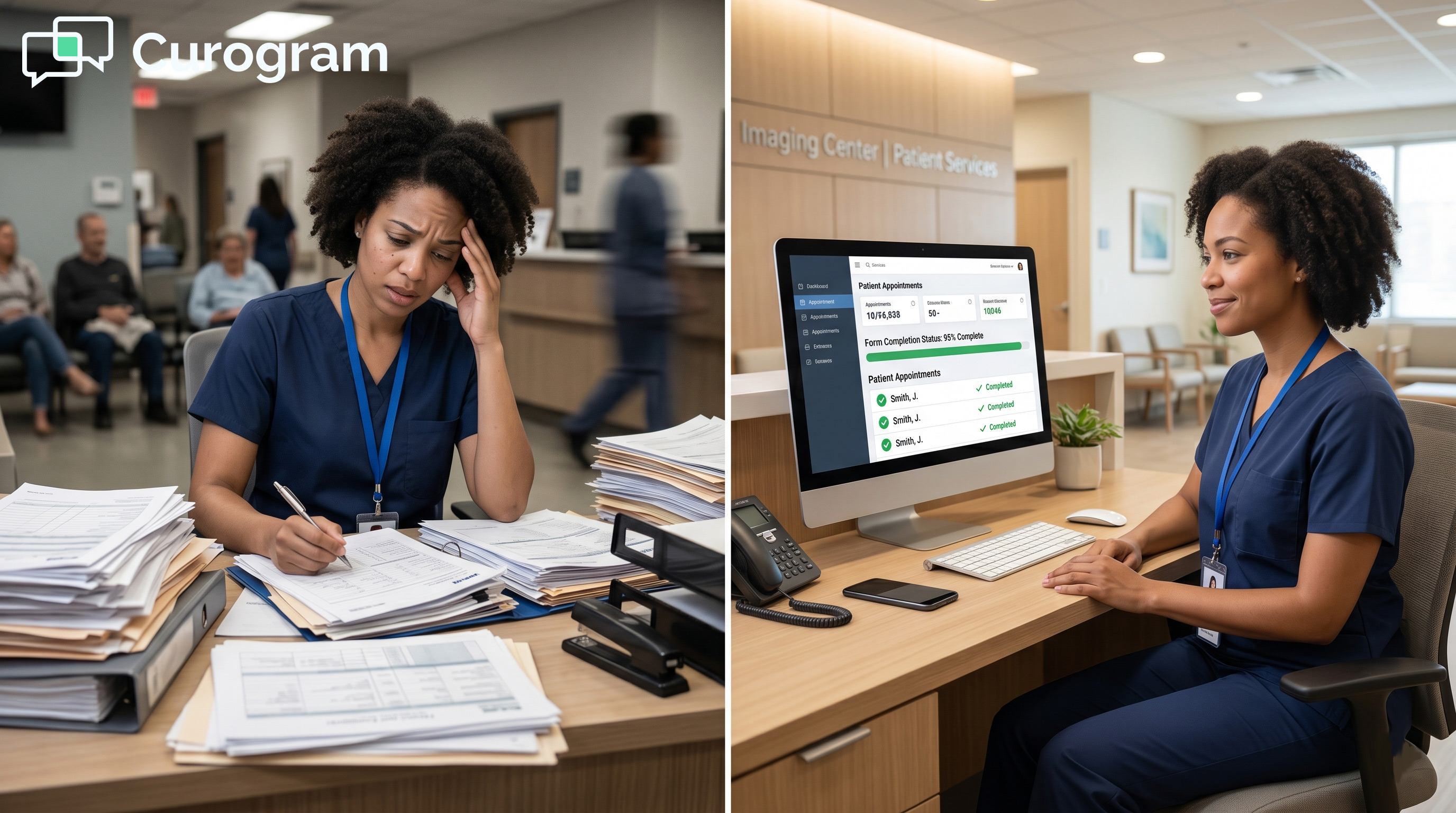
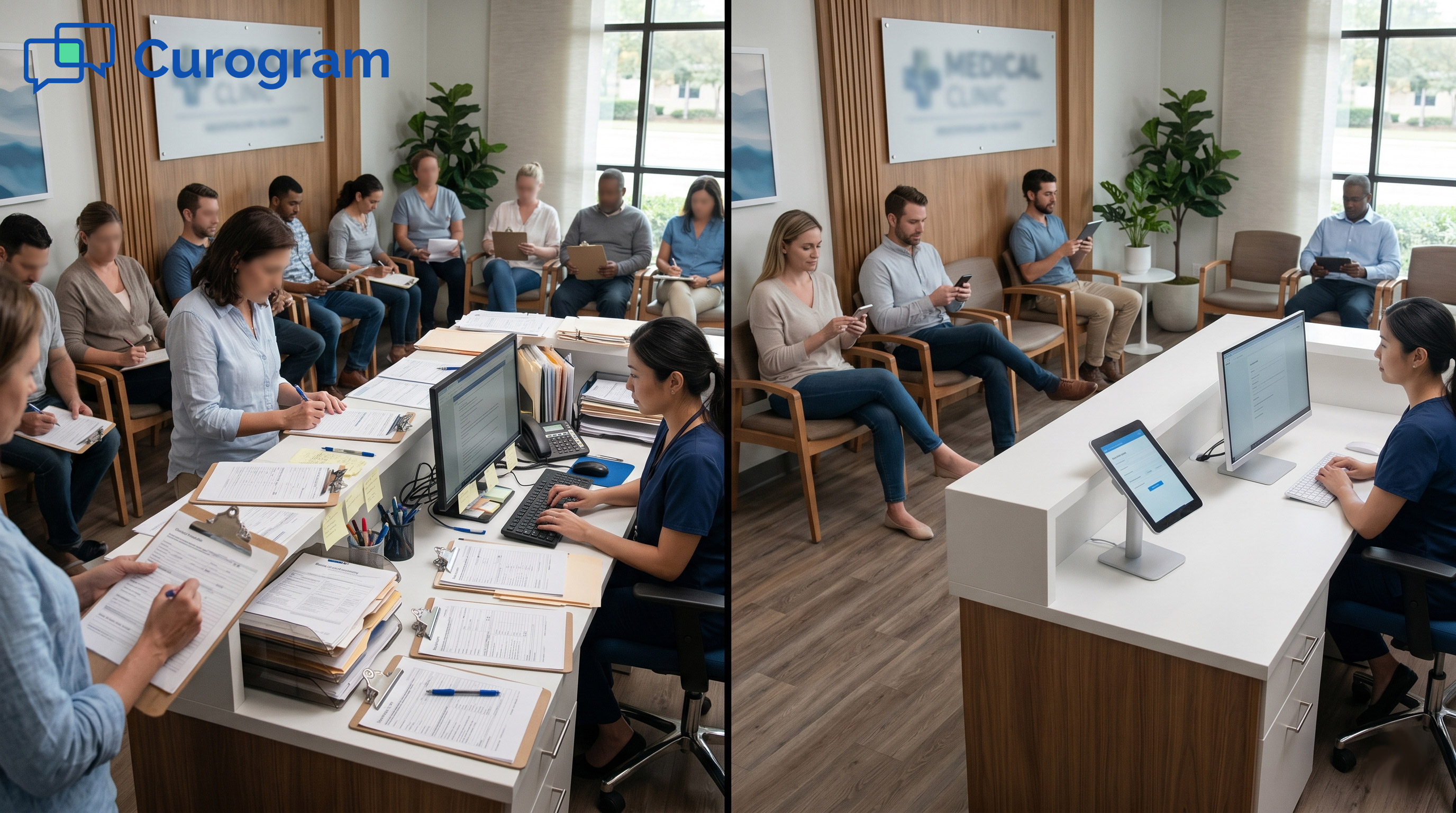
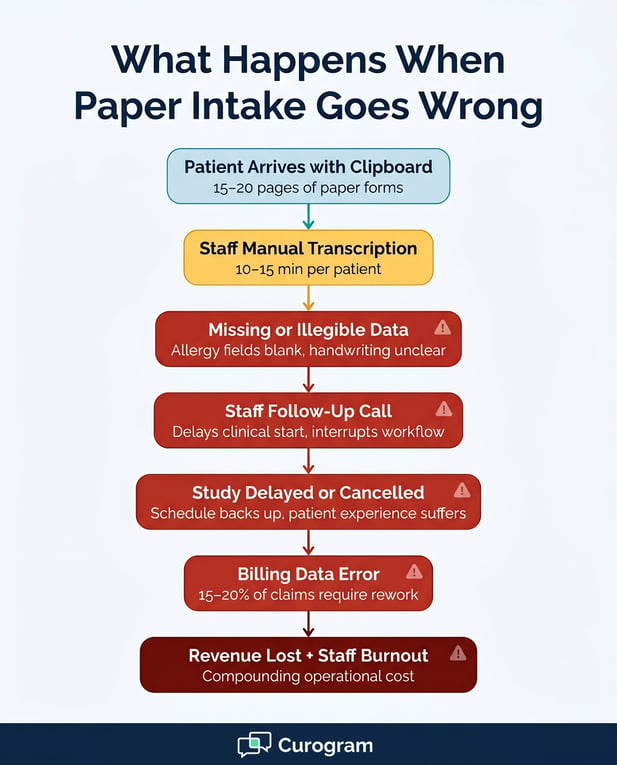
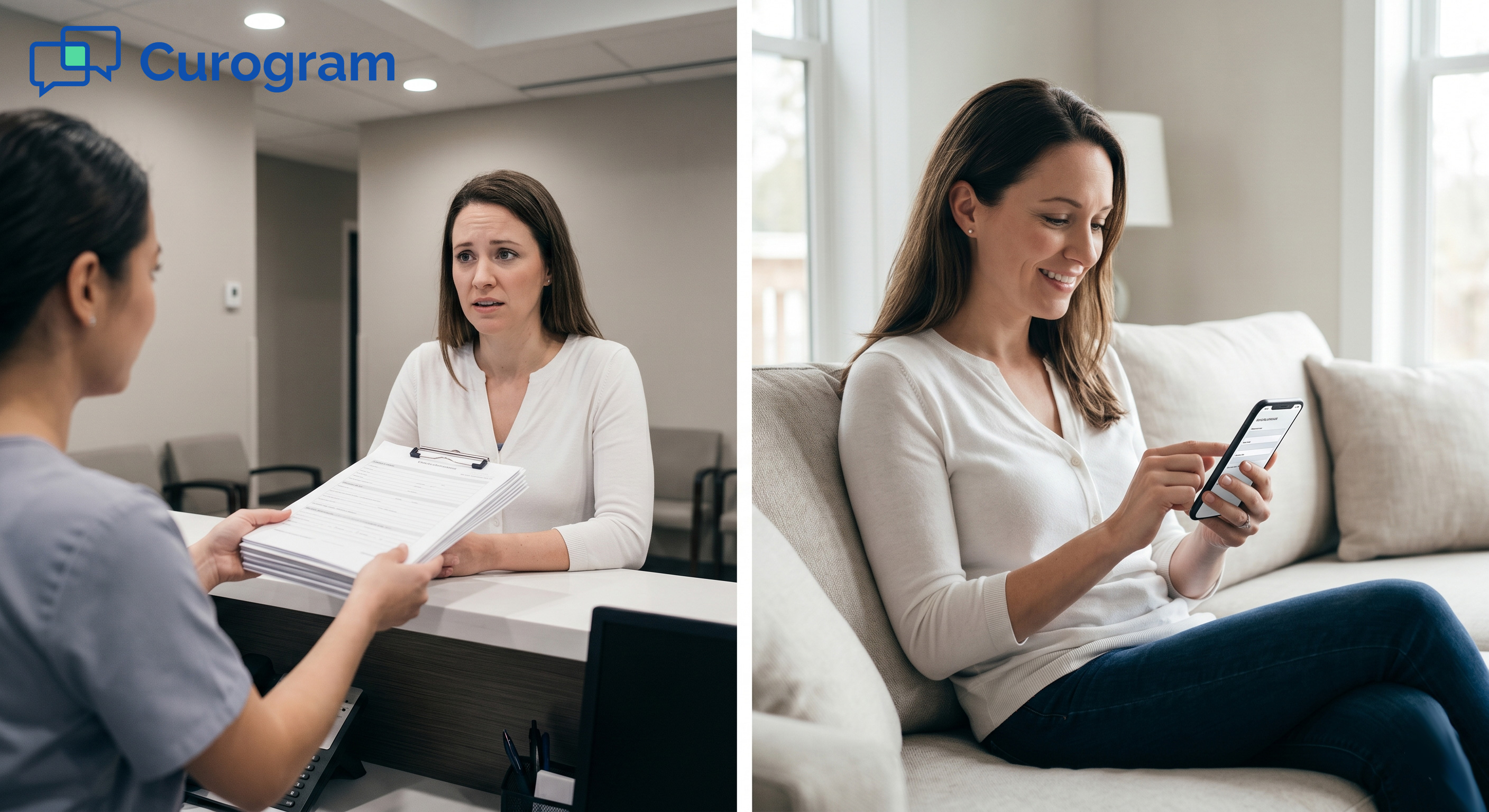
Typically, when a patient walks into your imaging center, they are handed a clipboard with 15 to 20 pages of forms. They sit in the waiting room. They fill in what they can. They skip what they don't know.
A front-desk staff member takes the clipboard and spends the next 10 to 15 minutes typing the data into StreamlineMD.
Then they notice something is missing. Maybe a contrast allergy. Maybe an MRI safety check. Now someone has to follow up.
This is the reality for many imaging centers running on paper-based intake. It's slow. It's costly. And it creates real clinical risk when key screening data is missing or entered incorrectly.
Here's the thing: this problem doesn't have to exist. Practices running digital intake forms for imaging centers are already seeing the difference.
Instead of scrambling at the front desk, patients complete their forms at home the day before their visit. By the time they walk in, the chart is ready.
Curogram integrates with StreamlineMD to make this happen. Forms are sent via SMS, completed on any phone without a login or app download, and mapped directly into the patient record. Staff no longer spend their mornings buried in data entry. They spend it on patients.
Based on Curogram client data from clinical settings, practices using Curogram's secure digital intake forms workflow report recovering 4 to 7 hours of staff time every week. Prep compliance rises from around 65% to above 90%. Billing errors from incomplete intake data drop sharply.
This article walks through how that works, why paper intake creates problems, and what the shift to a digital front door looks like in practice. If your imaging center runs on StreamlineMD, this guide is for you.
The Villain: The Paper Intake Chokepoint
Most imaging centers know paper intake is a problem. What they don't always see is just how big that problem is when you add it all up.
The Problem: What's Actually in That Clipboard?
A typical imaging center visit involves multiple forms. Consider what one patient carries in:
- Medical history questionnaire: 4 to 6 pages
- Contrast allergy screening: 2 pages
- MRI safety checklist: 3 to 4 pages
- Insurance verification form: 1 to 2 pages
- Consent form: 2 to 3 pages
- Facility prep checklist: 2 pages
That's 15 to 20 pages per patient. For a practice seeing 30 patients a day, that adds up to 450 to 600 pages daily and more than 10,000 pages a month.
The paper alone is a logistical burden, and that's before anyone starts processing it.
The Cost of Manual Transcription
Front-desk staff receive those clipboards and then have to transcribe or scan the data into StreamlineMD. They have to compare what's written to what's already in the system. They fix discrepancies. They file the originals.
Based on Curogram client data from clinical settings, the average time to process one patient's paper forms runs 10 to 15 minutes. For 30 patients a day, that's 300 to 450 minutes — up to 7.5 hours of staff time devoted purely to data entry.
That's not just inefficient. It's a serious drag on what your staff could be doing instead: serving patients, managing scheduling, following up on care.
The Agitation: Privacy Risk and Clinical Liability
Paper forms sitting in a waiting room or on a front-desk counter are a HIPAA exposure risk. Patient data is visible. Forms get misplaced. Sensitive health information ends up where it shouldn't.
Imaging centers are regularly audited for how they handle patient data, and paper intake creates gaps in the audit trail.
There's also a clinical risk dimension. When allergy screening or MRI contraindication data is incomplete or illegible, the downstream consequences can be serious.
A missed contrast allergy. A patient with a pacemaker cleared for an MRI in error. These aren't hypothetical concerns. They happen when intake is rushed or manually entered with errors.
HIPAA-compliant secure digital intake forms eliminate this risk by capturing data digitally, validating completeness before submission, and mapping it directly into the chart.
The Ripple Effect on Billing
Paper intake doesn't just affect clinical staff. Billing managers feel it too. Insurance verification and patient demographic data that arrives on a handwritten form is frequently incomplete or misread.
Based on Curogram client data from clinical settings, billing data re-work from transcription errors affects 15 to 20% of claims in practices still running paper intake. That's a revenue and workflow problem that starts the moment the clipboard is handed to a patient.
The Consequence: Competitive Disadvantage
Hospital-based imaging departments often have larger support teams that absorb the paper burden better. Smaller and mid-market imaging centers, office-based labs (OBLs), and ambulatory surgery centers (ASCs) don't have that cushion.
The cumulative impact of paper intake shows up in higher operating costs, lower patient satisfaction scores, and slower clinical start times. For a practice trying to grow, that's a compounding problem.
The good news: the solution is straightforward. And it integrates with StreamlineMD without disrupting what's already working.

The Guide: The Digital Front Door
The fix for the paper intake chokepoint isn't about working harder. It's about removing the bottleneck entirely.
Curogram acts as the digital intake layer for StreamlineMD, turning a paper-heavy process into a smooth, automated workflow that starts before the patient ever arrives.
How the Workflow Works, Step by Step
The StreamlineMD secure digital intake forms workflow follows a simple sequence:
- A patient is scheduled in StreamlineMD.
- Curogram automatically sends an SMS link 24 to 48 hours before the appointment.
- The patient taps the link and completes the form on any smartphone. No app. No login.
- Completed data pre-populates the StreamlineMD patient record in real time.
- Staff receive instant alerts if any data is missing or a contraindication is flagged.
- The patient arrives with a complete chart. No clipboard. No data entry.
This is what it means to automate secure digital intake forms for an imaging center. The process runs in the background. Staff are notified only when action is needed. Everything else handles itself.
Modality-Specific Form Templates
Not every imaging procedure needs the same questions. Curogram supports modality-specific screening forms so that the right questions are asked for the right study.
|
Modality / Procedure |
Key Screening Fields |
|
MRI |
Pacemaker check, implant history, claustrophobia, pregnancy status, makeup with metallic pigments |
|
CT with Contrast |
Contrast allergy history, renal function, metformin hold confirmation |
|
Vein Procedures |
Compression garment availability, post-procedure activity plan, swelling assessment |
|
Interventional |
Anticoagulation status, NPO compliance, groin access site assessment |
These templates eliminate the guesswork. Staff no longer have to manually verify whether the right screening questions were covered for each procedure type. The form does it automatically.
HIPAA-Compliant Delivery at Every Step
Every part of the process, from SMS delivery to data storage to StreamlineMD integration, runs through encrypted, HIPAA-compliant channels. Forms are not sent as plain-text links that expose patient data.
They're delivered through a secure session that protects the data end-to-end. This matters for audit trails. It matters for compliance. And it matters for the patients who trust your practice with their health information.
The Integration: How Curogram Connects to StreamlineMD
Curogram connects to StreamlineMD via FHIR API (R4) or HL7 integration. When a new appointment is created in StreamlineMD, Curogram detects it and triggers the secure digital intake forms for interventional radiology or other modality-specific forms automatically.
No manual step is needed from the front desk. Completed form data syncs back to the StreamlineMD patient record in real time, so the chart is current before the patient walks in.
This is what makes the secure digital intake forms imaging center integration different from a standalone form tool. It's not just a digital clipboard. It's a connected workflow where data flows where it needs to go without anyone having to carry it there.
What Staff Training Looks Like
Curogram is designed so that staff with no IT background can learn it quickly. According to Curogram's founder Michael Hsu, front-desk staff can get up to speed in under five minutes of training. The platform mirrors the simplicity of texting, which most staff are already comfortable with.
Staff learn four things: how to send a form, how to read completion notifications, how to escalate alerts for missing data or contraindications, and how to handle patients who don't have a smartphone (via printed QR codes or a brief tablet form at check-in).
That's the full training. No complex setup. No ongoing IT support required.
The Success: Secure Digital Intake Forms Transformation
Switching from paper to digital intake is not just an operational upgrade. It changes what's possible for your entire practice.
The gains show up in staff time, clinical prep, billing accuracy, and patient experience.
Measuring the Current State Before You Switch
Before going digital, it helps to map what you're dealing with. Start by listing every paper form currently used in your intake process.
Identify which screening questions are required by state privacy rules, facility protocols, and modality-specific compliance standards.
Then trace how staff currently handle incomplete or missing data. Where do the delays happen? How are contraindications escalated? Understanding this before implementing Curogram makes the transition cleaner and faster.
This mapping step also builds internal buy-in. When practice managers can show front-desk staff exactly which steps are being replaced and which are being improved, adoption tends to be much smoother.
A practice manager who champions the change early on makes a real difference in how quickly the team adjusts.
The Numbers: Before and After
|
Metric |
Before Curogram |
After Curogram |
|
Intake processing time |
10-15 min per patient |
2-3 min per patient |
|
Staff time on data entry |
5-7.5 hours per day |
Under 1 hour per day |
|
Prep compliance |
~65% |
90%+ |
|
Billing re-work from errors |
15-20% of claims |
Under 5% of claims |
|
Paper pages per month |
10,000+ |
0 |
Based on Curogram client data from clinical settings, these outcomes are consistent across imaging centers of different sizes.
The 80% reduction in intake processing time is not a best-case number. It reflects what practices regularly report after switching to Curogram.
What 90%+ Prep Compliance Actually Means
When a patient arrives for an MRI without completing their safety screening, the study is delayed. Staff scramble. The schedule backs up.
Sometimes the study can't proceed at all. Prep compliance isn't just a metric. It's a direct driver of clinical throughput and revenue.
Curogram achieves 90%+ prep compliance through proactive SMS reminders. A first message goes out 24 to 48 hours before the appointment. A follow-up is sent on the day of the visit.
If a patient still hasn't completed the form, the front desk is alerted before the patient arrives. Based on Curogram client data from clinical settings, this sequence reduces non-completion to under 5% across Curogram client practices.
The Shift: What Changes for Staff
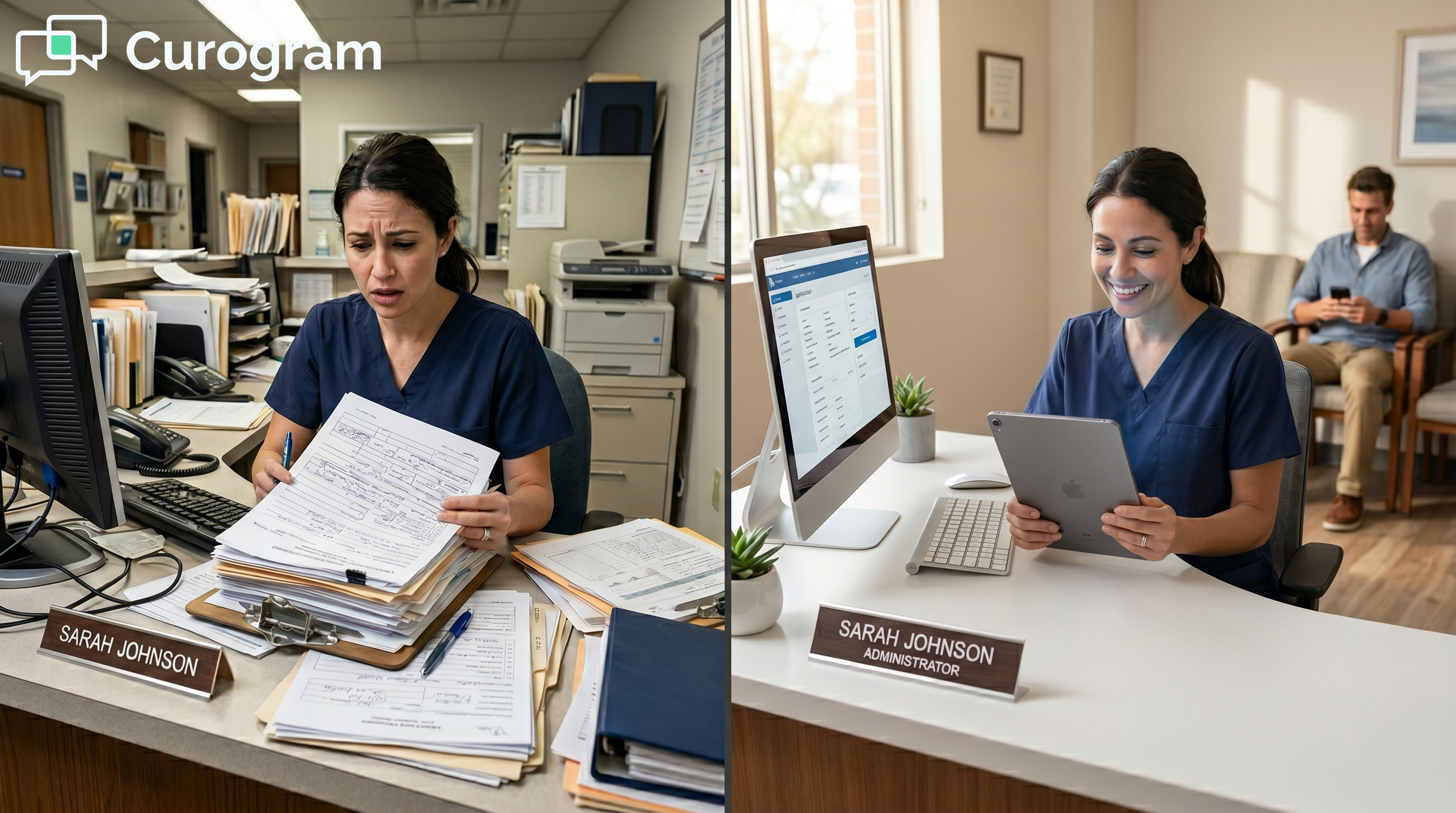
The most immediate change staff notice is time. Instead of spending the first two hours of each day processing paper forms, they're free to handle scheduling, patient questions, and care coordination. The work is still there. It's just different work, and more valuable.
The second change is accuracy. When data is entered once by the patient and maps directly into StreamlineMD, the transcription errors that cause billing re-work simply don't happen.
Billing managers at practices using Curogram report fewer rejected claims and less time spent correcting intake-linked errors.
The Outcome: A Practice That Runs Leaner
Imaging centers that fully implement Curogram's StreamlineMD secure digital intake forms workflow typically see results within the first few weeks.
Paper is eliminated from the front desk. Staff hours previously spent on data entry are redirected.
Patients arrive better prepared. Clinical start times improve. And the audit trail for every intake is clean and complete.
Conclusion: Transform Your Secure Digital Intake Forms Workflow
The paper intake chokepoint is not a small inconvenience. It drains staff time, creates compliance risk, and slows clinical throughput every single day.
But it is a solvable problem. And the solution does not require a major technology overhaul.
StreamlineMD is excellent at what it does: clinical documentation, procedural scheduling, and billing management. It is purpose-built for radiology and interventional practices.
What it doesn't do is manage the patient-facing intake process before the visit. That gap is where paper forms live. And that gap is exactly what Curogram fills.
Curogram handles secure digital intake forms communication. StreamlineMD handles the clinical record. Together, they create a complete workflow that neither system delivers alone.
Patients get a frictionless pre-visit experience. Staff get fewer manual tasks. Clinicians get complete, accurate charts before the patient walks in the door.
When you eliminate paper intake, the benefits ripple outward. Staff who used to spend hours on data entry are now available for higher-value work.
Billing teams deal with fewer errors and rejections. Patients who arrive prepared tend to have a better experience, and better experiences drive stronger reviews and repeat visits.
For OBLs, ASCs, vein clinics, and interventional radiology practices running StreamlineMD, the competitive landscape is shifting. Larger hospital systems have the staff to absorb paper burden.
Mid-market practices don't. Digital intake is not a future-state idea. It's a practical operational tool that smaller practices can implement right now, without a large IT investment.
Based on Curogram client data from clinical settings, practices typically recover 4 to 7 hours of staff time weekly after switching to Curogram.
Prep compliance rises to above 90%. Billing errors linked to intake drop sharply. These are consistent outcomes, not outliers.
If your imaging center is still relying on clipboards and paper forms, the first step is simply understanding what the alternative looks like in practice.
Not in theory, but in your specific workflow, with your specific form types, connected to your StreamlineMD instance.
That's what a Curogram workflow assessment shows you. It's a hands-on look at how the integration works, where you'll save the most time, and what the transition involves for your team.
Schedule a demo today. See how your imaging center can recover 4 to 7 hours of staff time weekly, starting with the intake process you're already running.
Frequently Asked Questions
Curogram sends a standard SMS text message with a secure link. The patient taps the link and fills out the form in their phone's browser, with no app to download and no account to create.
The forms are built for mobile and take under five minutes to complete. Based on Curogram client data from clinical settings, completion rates among patients aged 55 and older are consistently above 85% because the experience mirrors everyday texting.
Curogram sends a follow-up SMS reminder on the morning of the appointment, which keeps non-completion rates below 5% for most practices. If a patient still arrives without completing the form, staff can hand them a tablet at check-in to complete an abbreviated version, which is still faster than processing a paper clipboard. For patients without any smartphone access, printed QR codes and a brief paper backup remain available.
Curogram connects to StreamlineMD via FHIR API (R4) or HL7 integration. When an appointment is scheduled in StreamlineMD, Curogram automatically detects it and triggers the appropriate secure intake form 24 to 48 hours before the visit.
Once the patient completes the form, the data syncs directly into the StreamlineMD patient record in real time, with no manual step needed from front-desk staff.
SMS has a 98% open rate, which is far higher than email and much faster than portal-based communication. Patients don't need to log into anything or remember a password.
The form lives in a secure, encrypted session that opens from the text link, and because most people check their texts within minutes of receiving them, form completion rates are higher and happen earlier before the visit.
Digital intake creates a timestamped, structured record of every form submission, which is far more audit-friendly than paper files or scanned documents. Every response is stored in an encrypted system and mapped to the StreamlineMD record, giving compliance teams a clear chain of data custody.
HIPAA-compliant secure digital intake forms for radiology practices also eliminate the privacy risk of paper forms left in waiting rooms or on front-desk counters, which is a common audit flag.