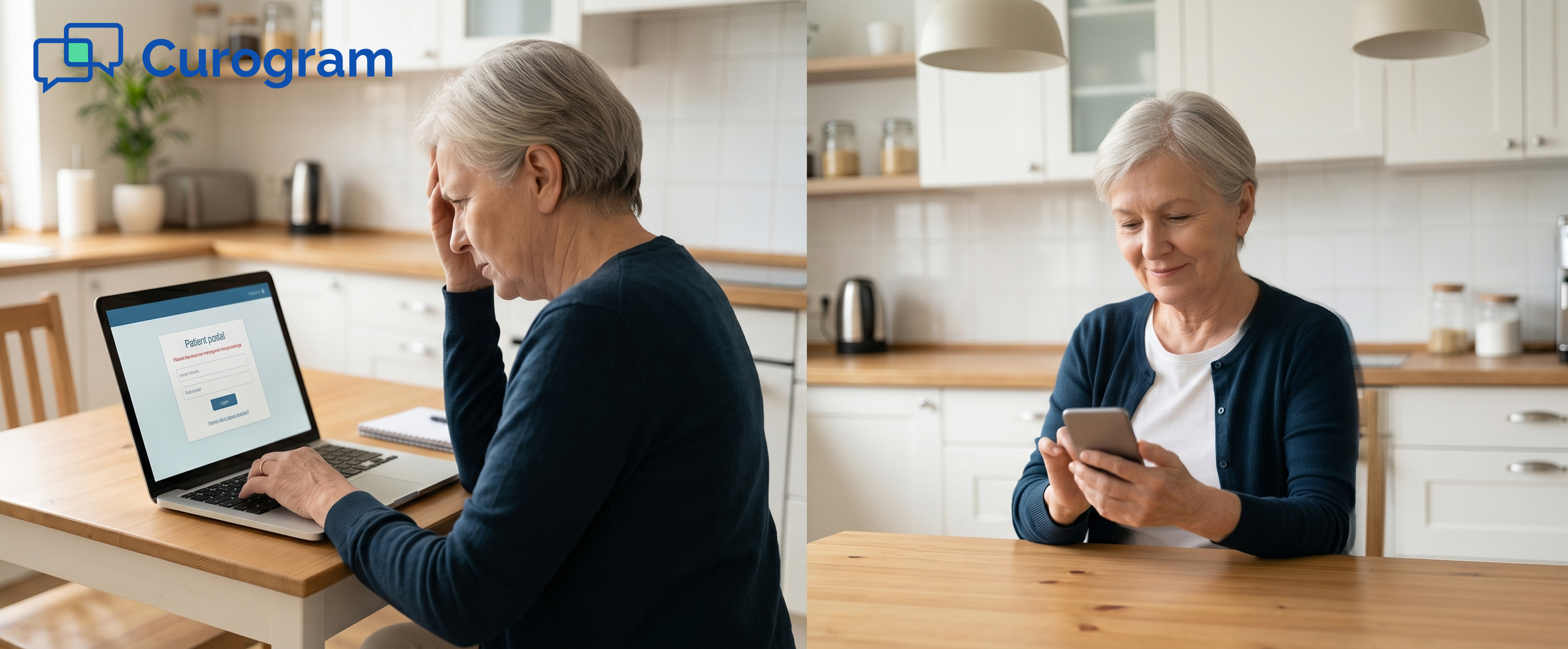
Instead of prep calls and voicemails, patients get SMS reminders sent right to their phones. They can reply, confirm, and ask questions without logging in anywhere.
Curogram integrates with StreamlineMD via FHIR R4 and HL7 APIs, keeps all messages encrypted, and meets SOC 2 Type II standards. Staff can learn the system in under 10 minutes. The result is fewer missed appointments, better patient prep, and less manual work for your front desk team.
You can do everything right, but still have everything go wrong. Is the scan confirmed? Yes. Have you sent prep instructions via voicemail? Yes, two days ago.
But when the patient arrives, you discover that they never got the message. They ate breakfast. As a result, the scan cannot go forward. Both your time and the patient’s time and effort are wasted.
This scene plays out in imaging centers every week. The slot is lost. The revenue is gone. And the staff member who left the voicemail had no way to know if it was ever heard.
The problem is not your team. It is the channel. Voicemail is a one-way street. It delivers no feedback. You cannot tell who listened, who ignored, and who simply never picked up.
For radiology and imaging practices running on StreamlineMD, there is already a built-in patient portal. But portal adoption among patients aged 55 to 75, the group that makes up most vascular and cardiac imaging caseloads, often sits below 15%. That means most of your patients are not logging in.
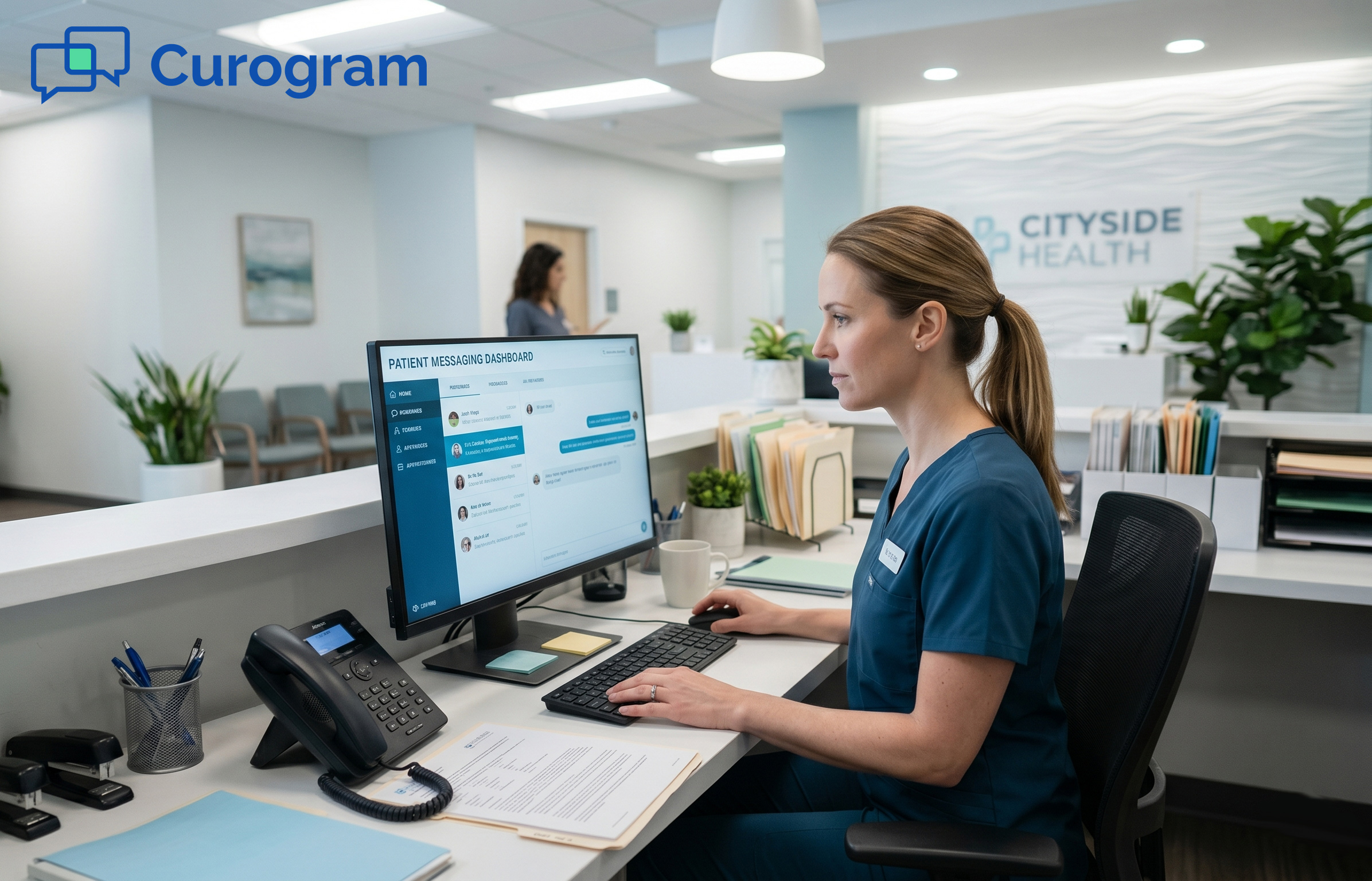
SMS is different. It shows up on any phone, no login needed. A text sent the afternoon before a scan gets read within minutes. The patient replies, confirms, and asks questions in real time. Your staff sees it all on one dashboard.
When HIPAA-compliant two-way texting is built into the StreamlineMD workflow, prep calls drop. Cancellations drop. And the front desk spends less time chasing patients and more time helping them.
This article walks through why the communication gap exists in imaging workflows, how two-way SMS closes it, and what that shift looks like in practice.
The Villain: The Communication Gap
StreamlineMD is built for clinical precision. It manages scheduling, procedure orders, billing, and records with accuracy. What it was not built for is last-mile patient communication.
That gap, between what the system knows and what the patient actually receives, is where cancellations are born.
Why the Patient Portal Falls Short for Imaging Patients
StreamlineMD includes a patient portal. On paper, it solves the communication problem. Patients can log in, view their appointments, and read prep instructions. In practice, many of them never do.
The patients who come in for peripheral vascular studies, cardiac imaging, and other interventional procedures tend to be older. For this group, portal use is low.
Logging in requires a username and password, possibly a two-step verification, and enough comfort with apps or browsers to navigate the interface. Many patients simply do not have that comfort.
Portal adoption rates in these patient groups often fall below 15 to 20%. That means up to 85% of your patients are not seeing the prep instructions you send through that channel.
The Real Cost of Low Portal Adoption
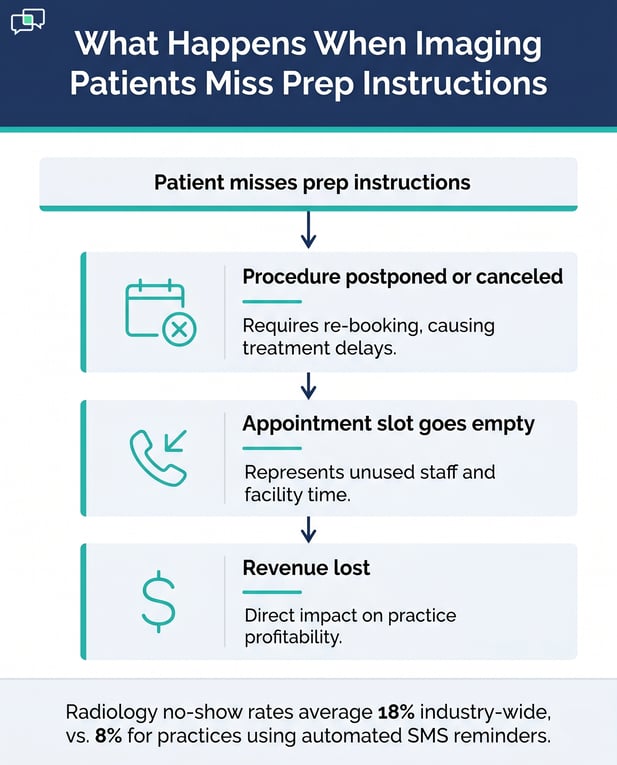
When patients miss prep instructions, procedures get delayed or canceled. A contrast CT requires fasting. A cardiac MRI has strict rules about metal and clothing. If patients arrive unprepared, the scan cannot proceed.
Each canceled scan is not just a scheduling headache. It is lost revenue that cannot always be recovered. The time slot goes empty. The staff time spent on the prep call is wasted. The patient has to reschedule, which may push them further out in the queue.
The Prep Call Labor Burden
Most imaging centers try to solve this with phone calls. A staff member calls each patient the day before to walk through prep instructions. It sounds simple. But at scale, it becomes one of the most time-intensive tasks the front desk handles.
Not every patient answers. Some calls go to voicemail. Some voicemails get returned. Some do not. Each missed connection adds another loop to the workflow. The staff member has to call again, or follow up by email, or simply hope the patient figured it out on their own.
This cycle repeats across dozens of appointments every day. The labor cost adds up. And unlike a text message, a voicemail offers no confirmation. You cannot see whether it was heard, and the patient cannot respond to ask a quick question.
When Manual Outreach Fails the Practice
Without a reliable, two-way channel, imaging centers face a predictable set of problems. Prep non-compliance goes up. Day-of cancellations rise. Revenue falls. The staff runs harder just to stay in place.
Some practices also fall into a compliance risk that is easy to overlook. When staff use personal cell phones to text patients about appointments or procedures, that is not a HIPAA-compliant channel. There is no audit trail. There is no encryption. And the liability for that exposure falls on the practice.
The communication gap is not a minor friction point. For imaging centers that handle high volumes of procedure-dependent appointments, it is a structural problem that costs real money every week.

The Guide: The Imaging Center's Communication Layer
Closing the communication gap does not require a new EHR or a total workflow rebuild. It requires adding the right communication layer on top of what already exists. For StreamlineMD practices, that layer is HIPAA-compliant two-way texting through Curogram.
Why SMS Works Where Other Channels Do Not
Text messages are not new. They have been on every phone for decades. That is exactly the point. SMS works on smartphones and basic flip phones alike. It does not need a data plan, an app store account, or a password. A patient with a ten-year-old phone in rural coverage receives the same message as a patient with the latest smartphone in a metro area.
Pew Research data shows that 98% of adults own a cell phone. For patients aged 55 and older, this universality is critical. They may not use apps. They may not have email on their phone. But they almost certainly receive text messages.
Curogram client data from clinical settings shows SMS achieves 68 to 78% response rates within two hours. Voicemail compliance, by comparison, typically falls between 25 and 35%. That gap translates directly to better prep compliance and fewer day-of cancellations.
The Comparison at a Glance
|
Channel |
Response Rate Within 2 Hours |
Works on All Phones |
Two-Way Capable |
HIPAA-Compliant (by default) |
|
SMS (Curogram) |
68-78% |
Yes |
Yes |
Yes |
|
Voicemail |
25-35% |
Yes |
No |
Varies |
|
Patient Portal |
Low (<15-20% adoption) |
Requires smartphone/browser |
Limited |
Yes |
|
Personal cell phone text |
High |
Yes |
Yes |
No |
How Curogram Integrates with StreamlineMD
Curogram connects to StreamlineMD through FHIR R4 and HL7 APIs. These are standard interfaces that most major practice management platforms support.
The integration pulls scheduled appointments, patient phone numbers, procedure types, and any relevant clinical notes directly from StreamlineMD.
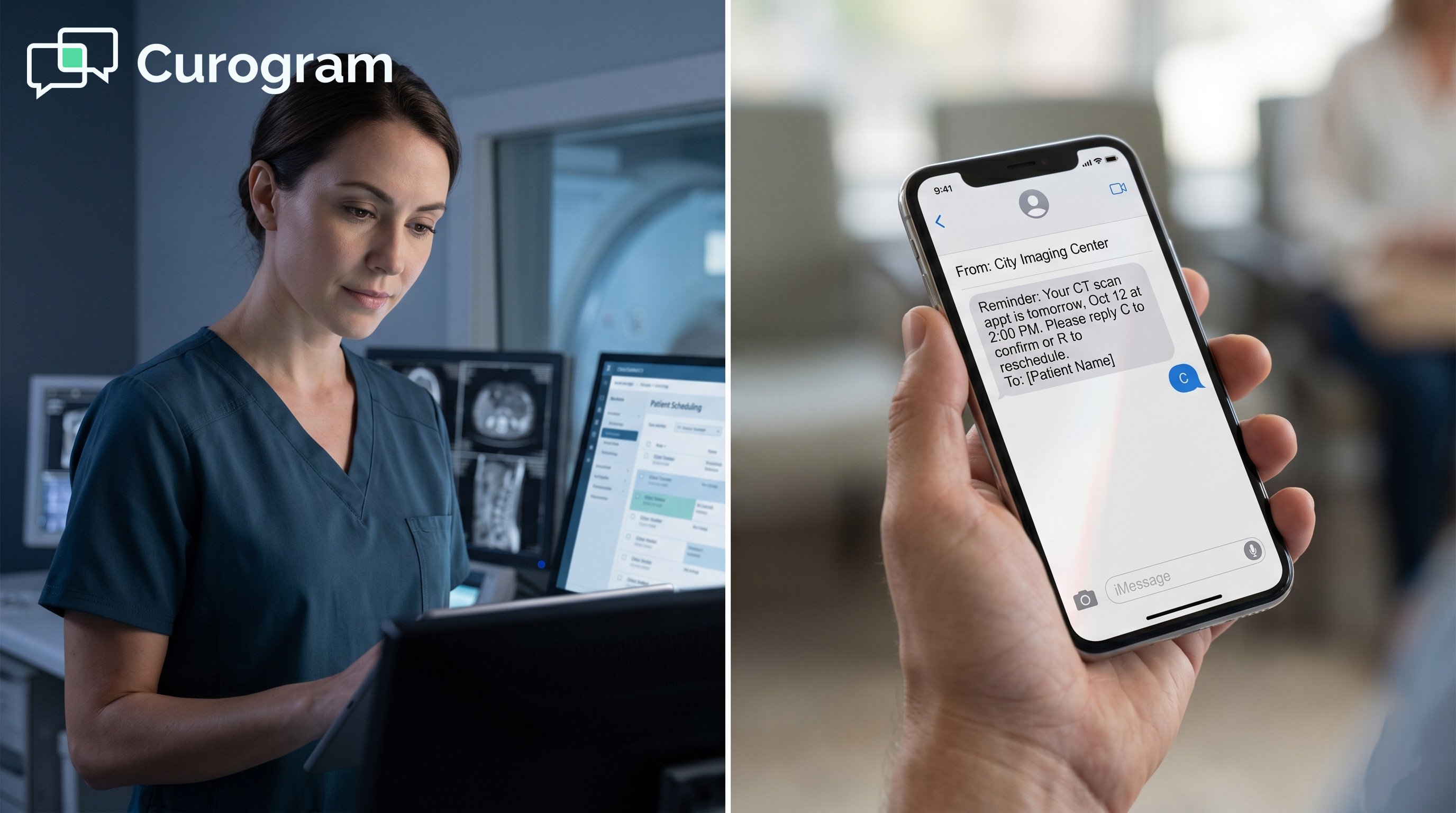
Once connected, the workflow becomes automatic. Appointment confirmations go out 24 to 48 hours before each procedure.
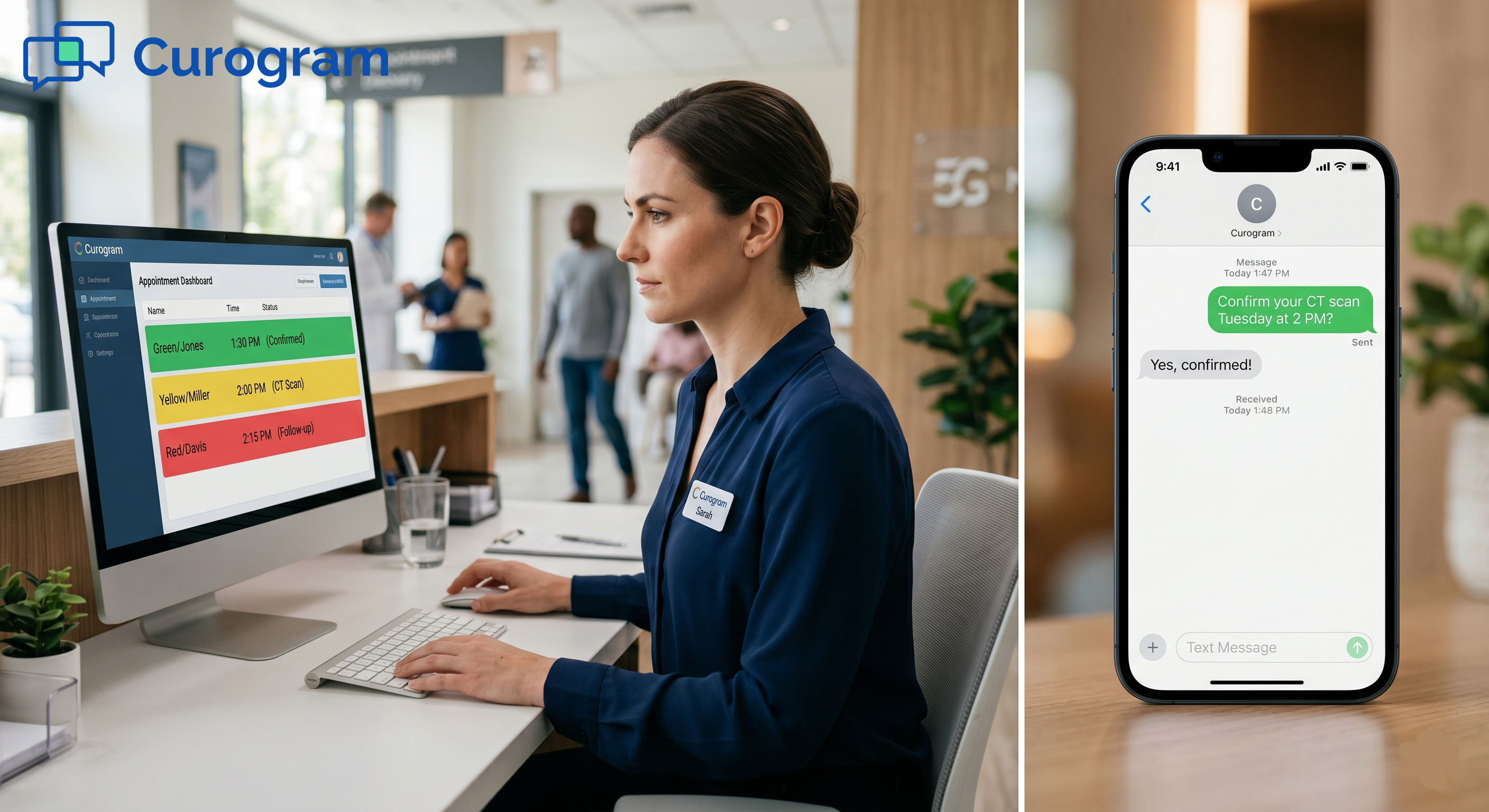
Patients reply with a simple "Yes" or "No." Staff see the real-time confirmation status on a shared dashboard. At-risk cancellations are flagged before the day of the scan.
Because different imaging modalities require different prep, Curogram uses the procedure type pulled from StreamlineMD to send the right instructions to the right patient.
A contrast CT patient gets fasting and medication guidance. A cardiac MRI patient gets instructions about clothing and metal restrictions. No manual sorting required.
The data flow is read-only by default, which means StreamlineMD remains the system of record. Write-back capability, such as logging patient confirmation status back into StreamlineMD, can be configured during setup depending on the depth of the StreamlineMD API.
Compliance Built Into Every Message
Curogram is SOC 2 Type II certified. Every message is encrypted in transit and at rest. Access logs are maintained for audit. Patient consent is documented within the platform.
This eliminates the liability created when staff use personal phones for patient outreach, which can result in HIPAA violations ranging from $100 to $1,500 per incident.
The platform is also built for front desk teams, not IT departments. Staff can learn the core workflow in under 10 minutes. There is no complex training cycle. The interface is designed to feel like standard texting, which means adoption is fast and the learning curve is short.
The Success: 2-Way HIPAA Texting Transformation
Understanding the problem is one thing. Seeing what changes when you solve it is another. When imaging centers integrate HIPAA-compliant two-way texting with StreamlineMD, the shift happens across three areas: confirmation rates, prep compliance, and real-time patient support.
Automated Confirmations That Actually Get Read
Manual confirmation calls take time. They often go to voicemail. They create no feedback loop. Automated SMS confirmations through Curogram replace that entire process.
When a patient is scheduled in StreamlineMD, Curogram automatically queues a confirmation message for 24 to 48 hours before the appointment.
The patient receives a short, clear text: confirm your appointment by replying Yes or No. The response shows up instantly on the staff dashboard.
Curogram client data from clinical settings shows an average appointment confirmation rate above 75% across active practices. That means more than three out of four patients confirm via SMS, without a single manual call.
For at-risk appointments, the system flags non-responders so staff can follow up early. This early visibility is the difference between filling a canceled slot and losing it for the day.
Modality-Specific Prep by Procedure Type
Imaging prep is not one-size-fits-all. A patient coming in for a contrast CT has different instructions than a patient scheduled for cardiac MRI or a peripheral vascular study. Sending the wrong prep, or no prep at all, is a clinical and operational risk.
Curogram uses the procedure type logged in StreamlineMD to send modality-matched prep instructions via text.
For example, a contrast CT patient might receive: "Do not eat or drink after 8 PM. Hold metformin 24 hours before your exam if you have kidney concerns. Bring your insurance card."
A cardiac MRI patient gets a different message about clothing and metallic items.
This happens automatically. No staff member has to manually select and send the right prep message. The procedure type in the schedule triggers the correct SMS sequence.
Two-Way Messaging for Real-Time Patient Support
Even with great prep instructions, patients have questions. Can they take their blood pressure medication the morning of the exam? What if they had a small snack? Is the facility easy to find?
Two-way SMS means patients can ask those questions and get answers in real time. A patient texts a question at 7 PM the night before their scan.
A staff member sees it on the shared dashboard the next morning and responds before the patient arrives. No missed call. No delay. No cancellation from confusion.
This real-time exchange prevents one of the most common causes of same-day cancellations: patient uncertainty about whether they followed prep correctly.
The Broader Impact on Practice Revenue
Curogram client data from clinical settings shows that practices using automated reminders and two-way texting see no-show rates 53% lower than the industry average.
For radiology in the Curogram dataset, the average no-show rate sits at 8%, compared to an 18% industry average. Each recovered appointment slot contributes directly to practice revenue.
Covina Arthritic Clinic confirmed more than 1,100 appointments per month through automated SMS alone, entirely without manual follow-up. That kind of volume would have required significant staff time using a phone-based system.
Atlas Medical Center reduced its no-show rate from 14.20% to 4.91% within three months of implementing automated SMS reminders, a result three times better than the industry average. These are the kinds of changes that show up on the income statement, not just the scheduling dashboard.
Conclusion: Transform Your 2-Way HIPAA Texting Workflow
The communication gap in imaging and interventional workflows is real. It costs practices in canceled procedures, wasted prep calls, and frustrated patients who arrive unprepared.
StreamlineMD handles the clinical side well. It manages scheduling, procedure orders, and billing with precision. But getting the right information to patients, and hearing back from them, requires something it was not built to do.
That is where 2-way HIPAA texting for radiology practices comes in. SMS is not a workaround. It is the missing channel. It reaches patients where they already are, on any phone, without requiring a login or an app.
Curogram fills the gap by integrating directly with StreamlineMD. Appointments sync automatically. Prep instructions are matched to each procedure type.
Patients confirm, ask questions, and receive answers, all through standard text messages. Staff see everything on a single dashboard.
The result is measurable. Confirmation rates climb. Cancellations drop. The front desk stops spending hours on prep calls and starts using that time on higher-value tasks. And the practice stops leaving revenue on the table from empty procedure slots.
StreamlineMD handles clinical documentation and billing. Curogram handles 2-way HIPAA texting for imaging center integration. Together, they create a complete workflow that neither system delivers on its own.
If your imaging center still relies on voicemail for prep communication, now is a good time to see what a different approach looks like. Schedule a demo and see how it works in your practice.
Frequently Asked Questions
Standard SMS is not encrypted and leaves no audit trail. HIPAA-compliant two-way texting, like Curogram's platform, encrypts messages in transit and at rest, logs all access for auditing, and documents patient consent.
It also operates under a Business Associate Agreement with the practice, which is required by HIPAA for any vendor handling patient health information. Using personal cell phones to text patients is not compliant and creates real liability.
Curogram connects to StreamlineMD through FHIR R4 and HL7 APIs, which are standard interfaces for health data exchange. The integration reads scheduled appointments, patient phone numbers, procedure types, and relevant clinical notes.
Data flow is read-only by default, which means StreamlineMD stays the system of record. Write-back capability, such as logging SMS confirmation status into StreamlineMD, can be configured during setup.
SMS arrives directly on any phone without requiring a login, an app, or even a data plan. For older patients, which make up a large share of vascular and cardiac imaging caseloads, this universality is critical.
Curogram client data from clinical settings shows SMS achieves 68 to 78% response rates within two hours. Voicemail compliance typically falls between 25 and 35%, and patient portal adoption for this demographic is often below 15 to 20%.
When a patient is scheduled in StreamlineMD, Curogram reads the procedure type from the schedule. It then sends a pre-built prep sequence matched to that modality.
A contrast CT patient receives fasting instructions and medication guidance. A cardiac MRI patient gets notes about clothing and metallic items. This happens automatically, with no manual selection required from staff. The right message goes to the right patient every time.
Non-responders are flagged on the Curogram staff dashboard, so the team can see at-risk appointments early. Curogram can also escalate to email or a phone call as a fallback, creating a tiered outreach workflow. Because 68 to 78% of patients respond via SMS, the fallback volume is small. This frees staff to focus manual follow-up on the patients who genuinely need it, rather than calling everyone on the list.