Curogram integrates with StreamlineMD to deliver automated appointment reminders for radiology practices and other imaging settings. The system pulls procedure codes directly from StreamlineMD and sends timed, modality-specific SMS prep messages to each patient. No manual work. No voicemail tag.
The results are clear. Atlas Medical Center cut its no-show rate from 14.20% to 4.91% in 90 days, per Curogram client data from clinical settings. Prep compliance climbed past 90%, and staff reclaimed hours they used to spend on the phone.
A patient scheduled for a contrast CT gets a call at 3 PM. She does not check voicemail until 9 PM. By then, she has already eaten dinner.
Tomorrow morning, she arrives for her scan unprepared. The study gets canceled. That slot is lost.
This is not rare. It happens daily across imaging centers everywhere. And the root cause is not patient carelessness.
It is a broken communication system.
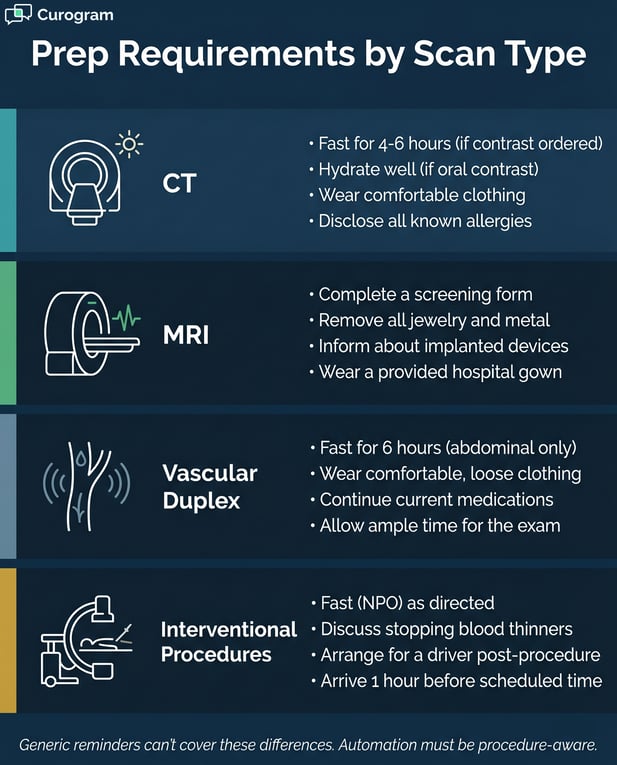
Manual prep calls were never built for multi-modality imaging. Each scan type has its own prep rules. Contrast CT needs fasting and a possible metformin hold. Cardiac MRI needs a medication review and safety screening. Vascular duplex needs compression garments.
Getting all of that right, for every patient, by phone, every day is not realistic.
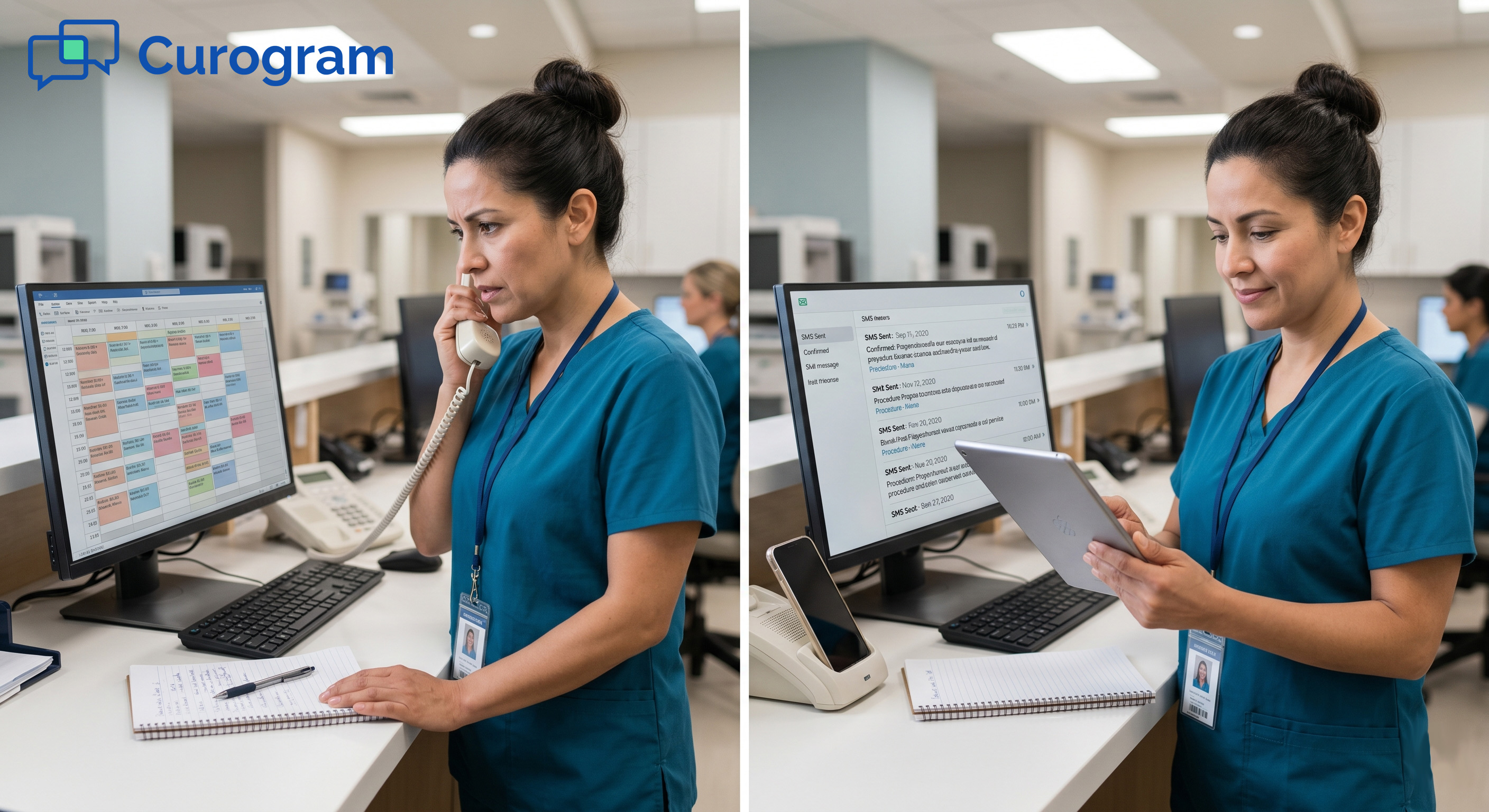
Staff try. But they deal with interruptions. They leave voicemails. They forget to mention one step.
A different staff member covers the next day and phrases things differently. By the time the patient walks in, the instructions they received may not match what the protocol requires.
This is the prep inconsistency problem. And it is draining imaging centers of revenue, time, and confidence.
Automated appointment reminders modality-specific prep sequences solve this directly. When Curogram integrates with StreamlineMD, it reads the procedure type from the schedule and sends the right prep messages automatically.
No calls. No variables. The same clear instructions go to every CT patient, every MRI patient, every vascular patient, every time.
In this article, we break down why prep inconsistency is such a costly problem, how automated SMS sequences work inside StreamlineMD, and what imaging centers actually gain when they make the switch.
The Villain: The Prep Inconsistency Crisis
Prep inconsistency is not just an inconvenience. It is one of the most overlooked sources of lost revenue in imaging. This section breaks down where the problem starts, how it grows, and why it keeps happening even when staff work hard.
Why Manual Prep Calls Keep Failing
A mid-market imaging center running 20 to 40 daily studies can require 2 to 5 staff members spending 40 to 60% of their shift on prep calls alone. That is a large chunk of the workday spent on a task that still fails one out of four times.
Voicemail compliance on the first attempt runs at just 25 to 35%, based on Curogram client data from clinical settings. That means up to 75% of patients either do not get the message or do not act on it. For a fasting protocol, that is a disaster.
Even when calls do go through, consistency breaks down. One coordinator says "nothing after 8 PM." Another says "nothing after midnight."
One mentions the metformin hold; another forgets it entirely. Patients receive different versions of the same instructions depending on who answers the phone that day.
The Legal Risk No One Talks About
Manual calls also create a compliance risk that practice managers often underestimate. If a patient cancels on the day of the study and claims they never received prep instructions, the practice must prove otherwise. Without a written record of what was said, that is nearly impossible.
Automated appointment reminders for imaging center workflows solve this by creating a clear log of every message sent, every response received, and every timestamp. That paper trail matters when disputes arise.
How Inconsistency Compounds Over Time
A single missed prep instruction leads to a same-day cancellation. That cancellation means a wasted time slot, a frustrated patient, and a gap in the schedule that is hard to fill on short notice. Multiply that across a week, a month, or a year, and the revenue impact becomes significant.
Curogram client data from clinical settings shows that no-show and cancellation rates without automated reminders typically sit between 10 and 25%. Applied to a 30-study-per-day practice, that represents hundreds of thousands of dollars in preventable revenue loss each year.
The Hidden Cost of Staff Time
The labor cost of manual prep calls is easy to overlook because it is spread across the day. Staff do not clock out labeled "prep calls."
The time blends into the general flow of the shift. But when you add it up, the numbers are significant.
A practice running 2 to 3 FTEs on prep calls, at an average salary cost of $175,000 to $225,000 per year, may be spending $70,000 to $135,000 annually just on prep call labor, per Curogram client data from clinical settings. That does not include the cost of errors, callbacks, or rescheduled studies.
That is budget that could go toward scheduling, patient care, or clinical support.
What Staff Lose When Calls Take Over the Day
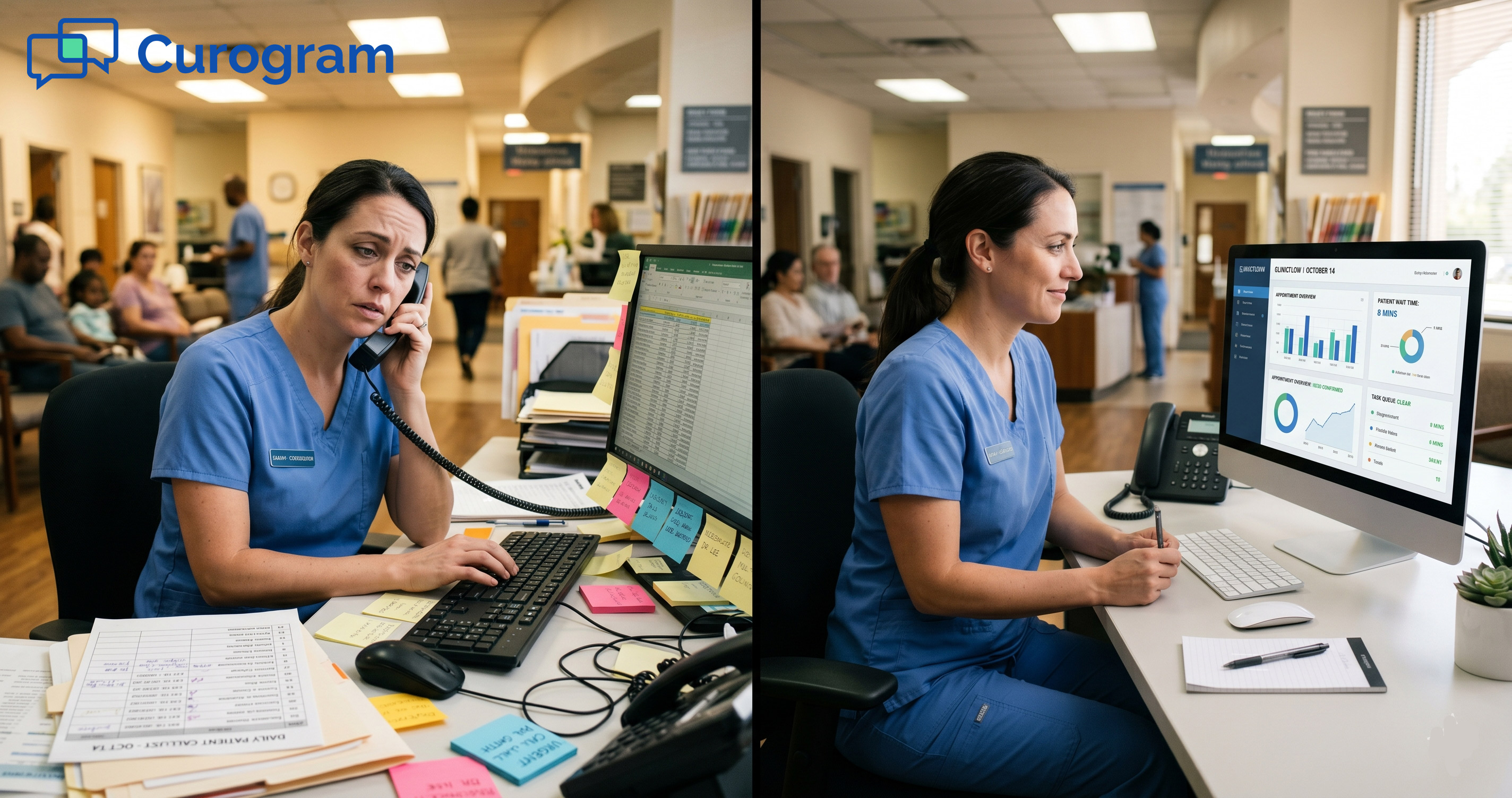
Prep calls create a cycle that is hard to break. Staff spend the morning calling patients for afternoon appointments. Then they spend the afternoon calling patients for the next day. When a callback comes in, it interrupts other tasks. When a patient is hard to reach, the process starts over.
This is not a staffing problem. It is a workflow design problem. And it wears people down. High call volumes are one of the leading sources of front desk burnout in imaging settings.
Why Voicemail Cannot Be the Plan
Voicemail assumes patients check their messages. Many do not. Others check them hours later, after the prep window has already closed.
A fasting instruction left at 3 PM on a voicemail does a patient no good if they only hear it at 8 PM.
SMS changes this dynamic. Text messages are opened at a much higher rate and far faster than voicemails. Most patients see a text within minutes.
That difference in response time is exactly why automated appointment reminders for interventional radiology and other imaging settings shift so quickly toward SMS.
What Happens When Prep Communication Breaks Down
The downstream effects of prep inconsistency touch every part of the imaging center. Radiologists sit idle when unprepared patients arrive.
Scheduling staff scramble to fill canceled slots. Patient satisfaction scores drop when people feel confused or uninformed before their scan.
Imaging centers that rely on manual prep calls are also at a competitive disadvantage compared to hospital-based imaging departments that have larger support teams and more resources dedicated to patient communication. Independent practices need a smarter solution, not more staff.
The Cascade That Starts with One Missed Instruction
One patient who missed the fasting rule becomes a same-day cancel. That cancel triggers a gap in the schedule. The scheduler tries to fill it with a last-minute booking, but that patient may not have been prepped either. The cycle repeats.
HIPAA-compliant automated appointment reminders imaging workflows interrupt this cascade at the source. When every patient gets the right message at the right time, the conditions that create same-day cancellations simply stop forming.
Competitive Risk in a Crowded Market
Patients have options. When a scan center is known for poor communication, patients notice. They mention it in reviews. They go elsewhere next time.
Consistent, clear prep communication is not just an operational matter. It is a patient experience issue that shapes reputation over time.

The Guide: The Prep Automation Engine
Understanding the problem is one thing. Having a clear, practical solution is another. This section explains exactly how Curogram integrates with StreamlineMD to automate prep communication and what that process looks like from the moment a study is scheduled.
How the Integration Works
Curogram connects to StreamlineMD via FHIR R4 and HL7 APIs. When a procedure is scheduled in StreamlineMD, Curogram reads the appointment type and procedure code, then automatically links it to the correct prep message sequence. No staff input is required to trigger the process.
This is the core of what makes the automate automated appointment reminders imaging center workflow so powerful. The system does not wait for someone to remember to make a call.
It runs on its own, every time, based on what is already in the schedule. Curogram is SOC 2 Type II certified and built to meet HIPAA standards, which is critical for any imaging center handling sensitive patient scheduling data.
From Schedule Entry to Patient Text
The workflow is straightforward. A scheduler books a CT angiography in StreamlineMD. Curogram detects the procedure code and queues the matching SMS sequence. Messages go out automatically at timed intervals before the appointment, no additional action needed.
This is a significant shift from the manual model. Staff no longer need to track who has been called, when, or what was said. The system handles it, logs it, and moves on.
What Makes This Different from a Generic Reminder
A generic reminder just tells a patient they have an appointment. A modality-specific sequence does much more. It delivers prep instructions in stages, so patients are not overwhelmed by a wall of text but still receive everything they need before they arrive.
This is the difference between automated appointment reminders imaging center tools and truly procedure-aware communication. Curogram falls firmly in the second category.
What a Modality-Specific SMS Sequence Looks Like
Each sequence is built around the clinical requirements of a specific procedure. The messages are spaced out over the days before the appointment, giving patients time to absorb each step. Here is an example of how a contrast CT sequence might look:
|
Message |
Timing |
Content Focus |
|
Message 1 |
48 hours before |
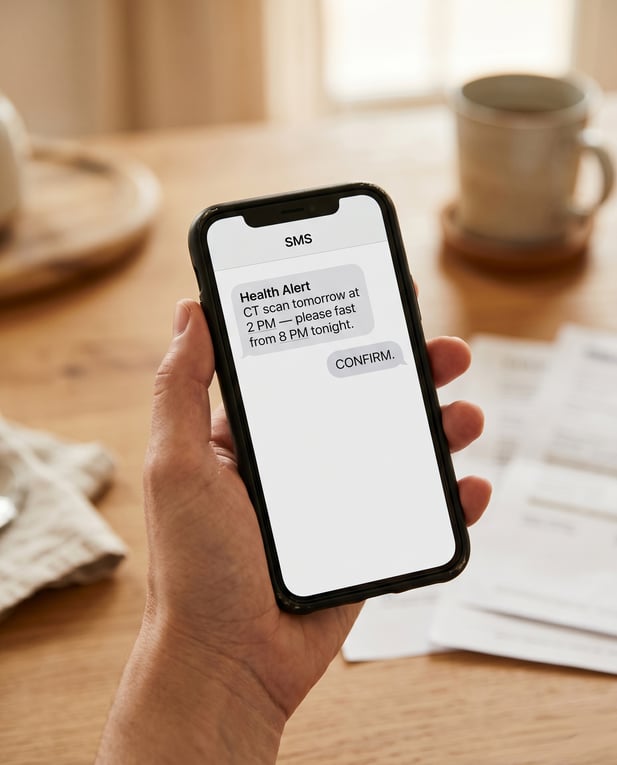
Appointment confirmation with date, time, and location. Reply CONFIRM or call the office. |
|
Message 2 |
36 hours before |
Fasting begins at 8 PM tonight. Nothing to eat or drink after that point. |
|
Message 3 |
24 hours before |
Reminder to hold metformin if renal function is a concern. Contact the office with questions. |
|
Message 4 |
4 hours before |
Final check-in message. Confirm arrival time and parking details. |
This layered approach gives patients time to absorb each instruction rather than trying to remember a single voicemail. It also allows the practice to flag non-responders early, so staff can follow up only with the patients who truly need attention.
Sequences for Other Modalities
Cardiac MRI sequences include medication review prompts and MRI safety screening reminders. Vascular duplex sequences remind patients about compression garments and positioning. Endovenous ablation sequences cover post-procedure recovery planning.
Every modality gets its own sequence. Every patient gets the right one. This is what the StreamlineMD automated appointment reminders workflow is designed to deliver.
Customization During Onboarding
During setup, Curogram works with each practice to build sequences that match their specific protocols. Wording, timing, and message count are all configurable. Updates can be made at any time without IT support.
This matters because protocols evolve. When clinical guidance changes, the messaging should too. Practices should not be locked into a system that requires a support ticket every time a prep instruction needs an update.
Why This Fits Interventional and Multi-Modality Centers
Interventional radiology adds another layer of complexity to prep communication. Procedures like endovenous ablation, vascular access, or image-guided biopsies each have unique pre- and post-procedure requirements. A one-size-fits-all reminder system simply does not work.
Automated appointment reminders for interventional radiology need to be flexible enough to handle procedure-specific details while still running without manual input. That combination is exactly what the Curogram and StreamlineMD integration provides.
Multi-Location Consistency
For centers running multiple locations, consistency across sites is a major challenge. Different staff, different habits, and different patient volumes can lead to very different patient experiences from one location to the next.
Automated sequences eliminate that variation. A patient scheduled at location A gets the same prep messages as a patient scheduled at location B. Same wording. Same timing. Same results.
Scaling Without Adding Headcount
One of the biggest advantages of automation is that it scales without growing the team. A practice that adds a second modality or opens a second location does not need to hire additional staff to handle the prep call load. Curogram handles the communication side automatically.
This is a meaningful shift for small to mid-sized imaging centers that want to grow without proportionally growing their overhead.
The Success: Automated Appointment Reminders Transformation
The impact of switching to automated prep sequences shows up in three main areas: no-show rates, prep compliance, and staff time. This section covers what the data looks like in practice.
The Impact on No-Show Rates
The no-show rate benchmark across imaging settings sits at around 23%, per Curogram client data from clinical settings.
That is nearly one in four scheduled studies that does not happen. For a 30-study-per-day practice, that translates to roughly seven missed appointments every single day.
Atlas Medical Center cut that number dramatically. They went from a 14.20% no-show rate down to 4.91% in just three months after implementing Curogram's automated SMS sequences.
That is a 65% reduction. It is also three times better than the industry baseline.
What That Means in Revenue
Applied to a practice running 30 studies per day at $1,200 per study, closing that gap translates to over $6,500 per day in prevented cancellation revenue. Over a month, that adds up to roughly $142,000. Over a year, the impact reaches into the millions.
These are not hypothetical numbers.
They are based on the math that follows from a real case study. Curogram radiology clients average an 11.03% no-show rate, compared to the 23% industry baseline, per Curogram client data from clinical settings.
Why SMS Outperforms Phone Calls for Reminders
SMS response rates run between 68 and 78% within two hours, based on Curogram client data from clinical settings. Voicemail compliance on a first attempt runs between 25 and 35%. The gap is not small.
When patients respond quickly, practices can identify non-confirmations early. That early signal gives staff time to fill canceled slots rather than discovering a no-show at the start of the appointment window.
How Compliance Rates Shift with Automation
Prep compliance under the manual call model typically runs around 60%, per Curogram client data from clinical settings.
That means 40% of patients are arriving without full knowledge of what they need to do before their scan. Multi-message SMS sequences push that figure past 90%.
The reason is simple. Written messages are easier to follow than remembered voicemails. Patients can re-read a text. They can show it to a family member. They can refer back to it the morning of their appointment. A voicemail does not offer any of that.
Same-Day Cancellations Drop
When prep compliance goes up, same-day cancellations go down. Patients who understand their prep instructions show up ready. Scans run on schedule. Imaging suite utilization improves. The whole day runs more smoothly.
This is the direct operational benefit of better prep communication. It is not just about sending messages. It is about what happens to the schedule when those messages work.
Patient Experience Improves Too
Patients who receive clear, well-timed prep messages feel more confident walking into their appointment. They are less likely to call the office with questions. They are less likely to arrive anxious or confused.
Better preparation leads to a better experience. And a better experience leads to better reviews, better retention, and stronger word-of-mouth. These are soft benefits, but they have real long-term value.
What Happens to Staff Time
When prep calls are automated, the hours that staff used to spend on the phone become available for higher-value work.
Scheduling optimization, patient education, check-in support, and clinical coordination are all areas where that time can go.
Automated sequences reduce prep call labor by 65 to 80%, per Curogram client data from clinical settings. On an annual basis, that frees up $45,000 to $108,000 per redeployed FTE. For a practice running two or three people on prep calls, the savings can be substantial.
Fewer Interruptions, More Focus
One of the less-discussed benefits is what happens to staff focus when the phone stops ringing for prep calls.
Constant interruptions make it hard to complete complex tasks. When that noise goes away, staff can do deeper, more concentrated work.
This matters for morale too. Staff who are not stuck in an endless prep call cycle tend to be more engaged and less burned out. That has its own downstream effect on performance and retention.
A Comparison: Manual vs. Automated Prep Communication
|
Factor |
Manual Calls |
Automated SMS Sequences |
|
Voicemail/Response Rate |
25 to 35% |
68 to 78% within 2 hours |
|
Prep Compliance |
~60% |
90%+ |
|
No-Show Rate (Curogram clients) |
Up to 23% (industry avg.) |
As low as 4.91% |
|
Staff Time on Prep Calls |
40 to 60% of shift |
Near zero |
|
Annual Labor Cost (prep calls) |
$70K to $135K |
Reduced by 65 to 80% |
|
Documentation / Audit Trail |
None (verbal only) |
Full timestamp log |
|
Message Consistency |
Varies by staff member |
100% consistent |
Source: Curogram client data from clinical settings.
Conclusion: Transform Your Automated Appointment Reminders Workflow
The prep inconsistency problem is not going to solve itself. As long as imaging centers rely on manual calls to deliver procedure-specific instructions, they will keep losing revenue to same-day cancellations, wasting staff time on voicemail cycles, and exposing themselves to compliance risk.
The good news is that the solution is already built.
Curogram integrates directly with StreamlineMD to deliver HIPAA-compliant automated appointment reminders imaging workflows. StreamlineMD handles clinical documentation and billing.
Curogram handles patient prep communication. Together, they form a complete imaging center workflow that neither system delivers on its own.
The results speak clearly. Atlas Medical Center reduced no-shows from 14.20% to 4.91% in 90 days. Prep compliance climbed past 90%.
Staff stepped away from the prep call cycle and moved toward work that actually requires human judgment.
These are not incremental improvements. They are the kind of operational shifts that change how a practice runs day to day.
For imaging centers using StreamlineMD, the path forward is straightforward. Define your sequences once during onboarding. Curogram maps them to your procedure codes. From there, the system runs automatically.
Every CT patient gets the fasting instructions. Every cardiac MRI patient gets the medication hold reminder. Every vascular patient gets the compression garment guidance. No exceptions. No variables.
The goal is simple: the right prep message reaches the right patient at the right time, every time.
If your imaging center is ready to stop relying on voicemails and start running on automation, the next step is a short conversation.
Schedule a Demo: See how Curogram automates prep sequences for CT, MRI, ultrasound, and interventional procedures in StreamlineMD.
Frequently Asked Questions
Curogram connects to StreamlineMD via FHIR R4 and HL7 APIs, reading the procedure code at the time of scheduling. Each code is mapped to a matching SMS sequence during the onboarding process. Once the mapping is set, the system triggers the correct sequence automatically every time that procedure type is booked. No manual selection is required.
Text messages are opened and acted on far faster than voicemails. SMS response rates run between 68 and 78% within two hours, compared to just 25 to 35% for voicemail on the first attempt, per Curogram client data from clinical settings.
Patients can also re-read a text, which is something a voicemail does not allow. Multi-message sequences give them the instructions in stages, making it easier to follow each step.
Curogram manages this automatically. If a patient has a CT on Tuesday and an MRI on Thursday, the system sends CT-specific prep messages for the Tuesday appointment and MRI-specific prep messages for the Thursday appointment. Each sequence runs independently, based on the procedure type and scheduled date. No manual separation is needed from staff.
Curogram's platform is SOC 2 Type II certified and built to operate within HIPAA guidelines. Prep messages are designed to confirm appointment details without transmitting protected health information directly via SMS.
Every message sent is logged with a timestamp, creating an audit trail that practices can reference if a patient disputes whether instructions were received. This is something manual phone calls cannot consistently provide.
After setup, the system runs without daily oversight. But practice managers retain full visibility through the Curogram dashboard, where they can review sent messages, track response rates, and identify any non-responsive patients who may need direct follow-up. This gives managers a real-time view of prep communication status without requiring them to manage individual outreach.