Modality-specific SMS prep sequences fix this by sending clear, timed instructions before the appointment. Each message is written for the exact procedure the patient is having, so the guidance is specific and easy to follow.
Curogram integrates with StreamlineMD to trigger these sequences automatically based on appointment type. Patients get the right prep instructions at the right time, without staff having to make a single phone call.
The result is less patient anxiety, higher prep compliance, and fewer same-day cancellations. Imaging centers using this approach have seen no-show rates drop by more than 65%, based on Curogram client data from clinical settings.
A patient scheduled for a cardiac MRI has a lot of questions. Should I take my blood pressure medication? What will the noise sound like? What if I feel claustrophobic inside the machine?
If your practice doesn’t answer those questions ahead of time, anxiety fills the gap.
That anxiety has real costs. Patients cancel. Others show up without following prep instructions. A few don’t show up at all. For a busy imaging center running 20 to 40 studies a day, these gaps add up fast.
The problem isn’t that patients are careless. The problem is that a single voicemail or a paper prep packet rarely does the job.
Patients are anxious. They miss details. They lose the paper. They can’t figure out the patient portal.
Prep compliance SMS patient anxiety imaging center challenges are well-known in the industry. But most practices are still relying on the same manual workflows that create the problem in the first place.
This article looks at how automated, modality-specific SMS prep sequences solve that problem.
When patients get clear, step-by-step guidance ahead of their procedure, they feel supported. They arrive prepared. And they’re far less likely to cancel.
Curogram’s integration with StreamlineMD makes this possible without adding work for your team. The right message goes to the right patient at the right time, every time.
The Villain: Pre-Procedure Anxiety and Confusion
Pre-procedure anxiety is more common than most practices realize. It shows up quietly, then turns into a same-day cancellation or a no-show. Understanding where it starts helps you see why standard communication methods fall short.
The Psychology Behind Procedure-Related Anxiety
A patient undergoing an imaging procedure for the first time starts with baseline anxiety. MRI claustrophobia. Fear of pain. Worry about what the results might show.
This is normal, and it’s manageable. But only if the patient feels informed and supported.
When communication from the practice is vague or delayed, that anxiety grows. Patients start asking questions they can’t answer. They imagine worst-case scenarios. Some call the office in a panic. Others just cancel.
Research on patient communication shows that clear, timely, and repeated information can reduce procedure-related anxiety.
That’s not a small number. It means better patient experience and fewer last-minute disruptions to your schedule.
Why Vague Instructions Make Things Worse
A generic reminder like “fasting required” does not tell a patient enough. It leaves room for confusion. Should they take their medications? Which ones? What counts as food? What about coffee?
When patients can’t get answers, they either call your front desk repeatedly or they make assumptions. Both options create problems. The first adds to your staff’s workload. The second increases the risk of prep non-compliance.
The Cost of Conflicting Instructions
Manual prep calls create another issue: inconsistency. One coordinator says “fast after 8 PM.” Another says “nothing after midnight.”
One mentions the metformin hold. Another forgets. Patients get different information depending on who picks up the phone.
That inconsistency is a compliance risk. It’s also a staff training problem that never fully goes away.
Automated appointment reminders for elderly patients and other groups with more complex prep needs are especially at risk when instructions vary by staff member.
What Happens When Communication Fails
The downstream effects of poor prep communication are significant. No-shows cost imaging centers an estimated $2.5 million to $3 million per year in lost revenue, based on a 30-study-per-day practice model. Prep non-compliance cancellations add to that number.
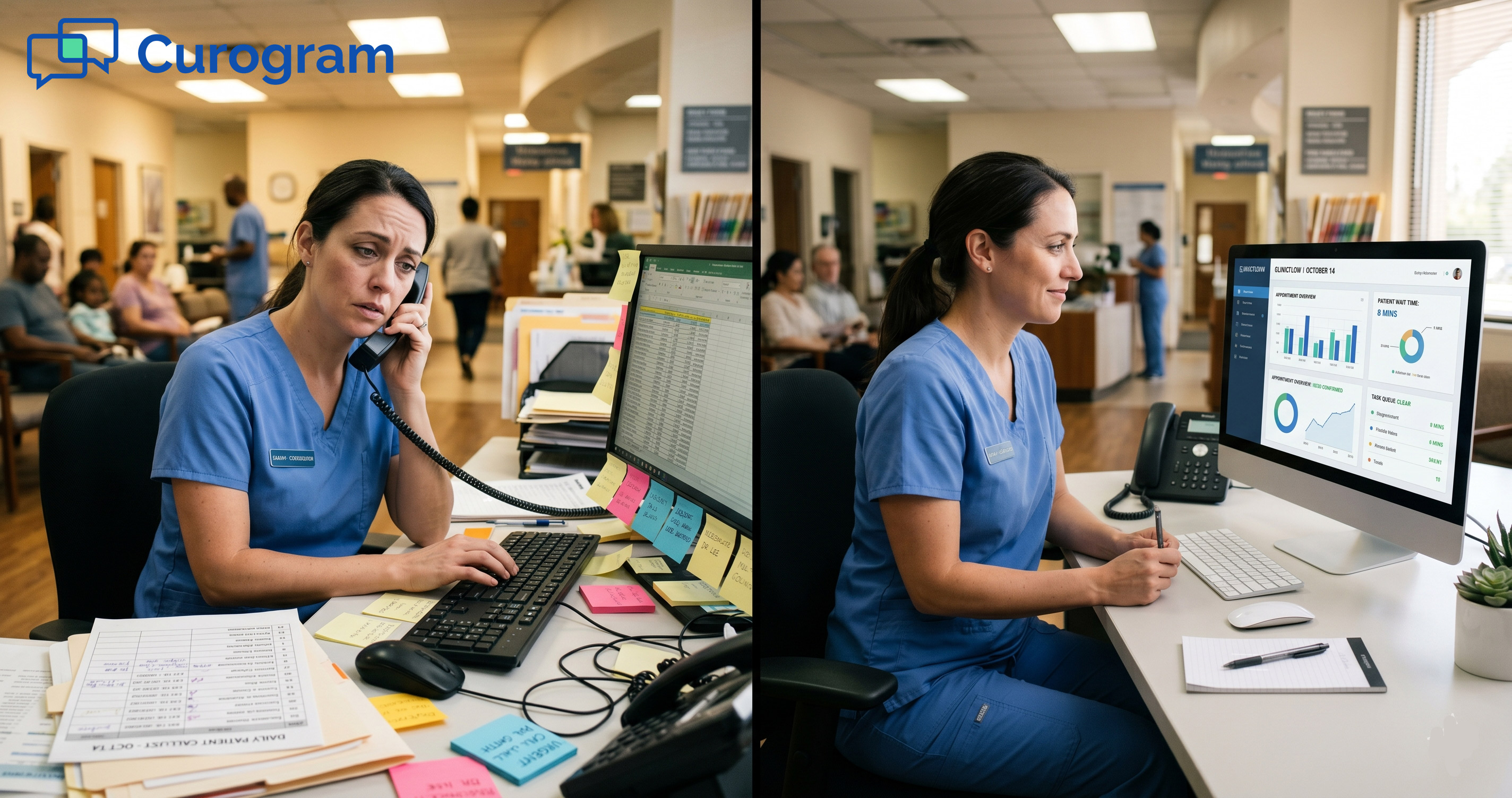
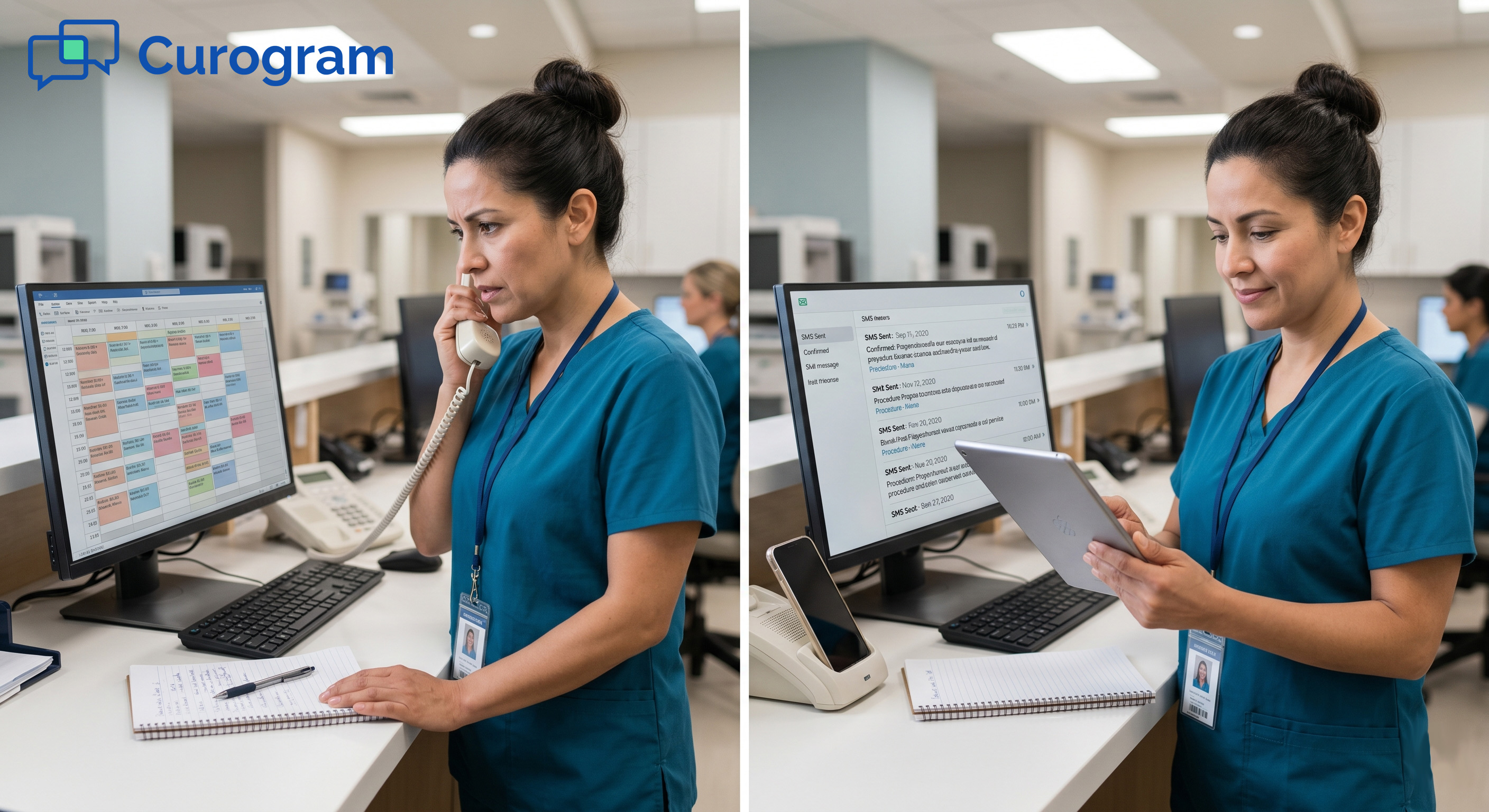
Staff spend 40 to 60% of their time on prep phone calls at some mid-market imaging centers.
That’s labor that costs between $175,000 and $450,000 a year, and it still doesn’t prevent 10 to 25% no-show or cancellation rates, according to internal Curogram research.
The problem is not effort. It’s the method. Phone calls are slow, inconsistent, and easy to miss. Voicemails get deleted. The system needs to change.
Anxiety-Driven Cancellations Are Preventable
Not every cancellation is about scheduling conflict. Many patients cancel because they’re worried. They’re not sure they did the prep right.
They’re afraid of the procedure itself. They haven’t heard from your practice since they booked.
These cancellations are preventable. When patients get clear, reassuring messages in the days before their appointment, they feel ready.
They feel like your practice is paying attention. That feeling matters more than most practices realize.
Elderly Patients Face Extra Barriers
Automated appointment reminders for elderly patients require extra thought. Older patients may have more complex prep needs, more medications to manage, and less comfort with patient portals. They also tend to have higher anxiety around medical procedures.
SMS is one of the most accessible channels for this group. It doesn’t require an app download. It doesn’t require a login. It arrives directly on their phone.
Automated appointment reminders without app download capabilities make a real difference for patients who struggle with digital tools.

The Guide: The Prep Automation Engine
The fix for pre-procedure anxiety is not more staff or more phone calls. It is a smarter, automated system that delivers the right information at the right time.
This section breaks down how modality-specific SMS prep sequences work and why they outperform every other communication method.
How Progressive Messaging Reduces Anxiety
A single voicemail is too much to absorb when a patient is already anxious. Breaking information into smaller, timed messages makes it easier to process. Each message builds on the last. By the time the patient shows up, they’ve heard the key points multiple times.
This is the core idea behind progressive messaging. Instead of front-loading all instructions in one call, the system sends them in stages. The first message confirms the appointment and sets expectations. Later messages add specific prep steps. The final message is a day-of reminder.
Patient engagement through automated appointment reminders works because patients respond better to repetition and clarity.
SMS automated appointment reminders patient satisfaction scores tend to be higher when patients feel informed and supported, not overwhelmed.
Sample Sequence: Cardiac MRI (Patient’s View)
|
When Sent |
Message Content |
Purpose |
|
48 hours before |
Your cardiac MRI is scheduled for Tuesday at 2 PM. We’ll send prep instructions soon. |
Confirms the appointment, sets expectations |
|
36 hours before |
Cardiac MRI prep: Bring a list of your medications, especially blood pressure and heart meds. Wear loose clothing without metal buttons. |
Begins specific prep guidance, reduces uncertainty |
|
24 hours before |
Reminder: No food or drink after 8 PM tonight. Continue all medications unless told otherwise. Text us if you have questions. |
Reinforces fasting, opens two-way dialogue |
|
4 hours before |
Your cardiac MRI is today at 2 PM. You’re all set. Text this number if you need anything. |
Final confirmation, reduces last-minute anxiety |
Each message is short, clear, and written for the specific procedure. That specificity is what makes it work.
Why SMS Outperforms Voicemail
Voicemail compliance sits at 25 to 35% in most imaging centers. SMS sequences see first-response rates of 68 to 78% within two hours, based on Curogram client data from clinical settings. That gap is significant when you think about how many patients are receiving prep instructions.
SMS also doesn’t require a patient portal login. There’s no app to download. It works on any phone.
Automated appointment reminders accessibility imaging comes down to reaching patients where they already are, and most patients are on their phones.
Two-Way Messaging as an Anxiety Reducer
One of the most powerful parts of the system is two-way SMS. Patients can reply to any message with a question.
Staff see those replies in a shared inbox and can respond quickly. That real-time connection is what stops a small worry from becoming a cancellation.
Here is a real example of how this plays out:
Patient: “I’m diabetic and take metformin. Should I still take it?”
Staff: “Please hold metformin for 48 hours before your exam. It can interact with contrast. We’ll go over this when you check in. Any other questions?”
That exchange takes two minutes. Without it, the patient might cancel out of concern. Two-way HIPAA-compliant texting turns a potential no-show into a confident, prepared patient.
HIPAA Compliance in Every Message
Every message sent through Curogram is HIPAA-compliant. Practice managers set up templates once.
Curogram handles delivery, escalation, and logging. No message containing protected health information is sent through an unsecured channel.
Clinical questions, like medication interactions or contrast safety, are flagged for staff review. Non-clinical questions are handled by a template. The system knows the difference.
No App Required for Patients
One of the biggest barriers to patient engagement automated appointment reminders tools is asking patients to install something.
Most patients, especially older ones, will not do it. SMS solves this because it requires nothing extra on the patient’s end.
Automated appointment reminders without app download capability are not just a convenience feature. For elderly patients and those with limited digital access, it is the difference between reaching them and losing them.
Consistency Across Modalities and Staff
Imaging centers with multiple modalities face a unique challenge. CT fasting protocols are different from MRI safety screening. Vascular duplex requires garment guidance. Endovenous ablation requires post-procedure care instructions.
Manual prep calls mean different staff deliver different instructions. One person remembers the metformin hold. Another forgets.
Curogram’s system sends the same message every time, for every modality, without relying on staff memory.
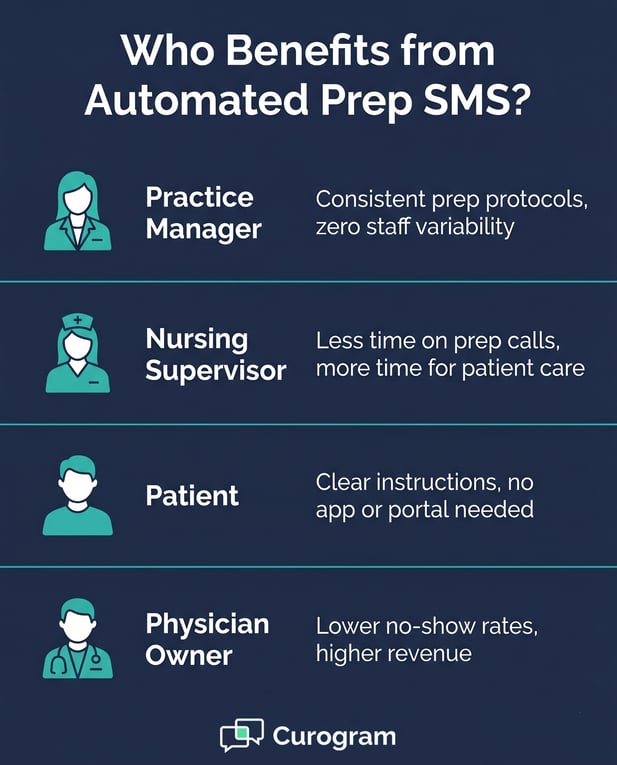
Practice managers define the sequences once, mapped to StreamlineMD’s procedure codes. After that, the system runs on its own. Zero variability. 100% protocol compliance, regardless of who is working that day.
The Success: Automated Appointment Reminders Transformation
Theory only matters if the numbers back it up. This section covers what actually happens when imaging centers implement modality-specific SMS prep sequences.
The results are consistent, and they show up in revenue, staff workload, and patient experience.
No-Show Rates Drop Significantly
Atlas Medical Center reduced its no-show rate from 14.20% to 4.91% in just three months after implementing Curogram’s automated reminder system.
That is a 65% reduction, and three times better than the industry average. Based on a 30-study-per-day practice, that kind of reduction translates to over $114,000 per month in recovered revenue.
Across Curogram’s radiology clients, the average no-show rate is 11.03%, compared to the industry average of 23%. That’s a gap of more than 50%, and it shows up across specialties, not just radiology.
From Manual Calls to Automated Precision
Before automation, a mid-market imaging center might have two or three staff members spending 40 to 60% of their time on prep calls.
That adds up to $70,000 to $135,000 per year in prep call labor alone. Automating those sequences cuts that cost by 65 to 80%.
The staff hours that are freed up don’t disappear. They get redirected to check-in, patient care, and scheduling. That is a better use of skilled clinical staff than dialing and leaving voicemails.
Prep Compliance Jumps When Instructions Are Specific
Generic prep reminders achieve 40 to 50% compliance. Specific, detailed instructions, like telling a patient exactly when to stop metformin and why, achieve 85 to 95% compliance, based on Curogram client data from clinical settings. The difference is specificity.
When patients receive instructions tailored to their exact procedure, they feel like the practice understands their situation. That trust makes them more likely to follow through. It also makes them less likely to call with last-minute questions.
Patient Satisfaction Rises with Better Communication
The patient experience does not start at check-in. It starts the moment a patient books an appointment. How they feel in the days leading up to a procedure shapes their view of your practice.
Patients who receive clear, timely prep guidance report higher satisfaction, even when the procedure itself is stressful.
SMS automated appointment reminders patient satisfaction scores improve because patients feel cared for, not just scheduled. That feeling is hard to put a number on, but it shows up in reviews, referrals, and retention.
Elderly Patients Respond Well to SMS
Older patients are often the hardest to reach through digital tools. They don’t always use patient portals.
They may not have smartphones with apps installed. But they do use text messaging, often more reliably than email.
Automated appointment reminders for elderly patients via SMS have shown strong engagement rates. The messages are short, direct, and easy to respond to.
For a group that tends to have more complex prep needs, that accessibility matters a great deal.
The Ripple Effect on Operations
Lower no-show rates mean your schedule fills more efficiently. Higher prep compliance means fewer same-day cancellations due to patient error. Freed-up staff hours mean better coverage at check-in and more time for patient care.
These outcomes do not happen in isolation. They build on each other. A practice that runs fewer phone calls, sees more prepared patients, and loses fewer appointments to no-shows is a more profitable, less stressful place to work.
What the Numbers Look Like in Practice
|
Metric |
Before Automation |
After Automation |
|
No-show rate |
14.20% |
4.91% (Atlas Medical Center) |
|
Industry avg no-show rate |
23% |
11.03% (Curogram radiology avg) |
|
Prep compliance |
40–50% |
85–95% |
|
First-response to SMS |
N/A (voicemail) |
68–78% within 2 hours |
|
Annual prep call labor cost |
$70K–$135K |
Reduced by 65–80% |
Sources: Curogram client data from clinical settings; Atlas Medical Center case study (approved for external publication).
Conclusion: Transform Your Automated Appointment Reminders Workflow
Pre-procedure anxiety and confusion are not unavoidable. They are a communication problem, and communication problems have solutions.
Patients do not separate your EHR from your texting platform. They experience your practice as one thing. When prep instructions are vague or arrive too late, that becomes part of how they see your practice.
When they arrive clear and on time, via a simple text they can read and reply to, patients feel cared for.
Modality-specific SMS prep sequences solve the prep compliance SMS patient anxiety imaging center challenges at the root. They replace inconsistent phone calls with reliable, procedure-specific messages.
They give patients a way to ask questions without calling. They free your staff from hours of daily prep call work.
The outcomes are real. Atlas Medical Center cut no-shows from 14.20% to 4.91% in three months. Prep compliance rates jump from under 50% to above 85% when instructions are specific and delivered progressively. Staff labor costs tied to prep calls drop by up to 80%.
Curogram’s integration with StreamlineMD makes all of this automatic. You define the sequences once.
The system handles delivery, two-way replies, escalation, and logging. Every patient gets the same high-quality prep experience, regardless of which staff member is on shift.
If your imaging center is still relying on voicemails and paper packets to prepare patients, there is a better way.
Schedule a demo and watch real examples of patient questions, anxiety reduction, and compliance in action.
Frequently Asked Questions
Patients feel anxious when they don’t know what to expect. Modality-specific SMS sequences send clear, procedure-tailored instructions at set intervals in the days before the appointment.
Each message is short and direct, so patients absorb the information without feeling overwhelmed. By the time they arrive, they’ve read the key prep steps multiple times and know what to expect.
Voicemail compliance typically sits at 25 to 35%, while SMS sequences see first-response rates of 68 to 78% within two hours, based on Curogram client data from clinical settings. SMS is easier to read, save, and reply to. Patients don’t need to find a quiet moment to listen to a message. They can check a text in seconds and reply if they have a question.
When patients can send a quick question and get a fast reply, small worries don’t turn into cancellations. A patient unsure about their medication can text and get a direct answer from staff within minutes. That real-time contact removes the doubt that often leads to anxiety-driven cancellations. It also reduces unnecessary calls to your front desk.
SMS doesn’t require a patient portal login or an app. It works on any phone and shows up as a standard text message. Automated appointment reminders for elderly patients via SMS have shown strong engagement because the format is familiar and simple. Older patients often find it easier to reply to a text than to navigate a portal or check a voicemail.
Curogram templates are built with escalation pathways for clinical questions. Non-clinical questions, like arrival time or parking, are handled by automated response. Clinical questions, like medication safety or contrast interactions, are flagged immediately for nurse or physician review. Staff responds directly through the same SMS thread, so patients get personalized guidance without switching channels.