10 min read
Preventing Chart Gaps: Digital Intake Forms Pre-Populate StreamlineMD
Jo Galvez
:
May 6, 2026
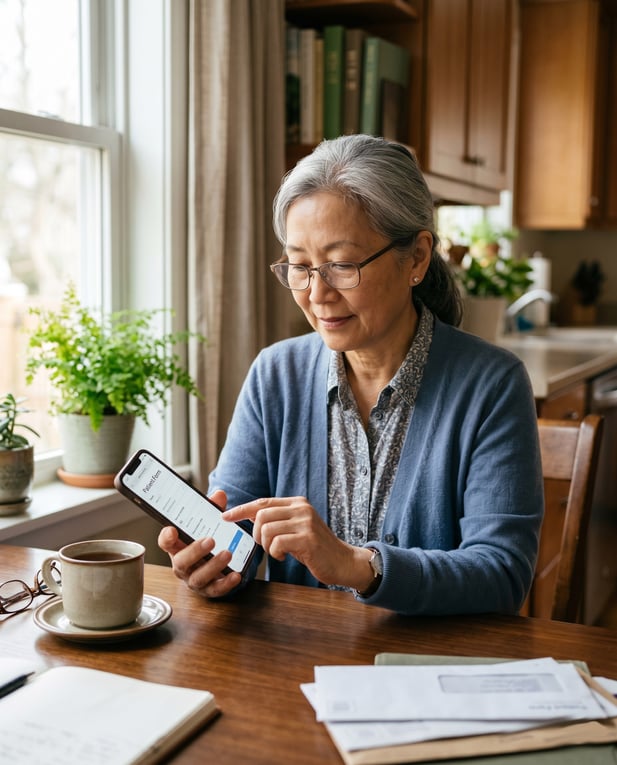
Patients tap a text link, answer a few simple questions, and they are done in 3 to 5 minutes. The form pre-fills their data from past visits, so they only need to confirm or update. For older patients, the form adapts to any phone screen.
For practices using StreamlineMD, Curogram connects directly to the patient chart, so staff do not have to re-enter data. The result is a faster, calmer check-in for patients and less manual work for staff.
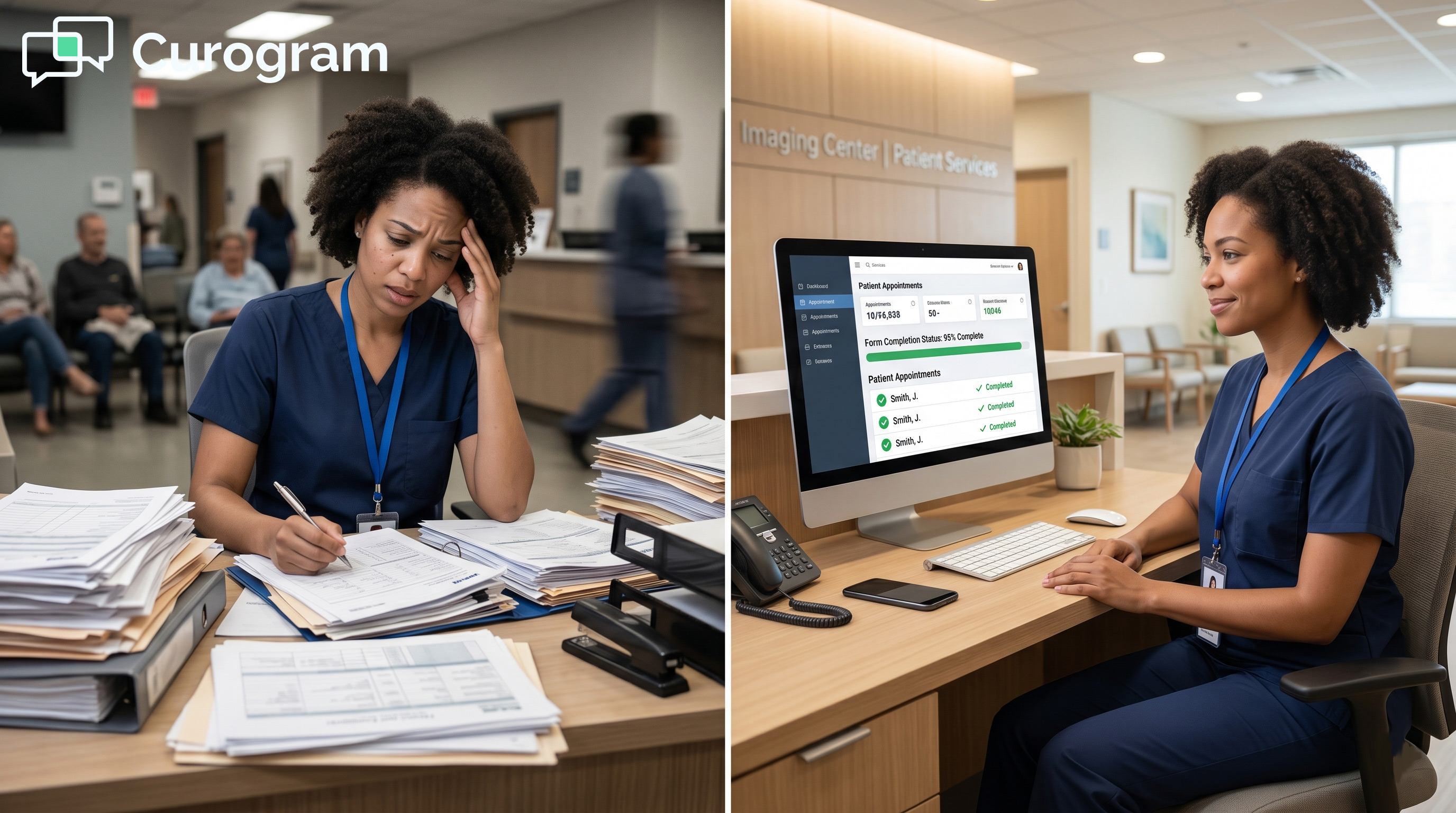
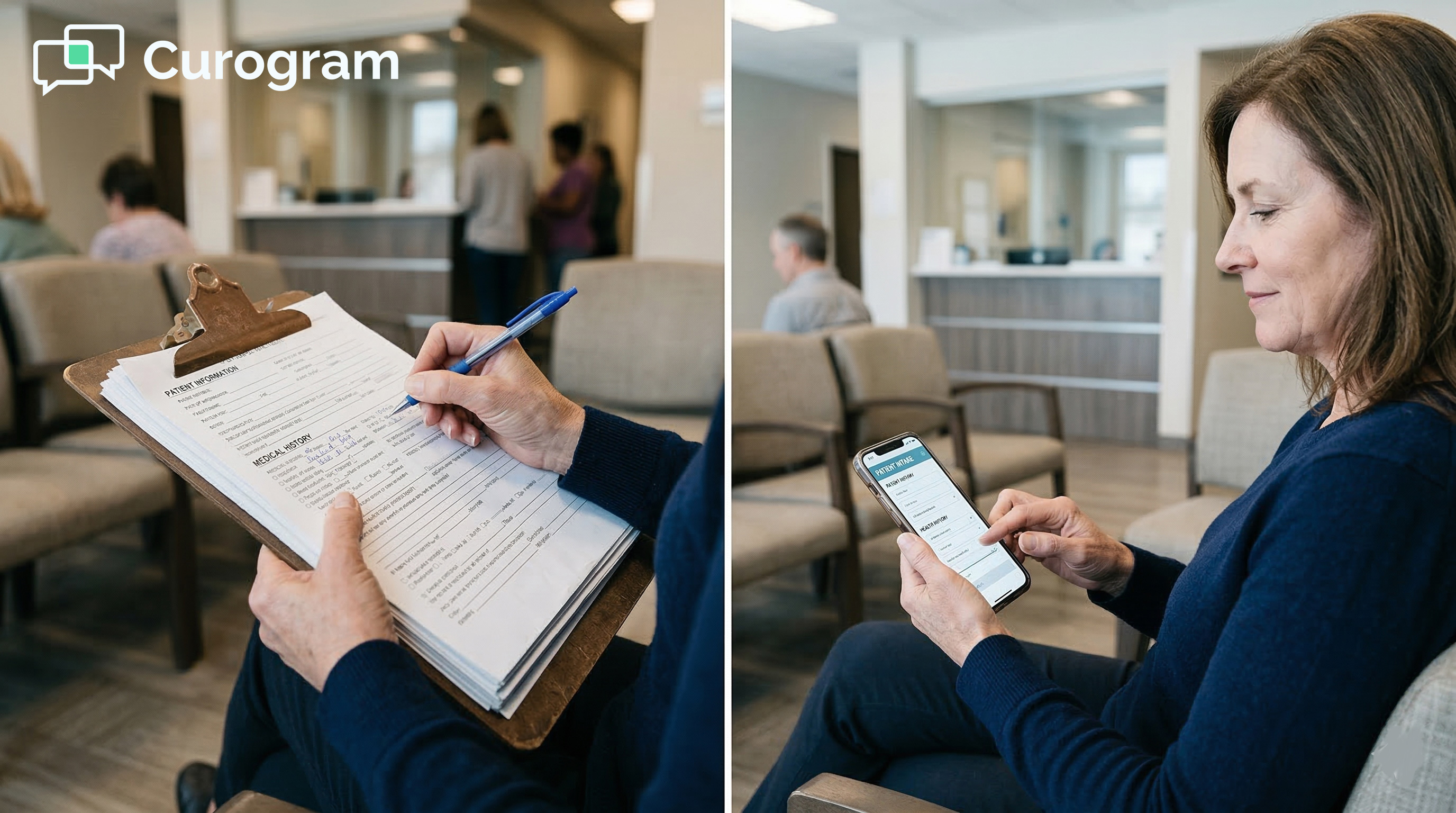
You arrive at your imaging appointment 15 minutes early. You hand over your ID and insurance card. Then the receptionist slides a clipboard across the desk. It has 19 pages.
That clipboard moment is the first real interaction patients have with a practice. And for many, it sets the wrong tone.
Paper-based patient intake forms in imaging centers create a quiet but constant source of stress. Patients have to recall surgery dates, medication names, and allergy histories, all while sitting in a public waiting room.
Some details get guessed. Some get skipped. Some answers are hard to read when staff type them in later.
The fix is simpler than most practices expect. When patients fill out their forms before they arrive, via a text message link, the whole check-in process changes.
There is no clipboard anxiety. There is no rushed guessing. And no staff member is squinting at bad handwriting.
This article looks at the patient intake forms imaging centers have relied on for decades, why those forms create friction, and how a shift to secure digital intake forms through Curogram and StreamlineMD changes the experience for both patients and staff.
If your front desk still hands out clipboards, this one is for you.
The Villain: Paper Clipboard Anxiety
Paper intake forms have been part of imaging workflows for as long as imaging centers have existed. They feel familiar. They require no setup.
But they carry a hidden cost, one that shows up in staff time, patient stress, and data quality. This section breaks down what that cost looks like from the patient's point of view.
The Problem: What Patients Actually Experience
You arrive at your imaging appointment. You have already fasted since midnight. You are a little tired and a little anxious about the scan. Then the receptionist hands you a clipboard.
The forms ask for your full surgical history, the names and doses of every medication you take, and whether you have had any reaction to contrast dye before.
You have never had contrast. You are not sure what to write. You do your best.
The form also asks for your insurance group number and the name of your referring provider. You check your phone. You check your wallet. You look up from the clipboard and realize everyone in the waiting room can see what you are writing. Your date of birth. Your address. Your medication list.
You finish the forms. Your hand is tired. The receptionist takes the clipboard and starts typing. She pauses and asks, "Is this aspirin or Aspen?"
You feel the weight of the whole check-in process pulling the visit off track before it has even started.
Why Privacy Matters in a Public Waiting Room
This is not a minor inconvenience. It is a real barrier to accurate data. When patients feel exposed, they rush. When they rush, they skip fields or write incomplete answers.
For imaging centers, missing or wrong allergy data carries clinical risk. A patient who skips the contrast allergy field is not being careless, they may just feel too self-conscious to sit and think carefully in a room full of strangers.
The Downstream Cost for Staff and Practice
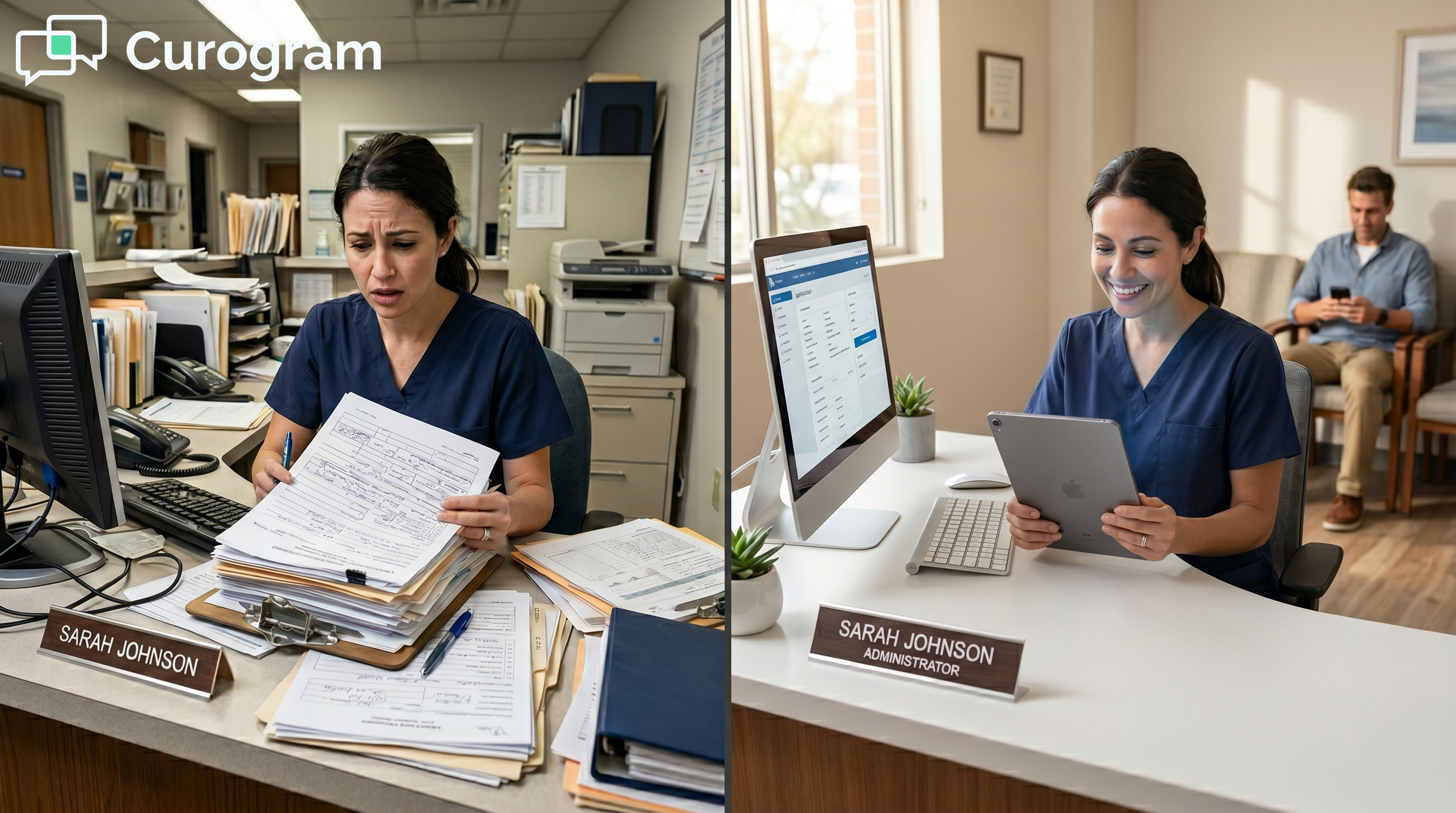
Once the clipboard comes back, the front desk team faces a second round of work. Every field has to be read, interpreted, and typed into StreamlineMD.
Handwriting is sometimes unclear. Abbreviations are sometimes wrong. Medical terms get transcribed with spelling errors.
According to Curogram client data from clinical settings, manual paper transcription accounts for 2 to 4 hours of avoidable staff work per day in a typical 20-patient imaging practice.
That is time that could go toward scheduling, patient calls, or billing follow-ups. Instead, it goes to data entry from a clipboard.
The result is a practice that delivers excellent clinical care but sends mixed signals from the very first patient interaction. Paper intake forms are not just outdated. They are expensive.
Paper Clipboard vs. SMS Digital Form: A Side-by-Side View
|
Factor |
Paper Clipboard |
SMS Digital Form |
|
Completion Location |
Waiting room, under time pressure |
At home, at patient's pace |
|
Privacy |
Visible to other patients nearby |
Private, on patient's own device |
|
Data Entry by Staff |
Manual re-typing required |
Auto-syncs to StreamlineMD chart |
|
Recall Accuracy |
Patient guesses from memory |
Patient has time to check records |
|
Allergy Disclosure Rate |
~65% capture rate |
90%+ capture rate (Curogram data) |
|
Average Completion Time |
10 to 15 minutes at check-in |
3 to 5 minutes before arrival |
|
Paper Cost per Month (20 pts/day) |
8,360+ pages/month |
Zero |

The Guide: The Digital Front Door
The good news is that imaging centers do not need to overhaul their entire workflow to solve this problem. The shift from paper to digital intake starts with one text message.
Here is how the experience works for patients, and why it matters for the practice.
The Solution: A Text Message the Night Before
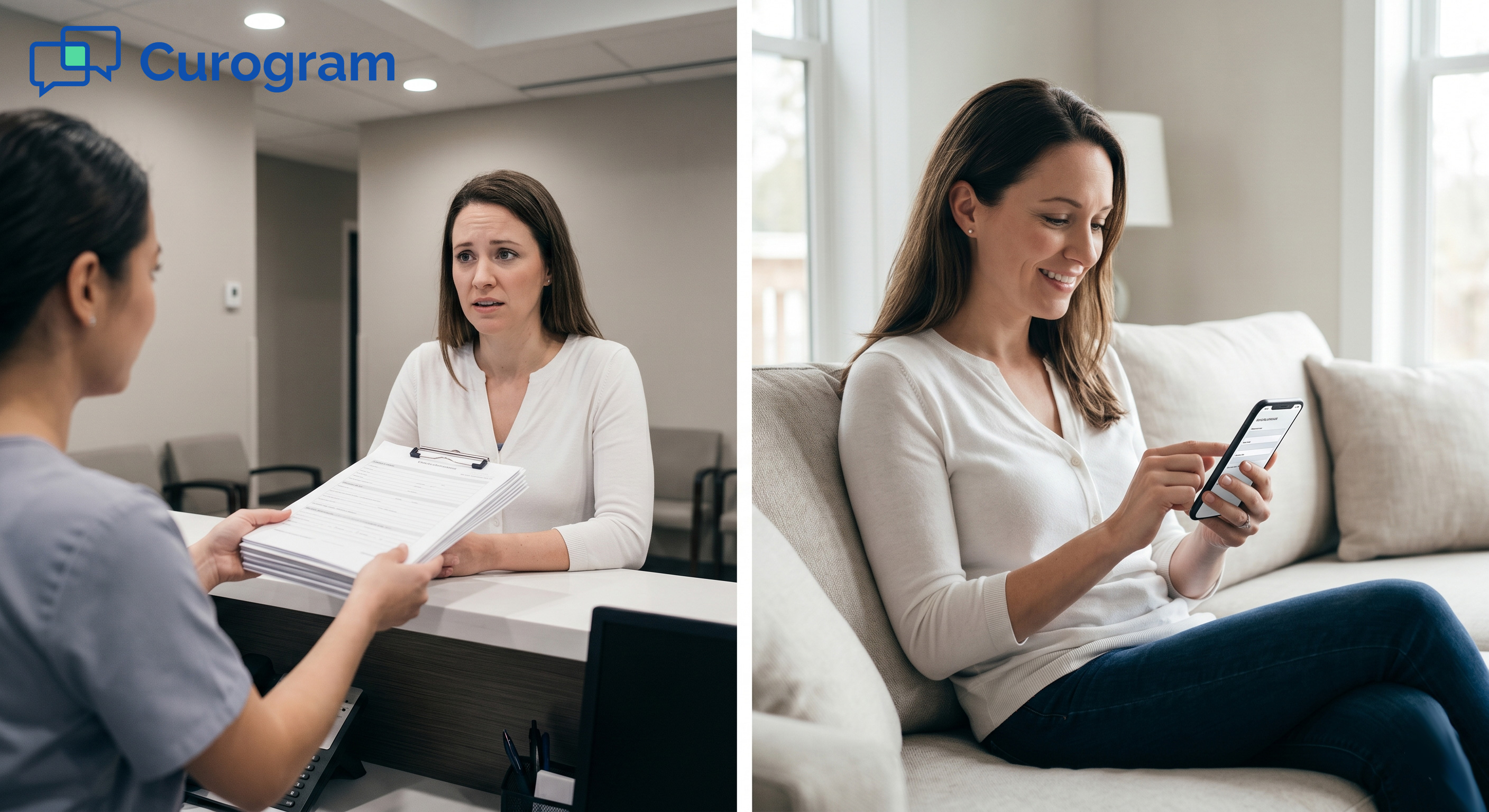
The evening before your appointment, you get a text. It reads: "Hi John, your imaging appointment is tomorrow at 10 AM. Please complete your pre-visit form (takes 3 min): [link]." That is it.
No login prompt. No app store. No patient portal password you forgot two years ago. You tap the link. A form opens on your phone. It already has your name, date of birth, and current medications filled in from your last visit.
You confirm them. You answer a few short questions about your prep, your allergies, and your insurance. You close the form. Done.
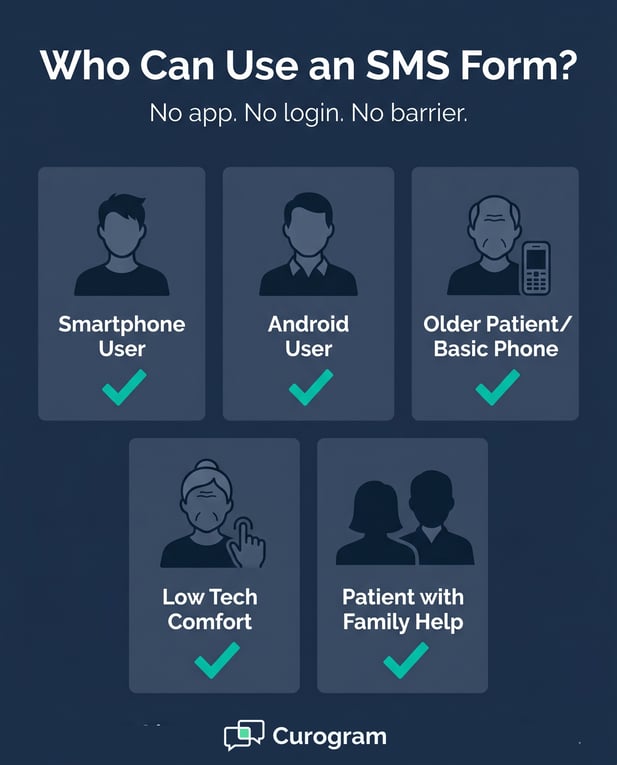
This is what secure digital intake forms via SMS look like from the patient side. The form works on any phone, including older Android devices and even basic smartphones. No app download is needed, and no tech skills are required.
This matters especially for secure digital intake forms for elderly patients, who may not use apps but can still tap a text link and answer simple on-screen questions.
Because patients complete the form at home, they have time to look up medication names, check their insurance card, and think through their allergy history. That extra time directly improves data quality.
Contrast allergy disclosure rates, based on Curogram client data from clinical settings, rise from around 65% with paper forms to over 90% with SMS-based digital intake.
How the Form Adapts to Every Patient
Not all patients are the same. Some are in their 30s, filing forms quickly on a commute. Others are in their 70s, taking more time, using larger text and bigger buttons. Curogram's SMS forms auto-fit to any screen size.
Questions appear one at a time, not as a long scroll of 19 pages. Buttons are large and easy to tap. The form does not require a stylus or reading glasses. For patients who want help, a family member can complete the form on their behalf with no login needed.
This is part of what makes SMS secure digital intake forms accessible to the full range of imaging patients. The platform meets patients where they are, without assuming a level of tech skill they may not have. Patient engagement with secure digital intake forms improves when the tool feels easy, not intimidating.
StreamlineMD Integration: No Double Entry
From the practice side, the keyword is integration. When a patient completes their form, their responses flow directly into StreamlineMD.
Staff does not retype anything. The chart is updated before the patient walks through the door.
This is purpose-built for radiology and interventional imaging workflows. Curogram connects to StreamlineMD to sync intake data, contrast allergy flags, MRI safety checklists, and insurance details, all without manual re-entry. Billing data accuracy improves. Chart transcription errors drop.
According to Curogram client data from clinical settings, practices that eliminate paper intake and use digital forms reduce billing data rework from 15 to 20% of claims down to less than 5%. That is a measurable financial impact from a change that starts with a text message.
The Integration: What Check-In Looks Like Now
You arrive for your imaging appointment. You completed your form last night. The receptionist looks up from the screen and smiles: "Welcome, John. You are all checked in. Head right to imaging, they are ready for you."
No clipboard. No paperwork. No waiting. Your appointment starts on time. The clinical team already knows your medication list, your allergy status, and whether you fasted. They are ready.
This is the patient experience secure digital intake forms for imaging creates. It is not flashy. It is just smooth. And smooth, for a patient who is already a little anxious about their scan, is exactly what they need.
The Success: Secure Digital Intake Forms Transformation
Switching to SMS-based intake forms is not just a tech upgrade. It changes how patients feel about your practice before they set foot through the door.
It also changes how your staff spends their time once the workday starts. Here is what that shift looks like in practice.
The Metric: Time Saved, Stress Reduced
For a 20-patient imaging practice, paper intake processing takes 10 to 15 minutes per patient on average. With digital forms, that drops to 2 to 3 minutes, an 80% reduction, according to Curogram client data from clinical settings.
Multiply that across 20 daily patients, and you get roughly 4 hours of recovered staff time per day. That is time that can go toward scheduling calls, handling billing questions, or simply keeping the schedule running on time.
For patients, the benefit is felt before they ever arrive. They complete their forms in 3 to 5 minutes, from home, with no rush and no audience. That shift alone is enough to lower the anxiety that comes with a medical imaging visit.
SMS patient satisfaction with digital intake is also measurably higher than with paper forms. Patients consistently rate the pre-visit text form as faster, easier, and less stressful than the clipboard process. When the first touchpoint feels easy, it changes how patients experience the whole visit.
Prep Compliance: A Smarter Safety Screen
For imaging centers, pre-visit screening is not just about convenience. It is about safety. Contrast allergies, metal implants, and medication holds all need to be flagged before a patient enters the scan room.
Paper forms do a poor job of capturing this data consistently. Patients rush through allergy fields. Some skip questions. Some write illegibly. Digital forms ask those same questions in a clear, one-at-a-time format that is harder to skip.
Based on Curogram client data from clinical settings, pre-visit digital screening raises contrast allergy disclosure rates from a baseline of about 65% to over 90%.
MRI safety checklist completion improves by a similar margin. This is a direct patient safety gain, not just an operational one.
Paper Elimination: The Numbers Add Up
Consider a 20-patient-per-day imaging center using paper intake. Each patient gets 19 pages. That is 380 pages per day, about 8,360 pages per month. Those pages need to be printed, stored, scanned, and eventually shredded.
Going digital eliminates all of that. There are no printing costs, no storage boxes, no shredding fees, and no risk of a paper chart going missing. The soft-cost savings from paper elimination add up faster than most practices expect.
The Shift: What Changes for Patients Who Struggle with Tech
One of the most common concerns about digital intake forms is whether older patients can use them. It is a fair question. But the answer is simpler than most people assume.
SMS delivery does not require a smartphone app or a login. It requires only the ability to tap a link in a text message
A 78-year-old patient with a basic phone can receive the text, tap the link, and fill out the form on a large-format, easy-to-read screen. The form adjusts automatically.
For patients who truly cannot manage on their own, a family member can help, or the front desk can assist over the phone before the appointment. The digital form is a tool for accessibility, not a barrier to it.
Patient engagement with secure digital intake forms across age groups, based on Curogram client data from clinical settings, is consistently strong. Completion rates exceed 85% when forms are sent 24 hours before the appointment with a clear, friendly message.
The Outcome: A Practice That Feels Different
The impact of digital intake is not just measurable. It is noticeable. Waiting rooms are calmer. Check-ins are shorter. Staff are less rushed. Patients arrive prepared and ready.
For the clinical team, it means they walk into each study knowing the patient's full history is already in the chart. For the billing team, it means insurance and demographic data is accurate from the start. For the practice manager, it means fewer escalations, fewer errors, and fewer calls from frustrated patients.
This is what secure digital intake forms for imaging center workflows, built on Curogram and powered by SMS, actually deliver. Not a promise. A process.
Conclusion: Transform Your Secure Digital Intake Forms Workflow
Paper clipboard anxiety is a solvable problem. It is not a small one, but it is solvable.
Every imaging center that still hands out clipboards is paying a hidden cost: in staff time, in data errors, in patient stress, and in missed opportunities to start each visit on the right foot.
The clipboard is not just slow. It sets the wrong tone for what is often an anxious patient experience.
Secure digital intake forms, delivered via SMS and connected to StreamlineMD through Curogram, change that experience from the first touchpoint.
Patients complete their forms at home, calmly, with time to look up information and answer accurately. Staff receive complete, clean data before the patient arrives. The chart is ready. The team is ready. The visit starts on time.
Patients do not think about your EHR. They do not think about your integration layer.
They experience your practice as one thing: a place that either made their visit easy or did not. Secure digital intake forms via Curogram ensure that answer is always easy.
The shift does not require a rebuild of your entire workflow. It starts with one text message, sent the night before an appointment.
From there, intake processing time drops by 80%, allergy disclosure rates rise above 90%, and staff recover hours of time they used to spend on data entry.
That is not a technology pitch. That is a measurable change in how your practice operates and how your patients feel.
Ready to see it in action? Schedule a demo to watch Curogram work alongside your StreamlineMD setup.
Frequently Asked Questions
The text message itself contains no medical information. It is just a link. When a patient taps that link, they are taken to an encrypted, HIPAA-compliant form hosted on a secure server.
Their answers are stored with the same level of protection as their provider's patient chart, including encryption, access controls, and audit logs. The imaging center is independently certified for HIPAA compliance, and Curogram's platform is built to meet those standards end-to-end.
The biggest reason is control. Patients fill out digital forms at home, at their own pace, without feeling watched or rushed. Paper forms in a waiting room put patients under pressure in a public setting. Digital forms remove that pressure entirely, which is why patient satisfaction with SMS intake is consistently higher than with paper-based alternatives.
The form works on any phone that can receive a text message. There is no app to install and no password to create. For patients who need help, a family member can assist them at home before the appointment.
For patients who cannot complete the form on their own at all, the front desk can walk them through it over the phone. The form is designed to be simple and accessible, with large text, one question at a time, and clear button labels.
Curogram integrates directly with StreamlineMD so that completed intake forms sync automatically to the patient's chart. Allergy flags, medication lists, insurance details, and MRI safety responses all populate the chart before the patient arrives.
This eliminates transcription errors and frees the front desk from manual data entry. Curogram is purpose-built for radiology and interventional imaging workflows, so the integration fits the way StreamlineMD practices already operate.
Most Curogram clients see measurable changes within the first few weeks of going live. Intake processing time drops from 10 to 15 minutes per patient to under 3 minutes almost immediately.
The contrast allergy disclosure rate typically rises to over 90% within the first month, based on Curogram client data from clinical settings. The full financial impact, including reduced billing rework and paper elimination savings, becomes clear within the first billing cycle.