


Telemedicine Reimbursement by State – Policies and Regulations | Blog
Review telemedicine reimbursement by state for all 50 states, and learn which parity laws, Medicaid rules, and licensing limits apply before you bill.

Most practices can tell you exactly what they spent to launch telemedicine. Far fewer can tell you what it has earned them since.
That gap is a real problem for you. Telemedicine takes real money and effort up front. You pay for software, devices, and training, and your staff learns new workflows while still keeping the front desk running.
Then the recurring bills keep arriving each month, and someone eventually asks the difficult question: Is this program actually paying off, or simply adding expense?
If you can't answer with numbers, you're not alone. Many practices track their telehealth costs closely but measure the return loosely, if at all. A busy video calendar and a few happy patients can feel like success. But a feeling is not a return on investment (ROI).
Insurance coverage for telehealth has grown considerably, and that certainly helps. Still, reimbursement is only one piece of the picture. A program can be paid for and still waste staff time, miss patients, or cost more than it should. To know if you're truly getting your money's worth, you need to look past the payment rate.
You likely already know how telehealth works and the rules that come with it, including the Health Insurance Portability and Accountability Act (HIPAA). Now it's time to measure what your program is actually delivering. The good news is that you don't need a finance degree to do it well.
This guide walks you through three simple, practical questions. Each one looks at a different part of your telemedicine ROI: your goals, your patients, and your costs. Together, they reveal whether your program is pulling its weight or quietly draining your operating budget.
So where should you begin? Start with a closer look at why no two practices ever get exactly the same results.
Healthcare organizations and providers have different profiles that significantly impact their telemedicine ROI. When calculating ROI, you should note that its scheme isn’t one-size-fits-all.
Healthcare organizations and medical practices are different from one another, which means telemedicine program ROI varies widely and depends on the following:
Since healthcare providers and organizations have different characteristics, their ROIs are fundamentally diverse. With this in mind, you can assess the return you are getting from your investment by asking the right questions and looking at the most crucial parts of your telemedicine program.
Virtual care investments are highly contingent on the objectives and goals of your telehealth capabilities. Each remote care setup is unique as it depends on the characteristics of your organization or practice. Set realistic goals for your remote healthcare delivery journey based on the size and nature of your organization, clinical capacity, and payment model.
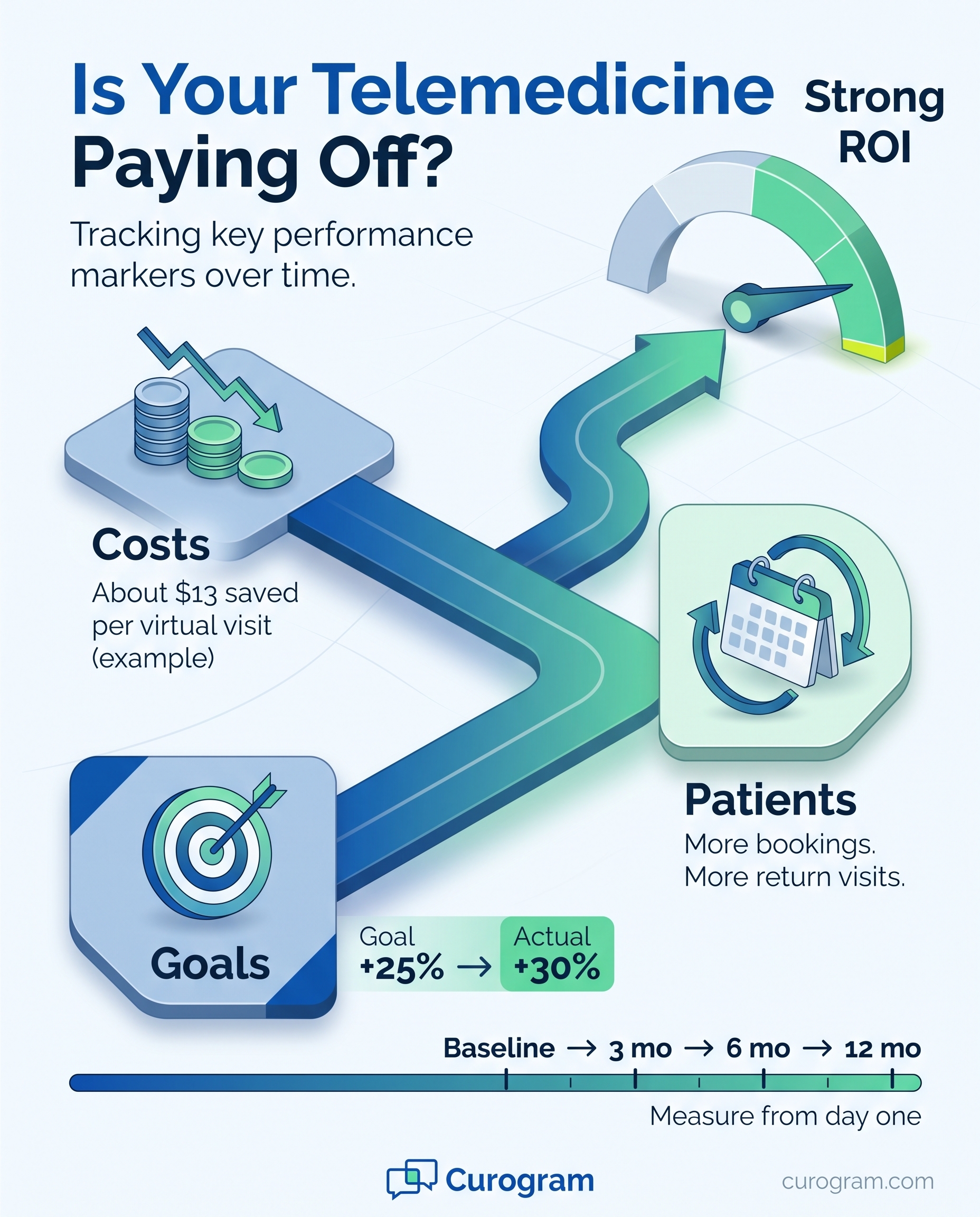
If your practice is new, you must test the waters. Schedule your office hours based on the flow of appointment bookings. Determine the number of patients you could accommodate for virtual visits per day. You can measure ROI by examining how many patients your practice can engage via telehealth. If your goal is to achieve a 25% boost of new patients, but you eventually reach 30%, you see a good ROI.
Ultimately, your patients will shape the goals of your telemedicine program. Stick to what your patients want and need when it comes to telemedicine. Don’t go overboard to avoid wasting time and money.
Appointment volume and patient retention numbers are crucial in every remote care program. You can measure ROI by looking at the number of appointment bookings and patient retention your practice has received since you started offering telehealth services.
Medical practices offer similar telehealth services at the same rates, but when it comes to patient volume and retention, one practice may be more successful than the other. A crucial factor in this distinction is patient retention.
Patients are the foundation of every medical practice. That is why they substantially contribute when calculating ROI on your telemedicine program. Gaining and keeping patients generates higher revenue, so your remote care program must focus on the cycle of getting and retaining patients. One way to do this is to simplify and improve patient appointment scheduling.
You can use text messaging as part of your scheduling system and send appointment reminders. Your telemedicine program must use a 2-way, HIPAA-compliant text messaging system that encourages more patients to book virtual consultations with your practice.
With texting, your patients can easily schedule and reschedule their appointments, and you can notify them with appointment reminders to prevent patient no-shows or cancellations. That improves ROI and can help grow your patient numbers.
Telemedicine can take over many tasks your staff once did by hand, such as scheduling visits and collecting health records. A good program should streamline your workflow, from digital patient forms to video visit setup. Done right, it cuts extra admin costs without lowering your standard of care.
Overhead is one of the biggest pieces of your ROI. A virtual visit usually costs less to deliver than an in-person one because it doesn't need an exam room, room turnover, or as much front desk work. Digital records and forms also mean less spending on paper, printers, and ink.

Here's a simple example of how those savings can add up. The figures below are illustrative only, not industry benchmarks.
| Cost area (illustrative example) | Savings per virtual visit | Monthly (40 visits) | Yearly (480 visits) |
|---|---|---|---|
| Front desk time (10 min at $20/hour) | $3.33 | $133 | $1,600 |
| Room prep and supplies | $8.00 | $320 | $3,840 |
| Paper forms, printing, and ink | $2.00 | $80 | $960 |
| Total | $13.33 | $533 | $6,400 |
In this example, moving just 10 visits a week to telehealth saves about $6,400 a year. That's before you count new revenue from extra appointments or fewer no-shows. Plug in your own costs to see what your real savings look like.
When your program runs well, it lowers admin costs and staff workload while bringing in more revenue. You spend less and earn more. That's what a strong telemedicine ROI looks like.
| Before you judge your telemedicine ROI, write down where you started. Record your monthly visit volume, no-show rate, phone call volume, and front desk hours from the 3 months before launch. Then track the same numbers at 3, 6, and 12 months. Without a reliable baseline, any improvement you report is really just a guess. |
Not at all. You don't need cutting-edge tools to run a good telemedicine program. You need two basics: reliable hardware and the right software.
Software is where you should be most careful. Your telehealth platform must follow HIPAA rules and regulations to protect patient data. Choosing the wrong system can create privacy risks that cost far more than any savings.
Hardware is the easy part. You and your patients likely already use desktops, laptops, tablets, and smartphones every day. You don't need the most expensive devices, just ones that work reliably.
That leaves more room in your budget for the ongoing costs that come with any program:
Count these costs in your ROI math from day one. They're easy to overlook, but they shape your true return just as much as the launch price.
Telemedicine can be a smart, profitable investment, but only if you measure it the right way. Reimbursement rates tell part of the story. The rest of it lives in your goals, your patient numbers, and your costs each month.
That's why the three questions in this guide matter. First, define what success looks like for your program. Second, track whether you're seeing and keeping more patients. Third, check whether your overhead and staff workload are actually going down.
If you can answer all three with real numbers, you'll know exactly where you stand. If you can't yet, that's still useful too. It shows you where to focus next, whether that's setting clearer goals, fixing scheduling gaps, or trimming wasted spend.
Healthcare providers should look at telehealth ROI from several angles: its effect on daily operations, its impact on revenue, and how it supports patient health outcomes. When you weigh these together, you get a clear picture of how your program affects your bottom line. That clarity makes every future budget and staffing decision much easier.
Keep in mind that measuring ROI is not a one-time task you finish and forget. Patient needs shift, payer rules change, and your practice grows. Review these numbers every few months so small problems don't quietly grow into costly ones.
The right tools can make that work much lighter. A platform that brings HIPAA-compliant texting, appointment reminders, and virtual visits together helps you keep patients engaged without piling extra daily tasks onto your front desk. It also gives you the reporting data you need to track your progress clearly over time.
Ready to see what that could look like for your practice? Book a demo of Curogram's patient communication platform and discover how simple tools can help you get more value from every virtual visit.
Telemedicine ROI is the return your practice gets from its virtual care program compared to what you spend on it. That includes software, devices, training, and staff time. A strong return can show up as new revenue, more loyal patients, lower overhead, or time saved at the front desk.
Start by adding up your gains, such as new visit revenue and cost savings. Then subtract your total program costs, divide by those costs, and multiply by 100. For example, if your program brings in $20,000 in gains and costs $8,000, your ROI is 150% (illustrative figures only).
It depends on your practice size, specialty, and how fast patients adopt virtual visits. Some practices see early wins in fewer no-shows or phone calls, while revenue gains take longer to build. Record your baseline before launch, then check your numbers at 3, 6, and 12 months.
Focus on a short list of numbers you can check each month:
Virtual visit volume and new patients
Patient retention and return visits
No-show and cancellation rates
Phone call volume and front desk hours
Overhead cost per visit
Together, these show whether your program is growing, keeping patients, and saving money.
Yes. Two-way texting makes it easy for patients to book, confirm, or reschedule virtual visits without calling your office. Automatic reminders also help cut no-shows. Curogram clients have reported a 98% text open rate and up to 50% fewer phone calls, which frees up staff time for patient care.
Review telemedicine reimbursement by state for all 50 states, and learn which parity laws, Medicaid rules, and licensing limits apply before you bill.

Telemedicine in Tennessee follows rules that have changed five times since 2015. Learn the current licensing, prescribing, and coverage requirements...
Telehealth took the whole world by storm, but are you ready to transition to online care? These examples will help you streamline your telehealth...