Skip to the main content.

16 min read

Telemedicine Reimbursement by State – Policies and Regulations | Blog

Telemedicine Reimbursement by State – Policies and Regulations | Blog
 💡 Telehealth reimbursement depends on 3 things: the state where the patient is during the visit, the patient's payer, and the service provided. The patient's location, called the originating site, decides which state's laws apply, and the doctor needs a license there.

Medicare sets one national policy, and its telehealth flexibilities run through Dec. 31, 2027. Medicaid and private plans follow state law, so rules differ widely. Every state Medicaid program pays for some telehealth, but covered services, patient locations, and provider types vary.

For private plans, some states require only coverage parity, meaning the service must be covered. As of fall 2025, 24 states required payment parity, meaning the same rate as an in-person visit.

The Interstate Medical Licensure Compact, now joined by 44 states, gives physicians a faster path to licenses in other member states.

Fee-for-service telemedicine visits dropped 24% after Medicare's telehealth flexibilities lapsed in fall 2025. The lapse lasted 6 weeks. Congress later paid for the visits given during the gap, but the drop shows how fast practices pull back when coverage is in doubt.

Medicare is only one layer. Each state writes its own telehealth rules for Medicaid and private plans, and those rules keep moving. Since 2021, 14 states have joined the Interstate Medical Licensure Compact (IMLC), and Michigan nearly left it this spring when its law expired.

Arizona, California, and New Jersey all added payment parity for private plans. Several state Medicaid programs that once paid only for live video now cover audio-only visits and remote patient monitoring too.

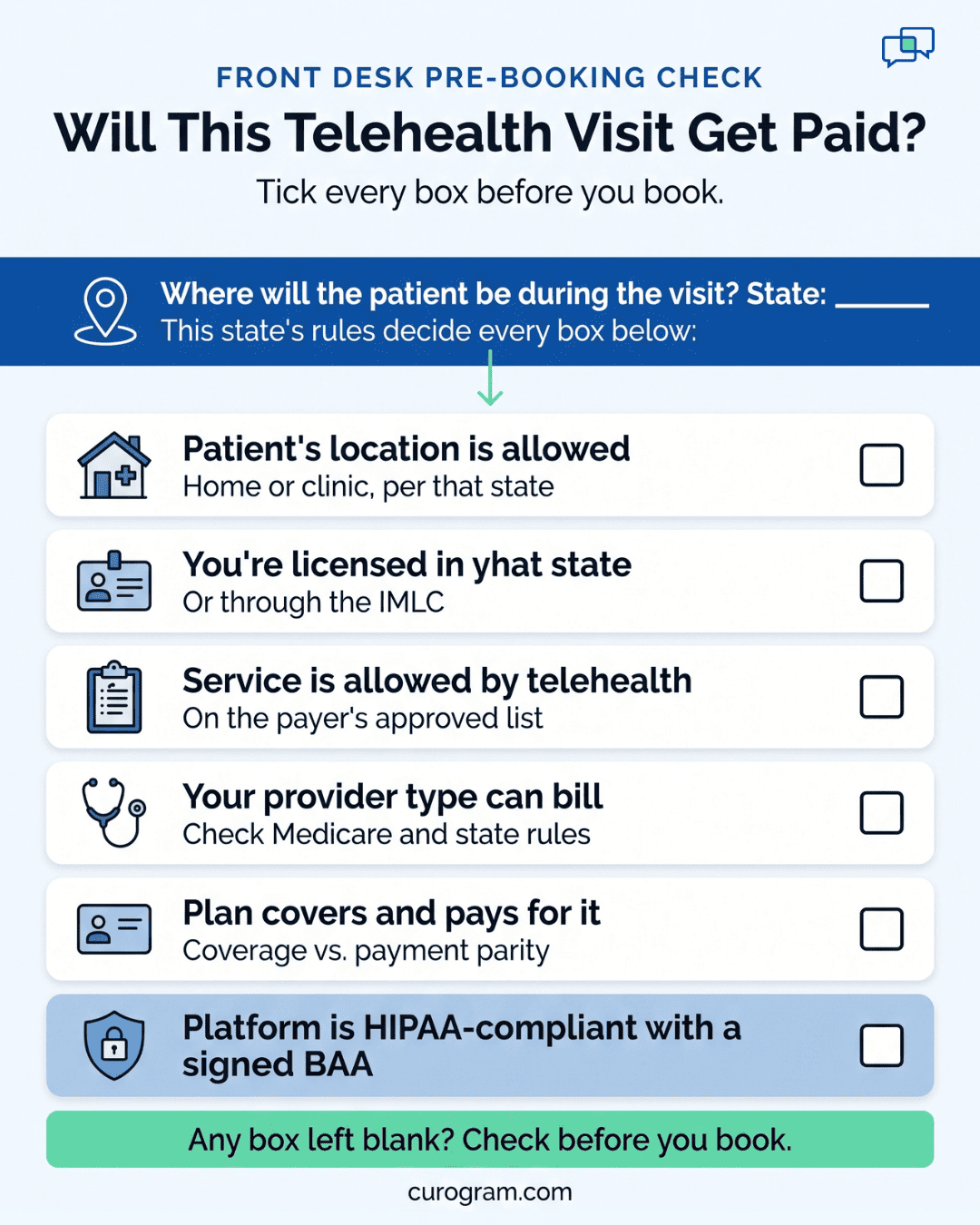
For your practice, it comes down to 3 facts you can confirm before booking. Whether a telehealth visit gets paid depends on where the patient will be during the call, which plan they carry, and what that state requires of that plan.

This guide starts with the telehealth services payers cover and the federal and state laws behind them.

What Telemedicine Services Qualify for Reimbursement?

Telemedicine is care given through digital tools, like video calls and secure messages, while the doctor and patient are in different places. Payers have a name for each place. The patient's location is the originating site, and the physician's location is the distant site.

You'll see those two terms again in payer rules. Many coverage limits depend on where the patient is during the visit.

Only some types of telehealth get paid. Live video visits have the widest coverage. Store-and-forward and remote patient monitoring depend on your state, and sometimes on the patient's diagnosis. Mobile health tools, like appointment reminders, aren't billed as care at all.

Type of Service What It Is Example Reimbursed?
Live video calls A real-time video visit between a provider and a patient A doctor sees a patient over two-way video Yes
Store-and-forward Sending recorded health data, like images and documents, to another provider A physician sends scans, blood test results, or photos of a skin condition to a specialist for review Depends on the state
Remote patient monitoring Sending health data the patient collects at home to a doctor A patient wears a Wi-Fi or Bluetooth device that tracks heart rate Depends on the state and diagnosis
Mobile health Using phones and tablets for health purposes A patient gets appointment reminders or medication alerts No


Telehealth Reimbursement Laws

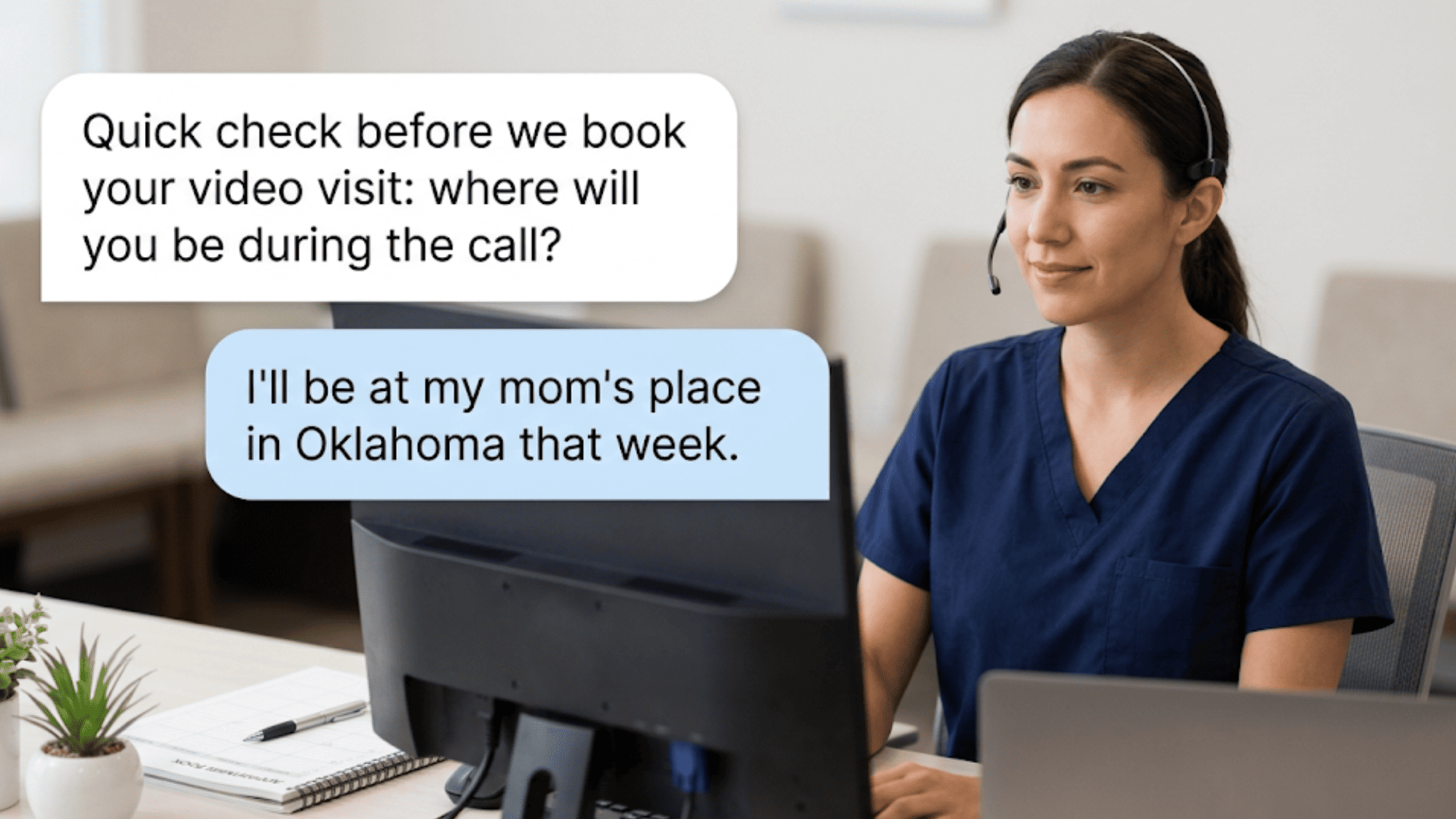
Telemedicine rules change from state to state. The patient's location during the visit decides which state's laws apply, since that's the originating site. If you practice in Texas and your patient joins the call from Oklahoma, Oklahoma's rules apply.

Licensing works the same way. You need a license in the state where the patient is during the visit, no matter where you're sitting.

Each state issues its own medical license, so treating patients in 3 states can mean 3 separate applications.

The Interstate Medical Licensure Compact (IMLC) gives doctors a faster path to licenses in its member states. Not every state has joined, though. For patients in a non-member state, you'll still apply to that state's medical board on your own.

Payment has its own layer of rules. State laws use two kinds of parity, and a state may require one without the other.

Type of Parity What It Means
Coverage parity If a plan covers a service in person, it must also cover that service by telemedicine.
Payment parity The plan pays the same fee for a telemedicine visit as for the same visit in person.


Rules also shift by payer. Private plans and Medicaid follow state law, so one insurer can have different telehealth rules in 2 different states. Medicare sets a single federal policy for the whole country. Before you bill, check the originating site's state laws and the patient's plan.

Federal Telemedicine Laws

Federal telehealth law covers far less ground than state law. Most federal action has come as short-term fixes during a crisis, like COVID-19, instead of lasting rules.

Medicare is where federal rules matter most. It's a federal program, so its telehealth policy is the same in every state. Medicaid works differently. It's a state-federal partnership, so each state sets its own Medicaid telehealth payment rules.

COVID-19 is what opened up Medicare telehealth. Congress has extended the Medicare telehealth flexibilities first put in place in 2020 many times, often at the last minute. You can see how close some of those calls were.

Date What Happened
Oct. 1, 2025 The flexibilities lapsed when Congress didn't pass a funding bill
Nov. 2025 A new funding bill paid back telehealth visits given during the gap
Feb. 3, 2026 Congress extended Medicare telehealth coverage through Dec. 31, 2027


That short lapse had a real cost. Fee-for-service telemedicine visits dropped 24% after the flexibilities ran out in fall 2025.

If Congress lets them expire again, Medicare goes back to its pre-pandemic limits, including the rules on where patients live and where the visit takes place.

Some changes are already permanent, though. Medicare's wider coverage for behavioral health telehealth is now a permanent benefit.

Telehealth reimbursement checklist for the front desk to confirm a video visit will get paid

State Telemedicine Laws

Two issues influenced the legislation of telehealth in each state:

  1. The geographic location
  2. The availability of medical professionals

It seems that the states with larger rural regions or the higher number of residents living in remote locations have a more liberal approach in regulating telemedicine. The shortage of medical professionals also plays a significant role in the decision-making process.

Even the states that allow and support remote care impose limitations on various aspects of telehealth. These restrictions usually apply to:

  • The originating site
  • The type of service
  • The healthcare provider

Depending on the insurer, the limitations may vary in the same jurisdictions. Medicaid and private payers may interpret the laws differently, so the practitioners should get familiar with the regulations thoroughly.

Eligible Originating Site

Your patient's home seems like the natural place for a video visit. Many state laws limit where the patient can be, though, and a visit from the wrong spot may not get paid.

States usually limit the originating site in 3 ways:

  1. Type of place. The patient must be at a medical facility, like a clinic or hospital, near their home.
  2. Staffing. Some states require a medical professional to be on site with the patient.
  3. Region. In some parts of the U.S., only patients in rural or remote areas qualify for telemedicine at all.

Medicare has set its home and rural limits aside through Dec. 31, 2027. For Medicaid and private plans, check the state's rules before your front desk books a patient for a video visit from home.

Eligible Types of Service

Some states only allow certain services by telehealth. The state medical board, the Medicaid agency, or the payer decides which services are safe to give remotely, and each one can draw that line in a different place.

Medicare keeps its own version: a published list of the service codes it will pay for by telehealth.

Before your team books a visit as telehealth, confirm 2 things:

  1. The service is allowed by telehealth in the state where the patient is.
  2. The patient's plan pays for that service by telehealth.

Telemedicine providers face the same discipline as doctors who see patients in person. A video visit that breaks a state or federal rule can bring the same penalties as a violation in your exam room.

Eligible Providers

States differ on which providers can bill for telehealth, and doctor shortages shape much of that. In remote areas, almost every type of provider can practice by telehealth. Specialists face fewer limits, especially those who treat rare diseases.

Medicare keeps its own list. Under the flexibilities that run through Dec. 31, 2027, physical therapists, occupational therapists, speech-language pathologists, and audiologists can also give Medicare telehealth services.

Peer-to-peer consults work differently. A physician who isn't an eligible provider can still help treat a patient over video, as long as the patient's primary doctor is eligible and on the call.

Reimbursement Policies State by State

With strict and somewhat complicated legislation, telemedicine reimbursement policies can be quite confusing. Let’s check the situation in each state. You can find additional information at the American Telemedicine Association state policy center.

Alabama

Alabama Medicaid covers live video visits and pays telemedicine, including audio-only visits, at the same rate as in-person care. Private payers don't have to cover telemedicine, but they can choose to.

Alabama has no payment parity law for private plans. It's an IMLC member, so Alabama physicians have a faster path to licenses in other member states.

Read more about Alabama telemedicine.

Alaska

Alaska Medicaid has covered a wide range of telehealth services for more than 10 years, and it pays them at the same rate as in-person care.

HB 265, passed in 2022, widened the ways providers can deliver care, including audio, video, and phone. Alaska has no parity law. Private payers can cover telehealth as they choose, but they must cover mental health services.

Arizona

Arizona has one of the broadest telehealth laws in the U.S. HB 2454, signed in 2021, requires private insurers to pay the same rate for audio-video telehealth as for in-person care.

Out-of-state providers can also register to treat Arizona patients by telehealth. Arizona Medicaid covers many services, with some limits on the type of service and the originating site.

Read more about Arizona telemedicine.

Arkansas

Arkansas passed a full parity law in 2015. Some limits apply to the originating site. Before treating by telehealth, the doctor must set up a doctor-patient relationship, either in person or over live video. Arkansas has since joined the IMLC.

Read more about Arkansas telemedicine.

California

California passed its first telehealth parity law in 1996. AB 744, passed in 2019, went further: since 2021, private plans must pay for telehealth on the same basis as in-person care.

Medi-Cal pays live video, audio-only, and store-and-forward services at no less than the in-person rate, as long as the service meets the standard of care. California isn't an IMLC member.

Read more about California telemedicine.

Colorado

Colorado sets no location limits on telemedicine. Medicaid and private payers must cover it the same way they cover in-person care. The state's Division of Insurance also requires private plans to pay telehealth at the in-person rate. Colorado joined the IMLC in 2016.

Read more about Colorado telemedicine.

Connecticut

Connecticut's parity law requires Medicaid and private insurers to pay for telehealth. State law requires Medicaid to pay telehealth services at the in-person rate, and audio-only visits are covered in some cases.

Medicaid covers both live video and store-and-forward. Connecticut joined the IMLC in 2022, and its health department began full participation on March 15, 2026.

Delaware

Delaware has a parity law. Medicaid and private payers must cover live telemedicine, and private plans must pay the same rate as for in-person care. Delaware joined the IMLC in 2021.

Florida

Florida Medicaid covers live telemedicine. The state's private payer law lets insurers and providers negotiate telehealth rates, so there's no payment parity. Private payers don't have to cover telehealth, but many plans include it. Florida joined the IMLC in 2024.

Read more about Florida telemedicine.

Georgia

Georgia has a parity law, and both Medicaid and private payers cover telemedicine. Georgia Medicaid pays for live video and store-and-forward services. The state joined the IMLC in 2019, which gives its physicians a faster path to practice across state lines.

Read more about Georgia telemedicine.

Hawaii

Many Hawaii residents live on remote islands, and the state's telehealth law reflects that.

Medicaid and private payers must cover telemedicine the same way they cover in-person care, and private plans must pay at the same rate. Hawaii joined the IMLC in 2023, but it can't serve as a physician's home state for the compact.

Read more about telemedicine in Hawaii.

Idaho

Idaho has no parity law, so private payers set their own telehealth rules. Idaho Medicaid covers live video visits. The state joined the IMLC in 2015, which gives Idaho physicians a faster path to licenses in other member states.

Read more about telemedicine in Idaho.

Illinois

Under Illinois' parity law, Medicaid and private payers must cover telehealth. Illinois Medicaid also covers remote patient monitoring, with some limits. The state joined the IMLC in 2015.

Read more about Illinois telemedicine.

Indiana

Indiana has a full parity law. Private payers and Medicaid both pay for telemedicine, and Medicaid covers remote patient monitoring too. Indiana joined the IMLC in 2022.

Read more about Indiana telemedicine.

Iowa

Iowa's telemedicine law has required full parity since 2019. The state is also an IMLC member, having joined in 2019. That gives Iowa doctors a faster path to treating patients in other member states.

Kansas

Kansas has a parity law, but it lets each payer set its own payment rules. That means 2 patients with the same visit type can bring back 2 different rates, depending on their insurer.

Your billing team has to check each plan. Kansas joined the IMLC in 2016, which gives its doctors a faster path to treating patients in other member states.

Kentucky

Since 2019, Kentucky has counted the patient's home as an eligible originating site. Its private payer law lets insurers and providers negotiate telehealth rates, so there's no payment parity. Kentucky joined the IMLC in 2019.

Louisiana

Louisiana's parity law limits telemedicine coverage in some ways, mostly around which providers can bill. Medicaid covers live video visits and remote patient monitoring. Louisiana joined the IMLC in 2020.

Read more about telemedicine in Louisiana.

Maine

Maine has a full parity law and clear rules on how to practice telehealth. Those rules once earned it a perfect grade in the American Telemedicine Association's state report. Maine joined the IMLC in 2017.

Maryland

Maryland has a full parity law. Medicaid and private payers pay for telemedicine the same way they pay for in-person care. Maryland joined the IMLC in 2018, which gives its doctors a faster path to practice across state lines.

Read more about Maryland telemedicine.

Massachusetts

Chapter 260, passed in January 2021, made telehealth coverage permanent in Massachusetts. Private plans must pay behavioral health visits at the in-person rate with no end date.

Parity for primary care and chronic disease care ended on Jan. 1, 2023. MassHealth, the state's Medicaid program, pays telehealth at parity, including audio-only visits. Massachusetts isn't an IMLC member.

Read more about telemedicine in Massachusetts.

Michigan

Michigan has removed most limits on where patients can be during a visit. Its parity laws require Medicaid and private payers to pay for telemedicine. Michigan joined the IMLC in 2018. After its compact law expired in 2025, lawmakers passed a fix in March 2026 to keep the state in the compact.

Read more about telemedicine in Michigan.

Minnesota

In Minnesota, private payers and Medicaid both cover telemedicine. Dental plans are included too, which few states require. Minnesota joined the IMLC in 2015.

Read more about Minnesota telemedicine.

Mississippi

Doctor shortages helped shape Mississippi's telemedicine rules. The state has a full parity law, so private payers and Medicaid pay for telehealth the same way they pay for in-person care. Mississippi joined the IMLC in 2016.

Missouri

Missouri expanded coverage to include telehealth visits in the patient's home. Its parity law requires private payers and Medicaid to pay for telehealth services. Missouri joined the IMLC in 2023.

Read more about Missouri telemedicine.

Medical receptionist confirming a patient's state before booking a telehealth video visit

Montana

Montana has a parity law, and private payers must cover telehealth. Medicaid covers it too, with a few limits. Montana joined the IMLC in 2015.

Nebraska

Nebraska adopted a full parity law in 2017, requiring Medicaid and private payers to pay for telehealth services. It joined the IMLC the same year.

Nevada

Nevada has a full parity law and has removed several old limits on telemedicine. Insurers cover a wide range of telehealth services. Nevada joined the IMLC in 2015.

New Hampshire

Private payers cover telehealth in New Hampshire. NH Medicaid pays for live video, store-and-forward, remote patient monitoring, and audio-only visits, with some limits. The state joined the IMLC in 2016, so many New Hampshire providers also practice in other member states.

New Jersey

New Jersey requires private payers to cover telemedicine. A payment parity rule for private plans ran through July 1, 2026.

NJ Medicaid now must cover telehealth on the same basis as in-person care, well beyond the telepsychiatry-only coverage it once had. New Jersey joined the IMLC in 2022.

Read more about telemedicine in New Jersey.

New Mexico

New Mexico has a full parity law, and all insurers cover telehealth. In 2025, the state broadened its Telehealth Act to cover more types of providers. New Mexico joined the IMLC in 2026, which makes cross-state licensing easier for its doctors.

New York

New York has a full parity law, so private insurers must cover telemedicine. NY Medicaid pays for live video, store-and-forward, and remote patient monitoring, and its payment parity runs through April 1, 2028.

The state also publishes detailed guidance on how to practice telehealth. New York isn't an IMLC member.

Read more about telemedicine in New York.

North Carolina

North Carolina has no parity law, so private payers set their own telehealth rules. Telepsychiatry is the one exception.

NC Medicaid is broader and pays for live video, store-and-forward, remote patient monitoring, and audio-only visits. North Carolina joined the IMLC in 2025.

Read more about telemedicine in North Carolina.

North Dakota

Private payers and Medicaid pay for live telemedicine in North Dakota. ND Medicaid also covers store-and-forward, remote patient monitoring, and audio-only visits. The state joined the IMLC in 2019.

Ohio

Ohio doesn't have a full parity law. Telehealth use there is strongest in telepsychiatry and behavioral therapy, and Ohio Medicaid pays for live video, store-and-forward, remote patient monitoring, and audio-only visits. Ohio has open licensing rules for telemedicine, and it joined the IMLC in 2021.

Read more about Ohio telemedicine.

Oklahoma

Oklahoma's parity law requires private payers and Medicaid to pay for telemedicine. The state also has a no-fee policy for telehealth in non-profit hospitals. Oklahoma joined the IMLC in 2019.

Oregon

Oregon is one of the few states that pays for telemedicine by email or phone. Its law requires both Medicaid and private insurers to cover telehealth, and Oregon Medicaid pays for all 4 main modalities. Oregon isn't an IMLC member.

Read more about Oregon telemedicine.

Pennsylvania

In 2024, Pennsylvania passed its first private payer telehealth law. Insurers must now cover medically necessary telemedicine, but the law doesn't require payment parity.

Medicaid covers live video, though it doesn't count store-and-forward or remote patient monitoring as telemedicine. Pennsylvania joined the IMLC in 2016, but it can't serve as a physician's home state for the compact.

Read more about telemedicine in Pennsylvania.

Rhode Island

Rhode Island has a full parity law, so Medicaid and private insurers must pay for telehealth. The state passed the IMLC in 2022, but putting it into effect has been delayed.

South Carolina

South Carolina is known for its telepsychiatry programs. It has no parity law, so private payers set their own telehealth rules.

SC Medicaid pays for live video, store-and-forward, remote patient monitoring, and audio-only visits. South Carolina isn't an IMLC member.

Read more about telemedicine in South Carolina.

South Dakota

South Dakota limits where patients can be during a telemedicine visit. It has no parity law, so private payers set their own rules.

SD Medicaid now pays for live video, store-and-forward, remote patient monitoring, and audio-only visits. South Dakota joined the IMLC in 2015.

Tennessee

Tennessee's parity law requires Medicaid and private payers to cover telemedicine. The state doesn't limit where patients can be during a visit. Tennessee joined the IMLC in 2017.

Read more about Tennessee telemedicine.

Texas

Doctor shortages helped push Texas toward looser telemedicine rules. Its parity law requires Medicaid and private payers to pay for telehealth the same way they pay for in-person care.

Since Jan. 1, 2026, Texas plans must also cover telehealth from out-of-state sites on the same basis as in-state care. Texas joined the IMLC in 2021.

Read more about telemedicine in Texas.

Utah

Utah has no telemedicine parity law, so private payers set their own rules. Utah Medicaid pays for live video, store-and-forward, remote patient monitoring, and audio-only visits. The state joined the IMLC in 2015.

Vermont

Vermont's full parity law requires private insurers and Medicaid to cover telehealth. Vermont Medicaid pays for all 4 main modalities, including audio-only visits. The state joined the IMLC in 2018, though it can't serve as a physician's home state for the compact.

Virginia

Virginia's parity law requires all insurers to cover telemedicine, with some limits. Virginia Medicaid pays for live video, store-and-forward, remote patient monitoring, and audio-only visits. Virginia isn't an IMLC member.

Read more about telemedicine in Virginia.

Washington

Washington has a full parity law, so practitioners get paid by both Medicaid and private insurers. Washington Medicaid covers all 4 main modalities. The state joined the IMLC in 2017, which makes cross-state licensing faster.

Read more about telemedicine in Washington.

West Virginia

West Virginia Medicaid covers live telemedicine for patients in rural areas and added audio-only coverage in 2024. The state has no full parity law. West Virginia joined the IMLC in 2015.

Wisconsin

Wisconsin has no active parity law. Wisconsin Medicaid pays for live video, store-and-forward, remote patient monitoring, and audio-only visits. The state joined the IMLC in 2015.

Read more about telemedicine in Wisconsin.

Wyoming

Wyoming has no parity law requiring payers to cover telemedicine. Wyoming Medicaid does cover telehealth. The state joined the IMLC in 2015.

Telehealth and COVID-19

COVID-19 pushed many states that had been cautious about telemedicine to change course. Many widened coverage, and several have joined the IMLC since 2020.

Some pandemic-era rules have ended since then. OCR stopped waiving HIPAA penalties for non-compliant telehealth tools on Aug. 9, 2023.

Others are still running. Medicare's telehealth flexibilities last through Dec. 31, 2027, and the DEA's rules for prescribing controlled drugs by telehealth run through Dec. 31, 2026.

We saw the need for these changes up close. In March 2020, we partnered with United Memorial Medical Center (UMMC) in Houston, the city's first hospital to offer free drive-thru COVID-19 testing to the public.

Patients texted a code, filled out a screening form, and were sorted by risk. Low-risk patients got self-care instructions, and medium-risk patients were routed to a video visit.

UMMC reported these results in April 2020:

Measure Result
Patients screened and scheduled 20,000+
Staff and PPE needed at the testing site Down almost 75%
Call center the texting replaced About 50 people


The American Medical Association also published guidance during the pandemic on how to bill telehealth visits correctly. Coding rules have changed since then, so check current AMA and CMS guidance before your billing team submits a claim.

Additional Tips for Telemedicine Reimbursement

You're free to pick any telehealth vendor. Payers still hold each visit to the standard of care, and that includes the platform it ran on. If the technology doesn't meet the required standards, insurers can deny the claim.

Before you sign with a vendor, check 3 things:

  1. HIPAA compliance. Every message and video call should be encrypted, and patient information should be password-protected. The vendor should also sign a business associate agreement (BAA) with your practice.
  2. EHR connection. A platform that syncs with your electronic health record (EHR) saves your staff from copying visit notes and patient details by hand.
  3. Billing connection. When the platform links to your billing system, your team can code each visit correctly and send the claim soon after the visit.

Our platform connects with more than 150 EMR and practice management systems. Depending on the system, it uses an API, HL7, a direct database link, or a web connection.

Most practices go live in under 2 weeks. Common systems include eClinicalWorks, athenahealth, Oracle Health (Cerner), and DrChrono. See more integrations here.

Conclusion: Keep Your Telehealth Billing Current

Telehealth payment rules don't stay still for long. Medicare's telehealth coverage lapsed for 6 weeks in late 2025, then came within days of lapsing again in January 2026. Since 2021, 14 states have joined the IMLC, and Michigan nearly dropped out this spring.

That pace changes how your team should work. We'd treat any state rule you checked more than a year ago as unverified. The costly denials rarely come from a law your staff never knew. They come from a rule someone looked up once, back when it was true.

So make the check part of booking. Before your front desk schedules a video visit, confirm where the patient will be, which plan they carry, and what that state requires of that plan. It takes about a minute per patient, and it's cheaper than reworking a denied claim.

Curogram handles HIPAA-compliant video visits, two-way texting, and appointment reminders, and it connects with more than 150 EMR and practice management systems. Most practices go live in under 2 weeks.

Book a demo to see how Curogram fits your telehealth workflow and your EHR, and how much phone time your team could get back.


Frequently Asked Questions

How does the patient's location affect telehealth reimbursement?

The patient's location during the visit is the originating site, and that state's rules decide coverage. If you practice in Texas and your patient joins from Oklahoma, Oklahoma's laws apply. You also need a license in Oklahoma. Some states go further and require the patient to be at a clinic or in a rural area. Confirm where the patient will be before your front desk books the visit.

What's the difference between coverage parity and payment parity?

Coverage parity means a plan must cover a service by telehealth if it covers that service in person. Payment parity means it must also pay the same rate. A state can require one without the other. Kansas, Kentucky, and Florida let payers set or negotiate their own telehealth rates. In those states, a covered video visit may still pay less than the same visit in your exam room.

How does the IMLC help doctors treat patients in other states?

The Interstate Medical Licensure Compact gives eligible physicians a faster path to licenses in member states. You still need a license in each state where your patients are, but you apply through one process. California, New York, Virginia, Oregon, South Carolina, and Massachusetts aren't members. Hawaii, Connecticut, Vermont, and Pennsylvania issue compact licenses but can't serve as a physician's home state.

What will happen to Medicare telehealth coverage after Dec. 31, 2027?

Unless Congress acts again, Medicare will return to its pre-pandemic limits. Patients would need to be in an approved rural area and at a qualifying site, not at home, for most visits. Behavioral health telehealth from home is a permanent benefit, but an in-person visit requirement would return. Physical therapists, occupational therapists, speech-language pathologists, and audiologists would also lose Medicare telehealth billing.

Why can a payer deny a telehealth claim for a covered service?

Coverage is only one of several checks a claim has to pass. A payer can deny the claim if the patient was at an ineligible originating site, or if the service isn't approved for telehealth in that state. Denials also happen when the provider type isn't eligible, or when the platform didn't meet HIPAA standards. Each check depends on the state and the plan, so confirm them before the visit.

Telemedicine in Maryland: Laws, Rules and Regulations, and Policies

1 min read

Telemedicine in Maryland: Laws, Rules and Regulations, and Policies

💡 Telemedicine in Maryland runs on three sets of rules: state insurance law, Medicaid policy, and licensing board rules. The Preserve Telehealth...

Read More
Alabama Telemedicine: Law, Rules, Policies, and Regulations | Blog

1 min read

Alabama Telemedicine: Law, Rules, Policies, and Regulations | Blog

💡 Alabama telemedicine is legal and widely used. But the rules sit in many places, not one law. Alabama Medicaid has no precise definition of...

Read More
Telemedicine Arkansas: State Laws and Policies | Blog

1 min read

Telemedicine Arkansas: State Laws and Policies | Blog

💡 Telemedicine in Arkansas is legal, and payers cover it. The state Telemedicine Act sets the rules. You need an active Arkansas license. You also...

Read More