1 min read
Telemedicine Arkansas: State Laws and Policies | Blog
💡 Telemedicine in Arkansas is legal, and payers cover it. The state Telemedicine Act sets the rules. You need an active Arkansas license. You also...
12 min read
Michael Hsu
:
Updated on September 16, 2026
Alabama has 67 counties. In a lot of them, the nearest specialist is an hour of driving away, and that drive is the reason appointments quietly disappear from the schedule. A patient managing heart failure or diabetes does not skip care because they stopped caring. They skip it because getting there costs a half day of work.
That gap explains why telemedicine took hold in Alabama faster than many people expected. The state signed the Interstate Medical Licensing Compact back in 2015, which made multi-state licensing far easier for physicians and opened the door to real expansion. Rural and underserved communities across the state have been the biggest winners.
Here is the frustrating part for practices.
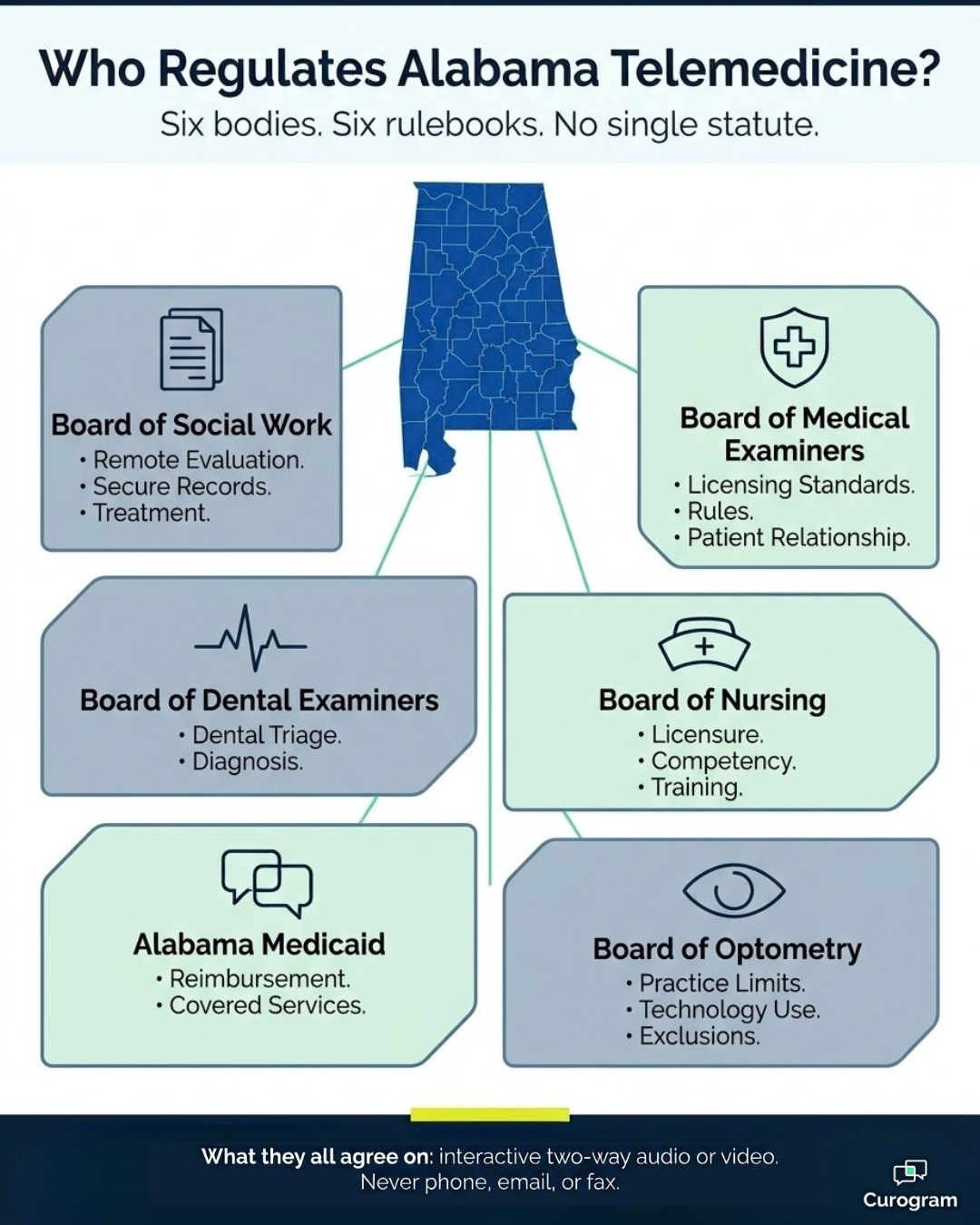
Alabama telemedicine laws and regulations do not live in one tidy place. There is no single statute you can read over coffee and walk away confident. The Medicaid provider manual says one thing, the Board of Medical Examiners says another, and the nursing, social work, and optometry boards each add their own language on top.
So practices end up guessing. They guess about which license covers a remote visit, whether a phone call counts, what has to be in a consent form, and which services Alabama Medicaid will actually pay for. Guessing wrong is expensive, because a visit that falls outside the rules is a visit that does not get reimbursed.
Your front desk feels it first. Staff field the same questions week after week, and nobody can point to a single document that settles them.
This guide pulls those scattered rules into one place. You will find how the state defines telemedicine, what licenses you need, what has to happen before a first visit, what Medicaid covers, where patients and providers are allowed to be, and how prescribing works.
Read it once, set your workflow, and stop guessing.
Unlike the majority of the states in the U.S., Alabama doesn’t have a precise definition of telemedicine noted in the state Medicaid policy. What the state does have, though, is a provider manual that explains how telemedicine is supposed to work:
Services have to be administered through an interactive audio or video telecommunications system which permits two-way communication between the distant site physician and the origination site where the recipient is located.
This doesn’t include a telephone conversation, electronic mail message, or facsimile transmission between the physician, recipient, or consultation between two physicians.
Telehealth Nursing is defined as ‘the practice of distance nursing care using telecommunications technology.’
According to the Board of Social Work, ‘telehealth is a mode of providing social work services through interactive audio, video or electronic communication occurring between a licensed social worker and the client, including any electronic communication for evaluation, assessment, treatment, and management of confidential information and case records in a secure platform.’
The Board of Optometry also describes telemedicine in the scope of their field:
‘As used in these regulations, a health service that is delivered by a licensed optometrist acting within the scope of his or her license and that requires the use of telecommunications technology other than telephone or facsimile’.
According to the Board, telecommunications technology should include, but not be limited to:
Alabama has no official parity law. It has state insurance law instead, in title 27, chapter 54. That law covers mental health and autism. The gap matters when you guess what a visit will pay.
The law points to the International Classification of Diseases. Every mental health disorder on that list is included. One is left out, and that is substance abuse.
Section 27-54-4 names these by name:
Three services are covered. They are inpatient care, outpatient care, and partial hospitalization. Each must come on "terms and conditions that are no less extensive" than other medical care. Insurers also have to "use the same criteria" they use for any other condition.
Large employer fully-insured plans should offer optional mental health coverage. That rule does not reach individual or small employer plans.
Large employer fully-insured plans should also offer extra autism coverage. The law names three conditions. They are Asperger's disorder, autistic disorder, and pervasive developmental disorder not otherwise specified.
Five kinds of treatment are covered. They are therapeutic care, behavioral health treatment, psychological care, psychiatric care, and pharmacy care.
After joining Interstate Medical Licensing Compact in 2015, Alabama made it super easy for physicians to tackle telemedicine. Unlike the licensure rules in some other states, physicians in Alabama can practice telemedicine without having a specific license for it.
All physicians need to have in order to practice telemedicine is a full traditional license obtained in Alabama, a special purpose license to practice telemedicine across state lines, or a license obtained via the Interstate Medical Licensing Compact.
As far as physician assistants are concerned, they need to have a license to practice as physician assistants and approved registrations to supervising physicians.
Before physicians examine or treat patients through telemedicine, they are required to obtain a patient’s informed and signed consent.
As far as rehabilitation services are concerned, there are some additional requirements that need to be mentioned in the consent, which you can read more about in the Provider Manual.
As soon as the COVID-19 broke out, the Alabama Department of Public Health (ADPH) released a notice on certain changes that took place during the epidemic and that are only temporary:
The medical director for telehealth at UAB, dr. Eric Wallace stated in an interview that telehealth isn’t about getting all of their visits remotely—it is about getting as many visits as possible remotely to prevent the spread while making sure that people who need care and need it in-person have that option.
If you’re looking to get into telemedicine, we suggest that you do it as soon as possible. There has never been a better time to hop on board with it, as it’s being used massively at the moment. To have a successful beginning, we recommend that you check Curogram out.
Curogram is a two-way texting platform that is designed specifically for medical practices. We implemented some of the most advanced features that are going to help you work with ease. Create your own workflows and virtual waiting rooms, dedicate more time to your patients, and book as many patients as you desire—Curogram will support your telemedicine journey like no other platform.
In collaboration with a hospital in Houston, we adapted our platform to solve some of the most important workflow needs of COVID-19 testing sites, including scheduling, automated screening, and communication.
Curogram helps identify who’s in the biggest need of testing, automates the entire screening process, reduces staff requirements by 75%, and increases the capacity of testing sites.
Although there is no information on store-and-forward reimbursement, Alabama Medicaid does reimburse for In-Home Monitoring for chronic heart failure and diabetes through the Alabama Coordinated Health Network program.
Under certain circumstances, Alabama Medicaid will reimburse for live video. Providers are not reimbursed for origination site or transmission fees, though.
Alabama Medicaid reimburses for the following services:
For some of these services, it is necessary that special conditions are present to be eligible for reimbursement.
There is no reimbursement for the following communication methods:
As we’ve already mentioned, all physicians and physician assistants who obtained a license in Alabama and who are enrolled as providers with the Alabama Medicaid Agency are eligible to provide telemedicine services.
According to the Provider Manual, to be able to provide these services, physicians are obliged to:
Providers who can practice telemedicine for Nursing Assessment and Care services for DMH Substance abuse and DMH Mental illness are:
The only services originating sites have to be located in Alabama for are rehabilitation services. If a physician is enrolled with Alabama Medicaid and has a license obtained in Alabama, the distant site can be located outside the borders of Alabama.
To provide rehabilitation services, healthcare workers need to be located in the following originating sites, according to the Provider Manual:

The Alabama Board of Medical Examiners states that a healthcare worker is supposed to examine the patient in-person before prescribing any medications, if possible. In case healthcare workers find it safe to prescribe controlled substances under certain circumstances, they are allowed to do so as long as they comply with all applicable federal and state laws.
As far as the Board of Optometry is concerned, service providers are allowed to prescribe controlled substances if they establish a proper doctor-patient relationship first.
To establish a proper doctor-patient relationship in Alabama, certain rules proposed by the Board of Alabama Medical Examiners need to be followed.
Healthcare workers involved in telemedicine are obliged to:
According to the Alabama Board of Nursing Administrative Code, nurses who want to get involved in telemedicine are required to do as follows:
Curogram is a two-way SMS messaging platform that is intended for medical practices. The goal of our platform is to enable you to work with ease while keeping track of all important records.
The platform has numerous features that help you work more efficiently, easily, and quickly. As soon as you start using Curogram, you will see immediate improvements in how you handle your work.
If you’re curious to know about Curogram’s advanced features, check these out:
|
Curogram supports HIPAA-compliant texting. |
We all know by now that texting is a preferred method of communication in this day and age. Ever since people started using Curogram, phone volumes have dropped by up to 50%, which only proves our previous statement. Exchanging text messages through Curogram is fully HIPAA-compliant, which is of great relevance in most states where telemedicine isn’t allowed to be practiced through channels that aren’t HIPAA-compliant. |
|
Curogram comes with the most advanced appointment reminders. |
Appointment reminders are handy, especially because we live in a world full of rushed activities that make us forget about important things, such as doctor appointments. You can set a 15–30-minute automated reminder for your patients to ensure that they show up on time. One of the main perks of telemedicine is that you don’t need to remind your patients hours and hours ahead—external factors, such as driving time, are eliminated. |
|
Curogram integrates with some of the best EHRs. |
EHRs are one of the most important security elements that ensure full safety against any risks. That’s why Curogram integrates with over 700 of the most popular EHRs. |
|
Curogram allows you to replicate real-life workflows. |
Since it was our goal to make our app as simple to get used to as possible, we’ve introduced the feature that lets you set up multiple virtual clinics, as well as waiting rooms. Your medical staff used to organized workflows will be able to adapt to these virtual settings in no time! |
|
Curogram facilitates internal communication and file sharing. |
If you need to share your patient’s record with one of your medical staff members, but also need the file exchange to be super secure, you can be at ease with Curogram. Feel free to communicate with your team and exchange any files you like—you will be completely safe! Since it was made for medical practices specifically, it is fully HIPAA-compliant. |
|
Curogram lets you send patient intake forms in the easiest way. |
Our platform allows you to send patient intake forms either via text or secure web forms. The forms will come back to you as PDF files in the blink of an eye. |
The Curogram platform is going to benefit you greatly both in the short and long run. It’s going to let you book as many patients as you like, which ultimately results in bigger revenue. You can also spend more time with your patients, which non-telemedicinal channels like Skype don’t enable you to do.
That’s one of the biggest perks of our platform—you get to organize your own workflow and schedule as many appointments as you want. There are no restrictions, so you can follow your natural working tempo.
Over 5,000 medical professionals have made Curogram their main workplace because it lets them focus on patients instead of data entry. Our users enjoy Curogram, especially because the platform automatically syncs all appointments and demographic data. This eliminates the need for double entry, which is a common thing for any other system.
If you’re curious about all the EHRs Curogram integrates with, check some of these out:
|
Curogram EHR integrations |
|
|
eClinicalWorks |
Athena |
|
Epic |
Cerner |
|
DrChrono |
NextGen |
|
Practice Fusion |
CareCloud |
|
Kareo |
OfficeAlly |
If you want to set up Curogram but are afraid that you don’t have enough time—fret not—the platform can be integrated only within 48 hours. The integration time is super quick because Curogram does not rely on complicated HL7 interfaces, which take ages to process.
All in all, Curogram provides all of our users with the ultimate efficiency. If you want to practice telemedicine in the easiest, most fuss-free way, Curogram will become your best friend instantly. The platform is intuitive, so you don’t have to worry about whether or not your technological skill set is enough. You will be able to use the app to its full potential, no matter your computer competence levels.
Don’t see your state? We just haven’t written about it yet! Stay tuned on our blog or check out our article on telemedicine reimbursement by state.
|
Nebraska |
|||
|
Alaska |
Iowa |
Nevada |
South Dakota |
|
Kansas |
New Hampshire |
||
|
Kentucky |
|||
|
New Mexico |
Utah |
||
|
Maine |
Vermont |
||
|
Connecticut |
|||
|
Delaware |
North Dakota |
||
|
West Virginia |
|||
|
Oklahoma |
|||
|
Mississippi |
Wyoming |
||
|
Montana |
Rhode Island |
Alabama did not build its telemedicine framework in one clean piece of legislation. It built the framework in layers, starting with the Interstate Medical Licensing Compact in 2015 and continuing through board rules, Medicaid manual updates, and emergency measures. That history is why the rules feel scattered today.
Once you line them up, though, the picture gets clear. You need a qualifying license, not a special telemedicine one. You need signed consent before the visit, every time.
You also need interactive two-way audio or video, because phone, email, and fax do not count here. And you need enrollment with Alabama Medicaid under the right specialty type if you expect to be paid.
The location rules are friendlier than most practices assume. Only rehabilitation services require an in-state originating site, which leaves a lot of room to serve patients across county lines and even from outside Alabama. For a state with as many rural communities as this one, that flexibility is the whole point.
Prescribing and doctor-patient relationship rules deserve the most care. Verify identity, document your reasoning, and stay available for follow-up. Those three habits protect your patients and your practice at the same time.
What is left is the operational side, and that is usually where good intentions break down. Consent forms, reminders, intake documents, and follow-up messages all have to move between your staff and your patients without anyone dropping a step. Doing that by phone adds hours to every week.
That is the gap a communication platform closes. If you want to see how HIPAA-compliant texting, automated reminders, and EHR syncing fit into a telemedicine workflow, you can book a Curogram demo and walk through the platform with someone who knows healthcare.
Frequently Asked Question
Yes. Licensed providers can deliver care remotely here. The state has been widening access since it joined the Interstate Medical Licensing Compact in 2015. The rules come from Alabama Medicaid and from each board, not from one state law.
No separate telemedicine license is required. You need one of three things. Those are a full Alabama medical license, a special purpose license for care across state lines, or a Compact license. Physician assistants need their own license plus approved registrations to supervising physicians.
Yes, for live video in some cases. Five services are covered. They are psychiatric diagnostic services, consultations, office or other outpatient visits, neurobehavioral status examination, and individual psychotherapy. Fax, email, phone calls, and site or transmission fees are not paid.
The Alabama Board of Medical Examiners expects an in-person exam first, when that is possible. Controlled substances may still be prescribed remotely. The provider has to find it safe and follow every federal and state law that applies. Optometrists may prescribe once a proper doctor-patient relationship is in place.
No. Alabama has no official parity law. Mental health and autism coverage do appear in state insurance law, under title 27, chapter 54. Those rules apply to large employer fully-insured plans, not to individual or small employer plans.
1 min read
💡 Telemedicine in Arkansas is legal, and payers cover it. The state Telemedicine Act sets the rules. You need an active Arkansas license. You also...
1 min read
💡 Telemedicine is legal and widely covered in Virginia, but three rules decide whether a visit is valid and paid.First, licensing follows the...
1 min read
💡 Telemedicine in Maryland runs on three sets of rules: state insurance law, Medicaid policy, and licensing board rules. The Preserve Telehealth...