
 Michael Hsu
Telemedicine in California | Blog
 Michael Hsu : 6/10/20, 8:52 AM
Learn how California's top health providers launched profitable, streamlined, and compliant telehealth services in our guide to telemedince in...

Most Virginia practices assume that if a payer covers a telehealth visit, it pays the same as the office version. That assumption costs money.
Virginia requires coverage parity, meaning a plan can't refuse a service just because it happened on video. Payment parity is a different rule, and Virginia doesn't have it. Your reimbursement rate still follows whatever your contract with that plan says.
That gap is a good preview of how telemedicine works here. The law is genuinely favorable, and it has been since 2010, when Virginia passed one of the country's earliest parity laws. What trips practices up is the fine print underneath it.
Our thesis is simple: telemedicine in Virginia is easy to practice and easy to get wrong on the billing and compliance side, and the details that matter most have changed recently.
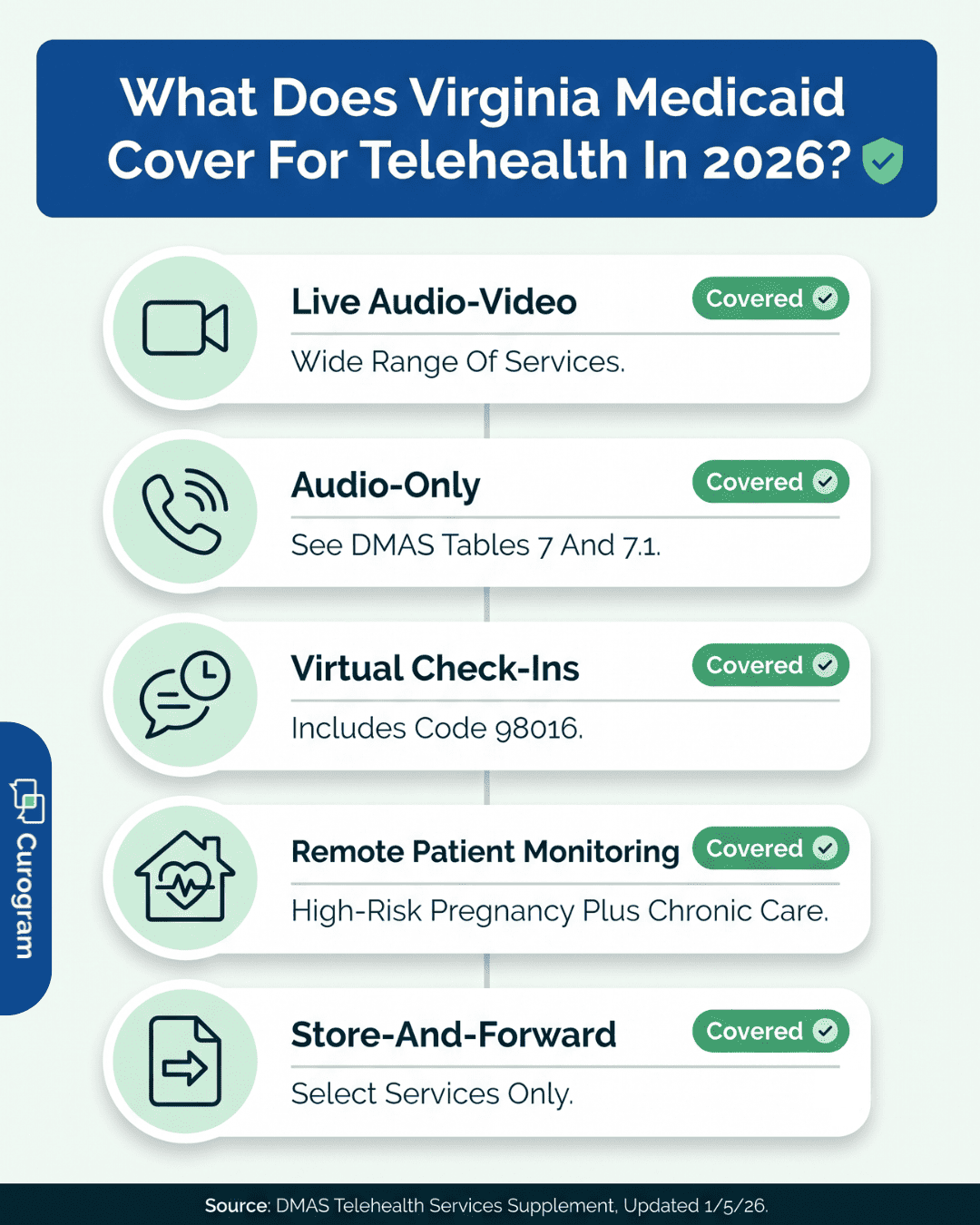
Some examples of what shifted. Virginia Medicaid now reimburses audio-only visits and virtual check-ins, not just live video. Remote patient monitoring expanded in 2025 to cover high-risk pregnant patients.
Since 2023, a telehealth-only provider no longer needs a physical Virginia office to enroll as a Medicaid provider. And federal rules allowing telehealth prescribing of controlled substances carry a hard expiration date of December 31, 2026.
Other things haven't moved at all. Virginia still isn't part of the physician licensure compact, so cross-state care means applying to the Board directly.
The Board of Medicine still expects the same standard of care you'd meet in person, along with verified identity, documented consent, and complete records.
Below we walk through who can practice, what the Board requires, what each payer covers, and where the schedule gaps quietly cost practices revenue.
Doctors have used technology in care for decades. Telemedicine changed the visit itself: a real appointment can happen without the patient in the room.
Virginia law defines telemedicine as delivering healthcare through electronic media, including interactive audio or video, to diagnose or treat a patient, or to consult with another physician, when the parties are in different places. Some channels don't meet that definition on their own:
For patients, the biggest gain is access. People in remote areas reach primary and specialist care they'd otherwise travel hours to see. Less travel, shorter waits, and added services make the visit easier. Communication between providers and patients moves faster, and so do peer-to-peer consults.
Virtual visits also take pressure off hospitals and clinics. A provider can sort out who truly needs a hospital or in-person visit and who doesn't. That cuts wait times and keeps acute and emergency care open for the people who need it most.
Cost is the other piece. U.S. healthcare spending per person stays high, and telemedicine gives practices a way to see more patients without adding overhead.
Providers and patients often mix up two words: telemedicine and telehealth. That distinction isn't always clear, and no federal definition draws a firm line between them.
States handle it differently. Some treat telemedicine as clinical care only, and telehealth as the wider category that also covers health education and disease prevention. So a term that means one thing in one state can mean something broader in the next.
Virginia keeps it simpler. State officials don't draw a hard line between the two, so providers here can treat them as synonyms. Telemedicine shows up more often in Virginia's legal text, which makes it the more common word in practice.
Under § 38.2-3418.16, telemedicine services mean using electronic media, including interactive audio or video, to diagnose or treat a patient, provide remote patient monitoring, or consult with other providers. That holds no matter where the patient sits at the time.
The same statute spells out what doesn't count. Audio-only phone calls, email, fax, and online questionnaires aren't telemedicine services on their own. Even so, the law doesn't block coverage for those under a different label, so a real-time audio-only call can still be covered as something other than telemedicine.
Wording matters more than it looks here. That label decides which rules and which coverage apply to a given visit.
A service that qualifies as telemedicine falls under the coverage protections in the statute above, while a plain follow-up phone call sits in a different bucket with its own billing path. For your front desk, getting the terms straight up front keeps claims coded correctly and cuts down on denials.
The Virginia Board of Medicine (VBM) provides extensive and precise guidelines for telemedicine providers. One idea runs through all of them: the standards you meet in person, you also meet on screen. Patient safety drives the guidance, which shows how to apply existing law to a virtual visit.
For most of telemedicine, Virginia's General Assembly hasn't written separate statutory rules. One exception stands out: prescribing controlled substances now carries its own statutory parameters.
Outside that, you follow the same rules and regulations that govern in-person care, and the Board's guidance shows how to read them for a virtual setting.
VBM answers the questions practices ask most:
We walk through each below.
Virginia, like most states, treats the patient's location as the place of care. So a provider treating a patient who is physically in Virginia needs a valid Virginia medical license.
The reverse holds too. A Virginia-based provider treating a patient in another state needs a license in that patient's state. Things get complicated near borders, or when one provider serves patients across several states.
The Interstate Medical Licensure Compact (IMLC) is a program that strives to make cross-state licensing easier. Virginia has not joined IMLC yet. As of 2026, Virginia remains one of a small group of states outside it, so physicians who want to treat Virginia patients still apply directly to the Board.
Virginia does offer a couple of narrower paths, including an expedited licensure agreement with Maryland and D.C., and follow-up by phone or email for a patient you already have an established relationship with.
One more exception covers provider-to-provider consults. A Virginia physician can seek advice from a colleague who isn't licensed here. That lets an out-of-state specialist weigh in on a Virginia patient's care, as long as a Virginia-licensed physician stays the primary provider.
VBM accepts telemedicine as a valid way to start a doctor-patient relationship, as long as you meet the same standard of care you'd meet in person. The state and federal laws that govern the relationship in traditional practice apply to a virtual visit too.
Before a first virtual visit, the Board expects three steps:
One caution on channels. Email, texts, fax, and audio-only calls don't establish a new relationship on their own, so a first visit built on any of them doesn't meet the standard. Those channels still have a place for follow-up care once a valid relationship exists.
Before treatment starts, you evaluate the patient to the same standard you'd use in person. VBM expects that evaluation to cover three things:
Virginia's in-person standard of care sets the floor, and a virtual visit has to meet or beat it. Document what you find, since the record is what shows the evaluation held up.
One limit is worth naming. An evaluation run only through email, an audio-only call, a text, or a fax doesn't meet Virginia's standard of care for establishing treatment.
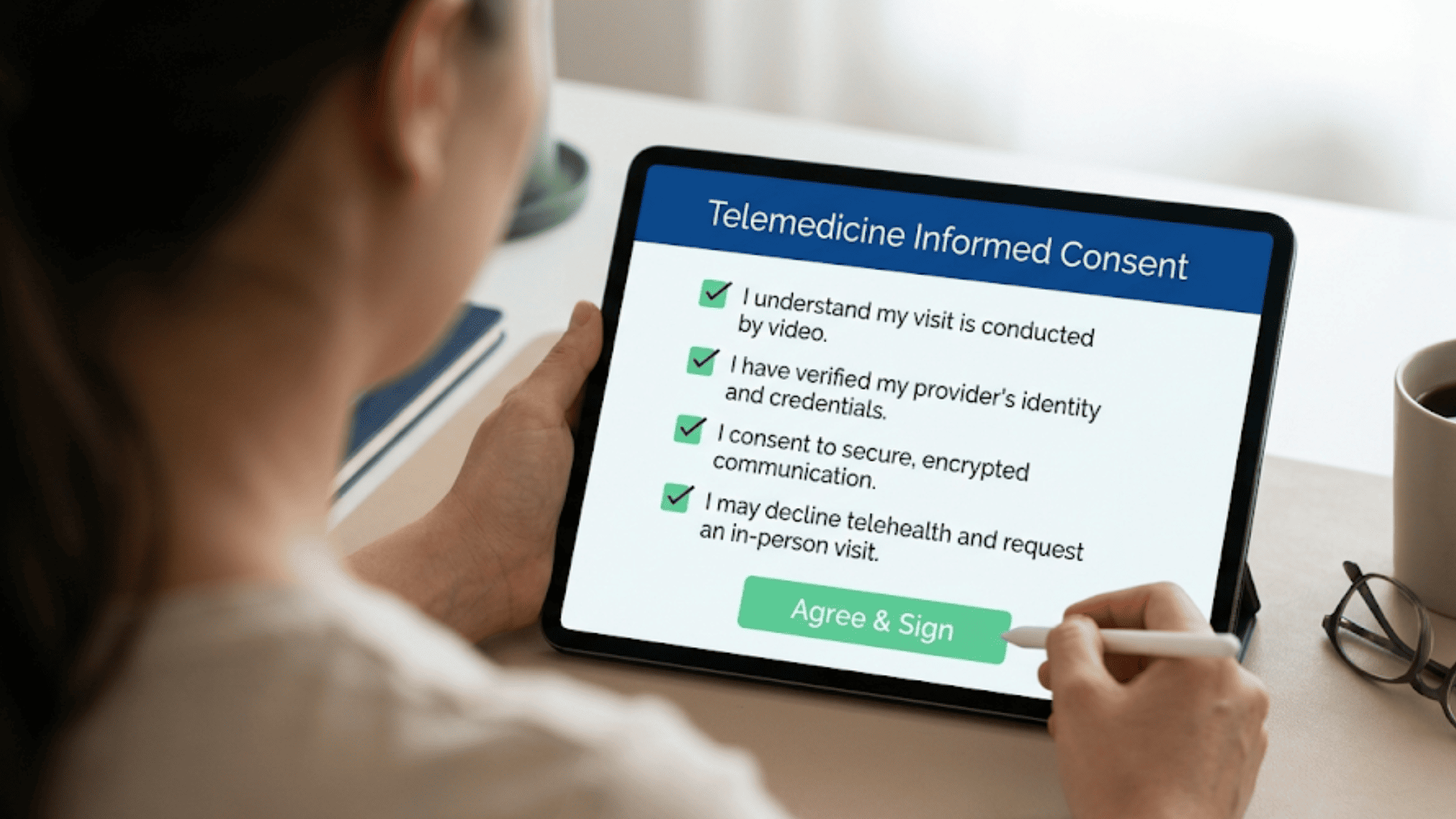
Yes. In Virginia, you don't start telemedicine treatment without informed consent from the patient. The consent should capture six things:
Keep that signed consent in the patient's medical record, since it's your proof the step happened.
Medical records follow the same rules as in-person care. VBM expects clear, complete records for every telemedicine patient, not only the ones you see in person.
A complete record should hold:
Patients can request their records, and you keep them available. You don't forward that data to a third party without the patient's approval.
You can prescribe medication by telehealth in Virginia. Online prescriptions follow the same state and federal laws as in-person prescribing, and the clinical call stays with you: indication, safety, and whether the prescription fits the patient.
Virginia favors e-prescribing to cut errors, and every electronic prescription should carry your contact details so a pharmacist can reach you with questions.
Controlled substances are the area with real movement. A COVID-era federal waiver lets providers prescribe them by telehealth without a prior in-person visit, and the DEA and HHS extended that flexibility again. The current extension runs through December 31, 2026.
Under it, a DEA-registered provider can prescribe a Schedule II-V controlled medication by telemedicine without an initial in-person exam, as long as it's for a legitimate medical purpose and follows all federal and state rules.
Audio-only telemedicine stays allowed for certain opioid use disorder medications. A permanent framework is in the works, including a proposed Special Registration for Telemedicine, but it isn't final yet. This one carries a hard 2026 date, so it's worth watching.
Two standing rules still hold. You shouldn't steer patients toward a specific pharmacy, and you shouldn't take incentives from one.
Privacy sits at the center of the provider-patient relationship. You have to keep patient information safe from breaches and loss.
That is why the communication channels that are being used in telehealth practice must be HIPAA-compliant. Store and protect that medical information with encryption and passwords.
VBM also wants written protocols for documenting, keeping, and transmitting every telemedicine record. Those protocols should cover:
Virginia's 2010 parity law set the foundation for telemedicine reimbursement, and it was one of the earliest in the country. It mandated the coverage for telehealth services to private payers and Medicaid. That head start is a big reason virtual care took hold here.
Two terms get blurred, and the gap between them matters: coverage parity and payment parity.
Coverage parity means a plan has to cover a telehealth service it would cover in person. Payment parity would mean paying the same rate for it. Virginia requires the first, not the second.
So a covered virtual visit still gets reimbursed at whatever your plan contract sets, not automatically at the in-person rate. Insurers can also apply the same prior authorization, network, and medical policy rules they use for in-person care. Building that into your revenue math keeps projections honest.
The protections still carry weight.
Under Virginia Code § 38.2-3418.16, a plan can't exclude a service just because it was delivered by telehealth, and any copay, coinsurance, or deductible can't run higher than the in-person equivalent. That commercial requirement applies to plans issued or renewed on or after January 1, 2021.
Medicaid runs on its own rules, and its coverage has broadened well past live video since then. We break down both payers in the sections below.
Here's how the main modalities line up by payer today:
| Modality | Medicaid | Private payers |
|---|---|---|
| Live telemedicine | Yes | Yes |
| Remote patient monitoring | Medically necessary only | Medically necessary only |
| Store-and-forward | For specific diagnoses | Not required |
Private insurers should reimburse live video telemedicine the same way they'd cover the equivalent in-person service. They can't refuse coverage just because a visit happened by telehealth.
Patient cost-sharing has a ceiling too. A copay, coinsurance, or deductible for a telehealth service can't run higher than what the patient would owe for the same service in person.
Store-and-forward is different: insurers aren't required to cover it, though many do, and it depends on an office visit between the provider and patient. Medically necessary remote patient monitoring must be covered.
Under Virginia's parity law, eligible originating sites include:
Coverage doesn't change based on where that site sits. Private payers treat rural and urban originating sites the same.
Virginia Medicaid defines telemedicine and telehealth as the real-time or near-real-time exchange of medical data through interactive audio and video, for diagnosis and treatment.
That's the core definition, though DMAS now covers more than live video, including audio-only visits, virtual check-ins, and remote patient monitoring under its current Telehealth Services Supplement.
Live telemedicine is reimbursed, and store-and-forward or remote patient monitoring can be covered at the program's discretion. Remote monitoring reaches chronic or acute conditions, and since 2025 it also covers high-risk pregnant patients.
Conditions like congestive heart failure, cardiac arrhythmias, diabetes, anticoagulation therapy, and pulmonary disease have qualified for monitoring.
Licensing decides who can bill. To treat a Virginia Medicaid patient, a provider needs appropriate Virginia licensure, since care happens where the patient sits.
One old barrier is gone: as of 2023 (HB 1602 and SB 1418), providers and groups that work only by telemedicine no longer need a physical Virginia office or in-state address to enroll as a Virginia Medicaid provider.
DMAS also sets which originating sites, providers, and services qualify. The current Supplement runs broader than any short snapshot, but here's a sample of each list:
| Eligible originating sites | Eligible providers | Eligible types of service |
|---|---|---|
| Provider offices | Physicians | Evaluation and management |
| Rural Health Clinics | Nurse practitioners | Psychiatric care |
| Hospitals | Nurse midwives | Speech therapy |
| Renal units | Psychiatrists | Specialty medical procedures |
Software decides whether virtual care runs smoothly or eats your day. You want a tool that's reliable, HIPAA compliant, and easy for staff to use, with real support when something breaks mid-clinic. Get that right, and you free up staff, see more patients, and cut downtime.
We at Curogram, offer advanced two-way texting features, multi-user video chat, internal messaging system, and virtual clinics and waiting rooms. Each one is built to keep telemedicine visits efficient and secure, and to keep the messages around a visit in the same place as the visit itself.
Our front-desk suite handles the patient communication side, so your practice can:
Curogram connects with any EMR and works as an add-on, so appointment data flows in and your team skips double entry. That keeps staff focused on patients instead of manual records. For the current list of systems we support, See more integrations here.
Beyond the visit itself, we help with the workflow around it. We offer comprehensive software and IT solutions that can help with scheduling and payment.

Virginia's telemedicine rules changed fast during the pandemic, and a lot of what began as an emergency fix became lasting policy. Regulators in Richmond and Washington moved quickly. Looking back explains the setup practices work under today.
At the time, advocates pushed to widen coverage for remote patient monitoring. Bill 1970 and Bill 1221 were part of that effort, aimed at reaching more chronic-care patients. Those specific bills stalled, though the goal behind them carried forward.
Virginia later expanded remote monitoring through other measures, including 2025's House Bill 1976, which added coverage for high-risk pregnant patients alongside chronic and acute conditions.
The state's Telehealth Services Supplement now reimburses audio-only visits and virtual check-ins, and a 2025 measure widened covered consultations to include patient-generated ones.
Since 2023, providers who work only by telemedicine no longer need a physical Virginia office to enroll as a Medicaid provider.
Some federal flexibilities outlasted the emergency too. Federal regulators kept telehealth prescribing of controlled substances open, and the current extension runs through December 31, 2026. Medicare made audio-only telehealth permanent as of January 1, 2025, for patients who can't or won't use video.
Interstate licensing was the other big push. As states scrambled to cover demand, letting out-of-state providers practice across state lines gained momentum. Virginia held its ground, and a provider still needs a valid Virginia license to treat a patient located here.
The state has not joined the physician licensure compact, and that stays true in 2026. Physicians who want to treat Virginia patients still apply directly to the Board of Medicine.
Don’t see your state? We just haven’t written about it yet! Stay tuned on our blog or check out our article on telemedicine reimbursement by state.
|
Nebraska |
|||
|
Alaska |
Iowa |
Nevada |
South Dakota |
|
Kansas |
New Hampshire |
||
|
Kentucky |
|||
|
New Mexico |
Utah |
||
|
Maine |
Vermont |
||
|
Connecticut |
Virginia |
||
|
Delaware |
North Dakota |
||
|
West Virginia |
|||
|
Oklahoma |
|||
|
Mississippi |
Wyoming |
||
|
Montana |
Rhode Island |
See how Curogram keeps Virginia patients showing up for their telehealth visits. Book a demo and we'll walk your front desk through texting, reminders, and virtual visits on your actual workflow.
 Michael Hsu : 6/10/20, 8:52 AM
Learn how California's top health providers launched profitable, streamlined, and compliant telehealth services in our guide to telemedince in...
 Michael Hsu : 6/13/20, 9:03 AM
Learn how Arkansas top telehealth providers launched profitable, streamlined, and compliant telemedicine services in Arkansas.
 Michael Hsu : 6/20/20, 10:49 AM
The provider's ultimate guide to telemedicine in Maryland. Learn how to streamline your telehealth business and keep ahead of the competition.