
 Michael Hsu
Telemedicine in California | Blog
 Michael Hsu : 6/10/20, 8:52 AM
Learn how California's top health providers launched profitable, streamlined, and compliant telehealth services in our guide to telemedince in...

Ask ten Illinois practice managers whether insurers have to pay for a video visit, and you will get ten different answers. Some will tell you that coverage is optional. Others will insist the rules ended along with the pandemic. A few gave up on virtual visits because the billing felt too messy.
Most of them are working from outdated information.
Illinois rewrote its telehealth rules in 2021, and the changes were bigger than most practices realize. Coverage is no longer the insurer's choice, and payment rates are protected. Your patients no longer have to sit inside a clinic to see you online.
If your team still turns away video visits, you are leaving money behind.
Here is a sample calculation.
Say you see 40 patients a week, and 3 of them would rather handle a routine follow-up by video. At $95 a visit, that comes to $285 a week, or roughly $14,800 over a year.
That is just three patients. Run the same math across a six-provider group and you clear $88,000 in annual revenue.
The catch is that Illinois telemedicine law lives in several separate documents. The Telehealth Act sets the terms, while the Insurance Code covers private plans. Medicaid handbooks control how you bill. Federal rules sit on top of everything, and one major rule expires this year.
This guide gathers all of it in one place. You will learn who can practice telehealth in Illinois, what plans must cover, how Medicaid pays, and what you can prescribe online. You will also learn which deadlines are approaching.
No legal jargon. Just what your practice needs to get paid.
We’ll review the definitions of telehealth and telemedicine found in two places:
The Illinois Compiled Statutes contain the Telehealth Act, a document that outlines how the state views remote healthcare. Illinois defines telehealth as any interaction between a licensed healthcare professional and a “remote location” that involves diagnosis, evaluation, treatment recommendations, and interpretation of electronically transmitted patient data.
Telemedicine is defined as the delivery of healthcare services through an interactive system for telecommunication. The Illinois Insurance Code clarifies further what these systems are any interactive, two-way video or audio communication channels.
The Illinois Administrative Code (IAC) compiles administrative rules of state agencies. The Code provides definitions relevant to the telehealth services providers covered by the Department of Healthcare and Human Services’ (HHS) medical programs.
This means that if you’re hoping to get reimbursed by Medicaid, your telehealth services need to fall within the scope of the definitions provided by the Code.
According to IAC, telehealth entails services provided through a telecommunication system. The document does not specify which services, leaving the definition incomplete.
Telemedicine is defined as the use of any system, synchronous or asynchronous, for the evaluation and treatment of a patient who is at one medical provider location by a provider who is at another one. This means that the patient must be at a hospital, clinic, or another medical facility at the time of the telemedicine encounter.
IAC also includes the term “telepsychiatry,” which means providing psychiatric services remotely under the same conditions that apply to telemedicine. Remote psychiatric care is allowed but only for inpatient care.
You can still treat patients remotely even if they aren’t in a medical facility—it is not forbidden by law—but HHS’ medical payer programs won’t reimburse you for your efforts. We will discuss HHS’ telehealth rules and regulations for Medicaid in great detail later in the article.
The core rule is short. If your patient is in Illinois, you must be licensed here. You also have to meet the same standard of care you would meet in the exam room. And you have to stay inside your scope.
Telehealth does not lower the bar. It just changes the room.
The list of providers who can practice telehealth here is long. It covers:
A 2025 law added clear telehealth rights for physical therapists. That fixed a gap that used to spark billing fights.
Telehealth practice in the state is not limited to Illinois-based providers.
The great news for out-of-state practitioners who wish to provide telehealth services in Illinois is that the state is a member of two interstate medical alliances:
The state’s membership with these two compacts makes it easier for both physical and mental health professionals to obtain the authorization to practice telemedicine in Illinois.
The providers holding one of the two interstate licenses must abide by the same rules and regulations as Illinois-based practitioners when providing telehealth services to Illinoisians.
Illinois has no separate law on what you may prescribe by video. Your judgment rules, and so does the in-person standard of care.
The real deadline is federal.
The DEA and HHS have pushed back the pandemic prescribing rules several times. The current window runs through December 31, 2026.
Here is what it allows without an in-person exam first:
| What you can prescribe online | How | Through |
|---|---|---|
| Schedule II–V controlled substances | Video visit | December 31, 2026 |
| Schedule III–V narcotics for opioid use disorder | Phone visit | December 31, 2026 |
So your prescribing workflow has an end date. The DEA is still writing the permanent rule.
The safe move is simple. Keep clean notes on every remote prescription now, and watch for the final rule before the year ends. Practices that build the habit early will not scramble in January.
|
Key takeaway: The costliest telehealth mistake in Illinois is not a billing error. It is assuming coverage is optional. Since 2021, private plans must cover telehealth the same way they cover office visits, and they cannot charge your patient a higher copay for going online. If your front desk still hedges about coverage, that script is costing you visits. |
The law doesn’t say anything about patient consent. As you are not legally obligated to obtain it, you can start a telemedicine session without worrying about it.
Even though Illinois law doesn’t mandate getting informed consent, it is still advisable to do so. On the federal level, the Health Insurance Portability and Accountability Act (HIPAA) obliges you to keep your patient data private and secure.
Telemedicine platforms often come with the risk of data breaches, and it would be reasonable to inform your patients about this issue.
This is also why choosing the right platform for online patient care is essential. Instead of going for a consumer app that comes with many risks, you should opt for a healthcare-specific, 100% HIPAA compliant one, such as Curogram. Our platform has all the technical safeguards in place to ensure all protected health information (PHI) you exchange with your patients is safe.
|
Curogram EHR integrations |
|
|
eClinicalWorks |
Athena |
|
Epic |
Cerner |
|
DrChrono |
NextGen |
|
Practice Fusion |
CareCloud |
|
Kareo |
OfficeAlly |
There’s always a back-and-forth between insurers and states regarding telehealth services coverage. The former often argue that they should determine the reimbursement rates for telehealth, whereas the state lawmakers try to impose parity, which would oblige them to pay the same rates as they would for the corresponding in-person services.
When it comes to reimbursement for telehealth services in Illinois, there are two coverage options:
This is where the law shifted most, and where outdated advice does the most damage. Illinois passed a telehealth parity law in 2021. Governor Pritzker signed it on July 22 of that year.
It delivered two separate protections.
Coverage parity means a plan must cover telehealth, e-visits, and virtual check-ins just like any other benefit. The care has to be medically necessary and clinically appropriate. Payment parity means in-network telehealth earns the same rate as the same service given in person.
There is a clock on the second protection. Payment parity ends on January 1, 2028 for most services. It stays in place for good when the care involves mental health or substance use.
The law also blocks a long list of insurer tactics:
| Insurers cannot | What it means for you |
|---|---|
| Require an office visit first | You can treat a new patient by video |
| Ask you to prove the patient faced a travel barrier | No paperwork on why they could not drive in |
| Limit where the patient sits | Home visits are covered |
| Require staff in the room with the patient | No escort needed on the patient's end |
| Charge higher copays or deductibles | Cost sharing must match in-person care |
| Add tougher prior approval steps | Online visits cannot carry extra red tape |
| Pick your platform for you | You choose, as long as it meets HIPAA |
That last row carries real weight. Your practice chooses the technology, and your practice owns the risk that comes with it.
Medicaid asks for more detail than private plans do. But it is no longer the narrow program it once was.
For telemedicine, the treating provider must be a physician, physician assistant, podiatrist, or advanced practice nurse. You need a license in Illinois, or in the state where your patient sits. For telepsychiatry, you must be a doctor who finished a psychiatry residency.
Behavioral health opens the list up. Illinois Medicaid pays psychiatrists, psychologists, social workers, and health centers. Epilepsy specialists are covered too.
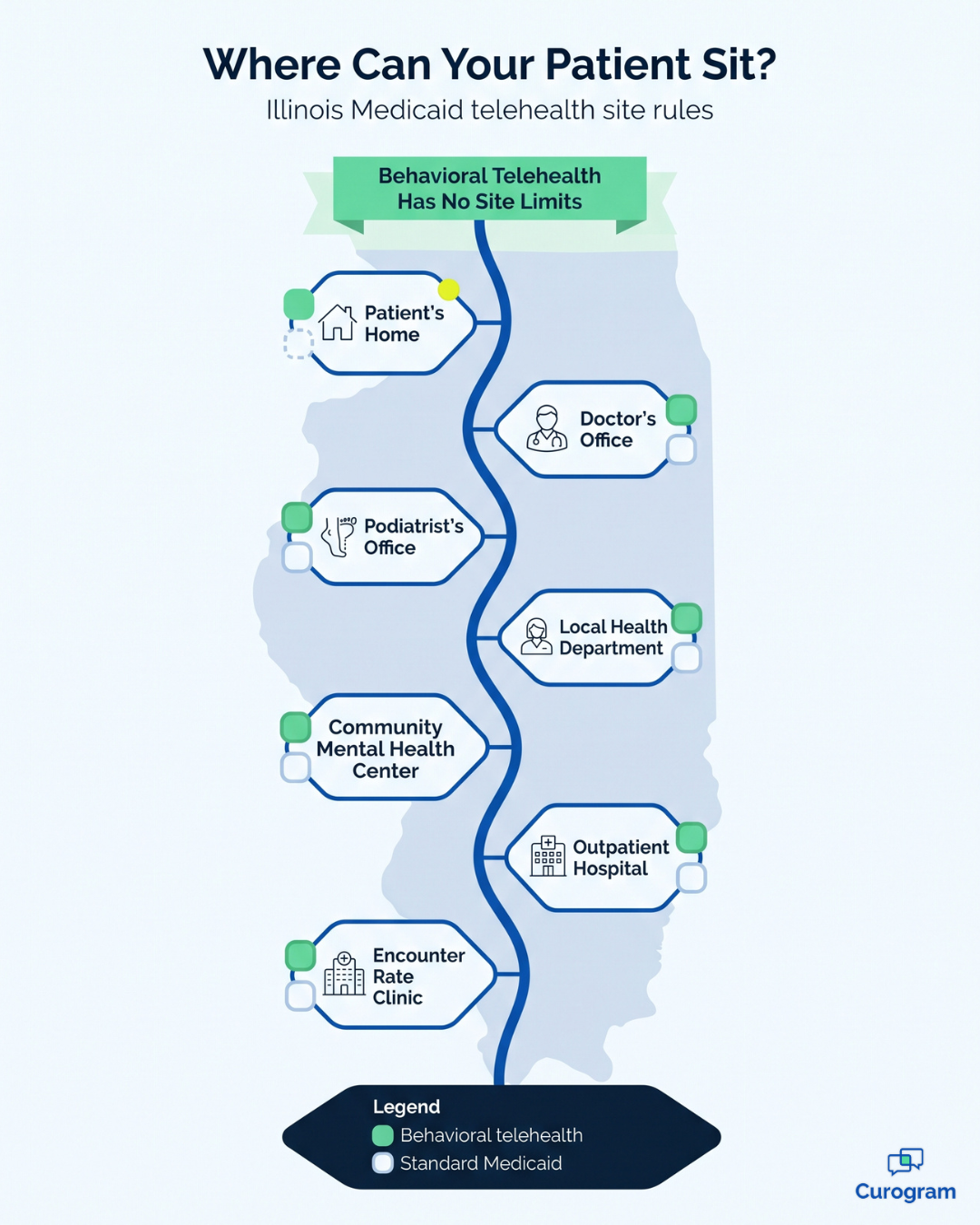
The state counts many places as a valid patient site. The list covers doctor and podiatrist offices, health departments, mental health centers, and outpatient hospitals. Each site can bill a facility fee.
Behavioral telehealth is different, and better. By law, Illinois Medicaid cannot set site or map limits on it. Your patient can be anywhere.
One old rule needs a direct fix. Illinois Medicaid stopped asking staff to sit with the patient back in January 2018. If your policy manual still says they must, change it.
Coding is where clean claims are won or lost.
Here are the codes that matter:
| Code | What it means | Use it when |
|---|---|---|
| Modifier GT | Audio and video | The visit used live video |
| Modifier 93 | Audio only | A phone visit met the same bar as an office visit |
| POS 02 | Telehealth outside the home | The patient was at a clinic |
| POS 10 | Telehealth in the home | The patient was at home |
| Q3014 | Site fee | You hosted a patient for someone else's visit |
Group therapy is still not covered. That one gap causes a lot of denials.
As you have seen, Medicaid usually doesn’t offer reimbursement for seeing your patient unless they’re at a medical facility already. It is clear that the state is still suspicious about the use of telecommunication channels for remote patient care.
There are two instances of remote patient monitoring that Medicaid will cover:
These come with their own sets of requirements, which makes it even more obvious that you’re unlikely to get any money from Medicaid practicing telemedicine.
Due to the national health crisis caused by the spread of COVID-19, Governor Pritzker issued Executive Order 2020-09 to expand the scope of what the state considers telehealth services as well as the technology that can be used. The Order loosens the Medicaid regulations significantly and presents a great example of how the Telehealth Act could be revised in the near future.
On the federal level, the HHS’ Office for Civil Rights issued legislation that allows providers to use non-HIPAA compliant remote communication technologies for as long as the national emergency lasts.
Illinois decision-makers did not stop at relaxing the legal requirements for telehealth practice—they introduced a program for monitoring patients with milder symptoms of the virus through the use of telemedicine.
This might be the right time for the State of Illinois to realize how useful telehealth can be and make some of the temporary changes permanent.

Whether you’re transitioning to telemedicine or broadening the scope of your services to include online medical care, Curogram is the right solution for you.
There’s no need to test your luck and your patients’ patience by using an inadequate platform that could compromise their sensitive data. Curogram provides you with a top-of-the-line messaging and telemedicine platform designed for use in healthcare.
Choosing the familiarity of a consumer app over the efficiency of our medical platform will cost you and your clinic a lot in the long run. You shouldn’t be afraid of a learning curve because there isn’t one—your patients will receive appointment reminders and visit links in an SMS! You get a real local number for texting that your patients can save in their contacts.
Your staff will love Curogram as it will allow them to communicate with everyone—be it patients, colleagues, or partner providers— from a single dashboard! There’s no need for dedicated business phones or other devices.
Your doctors won’t have to waste time prepping the patients or dealing with tedious administrative tasks—Curogram streamlines the appointments and makes it possible for doctors to see patient after patient without hindrances.
The best thing about it—Curogram integrates with any electronic management system in less than 48 hours.
|
Features of Curogram you’ll love |
|
|
Electronic patient forms |
Curogram lets you send electronic intake forms before the appointment to save time. We can digitize all your standard forms and make them mobile-friendly. Your patients will be able to e-sign documents straight from their smartphone. |
|
Virtual waiting room |
The best way to support your clinic’s natural workflows is by replicating the patient waiting room online. Curogram’s virtual waiting room allows you to line your patients up for appointments and streamline the whole process. Nurses and MAs can join them while they’re waiting and prep them so that when a doctor takes over, they can focus on patient care in the most efficient way possible. |
|
Smart appointment reminders |
As Curogram syncs with your EHR, it connects with your appointment schedule as well. This feature allows our app to send 500,000+ auto-generated visit reminders every month so that your staff members don’t have to sit on the phone all day. You can customize these fully, and your patients can even reply to them if they have any follow-up questions. |
|
HIPAA-secure mobile app |
You can use Curogram across all devices. Our mobile apps are 100% HIPAA secure, and you can use them to exchange sensitive PHI internally. We also offer a patient app, which they can download for free to get their medical records in a safe way. |
|
Reputation management |
Curogram’s automated SMS surveys can help you boost your clinic’s online ratings and reviews in no time. This feature pinpoints the most satisfied patients and sends them five-star online rating requests, which they can fulfill with a single tap. |
Don’t see your state? We just haven’t written about it yet! Stay tuned on our blog or check out our article on telemedicine reimbursement by state.
Telemedicine by State in the US
|
Nebraska |
|||
|
Alaska |
Iowa |
Nevada |
South Dakota |
|
Kansas |
New Hampshire |
||
|
Kentucky |
|||
|
New Mexico |
Utah |
||
|
Maine |
Vermont |
||
|
Connecticut |
|||
|
Delaware |
North Dakota |
||
|
West Virginia |
|||
|
Oklahoma |
|||
|
Mississippi |
Wyoming |
||
|
Montana |
Rhode Island |
Illinois now ranks among the friendlier states for telehealth. That shift is recent. The 2021 parity law turned coverage from a favor into a rule.
Your patients can be treated at home. Their copay cannot rise because they chose video. And you pick the tech, not the insurer.
That last point is where most of the risk still sits.
Two dates belong on your calendar. Federal rules for prescribing controlled substances online expire December 31, 2026. Any workflow that leans on remote prescribing needs a look before then. Pay parity for most Illinois services ends January 1, 2028, though mental health and substance use care keep it for good.
Neither date calls for panic. Both reward practices that plan early.
The work in front of you is smaller than it sounds.
Confirm your platform has a signed business associate agreement. Update any policy that still asks staff to sit with the patient. Retrain the front desk to stop hedging about coverage, because in Illinois these visits are covered. Then check that your billers use the right modifier and site code every time.
Those four steps take an afternoon. They protect money you already earn and money you now turn away.
Your technology deserves the same attention. A platform built for healthcare handles the rules quietly in the background. That frees your staff to focus on patients instead of paperwork. It also closes the gap between a booked visit and a finished one, which is where most practices lose money without noticing.
Ready to see how secure texting and virtual visits fit together? Explore how Curogram supports telehealth practices in Illinois and see what a compliant setup looks like for your team.
Frequently Asked Question
 Michael Hsu : 6/10/20, 8:52 AM
Learn how California's top health providers launched profitable, streamlined, and compliant telehealth services in our guide to telemedince in...
 Michael Hsu : 6/13/20, 9:03 AM
Learn how Arkansas top telehealth providers launched profitable, streamlined, and compliant telemedicine services in Arkansas.
 Michael Hsu : 6/19/20, 10:40 AM
Looking to capture the telehealth market? Here are the best methods that will help you practice telemedicine in Virginia profitably and successfully.