
 Michael Hsu
1 min read
Telemedicine Virginia: A Comprehensive Guide
 Michael Hsu : 6/19/20, 10:40 AM
💡 Telemedicine is legal and widely covered in Virginia, but three rules decide whether a visit is valid and paid.First, licensing follows the...

Most guides to telemedicine in Tennessee still point to the 2015 parity law. That law is still on the books. Five amendments have landed on top of it since then. One came during the August 2020 special session. Four more followed in 2021.
Tennessee has rewritten its virtual visit rules again and again. Many practices still run on a version that expired several revisions ago.
Some of the changes are easy to miss. The Board of Medical Examiners stopped issuing telemedicine licenses. Physicians who kept the old one lost the right to prescribe. Audio-only calls used to be excluded outright.
They now count as billable provider-based telemedicine in narrow, documented cases. The state also split its insurance rules into two tracks. Each track sets a different rule for where the patient may sit, and one of them requires a prior in-person visit.
Federal rules moved on their own clock. OCR's pandemic allowance for consumer video apps closed on August 9, 2023.
The FaceTime setup a clinic built in 2020 needs a business associate agreement today. DEA prescribing flexibilities end December 31, 2026. Medicare's geographic and audio-only rules run through December 31, 2027.
A setup that was fully compliant in 2020 can be out of compliance now. Nothing visibly breaks to warn you.
What follows walks the rules as they stand: who can practice, how the doctor-patient relationship forms, what you can prescribe, what the chart must show, which channels qualify, and how private payers and TennCare pay. Each section flags where the answer has moved since 2020.
Tennessee's medical practice rules define telemedicine simply. Rule 0880-02-.16 describes it as the practice of medicine between a licensed provider in one location and a patient in another.
It typically runs on secure video conferencing or store-and-forward technology. The visit should mirror what happens in your exam room, with the two parties apart.
Several methods sit outside that definition. The Board doesn't count audio-only phone calls, email, instant messaging, or fax as telemedicine.
One wrinkle catches practices off guard. Tennessee's insurance statute now treats a HIPAA-compliant audio-only call as provider-based telemedicine when video isn't available, which makes it billable.
The Board's practice rule still leaves audio-only out. So the billing question and the practice-rule question get answered separately.
| Method | Counts Under Board Rule 0880-02-.16 | Billable as Provider-Based Telemedicine |
|---|---|---|
| Secure video | Yes | Yes |
| Store-and-forward | Yes | Yes |
| Audio-only call | No | Yes, in limited cases |
| Email or instant message | No | No |
| Fax | No | No |
Rural patients gain the most from telemedicine in Tennessee. Many rural counties have no specialist within easy driving distance, so a video visit replaces a half-day round trip.
Hospitals also see fewer low-acuity arrivals, which frees beds and staff for urgent cases. Costs fall on both sides. You spend less on room turnover, and your patients spend less on travel and time away from work.
Remote monitoring gets easier too. Blood pressure readings and glucose logs reach your team between visits, so a bad trend surfaces before it becomes an admission.
Tennessee lawmakers had a practical reason to widen access. Chronic disease runs higher here than in most states. The Sycamore Institute puts Tennessee's diabetes prevalence at 13% against a national rate of 10%, and hypertension at 39% against 31%.
Patients managing those conditions need frequent contact, and frequent contact gets expensive when every touchpoint requires a drive.
Triage is where the value shows up fastest. A short video visit tells your provider who needs to come in, who needs a test ordered first, and who can be managed at home. Patients who do need in-person care then arrive with the workup already started.
Spring 2020 rewrote virtual care in a matter of weeks. Estimates put the jump in telehealth use at 50 to 75 times pre-pandemic levels, with the majority of outpatient visits conducted by telehealth that spring. Roughly 80% of providers used telehealth at some point during the pandemic.
Three things kept care moving:
Patients with unrelated problems could be seen without sitting in a waiting room next to a possible COVID case.
Chronic care continued, since diabetes checks, blood pressure follow-ups, and medication changes all worked over video.
Hospital staff got room to focus on the hard cases, and fewer low-acuity arrivals meant fewer chances for the virus to spread inside the building.
Tennessee moved quickly on the payment side. HB 8002, passed during an August 2020 special session, required health insurers to cover virtual care the same way they covered in-person care through April 2022, adding reimbursement parity on top of the payment parity the 2016 law had already established.
Those temporary rules were replaced before they lapsed. Permanent telehealth and provider-based telemedicine statutes now sit at TCA 56-7-1002 and 56-7-1003.
Volume settled after the surge, and it settled well above 2019. Three independent measures show where it landed:
Demand is still climbing, if slowly. In the first quarter of 2026, 18.4% of patients filed at least one telehealth claim, up from 17.3% the quarter before. Mental health topped every diagnostic category, in every age group and every region.
The South, which includes Tennessee, posted a 9% relative increase over the previous quarter.
Whether the two words mean the same thing in Tennessee depends on which rulebook applies. Practice rules treat them as one. Insurance rules do not.
Sources: Legal Information Institute, MHA, AccountableHQ
Telehealth is the broader word in most usage, and Tennessee's own rules bear that out.
The Department of Mental Health and Substance Abuse Services defines telehealth as the distribution of health-related services and information through electronic and telecommunication technologies, covering both clinical and non-clinical services.
Health education and disease prevention sit inside telehealth. They aren't telemedicine
Federal law sets no single definition, so each state writes its own. That matters when you treat patients across state lines.
One detail trips up practices with out-of-state patients. Your licensure obligation follows the patient's physical location at the time of the visit, not the address on file.
A Tennessee patient who joins a video call from a hotel in Georgia counts as a Georgia patient for that appointment. Confirm the patient's location at the start of every session and document it.
.png?width=2000&height=1125&name=Telemedicine%20in%20Tennessee%20Rules%20and%20Regulations%20%20Blog-inline2%20(1).png)
The Tennessee Board of Medical Examiners sets the practice rules, and Rule 0880-02-.16 carries most of the detail. The governing statute is TCA 63-1-155.
It took effect July 1, 2015, and has been amended five times since: once in the August 2020 extraordinary session and four more times during 2021. Anything you read that stops at 2015 is describing a version that no longer applies.
Two rules shape everything below:
The Board requires no separate telehealth license.
No licensing board may impose a stricter standard of professional practice for telehealth than the provider's own practice act allows.
Practices took this up in two ways: some built a virtual service from scratch, and others folded video visits into an existing schedule.
Five questions come up most often, and the sections that follow work through each one:
One principle runs through all five. A provider delivering care by telemedicine is held to the same standard of professional practice as one working in person. Two carve-outs limit that rule.
Tennessee's Chronic Pain Guidelines govern telemedicine encounters and prohibit treating chronic pain this way, and the equivalent-standards rule does not apply to services delivered inside a pain management clinic.
Tennessee treats the practice of medicine as happening at the patient's location. Rule 0880-02-.16 states it directly: no one may practice medicine on a patient located in Tennessee without a license from the Board. The insurance statute uses the term originating site for that same patient location.
Your license obligation follows the patient. A patient who is physically in Georgia during the visit needs a Georgia-licensed provider, even when your office sits in Memphis and the patient's mailing address is in Tennessee.
Four exemptions appear in the rule:
| Exemption | What It Covers |
|---|---|
| Out-of-state consultation | A physician licensed elsewhere, called in by a Tennessee licensed or registered physician, on specific clinical or scientific aspects of medicine |
| Military physicians | US military physicians acting within federal jurisdiction and the regulations tied to their duties |
| Informal physician dialogue | Uncompensated professional discussion between physicians about aspects of the field |
| Rare and orphan disease consults | A recognized, highly specialized physician from another state or country consulting to a research hospital, with or without compensation |
One rule closes the gap those exemptions might seem to open. A physician under contract to provide or deliver medical services in Tennessee must hold a Tennessee license, whether or not the work is directly paid.
Cross-state licensing got faster when Tennessee joined the Interstate Medical Licensure Compact (IMLC). The compact speeds up applications rather than replacing them.
You still receive a full, separate license from each member state you apply to, and the board in the state where your patient is located holds jurisdiction over that care. You name a State of Principal Licensure, that board issues a letter of qualification, and other member states then license you on an expedited basis.
The IMLC covers physicians only. If your clinical staff includes nurses, physician assistants, psychologists, counselors, social workers, or therapists, check the compact tied to each license type.
Tennessee participates in roughly a dozen, spanning nursing, physician assistants, psychology, counseling, social work, occupational therapy, physical therapy, and speech-language pathology and audiology.
Tennessee doesn't require an in-person visit first. The Board's position is that a physician-patient relationship exists when a physician serves a patient's medical needs, whether or not an in-person encounter has taken place.
Under TCA 63-1-155, the relationship forms through mutual consent and mutual communication, except in an emergency. That consent can be express or implied.
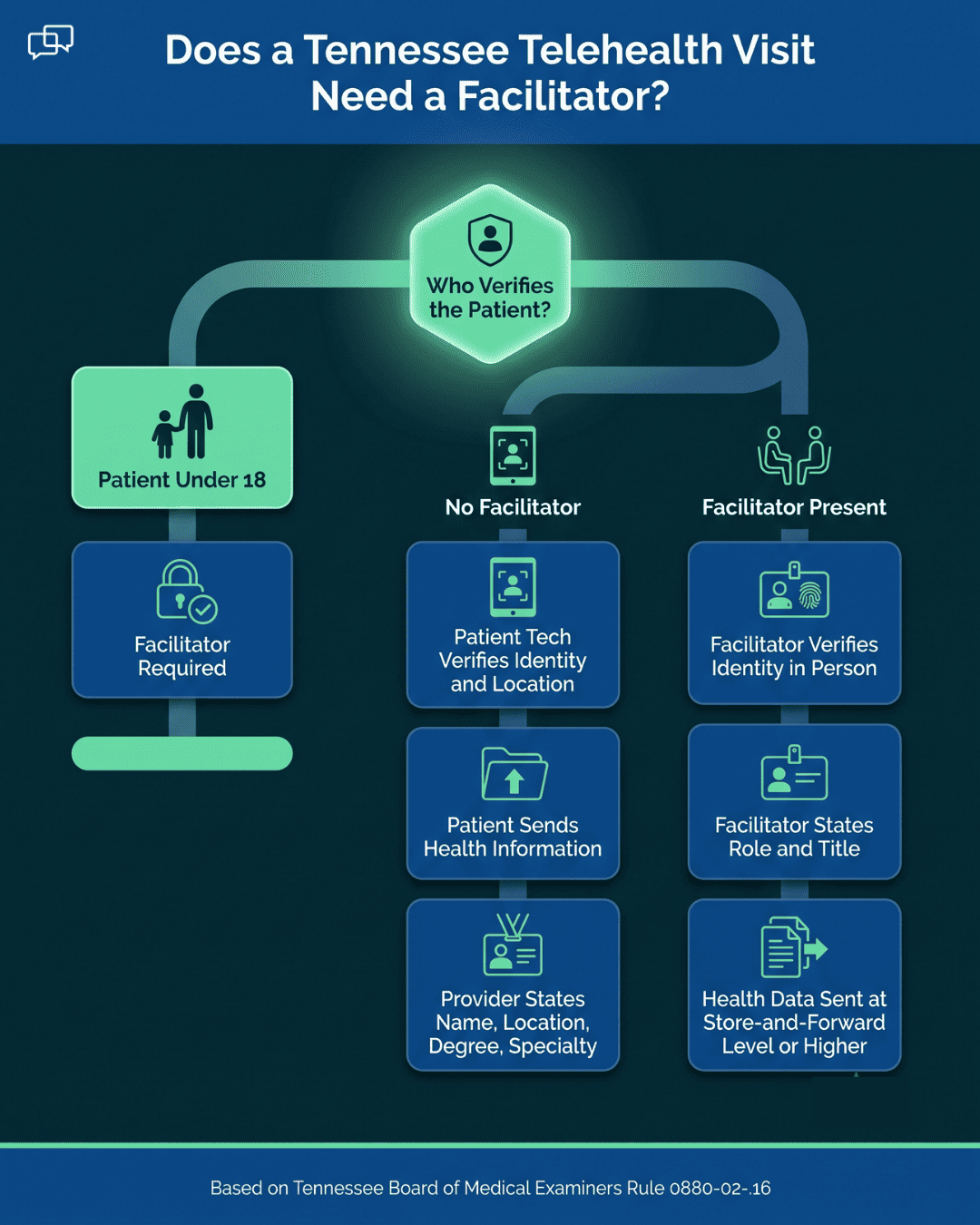
What the first encounter requires turns on one question: Is a facilitator physically with the patient?
A facilitator is often someone tied to a local system of care, or the patient's own parent or legal guardian. They must be physically present, and they handle verifying identity and location plus collecting and sending clinical data to you.
| Requirement | No Facilitator Present | Facilitator Present |
|---|---|---|
| Identity and location | The patient's technology must let you verify both with an appropriate level of confidence | The facilitator personally verifies the patient's identity |
| Health information | The patient transmits all relevant information at store-and-forward level or by secure video | All relevant information must reach you at store-and-forward level or higher |
| Introductions | You disclose your name, current and primary practice location, medical degree, and specialty area | The facilitator states their name, role, and title to the patient and to you, and you make the same disclosures |
Age changes the answer. No patient under 18 may be treated by telemedicine without a facilitator present, unless other law allows it. The Board has clarified that the facilitator doesn't have to stay for the entire encounter, though it may be recommended, and the physician should follow the standard of care in deciding.
The facilitator must still personally verify the patient's identity and state their role and title to the patient. For identity checks, the Board accepts government-issued photo identification, a facilitator, or both.
Two record duties attach to every telemedicine encounter:
You should have the patient's records on hand or be able to pull them during the visit.
You must also document that the encounter took place by telemedicine and name the technology used.
Poor data or a poor connection triggers a hard duty. You must declare that you cannot form an opinion for an adequate diagnosis, then request a direct referral for physical examination, ask for additional data, or recommend the patient be seen by their primary physician or another local provider.
Three habits are worth building in, though none appear in the Board's telemedicine rule:
Walk the patient through the technology you're using, including how their information stays protected.
Set an emergency backup plan for encounters where video can't deliver the standard of care.
Get the patient's agreement before bringing another clinician into the case.
Yes, and no in-person visit is required first. One exception applies to a shrinking group. A physician who kept a legacy telemedicine license instead of converting to a full one may not prescribe at all. Anyone holding a full, unrestricted Tennessee license can.
The Board applies its ordinary prescribing rule to telemedicine. Before you prescribe or dispense any drug to anyone, by any means, four things have to happen:
Rule 0880-02-.14(7)(b) lists exceptions to that sequence. Two Tennessee limits sit on top of it.
It governs telemedicine encounters and explicitly prohibits treating chronic pain this way. The rule holding telemedicine to the same standard as in-person care also does not apply to services delivered inside a pain management clinic.
Routine prescribing duties still apply, including checking the Controlled Substance Monitoring Database.
Since January 1, 2021, any Schedule II, III, IV, or V prescription must reach the pharmacy as an electronic prescription. For an APRN or PA, the collaborating physician's name, address, and telephone number must appear on it.
Exceptions exist, including a waiver from the commissioner of health for economic hardship or for technology limits outside your control, and cases where electronic prescribing would delay a patient's access enough to harm their condition.
Federal law once required an in-person exam before you could prescribe controlled substances remotely. That requirement is currently suspended.
Build your 2027 planning around that end date. DEA says the extension buys time to finalize a permanent rule, and its proposal would create three special registrations covering telehealth prescribers and the platforms that dispense.
The Board's own guidance encourages prescribers to consult personal counsel about whether their prescribing practices comply with federal law.
Telemedicine records carry the same weight as records from an in-person visit. Tennessee's workers' compensation rules put it plainly: record requirements for a telehealth visit are the same as if the provider had seen the patient face to face.
The enforcement side is concrete. Records for Tennessee patients are open to inspection under TCA 63-1-117, and failing to produce records the Board asks for, after proper notice, is grounds to suspend or revoke a license.
Three duties attach specifically to telemedicine:
Naming the technology is separate from noting the visit was virtual. A chart entry reading only "telemedicine visit" leaves half of that third duty unmet.
The rules don't require you to record or transcribe the encounter. A recording doesn't substitute for a written record.
If you do record, treat it as an addition to the chart. The written record still has to stand on its own, and patient consent to recording is a separate question.
Retention runs long in Tennessee:
| Patient | Minimum Retention |
|---|---|
| Adults | 10 years from your last professional contact |
| Minors | 1 year past the age of majority, or 10 years from last contact, whichever is longer |
Source: LegalClarity
Patients hold a statutory right of access. On written request from a patient or an authorized representative, you must furnish a copy or summary of the records within 10 working days.
HIPAA allows 30 days with one possible extension, so Tennessee's shorter deadline governs most requests made here. A patient whose request goes unanswered can report it to your licensing board.
Outside those channels, records stay confidential. A patient's name, address, and other identifying information may not be divulged or sold, and doing so counts as an invasion of the patient's right to privacy.
Statutory reporting to health or government authorities, and third-party payer access for utilization review, case management, and peer review, are the stated exceptions.
Every channel carrying patient information during a virtual visit has to be secure. The Board's rule recognizes secure video conferencing and store-and-forward technology. An audio-only call, an email or instant message conversation, and a fax are not telemedicine under that rule.
Billing draws the line in a slightly different place. Provider-based telemedicine excludes audio-only calls, email, phone text messages, faxes, and remote patient monitoring.
One exception applies: a HIPAA-compliant audio-only conversation counts when audio-video means aren't available, for behavioral health services and for other healthcare services.
You can still use email, chat, text, and phone alongside a visit. Those channels support the encounter rather than serving as the encounter, and each one falls under HIPAA the moment it touches patient information.
The rules for the tools themselves tightened in 2023. OCR's pandemic enforcement discretion ended with the public health emergency on May 11, 2023, and the 90-day transition closed on August 9, 2023.
Consumer apps like FaceTime, Zoom, and Skype were allowed during that window without a signed agreement. Since then, telehealth platforms have had to meet the HIPAA Rules in full.
Three steps close the gap:
Encryption and access controls belong on every platform in that chain. That includes the tools your staff uses to discuss patients with each other, not only the ones patients see.
Curogram brings those channels into one platform. Multi-user telemedicine covers the video visit the Board's rule calls for, and two-way texting, electronic patient forms, and secure internal office messaging handle the work around it.
Everything runs HIPAA compliant, and it connects with your existing EMR, so your front desk isn't entering the same information twice.

| Modality | Private Payers | TennCare (Medicaid) |
|---|---|---|
| Live video | Covered | Covered |
| Store-and-forward | Covered | Listed as not reimbursed; individual MCO policies vary |
| Audio only | Covered in limited, documented cases | Covered |
| Remote patient monitoring | Insurer's option if Medicare covers the service | Not reimbursed |
Tennessee's coverage rules didn't arrive in one piece. HB 699 took effect July 1, 2015 and built the professional framework.
The insurance side came later, rebuilt during the August 2020 extraordinary session and again across four separate 2021 acts. Before those changes, Tennessee law didn't generally require telehealth to be reimbursed on the same basis as the equivalent in-person service.
Insurers must cover healthcare services delivered by telehealth or provider-based telemedicine. They can't exclude a service from coverage solely because it was delivered virtually rather than in person. Coverage has to be consistent with what the policy provides for the same service in person.
Coverage and payment are two different questions. Nothing in the statute requires an insurer to pay more for a virtual encounter than it would for the same service in person, and nothing requires coverage for services that aren't medically necessary or that the policy wouldn't cover in person.
CCHP's April 2026 scorecard classifies Tennessee as a state with a private payer law but without payment parity.
Geography is settled. Insurers must reimburse without regard to the patient's geographic location or any federal, state, or local designation of that area.
Out-of-network telehealth gets reimbursed under the same policies that apply to other out-of-network care. An originating site hosting a patient is owed an originating site fee under 42 CFR 410.78.
Where the patient may sit depends on which track you're billing.
| Telehealth (56-7-1002) | Provider-Based Telemedicine (56-7-1003) | |
|---|---|---|
| Patient location | A qualified site, a school clinic, or a public elementary or secondary school | Anywhere the patient deems appropriate and that supports the technology |
| Prior in-person visit | Not required | Required with the provider, practice group, or health system |
That prior-visit rule has one exception: it doesn't apply to a patient receiving an initial behavioral health evaluation or assessment. Note that the earlier visit can be with anyone in your practice group or health system, not necessarily the same clinician.
One gap catches billing teams off guard. The parity requirements don't apply to ERISA plans, Medicare supplement policies, accident-only or specified disease coverage, hospital indemnity, disability income, long-term care, or grandfathered plans.
Self-funded employer plans sit outside state law, so check plan type before you assume parity applies.
TennCare follows the same statutory definitions. Telehealth means real-time interactive audio and video telecommunications, other electronic technology, or store-and-forward services, delivered by a provider at a qualified site to a patient at another qualified site.
Qualified sites include a healthcare services provider's office, a hospital licensed under title 68, a rural health clinic recognized under federal Medicare rules, a federally qualified health center, any facility licensed under title 33, or any other location the insurer accepts.
School clinics and public elementary and secondary schools staffed by a provider also qualify.
TennCare delivers services through managed care organizations, and each MCO writes its own telehealth policy. Coverage for live video and store-and-forward can differ from one MCO to the next. Verify with the specific plan rather than relying on the statute alone.
Behavioral health carries its own limits. The mental health department's guidance covers live video for crisis-related services and assessments for emergency admission to an inpatient psychiatric facility. It does not reimburse store-and-forward because its definition of telehealth systems requires live interactive audio-video.
One enrollment rule helps virtual-only practices: a provider or provider group delivering care exclusively by telehealth doesn't need a physical address or service address in Tennessee to enroll as a Medicaid vendor, as long as the clinicians hold the appropriate Tennessee licenses.
Platform choice in Tennessee is a compliance decision before it's a convenience one. Every rule above lands on your software: which modalities count, how you verify a patient, what has to appear in the chart, and who will sign a business associate agreement.
| What Tennessee Requires | What to Ask a Vendor |
|---|---|
| Secure video and store-and-forward | Does the platform support both, or video only? |
| A signed business associate agreement | Will you sign a BAA, and can your security documentation be reviewed? |
| Identity and location verification | Can a provider confirm who the patient is and where they are before the visit starts? |
| Modality and technology named in the record | Does the visit note capture that the encounter was telemedicine and name the tool used? |
| Audio-only fallback | Can staff record why video wasn't available and notify the patient about cost in advance? |
| Facilitator workflow for patients under 18 | Can a third person join and be identified in the record? |
| Electronic prescribing | Does it connect to e-prescribing and the Controlled Substance Monitoring Database? |
Administrative load is where a platform pays back fastest. Based on our internal data, Covina Arthritic Clinic confirms more than 1,100 appointments a month through automation, with no staff member placing those calls. Across our client base, the average appointment confirmation rate runs above 75%.
Curogram covers those requirements in one place. Two-way texting handles reminders, rescheduling, and quick patient questions without tying up your phone line.
Multi-user telemedicine runs the video visit itself. Secure internal office messaging keeps staff conversations about patients off personal phones, and electronic patient forms arrive filled out before the appointment starts.
It connects with your existing EMR, so your front desk isn't entering the same information twice. See integrations here.
Don’t see your state? We just haven’t written about it yet! Stay tuned on our blog or check out our article on telemedicine reimbursement by state.
|
Nebraska |
|||
|
Alaska |
Iowa |
Nevada |
South Dakota |
|
Kansas |
New Hampshire |
Tennessee |
|
|
Kentucky |
|||
|
New Mexico |
Utah |
||
|
Maine |
Vermont |
||
|
Connecticut |
|||
|
Delaware |
North Dakota |
||
|
West Virginia |
|||
|
Oklahoma |
|||
|
Mississippi |
Wyoming |
||
|
Montana |
Rhode Island |
Curogram was built for practices working under constraints like these. Request a demo and see how video visits, two-way texting, patient forms, and secure internal messaging fit the schedule you already run.

1 min read
Michael Hsu : 6/19/20, 10:40 AM
💡 Telemedicine is legal and widely covered in Virginia, but three rules decide whether a visit is valid and paid.First, licensing follows the...

1 min read
Michael Hsu : 6/20/20, 10:49 AM
💡 Telemedicine in Maryland runs on three sets of rules: state insurance law, Medicaid policy, and licensing board rules. The Preserve Telehealth...

1 min read
Michael Hsu : 6/12/20, 9:00 AM
💡 Telemedicine in Ohio is legal, insured, and broader than most guides suggest. Ohio Revised Code 4743.09, effective March 2022, allows roughly...