
 Michael Hsu
1 min read
Telemedicine Virginia: A Comprehensive Guide
 Michael Hsu : 6/19/20, 10:40 AM
💡 Telemedicine is legal and widely covered in Virginia, but three rules decide whether a visit is valid and paid.First, licensing follows the...

Ohio dropped its five-mile rule for telehealth patients. Plenty of practices are still following it.
That rule once required a Medicaid patient to be within five miles of the provider treating them remotely — a restriction that made little sense for a technology built to erase distance.
Ohio Medicaid now states plainly that there's no limitation on patient site. The patient can be at home, at school, in a shelter, in a nursing facility, anywhere in the state.
Ohio rewrote its telehealth law with House Bill 122 in March 2022, the State Medical Board issued new rules in February 2023, and Ohio Medicaid replaced its telehealth rule effective January 1, 2026. Most guidance online predates at least one of those. Some predates all three.
The cost of working from stale rules is quiet and ongoing. Audio-only visits go unbilled by teams who still believe Medicaid pays for video only. Schedulers turn patients away over a geographic limit that no longer exists.
Front desks tell callers a first appointment has to happen in the office, when Ohio settled that question three years ago. None of it triggers a denial letter or a board complaint. It just shows up as visits that never got scheduled and claims that never got submitted.
This piece covers what Ohio actually requires now — who can practice telemedicine, what technology satisfies the standard of care, how consent and charting work, what Medicaid pays for, and the two deadlines sitting on the near horizon.
Ohio's first telemedicine framework arrived in 2012, written by the State Medical Board of Ohio after providers and patients sent in a steady stream of questions about treating people remotely.
The Board called telemedicine a "potentially useful tool," pointing to better access to care, wider use of specialty expertise, easier access to patient records, and possible savings on treatment costs.
That version is gone. House Bill 122 replaced it, and the definition that governs today sits in Ohio Revised Code 4743.09, effective March 2022.
The current wording is simple. Telemedicine is health care delivered through communication technology by a licensed professional who is somewhere the patient is not. Two things changed that matter to your schedule.
Physicians no longer have a monopoly on it. Ohio now recognizes about twenty professional categories, from physician assistants and psychologists to therapists, counselors, dietitians, and pharmacists. If someone on your staff is licensed, there's a good chance they can see patients remotely.
State lines also dropped out. The 2012 language described a physician located outside Ohio, which led plenty of practices to read telemedicine as a specialist-shortage fix. Ohio physicians can treat Ohio patients remotely without a separate telemedicine certificate.
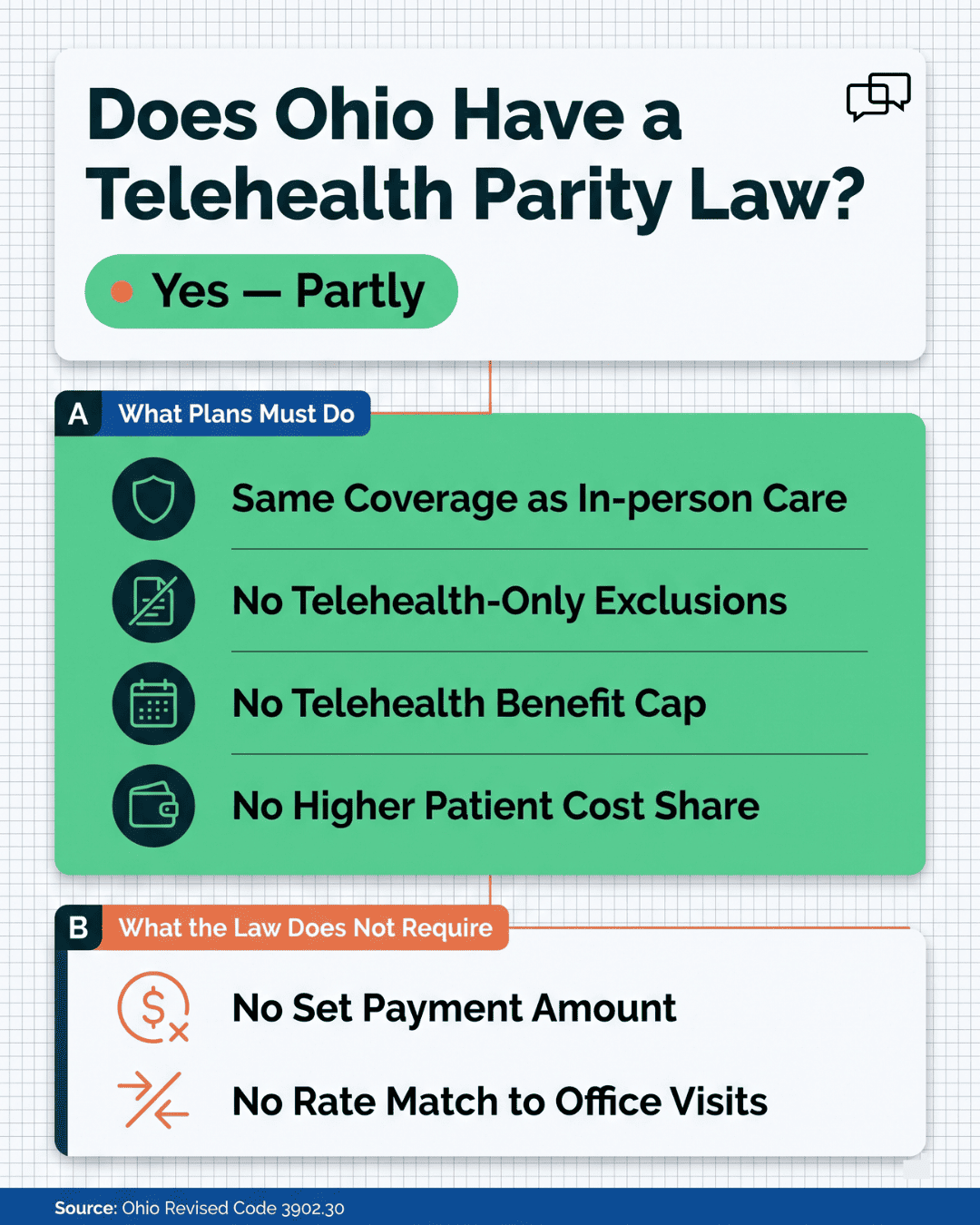
One correction worth making before you go further: older guides still claim Ohio has no parity law. It does.
Health plans must cover telehealth on the same basis as in-person care and can't charge patients extra for it. What the law doesn't do is set the rate — payment parity isn't required.
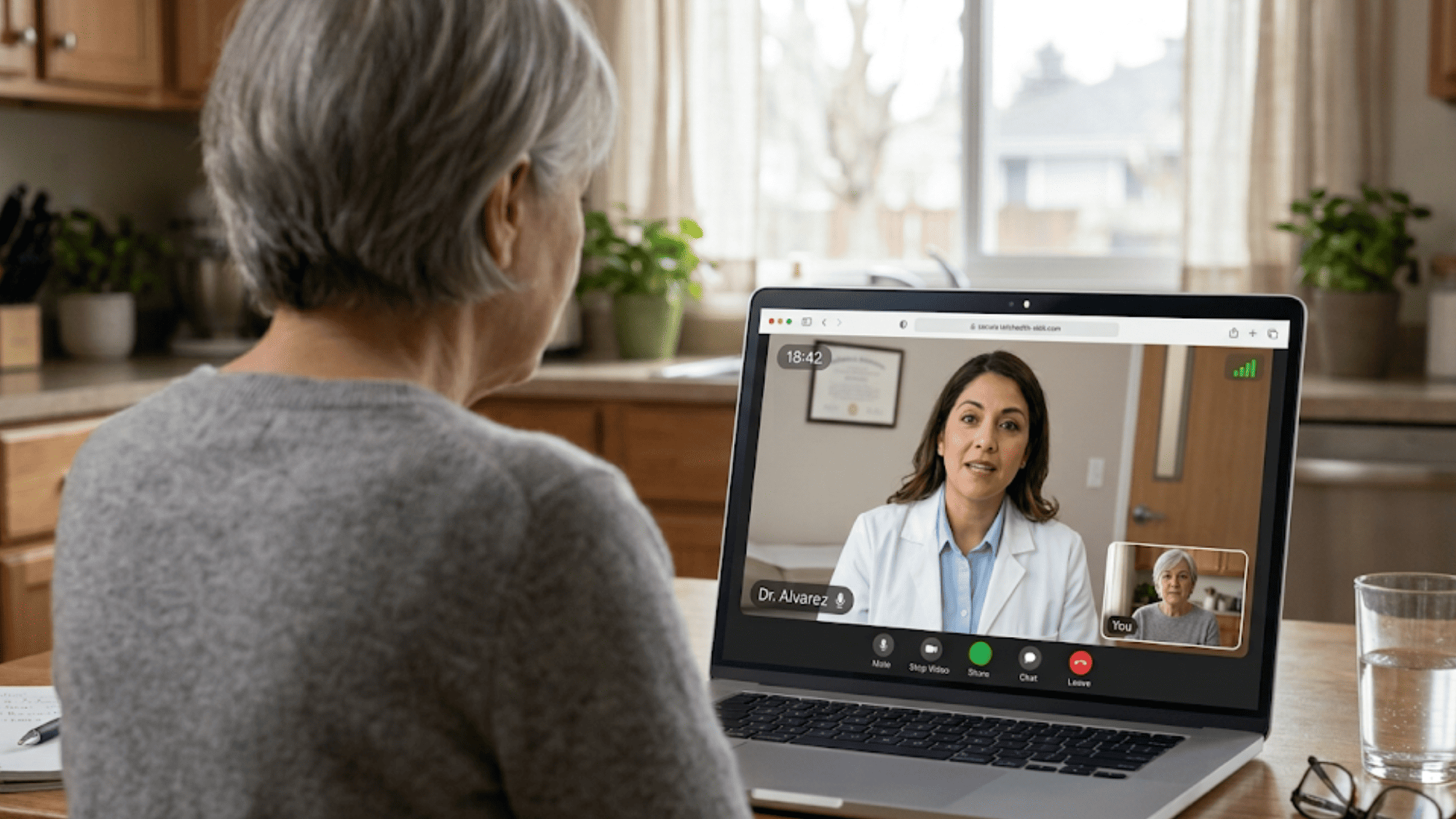
The Board's rule for physicians and physician assistants is Ohio Administrative Code 4731-37-01, in effect since February 2023. It sets one benchmark and builds everything else on top: a telehealth visit must meet the same standard of care as an in-person visit.
A video call may clear the bar for a medication follow-up and fall short for a new complaint that needs hands on the patient. The rule lets you use synchronous or asynchronous tools, but only when the standard of care can still be met with what you've chosen.
When it can't, the rule expects a different move — an in-person visit, a referral, or a formal consultation with another provider. Falling short of the standard is treated the same way it would be for an office visit, and the Board can discipline a licensee for it.
The rule also covers the practical requirements that follow from that standard: documented consent for telehealth treatment, prompt charting of the visit, and limits on remote monitoring devices.
Under OAC 4731-37-01, anyone on your team who takes part in a telehealth visit has to be trained and competent in what they're doing.
The rule doesn't hand you a curriculum. What it does is make training a condition of meeting the standard of care, which means the gap shows up as a care problem rather than a paperwork problem.
Behavioral health providers get a firmer version. OAC 5122-29-31 requires a written policy describing how staff assisting with or delivering telehealth services are trained on the equipment.
Modality choice is the part practices get wrong most often. Ohio permits synchronous and asynchronous technology, which covers live two-way video, phone consultations, other audio-only formats, and secure messaging. Permission isn't blanket approval, though.
Each tool is allowed only when it can still meet the standard of care for that patient and that condition. A phone follow-up on a stable prescription clears the bar. The same call for a new complaint that needs a physical exam does not.
Whatever channel you land on, ensure that it’s fully HIPAA compliant before a single patient uses it.
Your practice Gmail account doesn't qualify on its own. You'd need a signed Business Associate Agreement with Google and the account configured so protected health information stays encrypted in transit and at rest.
You can start a patient relationship over telehealth in Ohio. No prior in-person visit, no separate telemedicine certificate.
That wasn't always the answer. The Board's 2012 position treated remote care as a fallback for patients who couldn't come in, which left practices guessing. OAC 4731-37-01 closed the question in 2023.
Three things come with the visit: verify who you're talking to, get consent for telehealth treatment, and chart that consent with the history, diagnosis, and plan. Behavioral health works the same way — no initial in-person session required.
One rule does eventually pull the patient back in. Treat someone by telehealth for more than twelve straight months and Ohio Medicaid expects an in-person annual visit, or a referral to their usual source of care. An ER doesn't count.
That clock is a scheduling problem. No EHR flags it on its own, and patients doing fine on video have no reason to book. Practices that catch it run a recall list. Across our clients, 35% of patients who got an SMS recall booked within a month, based on our internal data.
An exam has to happen before you diagnose or treat. Ohio doesn't require it to happen in the room.
The test in OAC 4731-37-01 is whether the technology you're using gathers enough information to meet the same standard of care as an in-person visit. Live two-way video clears that bar for a lot of encounters. A rash you can see, a medication check, a follow-up on stable symptoms.
There's a second path when it doesn't. If the patient is sitting in a medical facility, a licensed professional there can perform the hands-on portion and relay physical findings to you at the distant site. That combination often meets the standard when video alone wouldn't.
What the Board won't accept is a questionnaire standing in for an exam. Diagnosing off a form the patient filled out, with no real evaluation behind it, can be treated as a violation and bring discipline.
When the technology can't get you there, the rule expects you to say so and act on it — bring the patient in, refer them, or consult formally with another provider. Documenting that call protects you more than stretching a video visit past what it can carry.

You can prescribe non-controlled substances over telehealth in Ohio without an in-person visit first. Physicians and physician assistants both have that authority under OAC 4731-37-01.
The old rule required a physical exam before any prescription. The current one swapped that for a checklist:
Controlled substances run on a separate track. OAC 4731-11-09 covers them in Ohio, with federal law on top.
DEA and HHS extended telemedicine prescribing flexibilities through December 31, 2026, letting DEA-registered prescribers issue Schedule II–V medications without a prior in-person exam.
Ohio also bars any board from requiring a first in-person visit for hospice or palliative patients, patients on medication for opioid use disorder, mental health treatment, or emergencies.
If you prescribe controlled substances remotely, mark that December date. A permanent DEA rule may not land before it.
Ohio holds telehealth charting to the same standard as an office visit. Symptoms evaluated, care provided, diagnosis, treatment, plan — all of it goes in the record, and the record has to be available to the patient.
One requirement is specific to remote care and easy to miss. Under OAC 5160-1-18, the practitioner site has to document which telehealth modality was used.
Video, phone, portal message, or store-and-forward. An audit that finds the visit but not the modality is a documentation gap, even when the clinical note is complete.
That's a second entry after every remote visit, on top of the note itself. Curogram integrates with any major EHR, so visit information lands in the chart after each virtual appointment instead of waiting for someone to key it in at the end of the day.
Ohio ties telehealth to the patient's location, not yours. If the patient is in Ohio, you need an active Ohio license in your profession. Your office can sit in Cleveland or Colorado.
There's no separate telehealth license to apply for. Ohio doesn't run a telehealth registration process, so an active license in your field is the whole requirement.
Compacts cover a lot of that ground. Ohio participates in the Interstate Medical Licensure Compact along with the nursing, psychology, physical therapy, occupational therapy, PA, counseling, social work, audiology and speech-language, and dental compacts.
If you're licensed in another member state, the compact route is usually faster than a standalone Ohio application.
Treating patients outside Ohio flips the question. ORC 4743.09 permits it when the law of the patient's state permits it, which makes that state's board the one to check before you schedule the visit.
Behavioral health has an extra condition. An agency serving Ohio clients by telehealth needs a physical location in Ohio, or access to one, where clients can choose in-person services instead.
Ohio Medicaid rewrote its telehealth rule effective January 1, 2026. If your billing team is working from anything older, most of what they know is wrong.
OAC 5160-1-18 covers synchronous audio-video visits plus three asynchronous categories: telephone calls, remote patient monitoring, and communication through secure email or a patient portal. Video-only reimbursement ended.
Anywhere. The old five-mile originating-site limit is gone, and Ohio Medicaid now states plainly that there's no limitation on patient site — home, school, hospital, nursing facility, shelter, temporary housing.
The one exclusion is penal facilities, with a narrow carve-out for youth under 21 in the 30 days before release.
The eligible list runs to roughly twenty categories now, not the short physician-and-psychologist roster from the old rule. Here are some practices that appear:
Physicians
PAs and APRNs
Psychologists
Licensed counselors and social workers
Chemical dependency counselors
Therapists
Audiologists
Speech-language pathologists
Dietitians
Dentists
Optometrists
Pharmacists
Chiropractors
Doulas
Lactation consultants
Some supervised practitioners can render but not bill.
The appendix to 5160-1-18 is long:
Office visits with medical decision making up to moderate complexity
Psychiatric evaluations and psychotherapy
Remote patient monitoring
Therapy services
Medical nutrition
Lactation counseling
Psychological testing
Limited oral evaluations
Hospice
Private duty nursing
Home health
Dialysis-related services
Doula care
Billing mechanics changed with the rule. Claims carry a GT modifier, and when the patient is at home, school, an inpatient or outpatient hospital, a nursing facility, or an ICF/IID, a U1 through U6 modifier identifies which. Place of service reflects where the practitioner was, not the patient.
Two dates matter:
The audio-only codes 99441–99443 were deleted and replaced by the 98000–98016 series.
Starting January 1, 2027, POS 02 and 10 stop being accepted on professional claims where Medicaid is primary.
Ohio requires coverage. It doesn't require a rate.
Under ORC 3902.30, a health benefit plan has to cover telehealth on the same basis and to the same extent as in-person care.
Plans can't exclude a service just because it was delivered remotely, can't set a telehealth-only benefit cap, and can't charge patients more than they'd owe for the comparable office visit. Coverage stopped being voluntary in March 2022.
Payment parity is where Ohio stops short. The statute obliges a plan to reimburse a covered telehealth service but doesn't name an amount or tie it to in-person rates.
Your contracted rate is what your contract says, so check it before assuming a video visit pays like an office visit.
Ohio Medicaid pays for more modalities than most practices realize:
| Modality | Reimbursed |
|---|---|
| Synchronous audio-video | Yes |
| Audio-only | Yes, through the 98000–98016 code series |
| Remote patient monitoring | Yes |
| Store-and-forward | Yes, for certain communication technology-based codes |
Payment is the lesser of your submitted charge or the maximum in appendix DD to OAC 5160-1-60. FQHCs and RHCs work differently — the face-to-face requirement is waived and payment runs through the prospective payment system.
Ohio's emergency telehealth rules are gone. Most of what they allowed is now permanent law, which is a better outcome than practices generally expect from an expiring waiver.
The emergency version added telephone consultations, email, and images sent by fax, and named a temporary list of eligible providers.
HB 122 took effect in March 2022, and Ohio Medicaid's rewritten rule took effect January 1, 2026. Between them, they made the useful parts permanent:
| Emergency flexibility | Status now |
|---|---|
| Telephone consultations | Permanent under OAC 5160-1-18 |
| Email communication | Permanent, if through secure email or a patient portal |
| Images sent by fax | Not in the current rule |
| Expanded provider list | Permanent and broader than the emergency list |
| Patient at home | Permanent, with no site restriction at all |
Two things the emergency rules didn't have now apply:
Practitioners treating a patient by telehealth for more than twelve consecutive months are expected to arrange one in-person annual visit or refer the patient to their usual source of care.
The audio-only codes 99441–99443 were deleted, replaced by the 98000–98016 series.
One flexibility is still temporary. DEA and HHS extended telemedicine prescribing of controlled substances through December 31, 2026 — the fourth extension, with a permanent rule still pending.
Ohio's rules ask three things of your telehealth setup: a channel that meets the standard of care, documented consent, and a chart entry that names the modality you used. Curogram handles all three from one web dashboard.
Patients tap a link in a text message and land in your waiting room — no app download, no portal password.
Your staff greets them there until a provider starts the video visit. Visit summaries and other records go back out the same way, through a HIPAA-compliant channel rather than an unsecured email account.
The platform connects with your EHR, so visit information reaches the chart without a second round of data entry.
Automated SMS reminders run alongside it. Across our clients, appointment confirmation rates average above 75%, and Atlas Medical Center cut no-shows from 14.20% to 4.91% in three months — based on our internal data.
That matters more in Ohio than it used to. Telehealth patients now need an in-person visit or referral after twelve consecutive months, and someone has to bring them back in.
Don’t see your state? We just haven’t written about it yet! Stay tuned on our blog or check out our article on telemedicine reimbursement by state.
|
Nebraska |
|||
|
Alaska |
Iowa |
Nevada |
South Dakota |
|
Kansas |
New Hampshire |
||
|
Kentucky |
|||
|
New Mexico |
Utah |
||
|
Maine |
Vermont |
||
|
Connecticut |
|||
|
Delaware |
North Dakota |
||
|
Ohio |
West Virginia |
||
|
Oklahoma |
|||
|
Mississippi |
Wyoming |
||
|
Montana |
Rhode Island |
Book a demo and we'll show you how Ohio practices run consent, modality documentation, and twelve-month recall from one dashboard — with the visit information landing in your EHR instead of a staff member's to-do list.

1 min read
Michael Hsu : 6/19/20, 10:40 AM
💡 Telemedicine is legal and widely covered in Virginia, but three rules decide whether a visit is valid and paid.First, licensing follows the...
1 min read
Michael Hsu : 6/7/20, 8:39 AM
💡 Alabama telemedicine is legal and widely used. But the rules sit in many places, not one law. Alabama Medicaid has no precise definition of...

1 min read
Michael Hsu : 6/11/20, 8:56 AM
💡 Illinois law requires private health plans to cover telehealth the same way they cover office visits. Plans must also pay in-network providers...