
 Michael Hsu
1 min read
Telemedicine Wisconsin: Laws and Policies | Blog
 Michael Hsu : 6/22/20, 11:03 AM
💡 Illinois law requires private health plans to cover telehealth the same way they cover office visits. Plans must also pay in-network providers...

Most guidance on telemedicine in New York still treats a phone call as something that supports a video visit. That description is out of date. Audio-only is a recognized modality under Public Health Law Article 29-G, and NYS Medicaid pays for it when 4 conditions are met.
That one change makes a useful test. If the source your practice relies on still lists 3 modalities, it predates the current rules. Whatever else it says about consent, licensing, and reimbursement is probably stale too.
New York's telehealth framework is stable enough to build a service line on. It also runs on expiration dates set by three separate bodies. Two of those dates have already lapsed once and been restored.
Payment parity holds through April 1, 2028. DEA authority for remote controlled substance prescribing ends December 31, 2026. Medicare flexibilities expire December 31, 2027.
None of the three moves in step with the others. Each governs a different slice of your schedule.
The daily rules changed just as much. Consent used to be a telepsychiatry requirement. It now applies to every telehealth visit, and the chart has to show it. Audio-only visits need a recorded reason for each encounter.
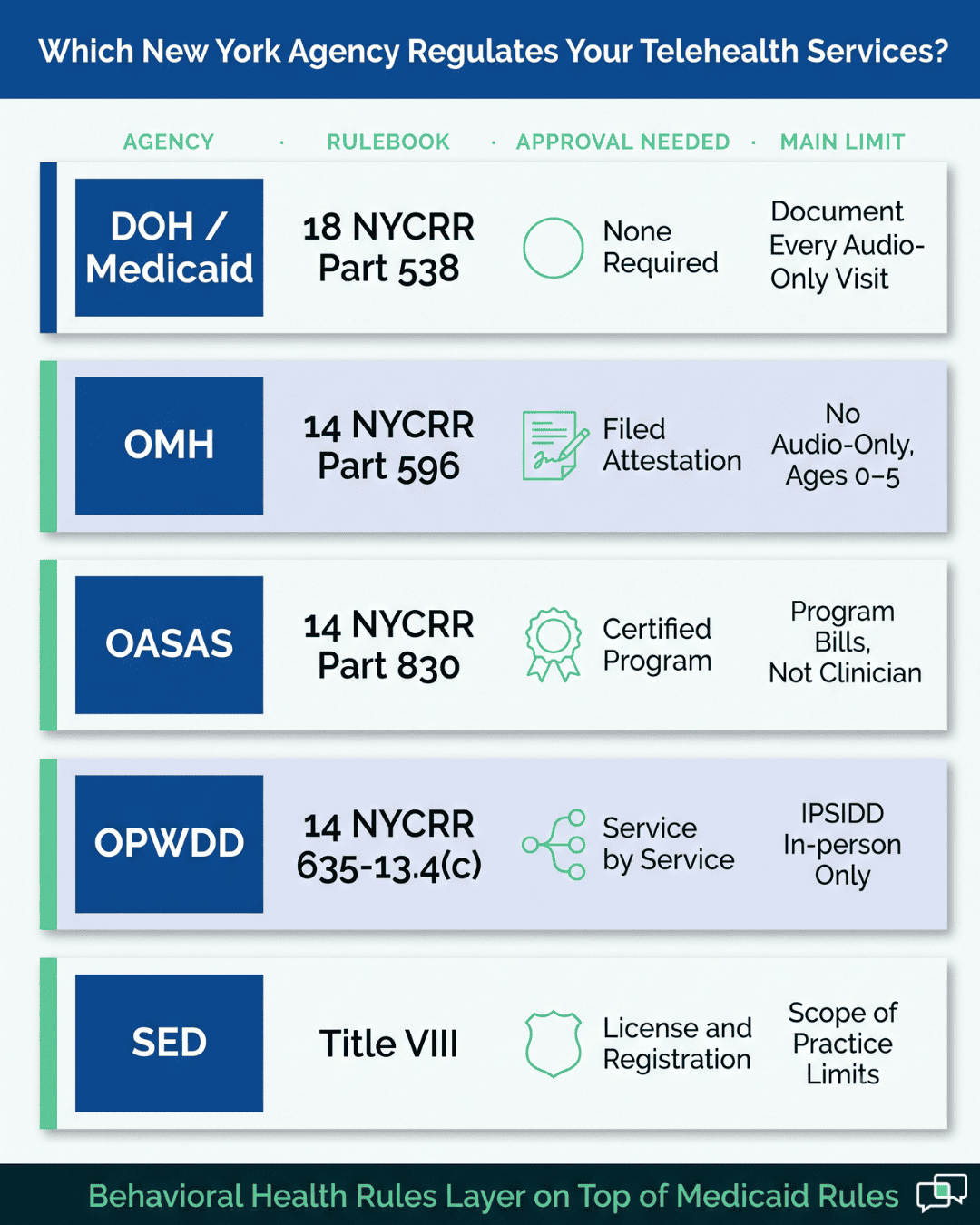
The eligible provider list has roughly doubled since the pandemic guidance was written. It now takes in physical therapists, social workers, peer recovery advocates, and care managers. Behavioral health carries its own layer on top of all of it, through OMH and OASAS.
What follows covers each area as it stands now, with the statute or manual behind every rule, so your front desk and billing team can work from something current.
Some states write separate rules for telemedicine and telehealth. New York doesn't. Telehealth is the umbrella term here, and telemedicine sits inside it. One definition, one rulebook.
The New York Insurance Law and Public Health Law provide a similar definition of telehealth:
"The use of electronic information and communication technology to deliver health care to patients at a distance."
Public Health Law §2999-cc spells out what those services cover:
State law recognizes four ways to deliver that care. It also names two channels that don't count on their own.
| Counts As Telehealth | Not Telehealth By Itself |
|---|---|
| Telemedicine (live two-way audio-video) | Fax |
| Store-and-forward | Email or text messaging |
| Remote patient monitoring | |
| Audio-only telephone |
Audio-only used to sit in the second column. It moved, and that changes daily practice: a phone visit can now stand on its own instead of propping up a video appointment.
For Medicaid and Child Health Plus members, audio-only counts only as far as Department of Health regulations allow, and those conditions live in 18 NYCRR Part 538.
Fax and messaging still don't qualify as a visit. You can use either to support one. Send a form, confirm a time, share a result. Just don't bill the message as the encounter.
Curogram handles New York telehealth visits from a browser, with HIPAA safeguards built in. Your front desk can open a virtual clinic, move patients through a waiting room, and text them the visit link from the same screen your staff already uses for appointment reminders.

NYS Medicaid defines telemedicine as live, two-way audio-video communication used to deliver care. The patient sits at the originating site. The provider works from the distant site.
The January 2026 Medicaid Telehealth Policy Manual also calls this audio-visual telehealth, so both terms show up in billing guidance for the same thing.
Store-and-forward moves protected health information (PHI) from one provider to another. Nobody has to be online at the same time. Records get sent, reviewed later, then acted on.
What typically travels this way:
New York law lets providers share PHI with each other to treat a patient, with that patient's consent. The rule holds whether the care happens in the office or remotely.
Remote patient monitoring (RPM) collects PHI and other medical data from a patient at an originating site and sends it to a provider at a distant site.
Some readings stream in live. Others get stored and forwarded later. Either way, the data can only support treatment and management of conditions that need regular monitoring.
NYS Medicaid names these conditions, among others:
Five rules govern an RPM episode from setup to close:
The default is broader than most practices expect. Under 18 NYCRR Part 538, any Medicaid provider who can deliver a service in person can deliver that same service by telehealth.
Two conditions apply: it has to suit the patient's needs, and it has to sit inside that provider's scope of practice.
Public Health Law §2999-cc and the January 2026 Medicaid Telehealth Policy Manual then name specific types:
Registered professional nurses sit on the list with a narrower role. They qualify only when receiving patient data at a distant site through remote patient monitoring.
One more category runs on a clock. Through April 1, 2028, mental health practitioners licensed under Article 163 of the Education Law may deliver telemedicine.
Three requirements come before the first virtual visit:
No blanket sign-off is required from the New York State Department of Health (DOH) or Office for People With Developmental Disabilities (OPWDD) before you begin.
OPWDD does carve out one prohibition. Independent Practitioner Services for Individuals with Developmental Disabilities (IPSIDD) must be delivered in person. Telehealth is not an option there.
Behavioral health adds a step that medical practices don't face. A program applying to use telehealth under OMH files a Telehealth Services Standards Compliance Attestation, confirming its plan meets the technical and clinical standards in 14 NYCRR Part 596.
OASAS authorizes telehealth only through programs it has certified or designated. The practitioner must be employed by that program or working under a contract or memorandum of understanding with it.
Billing follows the program, not the clinician. For Medicaid reimbursement, both the practitioner and the designated program need active enrollment in good standing, and the program bills as the primary entity.
Whichever agency governs the visit, the patient consents first. Written consent isn't required, but the chart has to show it before or during the first telehealth visit.
New York is not a member of the Interstate Medical Licensure Compact. Bills to join have been introduced in several sessions, including A6362 in the 2025–26 session, and none has passed. Forty-four states and the District of Columbia participate. New York remains outside.
That leaves one path in. To treat a patient located in New York, you need a full New York license under Education Law, and Medicaid reimbursement additionally requires enrollment in NYS Medicaid.
No shortcut applies. No telehealth-specific license or registration exists either, so the standard license is both the floor and the ceiling.
The rule runs in one direction only, and the other direction is generous. Public Health Law §2999-cc treats any site in the United States or its territories as an eligible distant site.
Your New York-licensed physician can hold visits from a home office in Florida, a conference hotel in Chicago, or a second practice location upstate. What matters is where the patient sits, not where the clinician does.
OMH follows the same logic for behavioral health. Under 14 NYCRR Part 596, telehealth practitioners may deliver services from anywhere in the US or its territories, including a private residence, provided the distant site holds a current New York license, permit, or Office designation and the space meets Office guidelines.
Limited licensure exceptions exist for some professions. Check the requirements for your specialty before assuming one covers your situation.
| Scenario | Allowed? |
|---|---|
| NY-licensed clinician, patient in NY, clinician anywhere in the US | Yes |
| Out-of-state clinician using an IMLC license, patient in NY | No |
| NY-licensed clinician, patient traveling outside NY | Depends on that state's rules |
| NY-licensed clinician billing Medicaid without NYS Medicaid enrollment | No |
Consent used to be a behavioral health question in New York. It isn't anymore. Every telehealth visit needs informed consent, documented in the chart before or during the first visit.
Written consent isn't required. Documentation is. Those two things get confused constantly, and the difference decides whether a chart survives an audit.
A verbal conversation counts, provided your note records it. No specific form is mandated, though many practices build one anyway. What matters is that your policies spell out how consent gets obtained and where it lands in the record.
Informed consent means the patient understands 4 things before the visit starts:
Minors add a step. Where a service requires parent or guardian consent in person, it requires the same for telehealth.
Recording is separate. A telehealth session cannot be recorded without the patient's consent, and that consent doesn't come bundled with consent to the visit itself.
Consent frequency trips up front desk teams because it varies by service type.
| Service | Consent Required |
|---|---|
| Telehealth visits | Once, before or during the first visit |
| eVisits (CBTS) | Annually |
| Virtual check-ins | Annually |
| Remote patient monitoring | Before each episode of care |
| eConsults | Before each consult, per specialty |
The eConsult rule is the strictest. One consent doesn't carry across different specialties, so a cardiology eConsult and a dermatology eConsult need separate documented consents.
The record also has to hold the treating provider's request and the consulting provider's recommendation and rationale.
NYS Medicaid sets out rights that sit alongside the consent process. Medicaid patients receiving remote healthcare services must:
Privacy runs underneath all of it. Telehealth services have to comply with HIPAA, 42 CFR Part 2, Public Health Law Article 27-F, and Mental Hygiene Law §33.13.
You're also expected to take reasonable steps to keep the encounter private on your end, which means the room the clinician is sitting in, not only the software.
New York places no restrictions on prescribing through telehealth when it's medically appropriate. State law is the easy part.
Controlled substances answer to Washington. The Ryan Haight Act normally requires at least one in-person evaluation before a practitioner can prescribe a controlled medication remotely. That requirement has been suspended since 2020, and the current suspension runs through December 31, 2026.
The Drug Enforcement Administration (DEA) issued this 4th temporary extension jointly with HHS, effective January 1, 2026, while it works toward a permanent rule.
|
What that means in practice: A DEA-registered practitioner can prescribe a Schedule II through V medication by telemedicine without ever seeing the patient in person, as long as the stated conditions are met. Mark the expiration date. Practices building a virtual controlled-substance workflow are building on a temporary authority. |
Buprenorphine prescribing changed too, and older guidance still circulates. The DATA waiver — the X-waiver — was eliminated by the Consolidated Appropriations Act, 2023. No separate approval applies now. A standard DEA registration covering Schedule III is enough.
SAMHSA's February 2024 final rule then sets which modality each medication allows:
| Medication | Screening and Full Exam by Telehealth |
|---|---|
| Methadone | Audio-visual only |
| Buprenorphine | Audio-visual or audio-only |
Screenings may also be performed by practitioners working outside the opioid treatment program.
For OMH-licensed programs, prescribers may deliver medication treatment services by audio-only telehealth when it's clinically appropriate for that patient.
New York used to be silent here. It isn't now. The January 2026 Medicaid Telehealth Policy Manual sets documentation requirements, and several are specific to the modality you used.
The baseline still comes from federal law. HIPAA rules state that all medical information in telemedicine should be documented and treated with the same care as in an in-person environment. Same standard, different room.
New York then adds requirements on top:
| Service | What The Record Must Show |
|---|---|
| Any telehealth visit | Informed consent, before or during the first visit |
| Audio-only visit | Why audio-only was used — patient preference, or no equipment or connectivity |
| Remote patient monitoring | Consent for the episode, plus the provider's clinical interpretation of the data |
| eConsult | Consent, the treating provider's request, the consultant's recommendation and rationale |
| Telemental health (Part 596) | The request for telehealth, the rationale, and that the encounter occurred |
The audio-only line catches practices off guard. That reason has to be recorded per encounter, not once per patient. A blanket note in the chart won't hold up.
Audio-only visits also have to contain every element of the billable code and meet the same documentation standard as an in-person visit. The modality changes. The bar doesn't.
All of which lands on whoever closes out the note. When your telemedicine platform sits apart from your chart, someone rekeys the visit details afterward, and per-encounter fields like the audio-only reason are the first to get skipped when the schedule runs long.
Curogram integrates with any EHR, so the visit record moves into the chart instead of waiting on manual entry at the end of a shift.

New York moved past coverage parity years ago. The rule now is payment parity: telehealth services get reimbursed on the same basis, at the same rate, and to the same extent as the equivalent in-person service.
Commercial plans answer to Insurance Law §§3217-h and 4306-g. Medicaid answers to Public Health Law §2999-dd. Both cover fee-for-service and Medicaid Managed Care.
Patients pay less, too. Under 11 NYCRR 52.16(q), plans cannot charge copays, coinsurance, or annual deductibles for in-network telehealth when the same service would have been covered in person.
Payment parity is not permanent. It runs through April 1, 2028.
That date has moved before, and not smoothly. Parity lapsed on April 1, 2026 and stayed lapsed for eight weeks.
A 10007 restored it on May 28, 2026, retroactive to April 1, 2022, which closed the gap for claims filed during the window. NYS Medicaid reimburses eligible practitioners across all 4 modalities:
Three more services bill separately: eConsults, virtual check-ins, and eVisits.
Parity doesn't mean every cost gets paid. Facility fees are the carve-out. When neither the patient nor the provider is physically inside the clinic, the facility cost wasn't incurred, so plans aren't required to reimburse it. Article 28 facilities feel this most.
The rest comes down to coding.
| Field | Use |
|---|---|
| POS 02 | Telehealth, patient not at home |
| POS 10 | Telehealth, patient at home |
| POS 11 | Office or private practice — keep using it, add a telehealth modifier |
| 93 or FQ | Audio-only |
| 95, GT, GQ | Other telehealth modalities |
NYS Medicaid encourages POS 11 where it applies, since in many cases it pays at the higher rate.
Every audio-only claim needs a 93 or FQ modifier unless modifiers aren't allowed for that service, as with teledentistry. The UA modifier is retired for audio-only and should no longer appear.
Managed care plans may layer their own billing guidance on top. They still have to cover every service appropriate for telehealth delivery, audio-only included.
The federal public health emergency ended May 11, 2023, and New York's temporary measures ended with it. Some of what those rules introduced became permanent. The rest lapsed.
Sorting the two matters, because outdated guidance about audio-only billing and cost-sharing is still circulating.
| COVID-Era Measure | Status Now |
|---|---|
| DFS waiver of telehealth cost-sharing | Permanent. 11 NYCRR 52.16(q) bars copays, coinsurance, and deductibles for in-network telehealth |
| Medicaid reimbursement for audio-only visits | Permanent, with conditions. Recognized under PHL §2999-cc, reimbursable under 18 NYCRR Part 538 |
| No copays for COVID-19 testing visits | Expired with the PHE |
| Telehealth delivery of 1915(c) Children's Waiver services | Reversed. Waiver services need explicit telehealth authority written into the waiver |
The audio-only change is the one that stuck hardest, and it stopped being an emergency accommodation. Four conditions govern it now:
Audio-visual has to be unavailable or the patient has to prefer audio-only.
You have to offer audio-visual or in-person on request.
The service has to work without a visual component.
The encounter has to meet the same code and documentation standards as any other visit.
Two OPWDD allowances also outlived the emergency. Remote delivery continues for:
Day Habilitation
Community Habilitation
Prevocational Services
Supported Employment
Pathway to Employment
Support Broker
Respite Services under the Comprehensive HCBS waiver
Crisis Services for Individuals with Intellectual and/or Developmental Disabilities may still be delivered by phone or other two-way, real-time technology that meets HIPAA requirements.
One limit applies to both. Remote technology cannot serve as the exclusive, long-term delivery method for these services.
New York gives telehealth real footing. Payment parity through April 1, 2028. Four recognized modalities, audio-only included. Any US site qualifies as a distant site. No telehealth-specific license to chase.
The rules are the easy half. What decides whether virtual visits hold up in your schedule is the platform running them, and two questions sit underneath that: whether it keeps you HIPAA-compliant, and whether patients and staff will actually use it.
Curogram runs on built-in HIPAA safeguards, backed by a signed Business Associate Agreement, so PHI stays inside a secure environment through the visit and after it.
Everything runs from one browser-based dashboard. No install, no separate login for each task. Your staff can create virtual clinics, send appointment reminders, start video calls, message your team, and share PHI from the same screen.
The workflow copies the one your practice already runs. Patients land in a waiting room. Your front desk preps them the way they would in the lobby. A provider picks up the visit when ready, without stopping to chase intake forms or handle the administrative work between appointments.
Signup friction is where virtual visits die. A patient who has to download an app, create an account, and verify an email before a 10-minute appointment often just doesn't show.
Curogram removes those steps. Your patient gets a text from the local number tied to your practice's account, with a link to the visit. Tapping it opens your virtual clinic's waiting room. Your medical staff prepares them there, then a provider starts the video call.
Don’t see your state? We just haven’t written about it yet! Stay tuned on our blog or check out our article on telemedicine reimbursement by state.
|
Nebraska |
|||
|
Alaska |
Iowa |
Nevada |
South Dakota |
|
Kansas |
New Hampshire |
||
|
Kentucky |
|||
|
New Mexico |
Utah |
||
|
Maine |
New York |
Vermont |
|
|
Connecticut |
|||
|
Delaware |
North Dakota |
||
|
West Virginia |
|||
|
Oklahoma |
|||
|
Mississippi |
Wyoming |
||
|
Montana |
Rhode Island |
Book a demo and we will walk through your workflow, from the appointment text to the documented note.

1 min read
Michael Hsu : 6/22/20, 11:03 AM
💡 Illinois law requires private health plans to cover telehealth the same way they cover office visits. Plans must also pay in-network providers...

1 min read
Michael Hsu : 5/28/20, 6:07 AM
💡 Telehealth in Florida is governed by Section 456.47 of the Florida Statutes, which took effect in July 2019 and has been amended five times...
1 min read
Michael Hsu : 6/3/20, 7:59 AM
💡 Michigan covers telemedicine, and its rules are broader than most published guides suggest. Private insurers must give a telemedicine service...