
 Michael Hsu
Telemedicine Arkansas: State Laws and Policies | Blog
 Michael Hsu : 6/13/20, 9:03 AM
Learn how Arkansas top telehealth providers launched profitable, streamlined, and compliant telemedicine services in Arkansas.

A patient in northern Wisconsin needs a medication check. She lives 40 minutes from your clinic, she has no ride, and she has put the visit off twice already. You see her by video instead. The care is good, the note is thorough, and the claim goes out.
Six weeks later, it comes back denied. The modifier was wrong.
Nothing about the medicine was wrong. The paperwork was.
That gap is the real story of telemedicine in Wisconsin. The rules for how you practice and the rules for how you get paid come from two places, and they do not match.
The Medical Examining Board decides what counts as acceptable care. Wisconsin Medicaid decides what counts as a payable service. Private insurers mostly decide for themselves.
Most practices learn this one denied claim at a time.
Here is the encouraging part.
Wisconsin's rules are far steadier now than they were a few years ago. Coverage that began as an emergency measure is permanent policy today.
Audio-only visits count for Medicaid. A patient's living room counts as a valid location. Much of the old confusion has cleared.
The gaps that remain are real, though, and they cost money when nobody is watching them.
This guide walks through what Wisconsin telemedicine law asks of you right now. That means licensing, the patient relationship, records, evaluation, and prescribing. It also covers who pays, who does not, and what the remaining gaps mean for your bottom line.
Wisconsin's Medical Examining Board (MEB) defines telemedicine as the practice in which patient care, treatment, or services are delivered through the use of medical data exchange via electronic communication technologies, while the provider and the recipient are in different locations. The Board requires that the virtual visit mimics an in-person appointment, meaning that it has to happen in real-time and face-to-face.
This implies that an interactive video conference is deemed to be the mandatory form of communication. Emails, audio-only calls, text messages, and facsimile transmissions do not suffice as per MEB.
Even with these restrictions, telehealth has helped reshape the inefficient system that could not provide adequate care to everybody in need.
The most important aspect of remote care is that it democratizes healthcare and allows:
Telemedicine can do a lot for Wisconsin residents, especially the elderly. They are already struggling to get the care they need. In some cases, it is the location, while in others, it is the patient’s restricted mobility that is causing the problem.
The number of unnecessary visits to emergency rooms and hospitals is causing confusion. It prevents medical professionals from treating the most critical cases, and it is financially unsustainable in the long run. The only way to keep the system afloat in Wisconsin, and beyond, is to establish a triage that would direct patients effectively.
Telehealth may be an answer, as it allows the physicians to assess and examine the patients online. They can decide about further actions and advise accordingly. Now, more than ever, it is essential to engage all capacities and use them to provide adequate care for everyone.
MEB views the terms telemedicine and telehealth as synonyms and does not make any clear distinction between them. There are no definitions on the federal level that would suggest how to differentiate between the two.
In some states, telemedicine is reserved for clinical practices, while telehealth is a broader term that incorporates health education and disease prevention.
With the development of remote care, federal officials should define these terms to avoid confusion. Providers should check how their jurisdiction views telemedicine and telehealth and use the terms accordingly.
The Wisconsin Medical Examining Board offers clear guidelines on how to practice telemedicine in Wisconsin. It focuses on the professional recommendations to the providers to ensure that all standards of care are respected and that the patients are receiving the best possible treatment.
With high-quality service offered in the traditional practice, MEB considers telehealth providers to be equally accountable for their practice. The same rules and regulations apply to both models.
The guidelines cover all essential aspects of the practice:
MEB does not require the in-person appointment for the doctor-patient relationship to be valid. It does insist on a face-to-face visit, which means that a real-time video call is a minimum standard.
There are strict rules to follow to comply with the regulation:
Once these are provided and documented, the doctor-patient relationship is valid, and the diagnosis and treatment may begin. The responsibilities that the physician has when caring for the patient in traditional practice apply to telehealth as well.
Telemedicine virtual visits happen at the location of the patient, meaning that the physician has to be licensed in Wisconsin to treat the patients residing in the state. The provider does not require separate permits for telehealth services, though some other states may impose such rules.
This is especially important for Wisconsin practitioners. With incomplete parity law, many telemedicine providers developed their businesses by treating patients from other states. It is crucial to understand the legislation of the patient's place of residence.
When Wisconsin joined IMLC, the cross-state licensing became much more manageable. The program allowed WI practitioners to offer their services to residents of all the participating states. IMLC has helped simplify the procedures for obtaining the necessary licenses and permits.
MEB requires all telehealth providers to keep clear and precise medical records on all patients they admit. Even one-time visits have to be correctly documented.
Medical record of the patient should include:
The medical records are confidential documents, according to the Board and the Wisconsin legislation. They should meet the same standards as their equivalents in the traditional practice. Most healthcare providers in the U.S. have already switched to electronic health records, so the technology is usually the same in both models.
The records and all communication channels must be HIPAA compliant. Data security and privacy are essential, and it is imperative to use the tools with encryption and password protection to prevent any third-party breaches and the loss of data.
Curogram offers integration with medical documentation software, as well as absolute compliance with the Health Insurance Portability and Accountability Act (HIPAA). Medical records should be available to the patient on request.
The provider must be able to fully assess and evaluate the patient. That is why it is essential to have a face-to-face visit, according to MEB.
The complete and proper evaluation consists of:
Telemedicine practitioners shall not evaluate patients and design treatment based on emails, text messages, audio-only calls, or online questionnaires. MEB considers these communication tools to be insufficient for proper diagnosis.
Upon the initial visit, the provider should determine whether the patient or their condition is appropriate for the telemedicine treatment. If not, they should recommend another course of action and restrain from providing services.
When it comes to standards of care, it is vital to provide adequate and responsible care to all patients regardless of the model being used for the treatment. This means that the services must correspond with the requirements of the specific diagnosis.
If the diagnosis exceeds the possibilities of telemedicine, the provider must inform the patient that they have to seek different treatment.
If the patient experiences deterioration, the doctor must have emergency backup plans ready.
These plans include referral to other medical professionals or institutions.
The equipment and technology used for telemedicine must ensure patient privacy and confidentiality of the relationship. That is why the providers should opt for reliable telehealth vendors. Curogram offers complete IT support to telemedicine practices.
All limitations and potential dangers of telemedicine services should be explained to the patient before the treatment begins.
There is no need for in-person contact before prescribing medication, according to MEB. Wisconsin providers are allowed to issue prescriptions via telehealth. They should meet the necessary standards that apply to the traditional model of practice.
This means that a physician must:
With these in check, the providers can issue online prescriptions at their discretion. MEB recommends integrating with e-Prescriptions to avoid errors and ensure patient's safety.
Some controlled substances may be subject to different rules on the federal level. It is the provider's responsibility to act in accordance with such regulation.
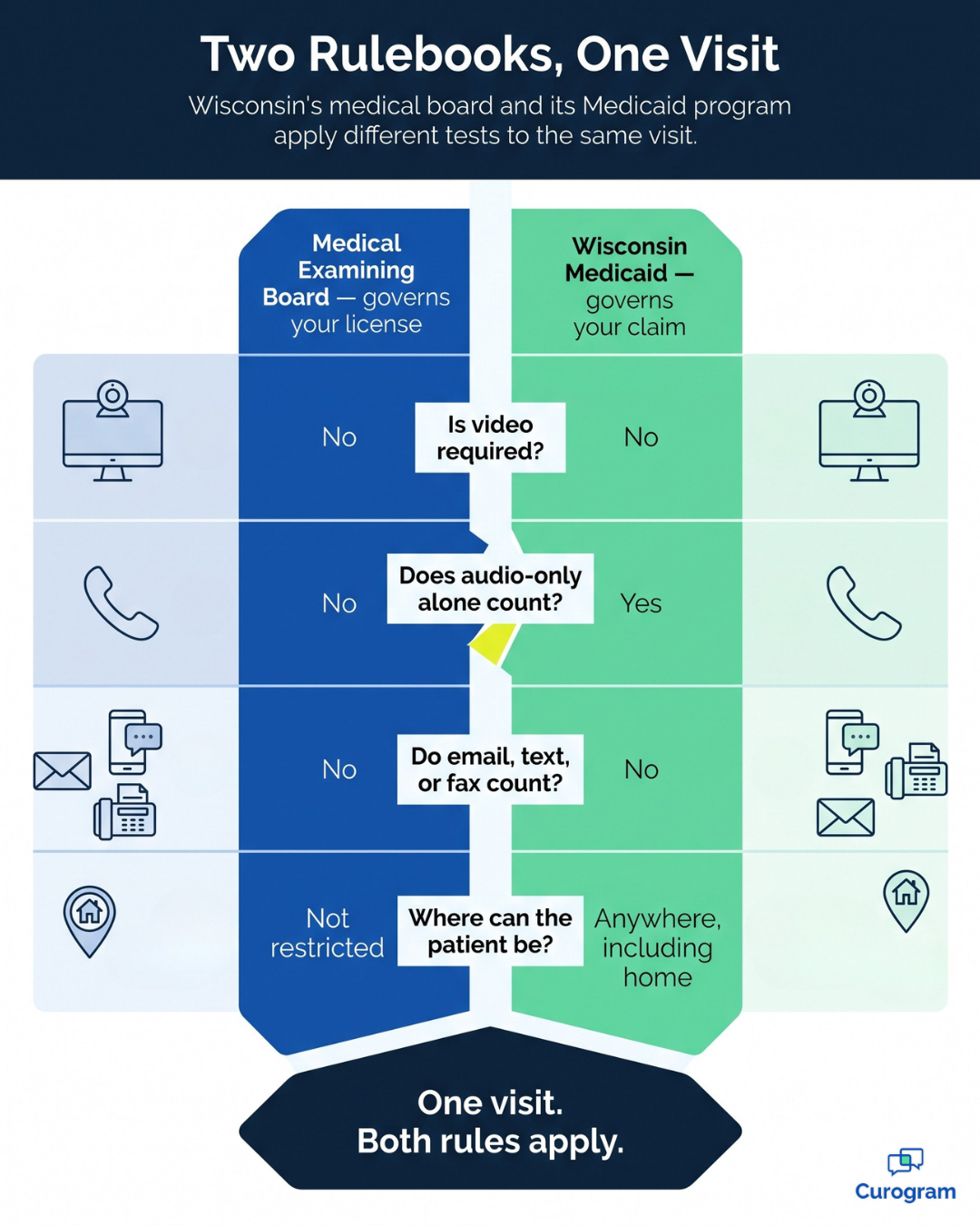
The most expensive misunderstanding in Wisconsin telehealth is assuming one set of rules governs everything. It does not.
| Question | Medical Examining Board (Med 24) | Wisconsin Medicaid (ForwardHealth) |
|---|---|---|
| Is video required? | No, but the technology must support the standard of care | No, audio-visual preferred but not mandatory |
| Does audio-only count? | Not on its own | Yes, when it is functionally equivalent to an in-person visit |
| Do email, text, or fax count? | No | No |
| Where can the patient be? | Not restricted by rule | Anywhere, including home |
Read that middle row twice. A visit can be perfectly payable under Medicaid and still fall outside the board's definition of telemedicine, if audio-only is all you used.
The board governs your license. The payer governs your claim. You answer to both.
More than 20 legislators advocated for SB 380 in November 2019. The bill passed and was instrumental in introducing significant expansions to telemedicine services in the American Dairyland. It did not include the complete parity law, unfortunately.
Although it is a step forward, SB 380 will need amending to allow telehealth practice to develop fully. The number of costly emergency room and hospital visits has already decreased, but payment parity is necessary to help the system stay afloat, especially during these critical times.
|
Reimbursement policies |
Live telemedicine |
Store-and-forward |
|
Medicaid |
Yes |
Yes (as of March 2020) |
|
Private payers |
Not mandatory |
Not mandatory |
Coverage in Wisconsin splits sharply between public and private payers. One side has settled. The other has not moved.
| Payer | Live video | Store-and-forward | Remote monitoring | Audio-only |
|---|---|---|---|---|
| Wisconsin Medicaid | Covered | Covered | Covered | Covered |
| Private payers | Not required by law | Not required by law | Not required by law | Not required by law |
Wisconsin Medicaid, or ForwardHealth, defines telehealth as care that is "functionally equivalent" to an office visit. That phrase is the key. Voices, images, and video must be clear enough that the visit loses nothing.
Coverage is now permanent, not an emergency measure. That shift took effect in early 2023 and changed what you can bill.
Four points matter most:
That last point is worth a pause. A covered telehealth visit is not worth less than an office visit.
Claims have their own rules. You need a place-of-service code: 02 if the patient is away from home, 10 if they are at home.
You also need the right modifier. Use GT for video, 93 for live audio-only, and GQ for store-and-forward. Behavioral health adds FQ and FR.
Consent runs on a yearly cycle. At least once a year, note that the patient knows they can say no to telehealth. You also cannot make telehealth a condition of treating someone.
Some services stay off the list. If it is not covered in person, it is not covered online. And anything that needs hands-on exam cannot move to a screen.
Here is what the paperwork is worth.
Say a clinic runs 60 telehealth visits a month at about $95 each.
If 8% get denied for a missing modifier or a vague note, that is five claims a month.
That comes to $475 a month, or roughly $5,700 a year. (These figures are illustrative. Your own volume and rates will differ.)
For your team, the point is narrow but useful. The care was right. The money was lost in three fields on a form.
Wisconsin has no private payer telehealth law. There is no service parity rule and no payment parity rule.
That does not mean commercial plans skip telehealth. Most big insurers cover it, since virtual visits cut their costs too. But coverage is a business choice, not a legal duty. It can change when a contract renews.
The result is uneven. Two patients can get the same visit on the same day and bring in very different revenue. The only difference is who insures them.
So build a simple habit. Check telehealth coverage and rates plan by plan, and check again at every renewal. A parity law would end that chore. Until one passes, the work is yours.
When it comes to telehealth, the right technology is crucial for the impeccable service. There are many benefits for practitioners who decide to establish telemedicine practice or incorporate it into their existing services. Cutting on administration and reallocating resources to patient care is among the most important ones.
For it to work, the technology has to be reliable, HIPAA compliant, and secure in terms of privacy and protection of information. We at Curogram offer comprehensive solutions that can help providers focus on medical aspects of their practice.

Some of the upsides of choosing our platform are:
Curogram understands the importance of proper integration with EHRs, and we built a system that integrates with any electronic health records platform. This allows the medical personnel to cut down on administrative work by preventing double entries.
|
Curogram EHR integrations |
|
|
eClinicalWorks |
Athena |
|
Epic |
Cerner |
|
DrChrono |
NextGen |
|
Practice Fusion |
CareCloud |
|
Kareo |
OfficeAlly |
With the COVID-19 pandemic hitting hard, telehealth practitioners are stepping up to release the pressure off the acute care providers. Curogram assists with establishing testing sites by providing software and IT support to medical professionals who decide to engage in such an endeavor.
The national health crisis showed that remodeling of the patient care is not only necessary but also long overdue. The states with regulated telemedicine services are responding to the pandemic much better. It is crucial to utilize all available resources to manage the situation, and remote care is an excellent solution.
In the times when people should stay home, telehealth is sometimes the only solution, not just for those affected by the coronavirus, but for chronic and elderly patients as well. The Wisconsin Department of Health Services (DHS) advised the patients and the insurers to opt for telemedicine whenever they can. It should reduce the exposure of both medical workers and patients to the virus.
The most important decision introduced in March 2020 was that Medicaid beneficiaries can receive treatment from their homes. Until recently, a patient's home was not among the eligible sites for WI Medicaid. Audio-only calls can now be used as a valid communication tool for telehealth in the State of Wisconsin.
Although some of the measures are temporary and apply only during the pandemic, DHS advised that they will continue to work with the providers to enhance the services and create a model that would help with the current and future crises.
Don’t see your state? We just haven’t written about it yet! Stay tuned on our blog or check out our article on telemedicine reimbursement by state.
Telemedicine by State in the US
|
Nebraska |
|||
|
Alaska |
Iowa |
Nevada |
South Dakota |
|
Kansas |
New Hampshire |
||
|
Kentucky |
|||
|
New Mexico |
Utah |
||
|
Maine |
Vermont |
||
|
Connecticut |
|||
|
Delaware |
North Dakota |
||
|
West Virginia |
|||
|
Oklahoma |
|||
|
Mississippi |
Wyoming |
||
|
Montana |
Rhode Island |
Wisconsin telemedicine law is no longer the moving target it was a few years ago. Two rulebooks govern your virtual visits. Once you can tell them apart, most of the confusion clears.
The Medical Examining Board decides if your care meets the standard. That means a Wisconsin license, a proper start to the patient relationship, a real exam, and records that hold up. Audio-only by itself does not pass that test.
Wisconsin Medicaid decides what gets paid. Its rules are wider than the board's. They cover live video, store-and-forward, remote monitoring, and audio-only visits. Your patient can be anywhere, and no provider type is shut out.
Private payers are still the open question. With no parity law, coverage shifts by contract, so checking stays part of the job.
None of this is hard once your workflow supports it. The practices that struggle are rarely making clinical mistakes. They lose claims to missing modifiers, vague notes, and consent nobody wrote down.
Those are systems problems, and systems can be fixed.
The right platform handles most of that quietly. Secure messaging keeps patient health data in the right channel. Reminders keep video visits from slipping people's minds. And when your platform writes back to your EHR, the proof of compliance is captured once instead of typed twice.
Wisconsin has handed practices a workable framework. The real question is whether your tools help you use it or get in the way.
If you are building or growing virtual care in Wisconsin, see how Curogram supports HIPAA-compliant telehealth workflows and find out what it would look like in your clinic.
Frequently Asked Question
 Michael Hsu : 6/13/20, 9:03 AM
Learn how Arkansas top telehealth providers launched profitable, streamlined, and compliant telemedicine services in Arkansas.
 Michael Hsu : 6/15/20, 9:19 AM
Starting to practice telemedicine in Georgia? Learn how the top providers in Georgia are deploying telemedicine practices profitably and efficiently.
 Michael Hsu : 6/20/20, 10:49 AM
The provider's ultimate guide to telemedicine in Maryland. Learn how to streamline your telehealth business and keep ahead of the competition.