
Imaging Center Virtual Consultations | Staff Operations
💡 Imaging center staff lose hours every week to pre-procedure phone calls, delayed physician check-ins, and last-minute cancellations.Curogram,...
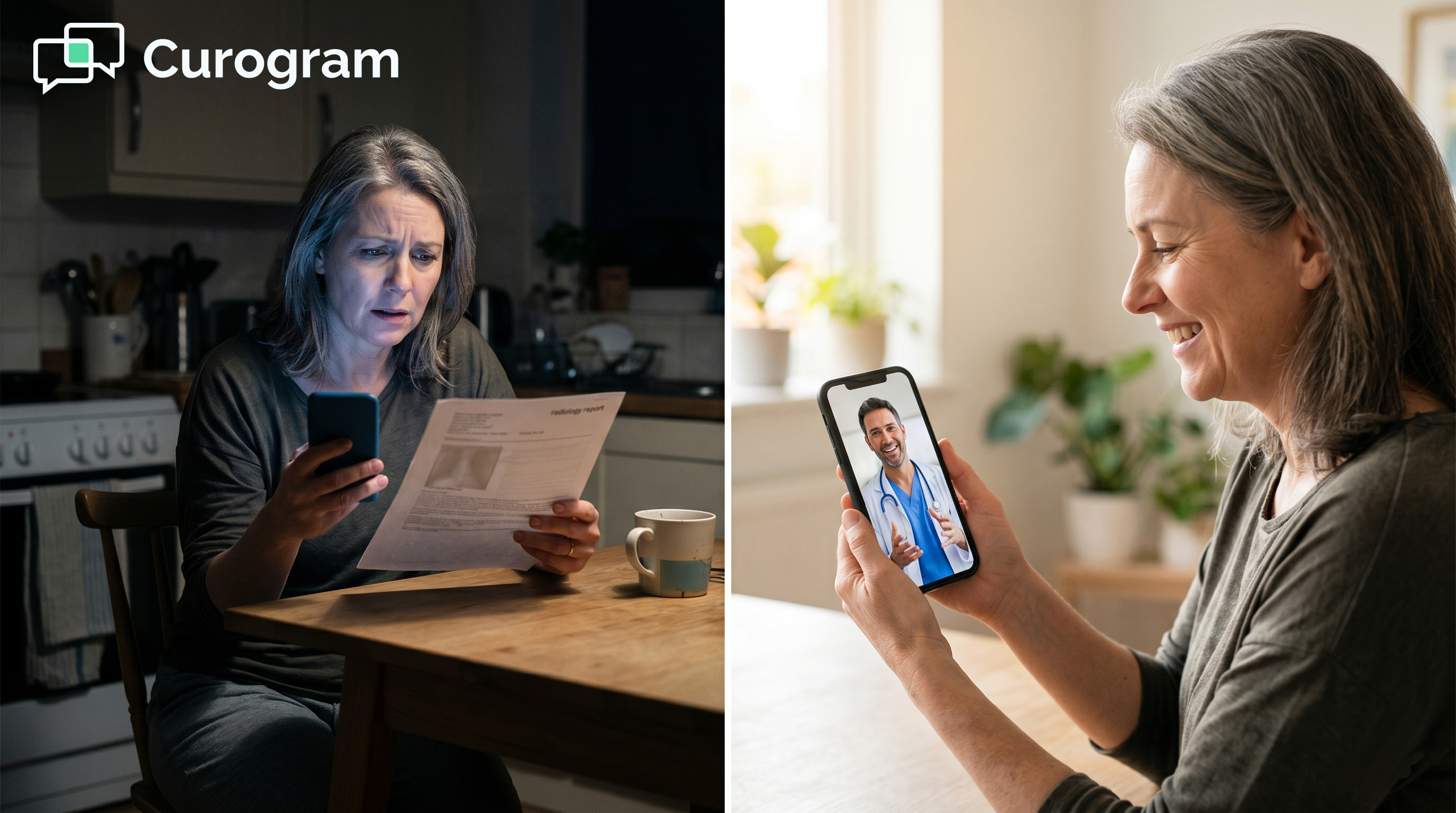
A patient opens their portal after an MRI. They see words like "pulmonary nodule" and "recommend follow-up CT." They Google it. Within five minutes, they are convinced they are seriously ill.
Their doctor's next open slot is three weeks away. The radiologist who read the scan is still in the reading room, with no way to reach that patient.
This happens every day at imaging centers running Exa PACS RIS. Exa is excellent at storing, routing, and displaying images. That is what it is built for.
What it does not include is any way for imaging staff to connect with patients or referring physicians through a virtual visit.
The good news is that this gap is easy to fill. Curogram integrates with Exa through its API to add HIPAA-compliant video consultations via text link. No extra software is needed on the patient side.
A text goes out, the patient taps a link, and the call begins. It works for pre-MRI prep, radiology results discussions, and referring physician coordination.
This article covers how that system works, why it matters, and what imaging centers can expect when they put it in place.
Exa PACS RIS does a lot of things well. It stores images with precision, routes studies to the right radiologist, and makes reports available through a patient portal.
But as a radiology workflow tool, it is not designed for real-time patient communication. That leaves three key gaps that imaging centers deal with every day.
Federal information blocking rules now require that patients get fast access to their medical records, including radiology reports. That is a good thing for transparency. But it creates a problem when a patient reads a report before their doctor has explained it.
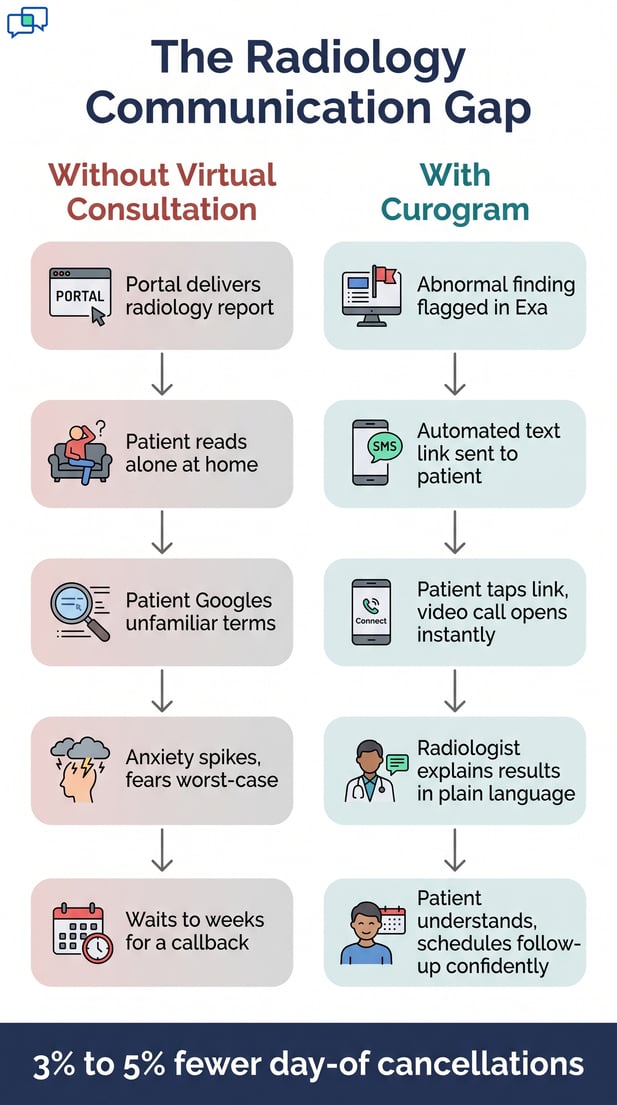
A report might say "2.3 cm pulmonary nodule, recommend 6-month follow-up CT." To a radiologist, that is a routine finding. To a patient reading it alone, it can feel like a death sentence.
They search the terms. The first results mention cancer. Anxiety spikes. Calls flood the front desk. And the radiologist who signed the report has no direct way to reach that patient.
This is the core problem with portal-only communication. Exa can deliver the report, but it cannot start the conversation that gives that report context.
When there is no way to offer a virtual radiology results discussion, centers are left with two bad choices: wait for the referring physician to call the patient back, which can take days or weeks, or have front desk staff field frantic calls they are not trained to answer.
Neither option builds patient trust. Neither keeps the radiologist's expertise in the loop where it matters most.
Missed conversations turn into missed follow-ups. When patients do not understand why a follow-up scan matters, many skip it. That is bad for their care and bad for the imaging center's revenue.
Based on Curogram client data from clinical settings, no-show and cancellation rates in radiology average around 8%. Every scan slot lost to anxiety or confusion is direct revenue lost. At an average MRI cost of $800 or more, even a few missed slots per week adds up fast.
Patients scheduled for their first MRI often do not know what to expect. Is it loud? Will I be in a tight space? What if I panic?
These are normal fears. Left unaddressed, they turn into day-of cancellations.
A phone call from a receptionist reading off a prep sheet rarely helps. What actually calms a patient is seeing the machine, hearing a familiar voice, and getting direct answers. That requires a visual conversation, not a script.
Each cancelled MRI slot is a loss of $800 or more in revenue. Based on Curogram client data from clinical settings, centers offering virtual pre-procedure consultations have seen 3% to 5% fewer day-of cancellations driven by patient anxiety.
For a center running 80 studies a day, that recovery adds up to $6,000 to $9,000 per month.
That is not a small number. And it does not account for the staff time saved by resolving patient fears before they arrive.
Patients do not need more text in a prep email. They need to see the suite and hear that their concerns are understood.
A 5-minute video walkthrough with a technologist does more to reduce anxiety than a two-page instruction sheet.
This is exactly what a pre-MRI consultation virtual visit makes possible. And it does not require any new software on the patient's end.
A hospitalist orders a CT scan for a patient with acute abdominal pain. The scan shows something that needs a quick conversation.
The radiologist tries to reach the hospitalist. The hospitalist is in rounds. Voicemails are traded for two hours. A clinical decision that should take three minutes takes most of the day.
This is not an edge case. It is a daily reality for imaging centers that lack a direct virtual channel for referring physician coordination.
Exa delivers the images. The reading room provides the interpretation. But the communication link between the two is still a phone call that often does not connect.

Curogram integrates with Exa PACS RIS through its API to add a virtual communication layer on top of the existing imaging workflow. The result is a simple, HIPAA-compliant path from a text message to a live video call, all without asking patients to download anything or create an account.
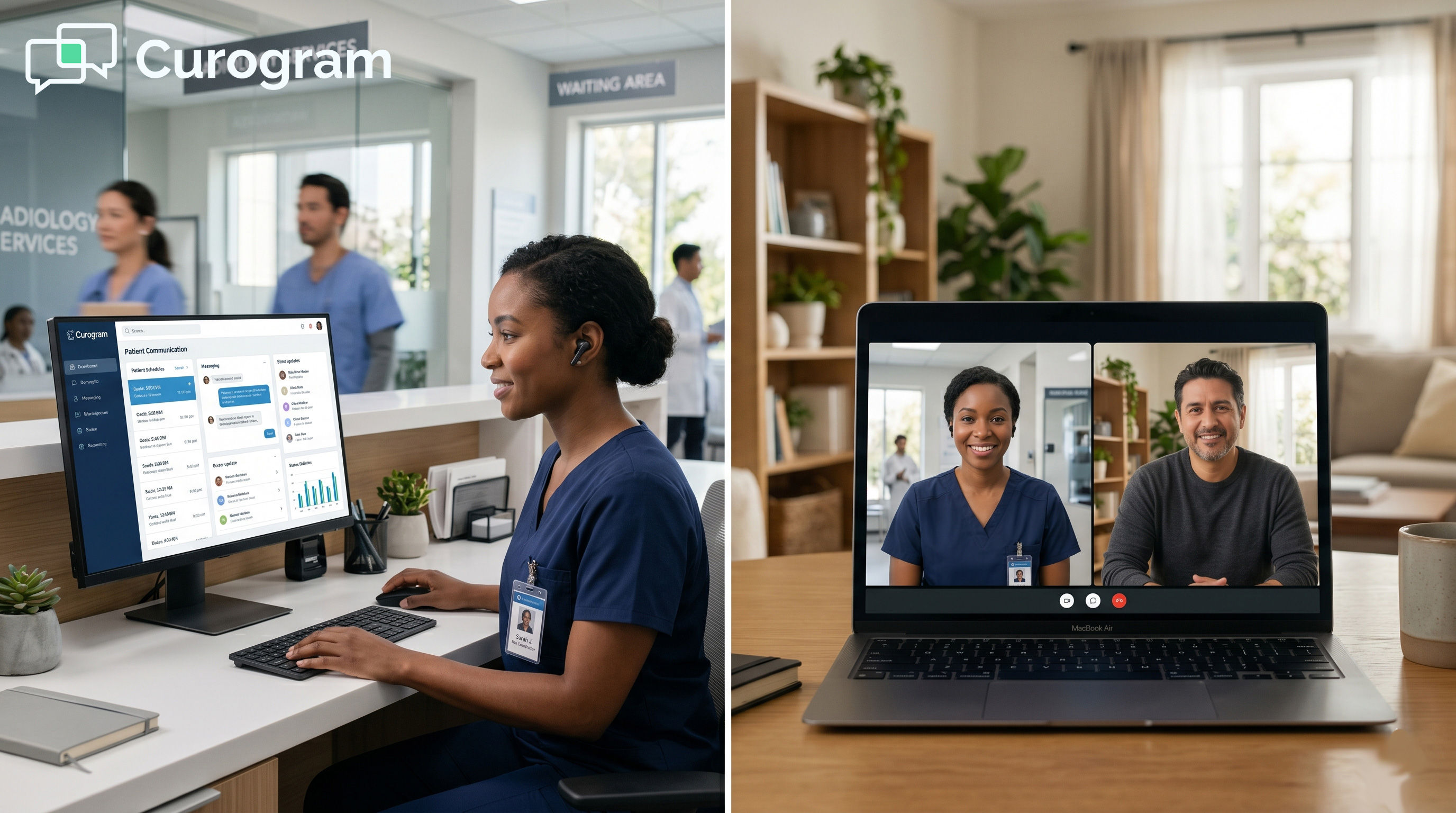
The core feature is straightforward. The imaging center sends a text. The patient taps the link in the message. A secure video call opens in their mobile browser.
The radiologist, technologist, or staff member joins from their workstation. The whole process takes under 60 seconds from text to live call.
This is what sets Curogram apart as a radiology virtual consultation platform. There is no Zoom invite, no portal login, no waiting room screen. It is a text link that just works.
Every part of the process is HIPAA compliant. Curogram holds a SOC 2 Type II certification and signs a Business Associate Agreement with every imaging center it works with. Video sessions use end-to-end encryption. No recordings are stored unless the center chooses to enable that feature.
This matters for radiology in particular, since results discussions involve protected health information. The imaging center telemedicine text link system is built to meet that standard without adding friction for the patient.
Patients are often reluctant to download a new app or create another health portal account. Curogram removes that barrier entirely. The video call opens in the browser. Camera and microphone access is requested. The call begins. That is it.
This low-friction design is important for older patients and those with limited tech skills. In radiology, those patients are common.
Curogram connects to Exa through its API platform to pull scheduling data and patient contact information. This makes it possible to trigger virtual consultations automatically based on the type of study or the status of a result.
For example, the system can be set to send a pre-procedure consultation text to every patient scheduled for a first-time MRI. Or it can send a results discussion link when the Exa Connect system flags a finding that may cause patient confusion. Consultation records sync back into the patient communication log after each call.
One of the most practical features is automation. Rather than requiring staff to manually send every consultation link, Curogram can fire them based on rules.
First MRI? Send a prep link. Abnormal finding flagged? Send a results discussion link. Referring physician needs an urgent update? Send a direct video link.
This kind of Exa RIS virtual patient communication removes the need for staff to decide who gets a follow-up call. The system handles it based on criteria the center defines.
After each virtual visit, a log of the consultation is added to the patient's communication record. This gives imaging centers a documented history of what was discussed and when. It supports compliance, reduces liability, and makes it easier for staff to track which patients have been reached.
Most telemedicine tools are built for primary care. They assume long appointments, full intake forms, and waiting room queues.
Radiology's needs are different. A pre-MRI walkthrough takes 5 minutes. A results explanation takes 10. A referring physician check-in takes 3.
Curogram's text-launched video is designed for exactly this kind of brief, targeted interaction. There is no scheduling overhead, no intake form, and no formal appointment slot needed. It is the conversation the patient or physician needs, when they need it.
Not all virtual consultation tools are built the same. Imaging centers evaluating their options should compare platforms based on how well they fit radiology's specific workflow. The table below covers the most relevant features.
|
Feature |
Curogram |
Generic Telehealth Platform |
openDoctor |
|
HIPAA-compliant video |
Yes (SOC 2 Type II) |
Varies |
No telemedicine included |
|
Patient app required |
No (browser-based) |
Often yes |
N/A |
|
Exa PACS/RIS integration |
Yes (via API) |
No |
Limited |
|
Triggered by study type |
Yes (automated) |
No |
No |
|
Pre-procedure video visits |
Yes |
Limited |
No |
|
Results discussion support |
Yes |
Partial |
No |
|
Referring physician video |
Yes |
Partial |
No |
|
Monthly cost |
Contact for pricing |
Varies |
$2,500+/mo |
|
Consultation log sync |
Yes |
No |
No |
Generic telehealth platforms are designed for scheduled office visits. They expect patients to log in, fill out forms, and wait in a virtual queue.
That model does not fit radiology. The imaging center telemedicine model needs to be faster, simpler, and integrated with the study workflow.
A radiology video call should start with a text link, not a portal login. It should take minutes, not require a scheduled appointment slot. And it should connect back to the imaging record automatically.
openDoctor is a common tool used alongside Exa for patient-facing scheduling. At $2,500 per month, it handles appointment booking. But it does not include telemedicine or any virtual consultation capability.
Imaging centers using openDoctor still have no way to conduct a pre-MRI consultation virtual visit or discuss results by video.
Curogram fills that gap directly. It works alongside existing scheduling tools rather than replacing them.
Because Curogram's video consultations launch from a text message, they fit naturally into the same channel used for reminders, prep instructions, and payment links.
The patient is already used to getting texts from the imaging center. Adding a video link to that channel feels seamless, not foreign.
This is what makes the imaging center telemedicine text link approach more practical than a standalone app. There is nothing new for patients to learn.
Adding virtual consultations to an Exa-powered workflow is not just about patient experience. It has measurable effects on revenue, staff workload, and clinical outcomes. Here is what the data shows.
Day-of cancellations from patient anxiety are one of the most common sources of lost revenue in radiology. When a patient arrives and panics at the sight of the MRI bore, the slot is wasted. The scanner sits idle. Staff are tied up managing the situation.
Based on Curogram client data from clinical settings, centers that offer virtual pre-procedure consultations see 3% to 5% fewer anxiety-driven cancellations.
For a center running 80 studies per day at $800 each, that recovery is worth $6,400 to $9,600 per month. The savings from just a handful of prevented cancellations each week can offset the cost of the platform entirely.
|
Studies/Day |
Avg. Revenue Per Study |
Cancellations Prevented (3-5%) |
Monthly Revenue Recovered |
|
80 |
$800 |
2-4 per day |
$6,400 to $9,600/mo |
|
60 |
$800 |
1-3 per day |
$4,800 to $7,200/mo |
|
40 |
$800 |
1-2 per day |
$3,200 to $4,800/mo |
These numbers are based on applying the 3% to 5% reduction in anxiety-driven cancellations observed in Curogram client data from clinical settings.
Patients who receive a virtual results discussion are more likely to schedule their follow-up imaging. When a radiologist takes 10 minutes to explain why a repeat scan matters, the patient understands the stakes. They show up. That keeps the imaging pipeline full and supports better long-term care.
When anxious patients have a direct video path to get their questions answered, they stop calling the front desk to repeat those same questions. That frees up staff for more valuable work.
Based on Curogram client data from clinical settings, practices using two-way texting and virtual consultations have reduced inbound call volume by as much as 50%.
For imaging centers, that means fewer interruptions to the front desk and more time spent on tasks that actually require human judgment.
A 3-minute radiology results discussion video call with a referring physician saves far more time than two hours of phone tag. When urgent findings need to be discussed, speed matters clinically. A direct video link via text gets both parties on the same call in seconds.
This kind of imaging center referring physician telehealth capability is not something most centers have today. It is also one of the features that referring physicians tend to notice and value quickly.
Patients who get a virtual walkthrough before their first MRI tend to leave better reviews. They arrive calm, they cooperate during the scan, and they remember the experience positively. That shows up in patient satisfaction scores and in online reviews.
A 5-star review that mentions the virtual tour is not just good for reputation. It drives new patient referrals and strengthens the imaging center's position in a competitive market.

Radiology expertise should not be locked behind a reading room door. The radiologist who reads a scan is the most qualified person to explain it. But without a virtual communication channel, that expertise stays invisible to the patient.
Curogram gives Exa-powered imaging centers a way to close that gap. It adds HIPAA-compliant video consultations via text link to any Exa workflow, making it possible to reach patients before and after their scan, and to connect referring physicians to radiologists without the phone tag.
The results are practical and measurable: fewer cancellations, better follow-up rates, faster clinical decisions, and patients who feel like they were actually cared for, not just scanned.
Your radiologists have the expertise. Your patients have the questions. Curogram builds the bridge, via a single text link, in under 60 seconds.
Ready to see how it works? Schedule a demo and identify your highest-value virtual consultation use case within the first week.
Radiology reports use clinical language that is not designed for patients. Terms like "nodule," "opacity," or "recommend follow-up" have clear meanings to a radiologist but can sound alarming to someone reading them alone.
When a patient finds this in a portal before their doctor has called, they tend to search online. Those searches often surface worst-case scenarios. A brief virtual results discussion changes that dynamic entirely.
Curogram's virtual consultations are HIPAA compliant at every step. The platform uses end-to-end encryption and holds a SOC 2 Type II certification. A Business Associate Agreement is signed with every imaging center.
No video is recorded or stored unless the center specifically enables that feature. Patient data is protected from the moment the text is sent to the moment the call ends.
A phone call can answer basic questions, but it cannot show the patient what the MRI suite looks like or let them see the machine before they arrive. Visual information is key for patients who fear small spaces or loud sounds. A short video walkthrough with a technologist gives the patient a real sense of what to expect. That visual reassurance reduces anxiety far more than words alone.
Curogram does not change anything about how Exa stores, reads, or distributes imaging studies. It connects through the Exa API to access scheduling and contact data, then adds a communication layer on top.
Exa handles the imaging workflow. Curogram handles the human conversations that surround each study. They are built for different jobs and work better together than either would alone.
Phone calls for clinical discussions are often interrupted, delayed, or missed entirely. A video link sent by text can be tapped immediately, even between rounds. The radiologist can pull up the relevant image on screen while talking. The referring physician gets the context they need in a fraction of the time. Most physicians who use it once tend to prefer it over phone tag.
💡 Imaging center staff lose hours every week to pre-procedure phone calls, delayed physician check-ins, and last-minute cancellations.Curogram,...
💡 An imaging center virtual consultation lets patients connect face-to-face with their radiology team through a simple text link. No app download....
💡 Rural clinic staff on Azalea Health can use text-based telemedicine to reduce no-shows and keep their schedules full. When a patient calls to...