1 min read
Telemedicine North Carolina: All You Need to Know | Blog
North Carolina is yet to embrace all the benefits telemedicine has to offer. The Old North State is a little behind when it comes to parity laws, and...
11 min read
Michael Hsu
:
Updated on August 28, 2026
Georgia said yes to telemedicine before most of the country was ready to ask the question. That was 2005. Two decades later, providers across the state still get tripped up by the same thing.
The problem is not whether you can treat patients online here. You can. The problem is that the answer shifts depending on who is asking.
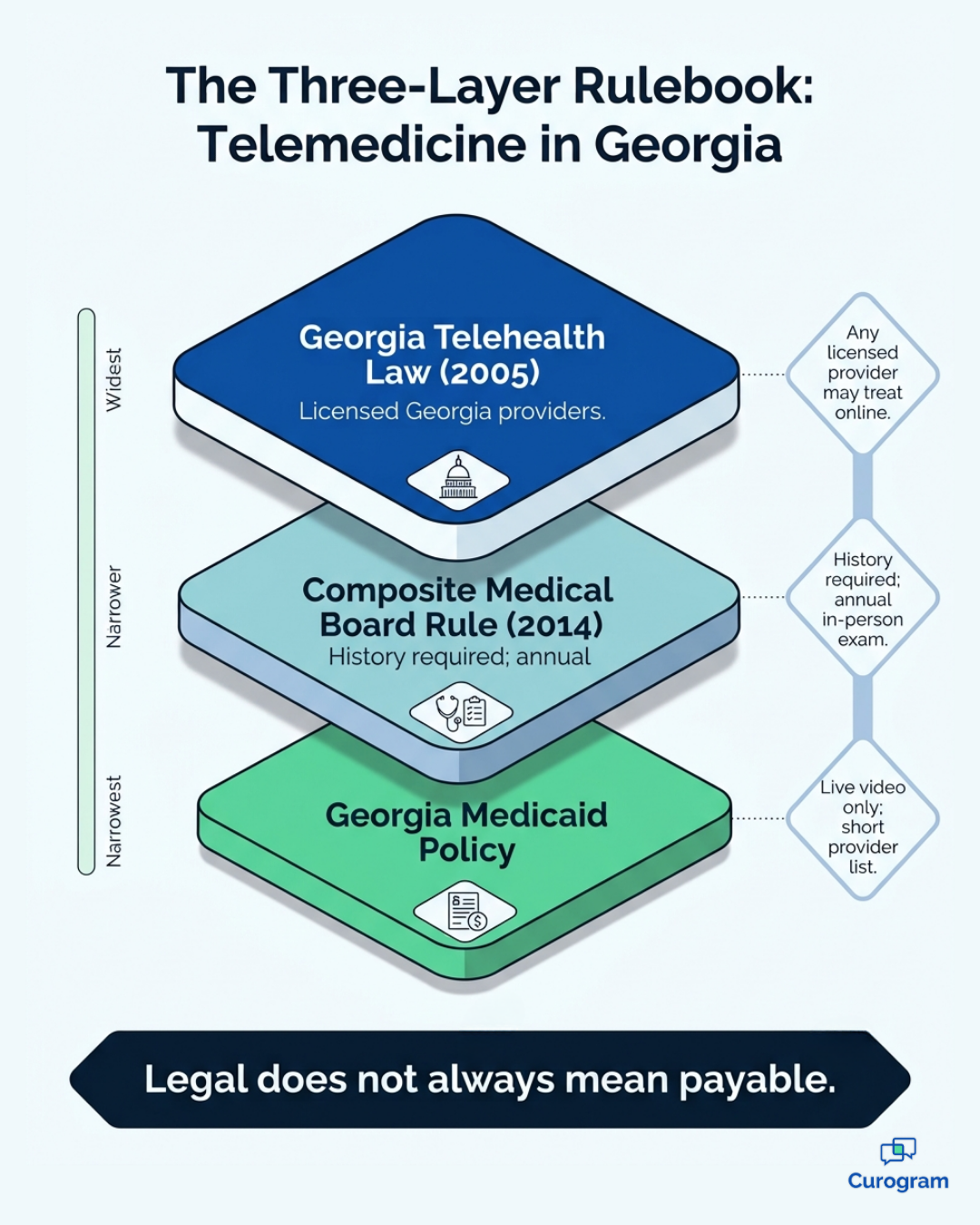
State law says one thing. The Georgia Composite Medical Board sets a tighter standard. Georgia Medicaid draws the line somewhere else entirely.
So a virtual visit can be legal, clinically sound, and still come back unpaid. That gap is where practices quietly lose money, and most do not spot it until the denials start piling up.
Multiply one denied claim across a full schedule and it stops being a rounding error. A practice running 40 virtual visits a week does not need many misrouted appointments before the write-offs add up. All of it is avoidable.
Here is the good news. The rules are not complicated once you see how the three layers stack up. They just live in three separate places, written by three different bodies across three different decades.
This guide pulls them together, so you can see what Georgia telehealth law allows, what the Medical Board expects before you examine a patient online, and what Georgia Medicaid will actually reimburse.
Just as important, you will see where the three sets of rules disagree. That is the part that costs you real money over a year of scheduling.
Read it once and you will know whether your practice can offer remote care, and on what terms. Read it twice and you will know which visits to book online and which ones still belong in the exam room.
Let's start where Georgia did, back in 2005, and work forward from there.
In 2005, the State of Georgia introduced amendments to the Official Code of Georgia Annotated, in order to enact the Georgia Telehealth Law. The goal was to provide definitions and a legislative framework for providing remote medical services in the state.
Right off the bat, Georgia Telehealth Law states that no insurance policy can enforce face-to-face contact as a requirement for reimbursing medical care. This marked Georgia as one of the first states in the U.S. to legally enforce payment parity for telemedicine and telehealth services.
In other words, since 2005, private insurance companies in Georgia must provide coverage for telemedicine and telehealth services if the same services would be covered if they were delivered in-person.
Georgia law views telemedicine and telehealth as separate, although similar terms. The main differences stem from the purpose of remote doctor-patient communication and the way in which remote medical care is delivered.
Telemedicine — Under Georgia Telehealth Law, Telemedicine is considered the delivery of clinical healthcare services by utilizing two-way audio and video, or other electronic and telecommunication technologies. The law explicitly excludes telephone doctor-patient consultations and facsimile transmission from the definition.
The purpose of telemedicine, as defined by law, is assessment, diagnosis, consultation, treatment, education, and exchange of medical information. Georgia Telehealth law also forbids the discrimination between urban and rural areas and states that medical professionals — licensed in the state and working within their scope of practice — can offer telemedicine services to patients in Georgia, without face-to-face contact.
There is no reference regarding consent for telemedicine in the Telehealth Law. That said, the strong emphasis on removing the in-person requirement implies that providers can establish a valid doctor-patient via telemedicine.
Telehealth — The 2019 Senate Bill 118 made several amendments to the Georgia Telehealth Law.
The Bill introduced the term “telehealth” with the purpose of expanding the utilization of remote healthcare services.
The law now recognizes telehealth as the use of information and telecommunication technologies, including phones and remote patient monitoring — to facilitate:
Although both types of medical services are delivered remotely, the difference is in intent — telemedicine helps providers diagnose and treat patients through live audio-video communication, while telehealth enables other forms of communication that aid in-person clinical care.
SB 118 introduced a few additional definitions regarding remote healthcare services and expanded on the state’s telemedicine policy.
The new definitions and policies pertained to:
Originating sites — SB 118 defines an “originating site” as any site in the State of Georgia in which the patient who receives remote healthcare services is located. It also gives insurers and patients the liberty to “agree to alternative setting arrangements” that both parties deem appropriate.
This effectively means that a patient’s home can be considered an originating site, along with any medical facilities in which the patient is receiving in-person medical care.
Distant sites — The amended Georgia Telehealth Law is quite flexible when it comes to the location of the provider offering telemedicine and telehealth services. There are no restrictions regarding distant sites. Any site where a medical professional licensed to practice medicine in Georgia offers remote healthcare services is considered a distant site.
The wording of this definition reinforced the interpretation that any licensed medical professional in the State of Georgia can offer remote healthcare services to patients in the state.
Insurers — Given that Georgia Telehealth Law enforces payment parity for healthcare services delivered via telehealth and telemedicine, the legislator deemed it important to clearly define which entities are considered “insurers” under law. Anyone authorized to sign contracts under this title or to provide health benefit policies is considered an insurer.
This includes, but is not limited to:
SB 118 highlights that no insurer can refuse to cover telemedicine and telehealth services solely on the basis that these services are provided remotely.
Insurers must reimburse healthcare providers for diagnosis, treatment, and consultation delivered via telemedicine. The basis and the reimbursement rates must be the same as with in-person medical services covered by the insurer.
The amendments also remove the possibility of enforcing any limitations on coverage for telemedicine services. This means that insurers cannot set a yearly or lifetime dollar maximum for telemedicine — they must reimburse the provider for all telemedicine services delivered, regardless of their frequency.
Insurers also cannot impose any copayment, coinsurance, or deductibles if they are not equally imposed on all services covered under the health benefit policy, regardless of whether they’re delivered remotely or in-person.
Store-and-forward technology — SB 118 defines store-and-forward technology as the transmission of medical data to and from an originating site or to and from a provider. This encompasses both sharing protected health information (PHI) between a patient and a provider, as well as between different providers for the purposes of facilitating remote medical care.
The technology used doesn’t have to be real-time, and the patient doesn’t need to be present for the transmission of their medical information.
All the changes introduced by SB 118 have been in effect since January 1, 2020.
In 2014, the Georgia Composite Medical Board issued a regulation called Practice Through Electronic or Other Such Means with the purpose of establishing standards of practice the providers will be held to when delivering remote healthcare services.
What’s particularly interesting regarding the Board’s prescribed standards is that the regulation explicitly states that all remote treatment and/or consultation must be done by:
This severely limited the utilization of telemedicine and telehealth in the state, but it was not long-lived. The SB 115, passed in 2019, corrected this narrow view by stating that any person who delivers remote healthcare services will be subject to regulation by the Board.
Looking at Georgia’s law chronologically, the Telehealth Law of 2005 didn’t provide any reference regarding who can practice telemedicine in the state. In 2014, the Board sought to provide clearly defined standards of practice and, in doing so, provided an extremely narrow list of eligible providers. This hindered the use of telemedicine and telehealth in Georgia, so legislators introduced SB 155 five years later that explicitly states that all medical professionals licensed in Georgia can offer remote health care services to patients in the state.
The Board set one more condition, and it trips up a lot of new programs. You need the patient's history before the visit starts.
Before you treat or consult remotely, you have to meet at least one of these conditions:
The Board can discipline any provider here for unprofessional conduct. So yes, you can admit, examine, diagnose, and treat new patients online, but your tools have to hold up.
If a case needs hands-on care, you are obligated to say so and cancel the video visit.
That last point is where the right platform earns its keep. Curogram's telemedicine platform runs high-definition two-way video built for clinical use, so you can examine, diagnose, and treat inside the Board's standards.
It also sends patient intake forms days before the visit, so you get the history early. That gives you time to decide whether the case belongs online or in the exam room.
The Board also expects a paper trail. You must keep patient records current, and document the evaluation, the treatment, and the identity of every provider involved.
If another provider or facility asked for the visit, you owe them a copy of that record too.
Done by hand, this is slow work that adds up across a full schedule. Curogram integrates with your EHR, so visit details flow into the chart automatically. You can also share PHI with partners and patients from the same dashboard.
| Curogram EHR integrations | |
|---|---|
| eClinicalWorks | Athena |
| Epic | Cerner |
| DrChrono | NextGen |
| Practice Fusion | CareCloud |
| Kareo | OfficeAlly |
| See more integrations here |
The Board treats telemedicine as support for in-person care, or as a stand-in when hands-on care is not close by. Its policy asks providers to make diligent efforts to have the patient seen and examined in person.
You do not have to be the one who performs that exam. A Georgia-licensed provider just has to see the patient in person at least once a year.
You also owe patients clear follow-up instructions in case they need urgent care later. That means your name, your credentials, and a number they can call. Care delivered to an inmate is the one exception.
Prescribing is where the Board draws its hardest line. You cannot prescribe controlled substances or dangerous drugs after a telemedicine or telehealth visit.
Everything else is open. You can prescribe over-the-counter medication and non-controlled substances without ever meeting the patient in person.
|
Run this quick check before you build a virtual schedule:
That third check is the one practices skip. State law can allow a visit that Medicaid will not pay for, and you find out when the claim comes back. |
Another thing the SB 115 introduced was the possibility for out-of-state medical professionals to leverage telemedicine to provide remote healthcare services to patients in Georgia.
Following the Bill, Georgia joined the Interstate Medical Licensure Compact, making it even easier for out-of-state telemedicine practitioners to obtain a license to offer remote healthcare to patients in the state.

Georgia Medicaid defines telemedicine as using two-way, real-time video to exchange patient medical information between two sites.
Medicaid’s definition is somewhat misleading, given that it explicitly states telemedicine involves “the exchange of patient information,” yet only through live video. The wording makes Medicaid’s telemedicine definition a bit convoluted, so we’ll simplify it:
Medicaid will only reimburse for live video visits, and will not reimburse for store-and-forward technology, remote patient monitoring, phone, and email consultations.
Apart from only reimbursing live video telemedicine, Georgia’s Medicaid program enforces several more limitations.
Whereas the law permits all licensed medical professionals in the state to practice telemedicine and telehealth, Medicaid has a limited list of eligible providers:
In order for Medicaid to reimburse healthcare providers for telemedicine services, said services must be deemed medically necessary and appropriate for the patient.
The list of services Medicaid covers is limited to:
If you’re participating in Georgia’s Medicaid program, it’s best to contact Medicaid directly and inquire whether they cover a specific telemedicine service, prior to admitting the patient online.
Georgia’s Medicaid program states that, in order to reimburse for telemedicine services, the provider must obtain written patient consent before a telemedicine visit. We also recommend familiarizing your patients with the potential security and confidentiality risks associated with providing medical care remotely.
Medicaid also imposes some restrictions regarding eligible originating and distant sites for telemedicine visits.
Eligible sites under Georgia’s Medicaid Program are:
Note that GA Medicaid doesn’t consider a patient’s home to be an eligible originating site. Patients must be admitted to one of the medical facilities listed above, and telemedicine services will only be reimbursed, provided that the facility that acts as an originating site cannot provide specific services in-person.
For all eligible services, Georgia Medicaid will reimburse providers according to their current physician fee schedule amount. This essentially means that all eligible remote healthcare services will be reimbursed at the same rates as the same services delivered in-person.
Don’t see your state? We just haven’t written about it yet! Stay tuned on our blog or check out our article on telemedicine reimbursement by state.
Telemedicine by State in the US
|
Nebraska |
|||
|
Alaska |
Iowa |
Nevada |
South Dakota |
|
Kansas |
New Hampshire |
||
|
Kentucky |
|||
|
New Mexico |
Utah |
||
|
Maine |
Vermont |
||
|
Connecticut |
|||
|
Delaware |
North Dakota |
||
|
West Virginia |
|||
|
Oklahoma |
|||
|
Mississippi |
Wyoming |
||
|
Montana |
Rhode Island |
Georgia gave providers a real head start, and the rules have only opened up since. Payment parity is settled law, any licensed provider here can treat patients online, and out-of-state doctors have a way in.
What has not changed is the gap between what the law allows and what a payer will actually fund. That gap is manageable, but your workflow has to catch it before the visit, not after the denial.
That is the case for the right platform. Curogram is built for medical practices, so it works around the workflow you already have instead of replacing it.
The platform is fully HIPAA compliant with built-in safeguards, so your staff is not stuck sorting out technical details. Training takes minutes, not weeks.
One dashboard handles the whole visit. Send appointment reminders, message patients, share PHI with staff and partners, run video visits, and collect payment.
The reminder piece alone moves the numbers. Automated text reminders cut no-shows by up to 75%, and Curogram client Atlas Medical Center took its no-show rate from 14.20% down to 4.91% in three months.
Here is what that looks like in dollars. Say you run 200 video visits a month at $100 each. A 14% no-show rate costs you 28 missed visits, or about $2,800.
Cut that rate to 5% and you win back about 18 visits. That is close to $1,800 a month, or $21,600 a year. The figures are illustrative, but the pattern holds.
Electronic intake forms go out days early, so providers stop losing the first 15 minutes of a visit to history taking. Virtual waiting rooms let your MAs, nurses, and doctors work the way they already do.
Georgia made room for telemedicine. The rest is execution.
See how Curogram fits your practice. Schedule a demo with our team.
Frequently Asked Question
Yes, as long as you meet the Board's conditions. You need the patient's history before the visit, and your technology has to be equal to or better than an office exam. If the case needs hands-on assessment, you are obligated to say so and move the patient to an in-person appointment.
They do. Georgia has enforced payment parity since 2005. A private plan must cover a remote service at the same rate as the in-office version. Insurers also cannot cap telemedicine by the year or by the dollar, and they cannot add copays you would not see on any other service.
You can prescribe over-the-counter drugs and non-controlled drugs without meeting the patient in person. Controlled substances and dangerous drugs are off the table after a video visit. Federal rules here have shifted several times. Check the latest guidance before you set up a prescribing workflow.
Georgia treats the patient's location as the place of practice. If your patient is in Georgia during the visit, you are practicing in Georgia. So you need a Georgia license or a Georgia telemedicine license. The Interstate Medical Licensure Compact gives qualified doctors a faster path to one.
At least once a year. The Board asks providers to make diligent efforts to have the patient examined in person, but you do not have to be the one who performs that exam. Any Georgia-licensed provider can handle it, which makes referral relationships worth setting up early.
1 min read
North Carolina is yet to embrace all the benefits telemedicine has to offer. The Old North State is a little behind when it comes to parity laws, and...
1 min read
💡 Telemedicine is legal and widely covered in Virginia, but three rules decide whether a visit is valid and paid.First, licensing follows the...
1 min read
You won’t find much about telemedicine in the Illinois Statutes. The Telehealth Act boils down to a broad definition of the term and a list of...