
 Carylee Gali
5 Critical Rules to Remember When Texting Patients
 Joshua Inciso : 11/10/22, 12:56 PM
Discover how the 5 rules for texting your patients can improve your practice. Maintain proper and secure communication by implementing these rules.

Most medical practices shop for a communication system the same way. They compare pricing, scan the feature list, and look for one reassuring word: HIPAA. If that label appears, the search feels finished.
That's where the trouble starts.
A vendor can describe itself as HIPAA ready and still leave your practice exposed. The label explains what the vendor protects on its end, but it says nothing about how your team uses the tool every day.
RingCentral is a good example. It's one of the biggest names in cloud communication, and many clinics rely on it for calls, video, team messaging, and fax. So the question comes up often: is RingCentral HIPAA compliant?
The short answer is yes, it can be. RingCentral signs a Business Associate Agreement (BAA) with paying healthcare customers and invests in security. But the BAA is only the starting line, because your practice is still responsible for how patient information moves through the system.
There's a bigger question, too. Even a compliant platform may not match the way a medical office actually operates. Consider a front desk that juggles calls, reminders, and reschedules all morning. If the phone system can't share data with your EHR, staff enter the same details twice, and that time never comes back.
Remote and hybrid care have raised the stakes even further. More patient conversations now happen by phone, text, and video, and each one is an opportunity to protect PHI or to put it at risk.
In this guide, you'll learn what RingCentral offers healthcare teams and how it supports HIPAA compliance. You'll also see where users say it falls short and which features to prioritize in a HIPAA-compliant alternative. By the end, you'll know whether RingCentral fits your practice or whether a platform designed for patient communication makes more sense.
RingCentral started out as a cloud-based phone system. Over time, it grew into a full communication suite for businesses of every size, including medical practices.
Its main business phone product, once called RingCentral MVP, is now called RingEX.
It bundles several tools in one place:
RingCentral also sells some products on their own, such as RingCentral Video and its contact center platform. This lets your practice choose a package that fits your size and budget.
If you use RingCentral to create, receive, send, or store electronic PHI (ePHI), you need a signed BAA first. Under HIPAA, RingCentral then acts as your business associate. That means it takes on legal duties to protect the patient data it handles for you.
RingCentral saw a clear chance to serve healthcare, so it built strong security into its platform. These tools help keep patient data safe across calls, chats, and meetings.
The company describes its approach as seven layers of security. Those layers cover the building, the network, the servers, the data, the apps, business steps, and the company as a whole. Here's how they help with HIPAA in real life.
Under the hood, RingCentral has the core tools that healthcare buyers look for:
These tools work in the background to stop threats before they reach your data. For your team, that means less risk from hackers.
Encryption is one of the best ways to keep ePHI safe, both when it's stored and when it's on the move.
RingCentral uses two types to guard data as it travels:
RingCentral says it encrypts data sent over public wired and Wi-Fi networks.
One catch: calls that cross the old-style phone network (PSTN) fall outside that promise.
RingCentral runs its platform in data centers audited under SSAE 18 and ISO 27001 standards. On site, it uses key-card entry, full-time guards, and engineers to protect the hardware.
In plain terms, a stranger can't walk in and walk out with a server full of patient records.
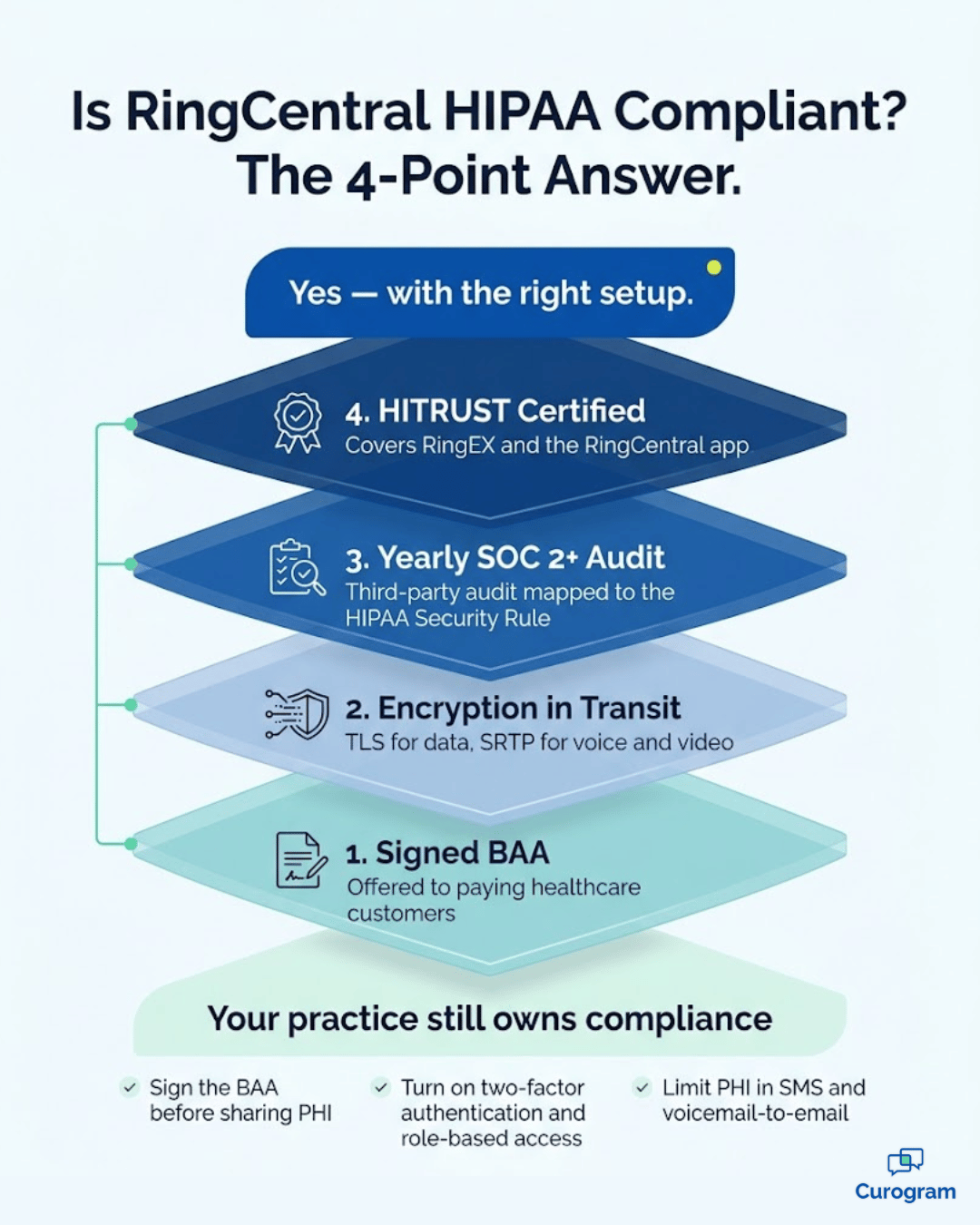
RingCentral goes through a third-party SOC 2+ audit every year. This audit checks its controls against the HIPAA Security Rule. You can ask for a copy of the latest report.
RingEX and the RingCentral app have also earned HITRUST certification. HITRUST is a security standard that many healthcare groups trust, so it adds more proof.
Still, RingCentral is clear on one point. Its own HIPAA overview says that customers covered by HIPAA are, in the end, responsible for meeting its rules.
|
No platform can make your practice HIPAA compliant on its own. Before any patient data touches a new tool, run through these four checks:
In practice, compliance is a shared job. The vendor secures the platform, and your team secures how it's used. |
The most vital advantage of RingCentral is that it is fully HIPAA compliant. Healthcare providers who opt for this solution should not get into any trouble for violating HIPAA rules and regulations.
Even though RingCentral is HIPAA compliant, it does not guarantee the best solution for your practice. Any software system has its drawbacks, and RingCentral is no exception.
If you’re considering telemedicine or virtual appointments as part of your practice’s services, you may encounter quite a few problems and hurdles with RingCentral.
Present and former clients of RingCentral have left informative and in-depth reviews about the company’s services on TrustRadius, a popular review site for business technology.
Some of the most current and prevalent issues with RingCentral, according to its users, are:
Additionally, there’s a reason why RingCentral doesn’t mention electronic health record (EHR) integration and doesn’t respond to customer inquiries regarding this capability — its platform doesn’t integrate with any EHRs.
When choosing a telemedicine solution, EHR integration should be one of your top priority features. Without an EHR option, you and your team must manually enter all of the information into your EHR when sharing PHI. That means you waste valuable time on tedious administrative tasks rather than spending that time treating patients.
Considering everything, it’s evident that RingCentral is a HIPAA-compliant platform, but the system also has downsides that may significantly affect the operation of your medical practice.
RingCentral's biggest strength for healthcare is security. With a signed BAA and the right setup, your practice can use it in a HIPAA-compliant way.
But compliant doesn't mean ideal. Every platform has trade-offs, and RingCentral is no exception. This matters most if virtual visits and patient texting are a big part of your care.
Current and past users have shared detailed reviews on TrustRadius, a popular review site for business software.
Here's how the strengths stack up against the most common complaints:
| What works well | What users often report |
|---|---|
| BAA available to paying healthcare customers | Slow support and long hold times |
| TLS and SRTP encryption, plus yearly SOC 2+ audits | Higher cost than some other options |
| HITRUST certification for RingEX and the app | Features buried in menus and hard to find for new users |
| Phone, video, messaging, and fax in one suite | Limited flexibility to add or remove users mid-contract |
| Scales from small offices to large health systems | Reporting and analytics that feel basic |
EHR integration is another factor to weigh. In 2024, RingCentral announced EHR integrations with Epic, Cerner (now Oracle Health), and Allscripts through a partnership with patient engagement company SpinSci. Those tools are built mainly for contact center agents who handle large call volumes.
For a smaller practice, that setup may be more than you need, or harder to get. Ask any vendor if it supports your EHR, what the link costs, and who sets it up. Without a solid connection, staff must enter patient details by hand, which takes time away from patients.

So yes, RingCentral can be a HIPAA-compliant choice. But its trade-offs can affect how smoothly your practice runs day to day.
Telehealth and remote communication offer real benefits for your practice. But between HIPAA requirements and technical setup, selecting the right platform can feel overwhelming.
The good news is that you have plenty of options to choose from. The key is to look beyond the HIPAA label and evaluate each platform by how well it supports your daily operations.
Here's what matters most.
Your patients' communication preferences should guide your decision. Many patients now expect to get text messages from their providers, and texts are hard to miss, with open rates as high as 98%.
A secure 2-way text messaging system for booking and reminders makes it easy for patients to confirm, reschedule, or ask a quick question. Atlas Medical Center used Curogram's automated reminders to cut its no-show rate from 14.20% to 4.91%.
Here's a sample calculation to show what that means. For a clinic with 1,000 visits a month, that drop works out to about 93 fewer missed visits every month.
Connecting a new platform to your EHR or EMR can take considerable time. Some vendors need several weeks to complete an integration, so request a clear timeline up front.
Look for a platform that plugs into the systems you already use for scheduling, charting, and billing. Curogram integrates with almost any EMR, and most staff can learn it in under 10 minutes. That means your team can get started fast without changing how they work.
The right platform should reduce work for your front desk, not create more of it. Digital forms that flow into your EHR cut down on double entry. An internal messaging tool lets staff set up channels to talk through daily tasks without leaving the platform.
Texting also eases phone traffic. Curogram users have cut call volume by up to 50% and raised front desk productivity by more than 30%.
Here's an example of the impact. If your front desk takes 200 calls a day and each one lasts about 3 minutes, cutting half of them saves roughly 5 hours of staff time every day.
You should know exactly what you're paying for and what's included from day one. Hidden fees and confusing renewal terms make it difficult to plan your budget.
Before you commit, ask for a live demo. Seeing the platform run with your own workflows is the fastest way to know if it fits. Being HIPAA compliant is a must, but it's only one part of the decision.
So, is RingCentral HIPAA compliant? It can be. The company offers a BAA to paying healthcare customers, encrypts data in transit, and supports its security program with SOC 2+ audits and HITRUST certification. For many organizations, that's a strong foundation.
But a medical practice isn't just any organization.
Your team needs much more than secure phone lines. You need tools that match how patients prefer to reach you and how your staff actually operates. That means simple texting, automated reminders, and a reliable connection to your EHR, so no one has to enter the same information twice.
This is where RingCentral can fall short for some practices. Users report slow support, features that are difficult to locate, and contracts that are hard to adjust. Its EHR integrations also focus on large contact centers, which may not reflect the needs of a smaller office.
None of this makes RingCentral a bad product. It simply means the HIPAA label shouldn't be the only thing you evaluate. The right platform protects patient information and makes every day easier for your team.
Before you decide, take an honest look at your current workflow. Count how many calls your front desk handles daily, how often patients miss appointments, and how much time goes into manual data entry. Those answers will show you exactly what to prioritize first.
Curogram was designed for exactly these challenges. It's a HIPAA-compliant patient communication platform with 2-way texting, automated reminders, and integration with almost any EMR. Practices using it have reduced no-shows, cut phone calls by up to 50%, and freed staff to focus on patients instead of phones.
Ready to see how it could work for your practice? Book a demo of Curogram's HIPAA-compliant patient texting platform and discover how much time your team could get back each week.
 Joshua Inciso : 11/10/22, 12:56 PM
Discover how the 5 rules for texting your patients can improve your practice. Maintain proper and secure communication by implementing these rules.

 Aubreigh Lee Daculug : 10/1/26, 6:00 PM
Four failures behind broken clinic texting: personal phones, no BAA, no audit trail and no opt-out record. What each exposes and how to close it.

 Jo Galvez : 3/15/26, 1:00 PM
Honest comparison: Curogram vs Luma Health, Klara, and Artera. Features, pricing, integration, and which platform is right for your medical practice.