NextGen Smart Reminders | 2-Way Confirmation, Fewer No-Shows
💡 NextGen Enterprise appointment reminders powered by Curogram send 2-way texts patients can reply to — confirming, cancelling, or rescheduling. ...

8 min read
Aubreigh Lee Daculug
:
March 24, 2026
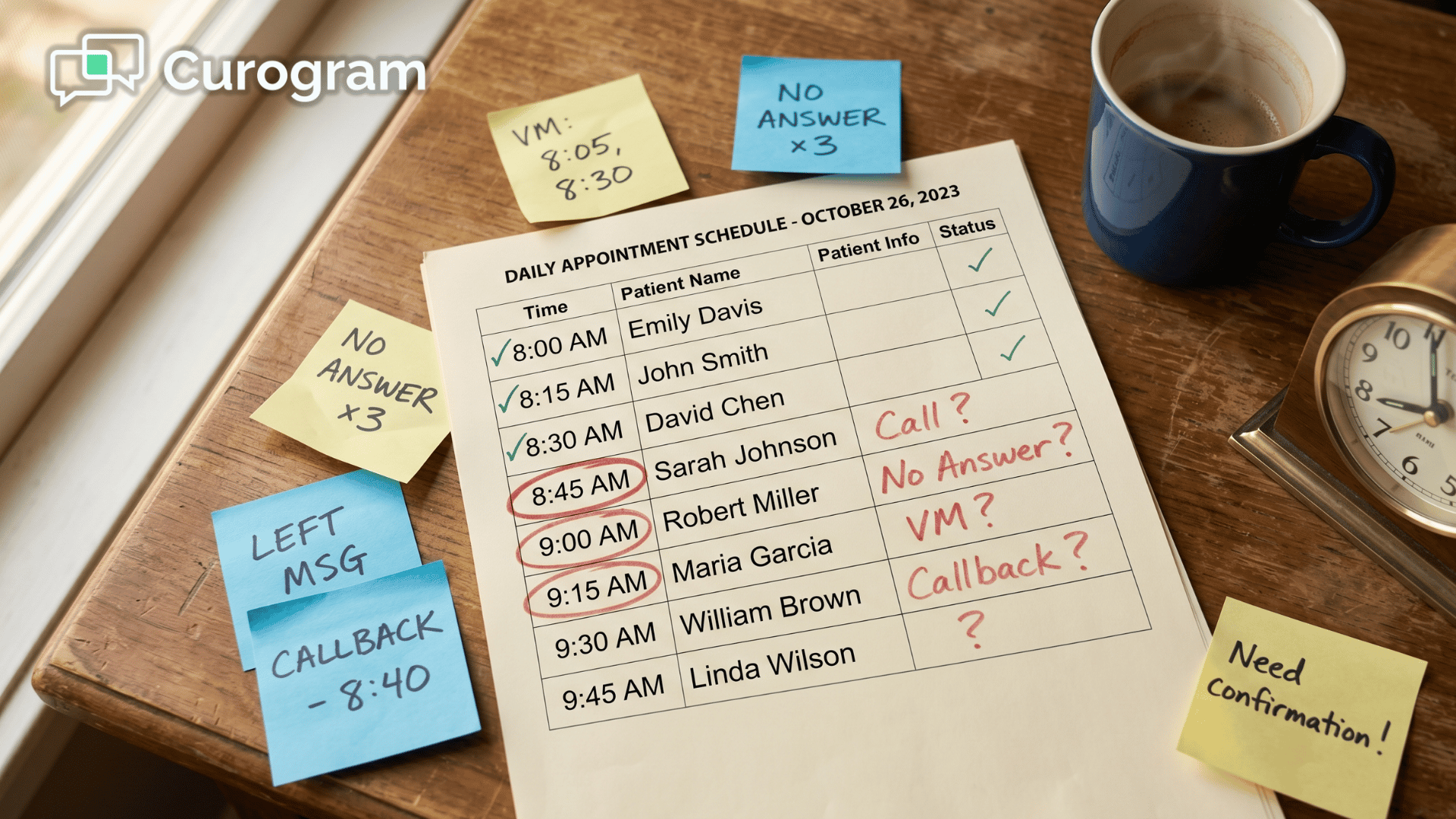
Your NextGen reminder system is on. Texts and emails are going out on schedule. So why is your front desk still on the phone at 8 a.m., calling patients to ask if they're coming in?
The answer is simple: reminders notify. They don't confirm. When a patient doesn't reply, the schedule still shows a question mark.
And until that question mark turns into a confirmed appointment, someone on your team has to make a call.
This is the manual call loop — and it's running at every location in your network, every single morning. It's predictable, time-consuming, and entirely avoidable.
For large ambulatory NextGen Enterprise organizations, the morning call burden on scheduling staff adds up fast: 3–5 hours per location per day, multiplied across every site, every provider, every specialty.
Curogram's automated 2-way text confirmation workflow closes the gap your NextGen PM schedule leaves open.
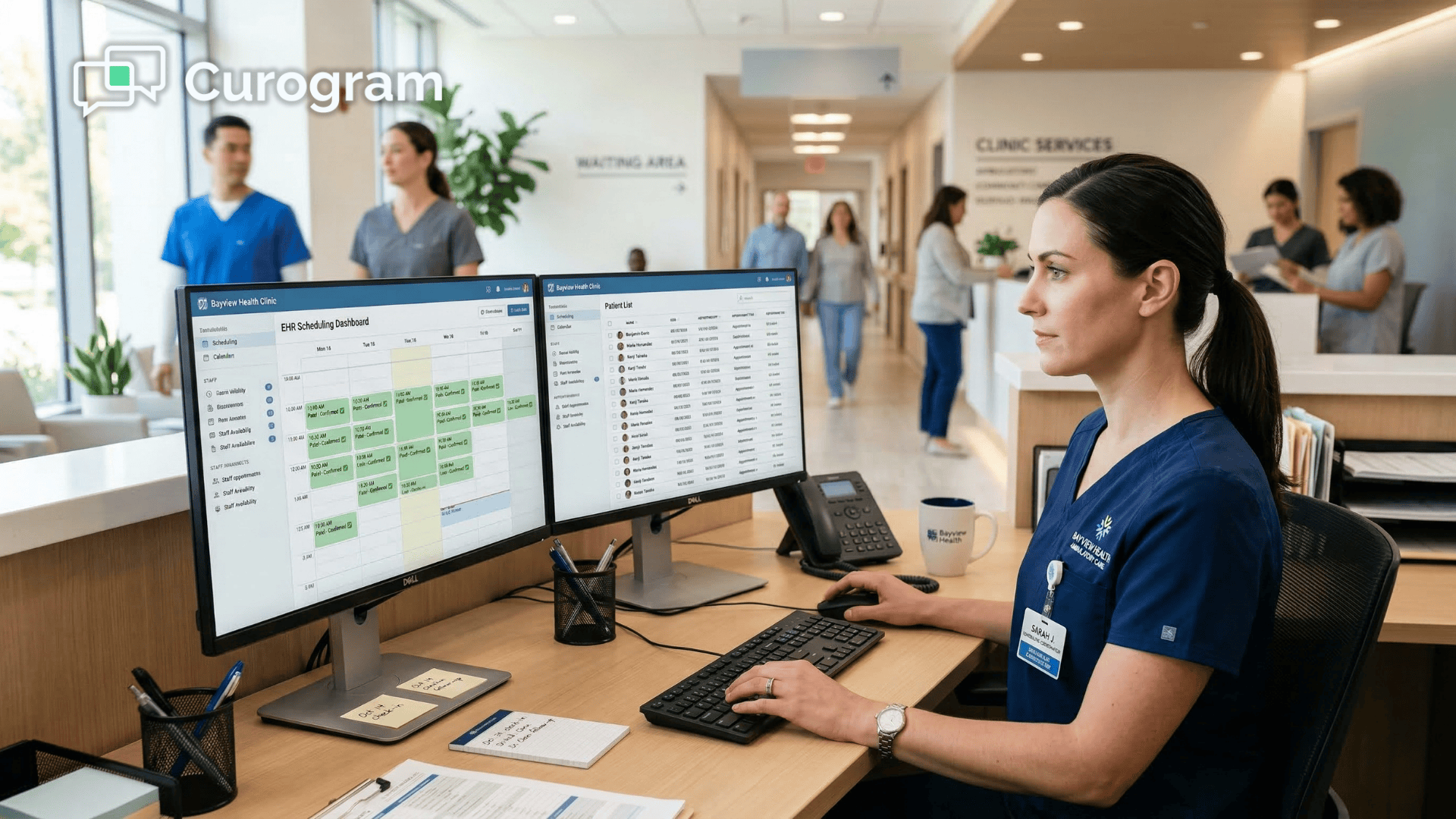
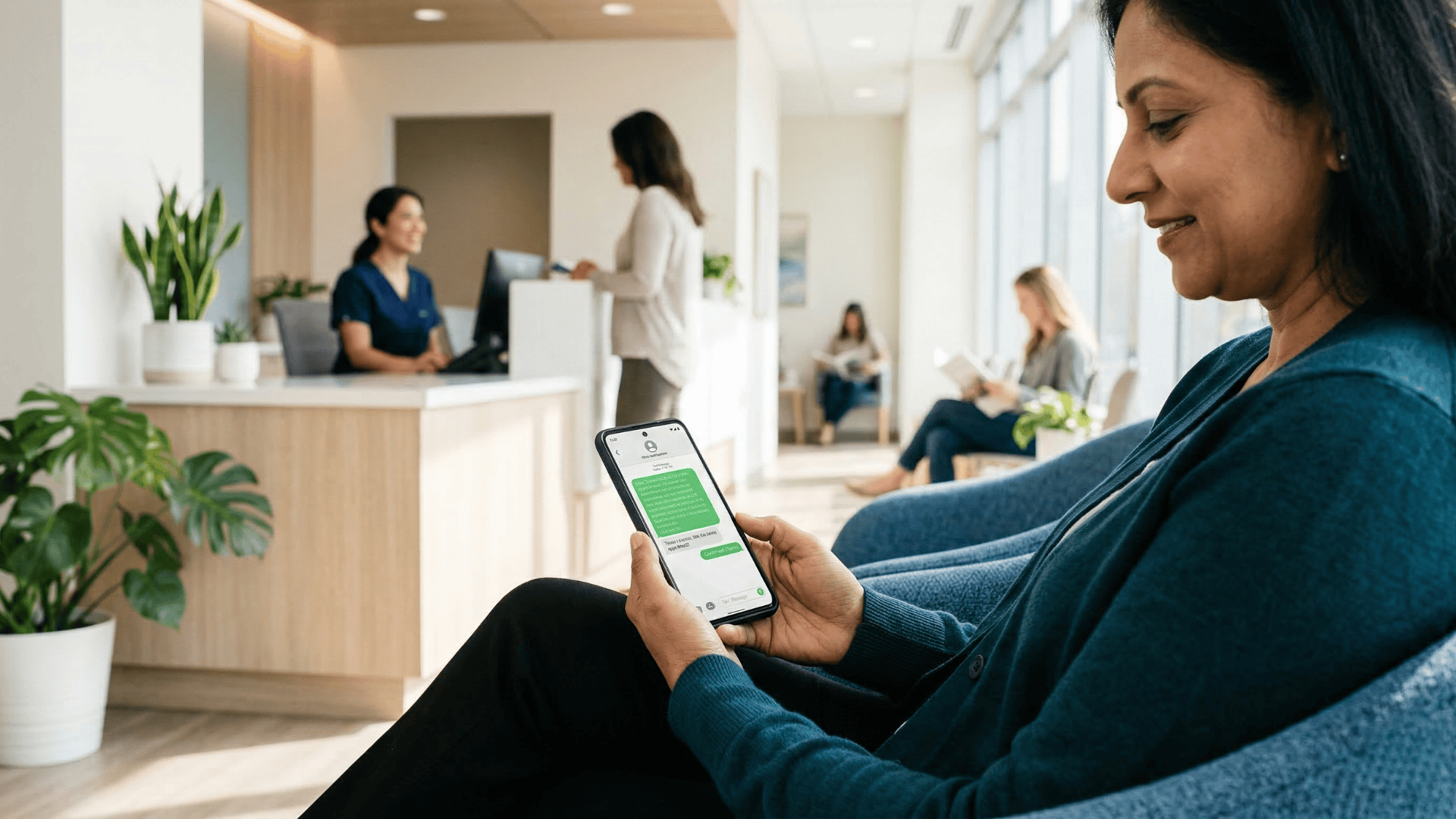
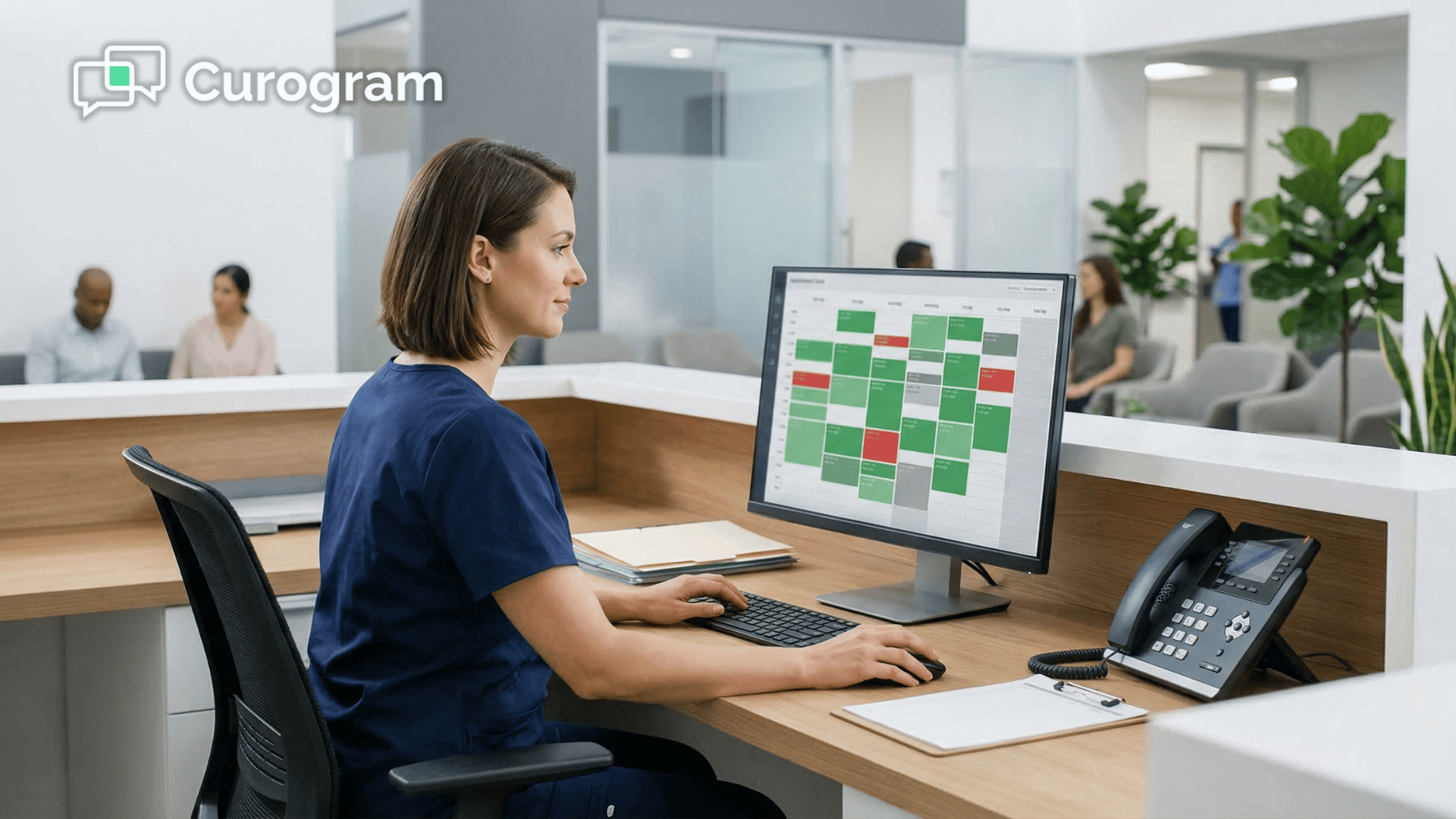
Patients reply directly to their reminder texts, confirmation status updates in real time, and your team starts the day reviewing a dashboard of green checkmarks instead of a list of calls to make.
This article breaks down how it works, why it matters for multi-location operations, and what real practices have already saved by making the switch.
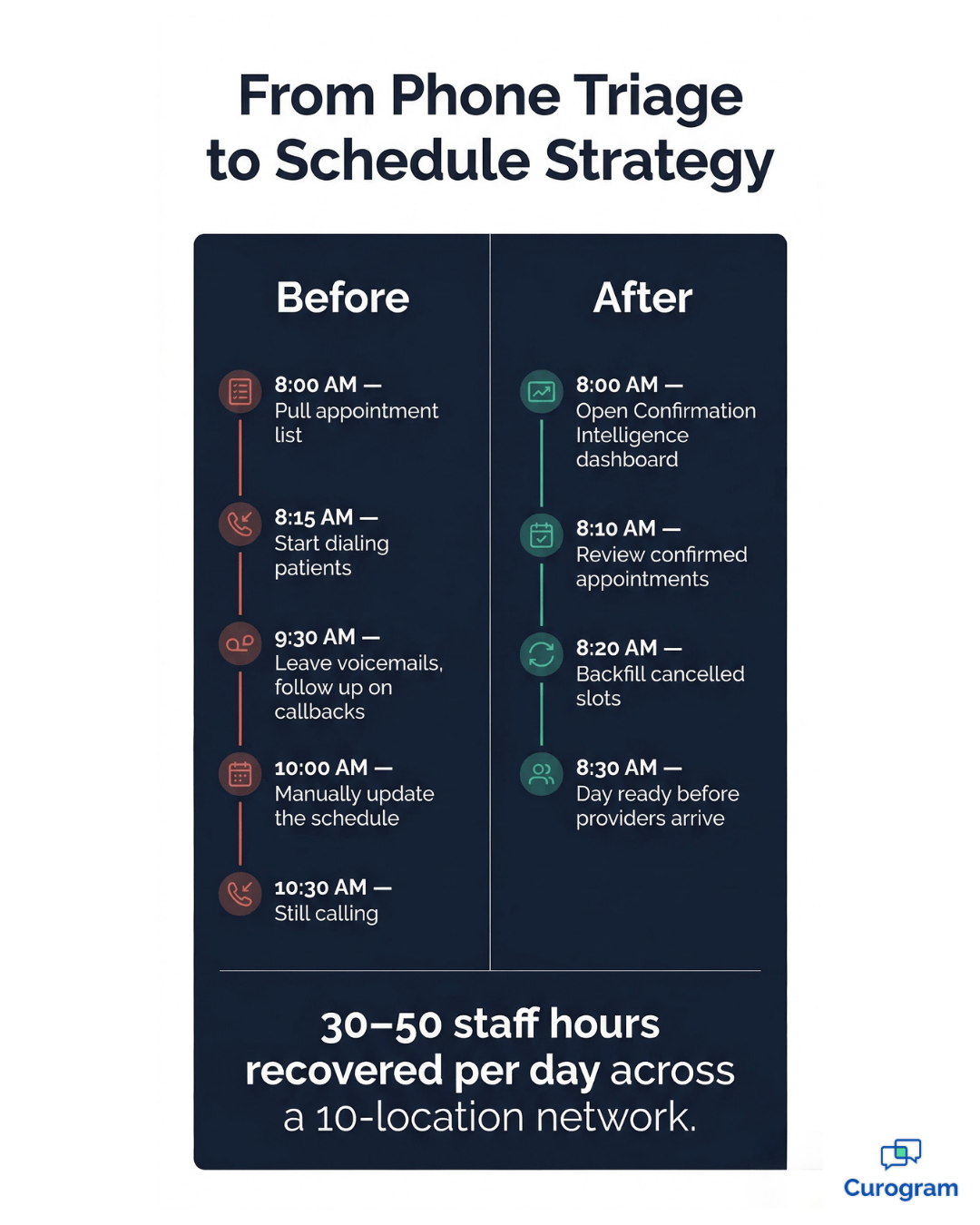
At every NextGen Enterprise location, the workday starts the same way. Scheduling staff pull tomorrow's appointment list from the PM schedule, open the phone system, and start dialing.
If a patient answers, the call takes two to three minutes. If they don't, staff leave a voicemail, flag the patient for a callback, and move on.
For a network with 50 providers across 10 locations, each averaging 25 patients per day, that's 12,500 appointments per week being manually confirmed one phone call at a time.
The time drain is significant. A single location with five providers and 125 appointments per day can lose 3–5 hours of staff time to confirmation calls alone — before a single walk-in has been checked in, before a single rescheduling request has been handled, and before the 80+ other inbound calls that arrive throughout the day.
Across a 10-location network, that's 30–50 hours per day of capacity consumed by a task that should be automated.
It is worth noting that this problem is not caused by staff working inefficiently. It is caused by a system gap. NextGen's PM schedule is built to manage appointments, not to capture patient responses to those appointments.
That gap was always filled manually — by a phone call, a voicemail, a follow-up. Scheduling staff are not doing the wrong thing. They are doing the only thing the current setup allows, even as it accelerates staff burnout.
Manual confirmation calls generate informal records that no reporting system can use.
The result is a confirmation "workflow" that exists only in staff memory — and disappears the moment someone leaves. Operations leaders can see that no-shows are a problem.
But they can't measure exactly where the process breaks down.
There is also a staffing impact that often goes unspoken. Administrative workload in healthcare is a major driver of burnout in healthcare administration, where turnover is already high.
Every time a scheduling supervisor loses a team member, the institutional knowledge of who confirmed, who didn't, and who needs a callback walks out the door.
The next hire starts the loop all over again.
Taken together, the manual call loop is not just a time problem. It is a data problem, a morale problem, and a scalability problem. And all of it stems from the same root cause: a confirmation step that depends entirely on human effort rather than automation.

Curogram's automated confirmation workflow replaces the entire manual process:
minders go out at configurable intervals (72 hours, 48 hours, 24 hours, or a custom schedule), patients reply via text with "Confirm," "Cancel," or "Reschedule," and confirmation status syncs to the NextGen PM schedule in real time.
Cancelled slots open automatically for backfill. Reschedule requests route to scheduling staff.
No phone calls. No manual updates. No morning call marathon.
What that means in practice is that the confirmation step becomes invisible to staff. It happens between the patient and the system, without anyone on your team needing to initiate it, monitor it, or follow up on it.
Staff only step in when a patient does not respond or when a reschedule request needs human judgment. Every other outcome resolves on its own.
What makes this meaningful for operations leaders is the reporting layer. Curogram's Confirmation Intelligence dashboard gives VPs of Operations and scheduling supervisors something manual calls never could: structured, reportable data.
Which locations have the highest confirmation rates? Which providers see the most no-shows? Which time slots go unfilled most often? This is the kind of data that turns no-shows from an accepted cost into a measurable, improvable metric.
The integration with NextGen is direct. Confirmation status writes to the NextGen PM schedule as a structured field update — not a freeform note, not a separate system staff have to log into.
The PM schedule reflects real-time patient intent:
Confirmed, cancelled, rescheduled, or no response. IT directors get audit logging, role-based access controls, and cloud-based processing that runs independently of NextGen's desktop performance.
For organizations that have wrestled with getting disparate systems to talk to each other, this matters more than it might seem. The confirmation data lives where your team already works.
There is no new login, no dashboard in a separate tab, no end-of-day sync to worry about. Your scheduling staff open the NextGen PM schedule and the confirmation status is already there.
Confirmation logic is fully configurable per location, per specialty, and per provider.
The workflow adapts to how each site already operates rather than forcing a single process on every department.
The automated appointment confirmation text workflow handles these differences automatically.
No manual overrides, no separate reminder stacks for each specialty, and no extra configuration burden on your IT team after the initial setup.

The numbers tell a clear story. Based on our internal data, Covina Arthritic Clinic grew from 369 to more than 1,300 automated confirmations per month after deploying Curogram's automated appointment confirmation text system — without adding a single staff member to handle the volume.
That growth represents thousands of manual confirmation calls that no longer needed to happen.
Atlas Medical Center cut its no-show rate from 14.20% to 4.91% in just three months. That is more than a three-times improvement — and it happened because patients were receiving timely, two-way reminders they could actually respond to.
For a 10-location NextGen network, reducing no-shows at that scale translates directly to a 10–20% increase in recovered revenue, with each filled slot contributing to profitability.
Based on our internal research, Curogram clients see no-show rates that are 53% lower than the industry average.
Those recovered slots are not abstract revenue. They are same-day appointments backfilled before the provider arrives, follow-up visits that would have gone unscheduled, and procedure slots that would have sat empty at full overhead cost.
For large ambulatory organizations, the financial impact of a 9-percentage-point drop in no-show rates can reach well into six figures annually, depending on payer mix and average visit value.
The shift shows up differently depending on where someone sits in your organization, but it is visible across every role.
The benefit compounds at scale. For a NextGen multi-location confirmation automation deployment covering 10 or more sites, the cumulative time savings can reach the equivalent of four to six full-time employees — not by cutting headcount, but by redeploying existing staff from phone triage to patient care coordination.
That is the kind of staffing efficiency that operations leaders can actually measure and report.
None of this requires a change management initiative or months of staff retraining. The automation runs in the background.
Staff adapt quickly because the new workflow is simpler than the old one — they check a dashboard instead of making calls. The biggest adjustment is usually convincing the team that yes, it really does work without them picking up the phone.
Your NextGen PM schedule is excellent at managing appointments. What it doesn't do is close the gap between "scheduled" and "confirmed." That gap is where your scheduling staff spend their mornings — calling, waiting, leaving voicemails, updating notes by hand.
It's not a workflow. It's a workaround.
Curogram handles the human step that sits between a scheduled appointment and a guaranteed one. The automated 2-way confirmation workflow sends the reminder, captures the reply, and writes the status to your NextGen PM schedule — all without anyone picking up a phone.
Your front desk staff stop being a human reminder system and start being the schedule strategists they were hired to be.
The results are immediate and measurable. In the first month, most NextGen Enterprise organizations can track exactly how many manual confirmation calls were eliminated, how many slots were backfilled from early cancellations, and how much staff time was recovered.
For large ambulatory operations, that often translates to tens of thousands of dollars in recovered appointments and a meaningful reduction in administrative overhead.
This is not a niche workflow improvement. It is a foundational change to how your scheduling operations run — one that scales cleanly across every location, every specialty, and every provider in your network.
Curogram deploys network-wide in weeks with a dedicated implementation engineer, so you are not waiting months to see the impact.
Schedule a demo and get an Enterprise Assessment that shows automated confirmation in action across your NextGen environment.
Yes. Reminder cadence, confirmation logic, and escalation rules are fully configurable per location, per specialty, and per provider. Your orthopedic pre-surgical reminders can operate on different timing and messaging than your primary care confirmations. The platform adapts to how each site already works — not the other way around.
No. Your implementation engineer configures Curogram's confirmation workflow to complement or replace your existing reminder stack, eliminating duplication entirely. For organizations currently using Luma for reminders, Curogram can take over the confirmation function while Luma handles other engagement use cases, or Curogram can serve as a full replacement for the reminder workflow.
Curogram writes confirmation status directly to the NextGen PM schedule via API-based integration. When a patient texts "Confirm," the schedule updates in real time. When they cancel, the slot flags for backfill automatically. No staff intervention, no manual entry, no separate system to check. Your scheduling team sees confirmation status in the same PM view they already use every day.
Non-responders are flagged automatically in the Confirmation Intelligence dashboard so staff can prioritize follow-up where it is actually needed — rather than calling every patient on the list. This is a significant shift for NextGen front desk teams that currently have no way to triage who needs a callback and who has already confirmed. Instead of working through a full appointment list, staff focus only on the small subset of patients who have not responded by a defined cutoff time.
Most NextGen Enterprise organizations are fully live within a few weeks. Curogram provides a dedicated implementation engineer who manages the API-based connection to your NextGen PM schedule, configures reminder cadence and confirmation logic per location and specialty, and coordinates testing before go-live. There is no disruption to your existing scheduling workflow during setup, and staff training is minimal because the automation runs without requiring any new steps from your front desk team.
💡 NextGen Enterprise appointment reminders powered by Curogram send 2-way texts patients can reply to — confirming, cancelling, or rescheduling. ...
💡 Azalea Health office manager SMS appointment confirmation automation replaces daily manual calling with a system that runs on its own. Curogram...
💡 Practice Fusion front desk appointment confirmation is a daily challenge for small clinics. Staff spend hours each morning calling patients to...